• Home
  • Latest
  • Fortune 500
  • Finance
  • Tech
  • Leadership
  • Lifestyle
  • Rankings
  • Multimedia
FinanceBarack Obama

Should taxpayers rescue debt-stressed college grads?

By
William G. Gale
William G. Gale
and
Benjamin Harris
Benjamin Harris
Down Arrow Button Icon
By
William G. Gale
William G. Gale
and
Benjamin Harris
Benjamin Harris
Down Arrow Button Icon
June 11, 2014, 9:48 AM ET
Obama Signs Presidential Memorandum On Reducing Student Loan Debt
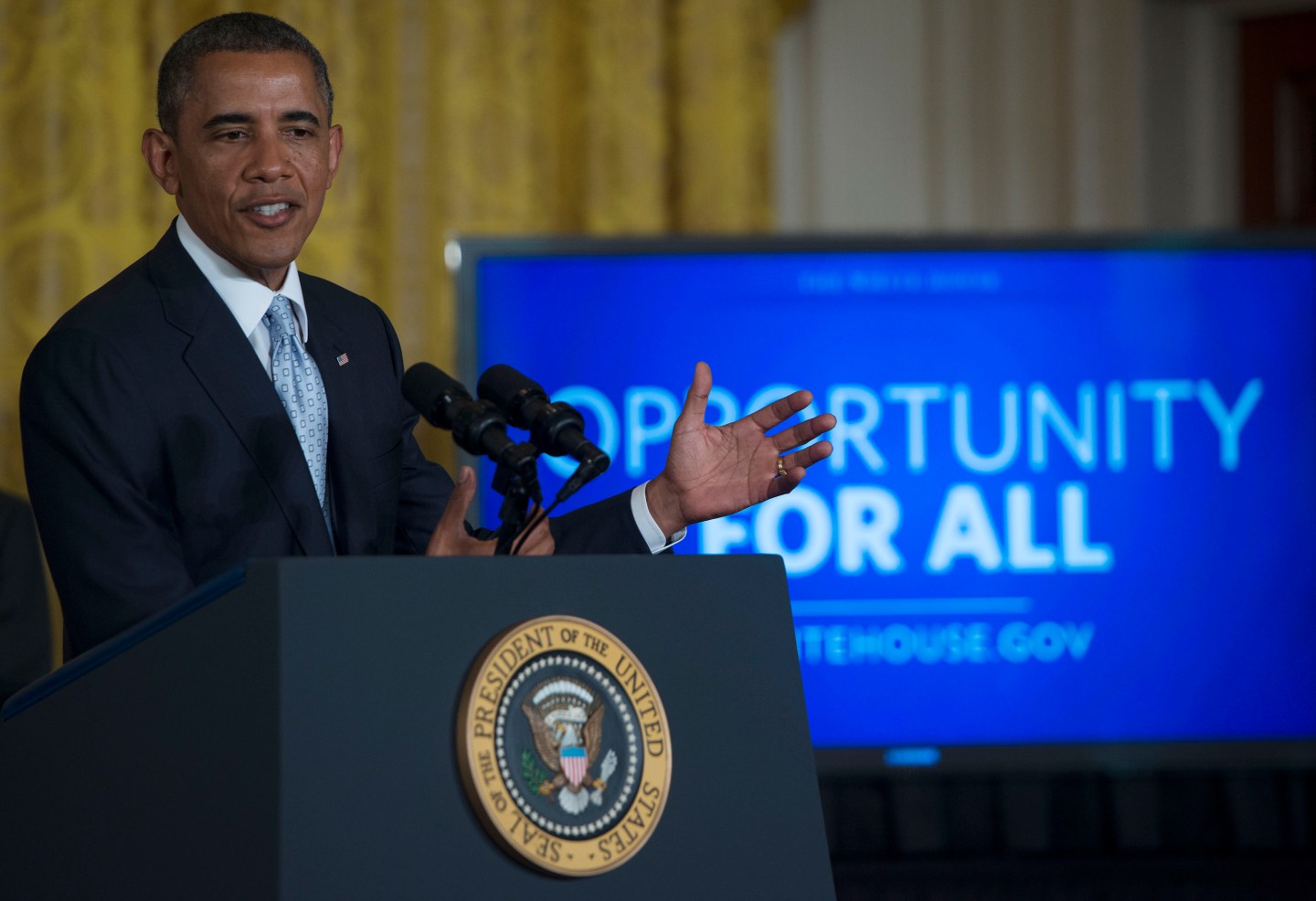
WASHINGTON, DC - JUNE 09: Barack Obama speaks prior to signing a presidential memorandum on reducing student loan debt on June 9, 2014 in Washington, DC. (Photo by Leigh Vogel/WireImage)Leigh Vogel WireImage

This week, President Obama announced a plan to extend financial relief to households carrying student loan debt. The executive order would allow an additional 5 million existing borrowers with high monthly payments, relative to their income, to spread their payments out over a longer period of time.

The President’s actions may well be in response to growing concern over student loans. One commonly cited statistic notes that student loan debt, totaling $1.2 trillion, has now eclipsed all other forms of consumer loans except mortgages. Others, including former Treasury Secretary Larry Summers, have argued that student loans are holding back economic growth by discouraging spending and restricting homeownership by young families.

A recent review of ours at the Brookings Institution adds to this chorus of concern, noting that student loan debt can discourage graduate education, influence career choice, delay the timing of marriage and childbirth, and even lead to lower credit worthiness.

But before outstanding student loans are cast as a “crisis,” it is important to note that it’s not all doom and gloom. First, one of the strongest documented facts is that attending and graduating from college has a strong impact on individual’s future economic prospects. This means both that attending college is a good investment and that a significant portion of the ultimate costs can and should be borne by the student or his/her family.

Second, while recent increases in tuition costs have been noted frequently and are an important driver of higher student loan debt, another factor is simply that more people are attending college. Between 2002 and 2011, enrollment was up 27%, with especially large increases in graduate students. From this perspective, student debt is rising in part because more Americans are investing in themselves—unequivocally an encouraging trend that will pay dividends for those individuals and for the country down the road.

At the heart of the problem, though, is a shift in priorities at the state and local level. Decades ago students could attend public colleges with strong financial backing from the American taxpayer. This support has gradually waned. Between 1962 and 2011, the inflation-adjusted cost of attending a public college has more than doubled from about $7,000 to more than $17,000, reflecting in part a diminished public willingness to support college attendance.

The federal government has intervened to partially offset this trend. The American Opportunity Tax Credit—worth up to $2,500 per year—represents a far more generous tax credit than available to students even five years ago. And Pell Grant funding has continued to gradually trend upwards, offering improved support for low-income students.

Despite this increased federal investment, the U.S. lags far behind the typical developed economy in financing postsecondary education. In 2010, just 36% of postsecondary education was funded from public sources—roughly half the average share for OECD countries and lower than the share paid by all but three OECD countries for which data are available.

The President’s proposed reform should make it easier for students to reduce monthly loan payments out the repayment period, but it doesn’t address the much more difficult question facing both Congress and state lawmakers around the country: Do today’s taxpayers, who benefitted from high educational subsidies in years past, want to return the favor to the next generation? If the answer is no, high levels of student debt will be here to stay.

William G. Gale is a Senior Fellow and Benjamin H. Harris is a Fellow in Economic Studies at The Brookings Institution.


About the Authors
By William G. Gale
See full bioRight Arrow Button Icon
By Benjamin Harris
See full bioRight Arrow Button Icon

Latest in Finance

Finance
Lorem ipsum dolor sit amet, consectetur adipiscing elit, sed do eiusmod tempor incididunt ut labore et dolore magna aliqua. Ut enim ad minim veniam
By Fortune Editors
October 20, 2025
Finance
Lorem ipsum dolor sit amet, consectetur adipiscing elit, sed do eiusmod tempor incididunt ut labore et dolore magna aliqua. Ut enim ad minim veniam
By Fortune Editors
October 20, 2025
Finance
Lorem ipsum dolor sit amet, consectetur adipiscing elit, sed do eiusmod tempor incididunt ut labore et dolore magna aliqua. Ut enim ad minim veniam
By Fortune Editors
October 20, 2025
Finance
Lorem ipsum dolor sit amet, consectetur adipiscing elit, sed do eiusmod tempor incididunt ut labore et dolore magna aliqua. Ut enim ad minim veniam
By Fortune Editors
October 20, 2025
Finance
Lorem ipsum dolor sit amet, consectetur adipiscing elit, sed do eiusmod tempor incididunt ut labore et dolore magna aliqua. Ut enim ad minim veniam
By Fortune Editors
October 20, 2025
Finance
Lorem ipsum dolor sit amet, consectetur adipiscing elit, sed do eiusmod tempor incididunt ut labore et dolore magna aliqua. Ut enim ad minim veniam
By Fortune Editors
October 20, 2025

Most Popular

Finance
Lorem ipsum dolor sit amet, consectetur adipiscing elit, sed do eiusmod tempor incididunt ut labore et dolore magna aliqua. Ut enim ad minim veniam
By Fortune Editors
October 20, 2025
Finance
Lorem ipsum dolor sit amet, consectetur adipiscing elit, sed do eiusmod tempor incididunt ut labore et dolore magna aliqua. Ut enim ad minim veniam
By Fortune Editors
October 20, 2025
Finance
Lorem ipsum dolor sit amet, consectetur adipiscing elit, sed do eiusmod tempor incididunt ut labore et dolore magna aliqua. Ut enim ad minim veniam
By Fortune Editors
October 20, 2025
Finance
Lorem ipsum dolor sit amet, consectetur adipiscing elit, sed do eiusmod tempor incididunt ut labore et dolore magna aliqua. Ut enim ad minim veniam
By Fortune Editors
October 20, 2025
Finance
Lorem ipsum dolor sit amet, consectetur adipiscing elit, sed do eiusmod tempor incididunt ut labore et dolore magna aliqua. Ut enim ad minim veniam
By Fortune Editors
October 20, 2025
Finance
Lorem ipsum dolor sit amet, consectetur adipiscing elit, sed do eiusmod tempor incididunt ut labore et dolore magna aliqua. Ut enim ad minim veniam
By Fortune Editors
October 20, 2025
Fortune Secondary Logo
Rankings
  • 100 Best Companies
  • Fortune 500
  • Global 500
  • Fortune 500 Europe
  • Most Powerful Women
  • Future 50
  • World’s Most Admired Companies
  • See All Rankings
Sections
  • Finance
  • Fortune Crypto
  • Features
  • Leadership
  • Health
  • Commentary
  • Success
  • Retail
  • Mpw
  • Tech
  • Lifestyle
  • CEO Initiative
  • Asia
  • Politics
  • Conferences
  • Europe
  • Newsletters
  • Personal Finance
  • Environment
  • Magazine
  • Education
Customer Support
  • Frequently Asked Questions
  • Customer Service Portal
  • Privacy Policy
  • Terms Of Use
  • Single Issues For Purchase
  • International Print
Commercial Services
  • Advertising
  • Fortune Brand Studio
  • Fortune Analytics
  • Fortune Conferences
  • Business Development
  • Group Subscriptions
About Us
  • About Us
  • Editorial Calendar
  • Press Center
  • Work At Fortune
  • Diversity And Inclusion
  • Terms And Conditions
  • Site Map
  • About Us
  • Editorial Calendar
  • Press Center
  • Work At Fortune
  • Diversity And Inclusion
  • Terms And Conditions
  • Site Map
  • Facebook icon
  • Twitter icon
  • LinkedIn icon
  • Instagram icon
  • Pinterest icon

Latest in Finance

Prediction markets have sparked a golden age of insider trading—but the party may be coming to an end
InvestingPolymarket
Prediction markets have sparked a golden age of insider trading—but the party may be coming to an end
By Jeff John RobertsApril 2, 2026
10 minutes ago
Asian markets drop after Trump signals he’ll bomb Iran ‘back to the stone ages’, tells other countries to ‘take the lead’ in reopening Hormuz
Asiaoil and gas
Asian markets drop after Trump signals he’ll bomb Iran ‘back to the stone ages’, tells other countries to ‘take the lead’ in reopening Hormuz
By Nicholas GordonApril 2, 2026
30 minutes ago
Gen Z fled San Francisco for Texas and Florida. Now they’re turning ‘welcomer cities’ into the next big tech towns
Real EstateGen Z
Gen Z fled San Francisco for Texas and Florida. Now they’re turning ‘welcomer cities’ into the next big tech towns
By Sydney LakeApril 2, 2026
2 hours ago
The tax escape map: Billionaires are bolting for Florida from the West Coast and taking billions in tax revenue with them
Real EstateBillionaires
The tax escape map: Billionaires are bolting for Florida from the West Coast and taking billions in tax revenue with them
By Marco Quiroz-GutierrezApril 2, 2026
2 hours ago
Current ARM mortgage rates report for April 2, 2026
Personal FinanceReal Estate
Current ARM mortgage rates report for April 2, 2026
By Glen Luke FlanaganApril 2, 2026
2 hours ago
Current refi mortgage rates report for April 2, 2026
Personal FinanceReal Estate
Current refi mortgage rates report for April 2, 2026
By Glen Luke FlanaganApril 2, 2026
2 hours ago

Most Popular

Two-thirds of parents say their adult Gen Z kids still rely on them financially  for support—even though it's putting them under strain
Success
Two-thirds of parents say their adult Gen Z kids still rely on them financially  for support—even though it's putting them under strain
By Fortune EditorsMarch 31, 2026
2 days ago
Jerome Powell says the $39 trillion national debt is ‘not unsustainable,’ but warns the trajectory ‘will not end well’
Economy
Jerome Powell says the $39 trillion national debt is ‘not unsustainable,’ but warns the trajectory ‘will not end well’
By Fortune EditorsMarch 30, 2026
3 days ago
Current price of gold as of April 1, 2026
Personal Finance
Current price of gold as of April 1, 2026
By Fortune EditorsApril 1, 2026
20 hours ago
Current price of oil as of April 1, 2026
Personal Finance
Current price of oil as of April 1, 2026
By Fortune EditorsApril 1, 2026
21 hours ago
A man used AI to call 3,000 Irish bartenders to track the cost of Guinness. Now pubs are lowering their prices to compete
AI
A man used AI to call 3,000 Irish bartenders to track the cost of Guinness. Now pubs are lowering their prices to compete
By Fortune EditorsMarch 30, 2026
3 days ago
Hiring just hit a level not seen since the economy was ‘closed down literally’ during COVID, top economist says
Economy
Hiring just hit a level not seen since the economy was ‘closed down literally’ during COVID, top economist says
By Fortune EditorsMarch 31, 2026
2 days ago

© 2026 Fortune Media IP Limited. All Rights Reserved. Use of this site constitutes acceptance of our Terms of Use and Privacy Policy | CA Notice at Collection and Privacy Notice | Do Not Sell/Share My Personal Information
FORTUNE is a trademark of Fortune Media IP Limited, registered in the U.S. and other countries. FORTUNE may receive compensation for some links to products and services on this website. Offers may be subject to change without notice.