• Home
  • Latest
  • Fortune 500
  • Finance
  • Tech
  • Leadership
  • Lifestyle
  • Rankings
  • Multimedia

Exclusive

An hour in the Oval Office with President Trump Fortune Editor-in-Chief: Alyson Shontell sat down with President Trump in the Oval Office for an hour. Tariffs, Intel, AI, Boeing, Iran—and the question every CEO eventually has to answer: who's next?

An hour in the Oval Office with President Trump Fortune Editor-in-Chief: Alyson Shontell sat down with President Trump in the Oval Office for an hour. Tariffs, Intel, AI, Boeing, Iran—and the question every CEO eventually has to answer: who's next?

An hour in the Oval Office with President Trump Fortune Editor-in-Chief: Alyson Shontell sat down with President Trump in the Oval Office for an hour. Tariffs, Intel, AI, Boeing, Iran—and the question every CEO eventually has to answer: who's next?

An hour in the Oval Office with President Trump Fortune Editor-in-Chief: Alyson Shontell sat down with President Trump in the Oval Office for an hour. Tariffs, Intel, AI, Boeing, Iran—and the question every CEO eventually has to answer: who's next?

An hour in the Oval Office with President Trump Fortune Editor-in-Chief: Alyson Shontell sat down with President Trump in the Oval Office for an hour. Tariffs, Intel, AI, Boeing, Iran—and the question every CEO eventually has to answer: who's next?

An hour in the Oval Office with President Trump Fortune Editor-in-Chief: Alyson Shontell sat down with President Trump in the Oval Office for an hour. Tariffs, Intel, AI, Boeing, Iran—and the question every CEO eventually has to answer: who's next?

An hour in the Oval Office with President Trump Fortune Editor-in-Chief: Alyson Shontell sat down with President Trump in the Oval Office for an hour. Tariffs, Intel, AI, Boeing, Iran—and the question every CEO eventually has to answer: who's next?

An hour in the Oval Office with President Trump Fortune Editor-in-Chief: Alyson Shontell sat down with President Trump in the Oval Office for an hour. Tariffs, Intel, AI, Boeing, Iran—and the question every CEO eventually has to answer: who's next?

An hour in the Oval Office with President Trump Fortune Editor-in-Chief: Alyson Shontell sat down with President Trump in the Oval Office for an hour. Tariffs, Intel, AI, Boeing, Iran—and the question every CEO eventually has to answer: who's next?

An hour in the Oval Office with President Trump Fortune Editor-in-Chief: Alyson Shontell sat down with President Trump in the Oval Office for an hour. Tariffs, Intel, AI, Boeing, Iran—and the question every CEO eventually has to answer: who's next?

FinanceEconomics

The ‘invisible hand’ has an iron grip on America

By
Chris Matthews
Chris Matthews
Down Arrow Button Icon
By
Chris Matthews
Chris Matthews
Down Arrow Button Icon
August 13, 2014, 2:44 PM ET
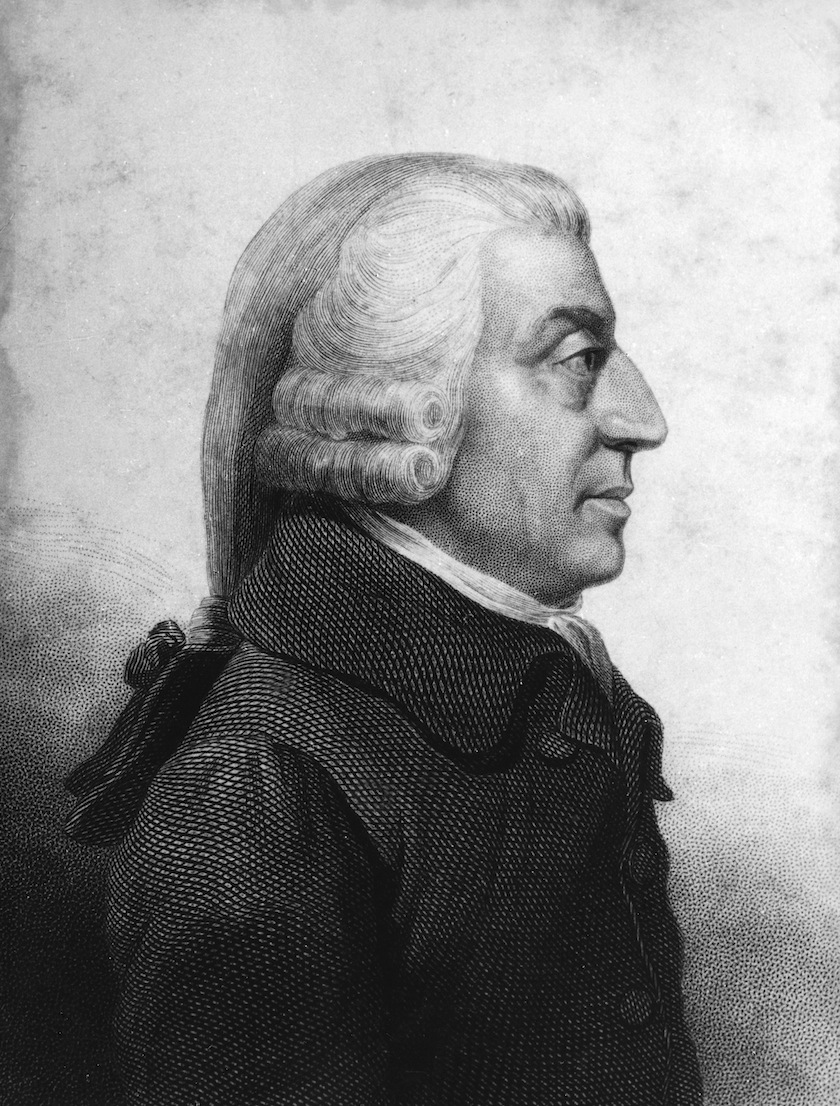
A portrait of Adam Smith
A portrait of Adam SmithPhoto: DEA PICTURE LIBRARY De Agostini/Getty Images

There are few metaphors that have captured the American economic psyche as powerfully as the “invisible hand” of the market. The term, first coined by Adam Smith in 1759, is used to describe how the self-interested behavior of people in a marketplace leads to the greater good for all. No need to rely on concerted efforts of government or the church to direct commercial activity. If the proper economic and legal institutions are set up, we can all be made better if simply left to our own devices.

Before Smith coined the phrase “invisible hand,” the discipline of economics didn’t even exist, which is likely why he is so revered by economists today. But while economists respect Smith for inventing the field, they are much less uniformly fond of the “invisible hand” and its sway over public discourse and policy. As Nobel prize-winning economist Joseph Stiglitz put it:

Adam Smith, the father of modern economics, is often cited as arguing for the “invisible hand” and free markets. But unlike his followers, Adam Smith was aware of some of the limitations of free markets, and research since then has further clarified why free markets, by themselves, often do not lead to what is best…. [T]he reason that the invisible hand often seems invisible is that it is often not there.

In other words, markets are pretty good at allocating resources where they are most needed, but there are so many exceptions to this rule that these exceptions deserve as much attention as the rule itself. Jeff Madrick, a fellow at the Century Foundation, is the latest economics commentator to take aim at the invisible hand in a forthcoming book, naming it one of his “seven bad ideas” of mainstream economics that “have damaged America and the world.”

Madrick argues that Smith had it backwards when he argued that the absence of government involvement in the economy—beyond enforcing property law—enabled the explosion of wealth in 18th century England. It was the confluence of factors like population growth and technological progress that unlocked society’s potential for economic growth, which then created a virtuous circle that led to greater technological progress and population expansion, which led to even more opportunities for growth.

Indeed, there’s plenty of evidence that the invisible hand simply doesn’t exist. Take, for instance, two of the most important markets Americans participate in: healthcare and education. When shopping for either of these services, it’s very difficult for a shopper to actually know the quality or effectiveness of the product he is buying. For the “invisible hand” to work, customers have to actually know what they need so that they can signal to producers to create it. But customers are so afraid of not having enough education or healthcare that there is really no impetus for them to walk away from a potential transaction. The result? Producers create and charge more and more while society is no better off for it.

Despite the evidence, though, the concept has a powerful hold on Americans. Politicians consistently refer to it in speeches—a line in Mitt Romney’s 2012 presidential stump speech went, “The invisible hand of the market always moves faster and better than the heavy hand of government.” And it makes sense why the idea appeals to so many people. For those who are already wealthy, they have little to gain from economic interference. Others are reassured that by simply looking out for themselves they can work towards the greater good. If the invisible hand reflects reality, we have no moral obligation to look beyond our own interests. How convenient.

But Adam Smith’s vision of the invisible hand also has a cultural appeal to Americans. America was founded as a place of (relatively) small and restrained government, and the founders were enamored with thinkers who showed that societies could prosper with this form of governance. As Madrick points out, Thomas Jefferson cited Smith’s The Wealth of Nations as evidence that a robust economy could result from the strength of individual decisions rather than government policies, and fellow founders John Adams, Alexander Hamilton, James Madison, and George Washington were fans too. But American affinity for the invisible hand goes far beyond our founding fathers or even economics. University of Virginia literary critic Paul Cantor recently published an examination of the invisible hand, and he found the idea of what he calls “spontaneous order” throughout American culture. He writes:

The heroes of American culture often do not seem to be orderly in any conventional sense. They are more inclined to break rules than to obey them. They are frequently mavericks, creative individuals who go against the crowd and chart their own course … because old orders have a tendency to rigidify and block progress, people who make up the rules as they go along tend to be valuable to society.

There is a tendency in America to revere the maverick and to see top-down control as an obstacle to progress. Indeed, there’s something to be gained from this inclination. When Smith was writing about the invisible hand, he highlighted the benefits of spreading power across many people in a society. When government becomes too powerful, it can thwart these advantages. This was true in the 18th century, when Smith was writing about the invisible hand, and it is still the case today. But Madrick persuasively points out that Smith’s metaphor has been hijacked by those who wish to see no government regulation whatsoever. After all, the government regulation we see today is the product of a democratic process, and it incorporates a sort of diffusion of power that would have been inconceivable to Smith in his day.

Just because we’ve long since accepted Adam Smith’s premise that an even distribution of economic rights and political power is a good thing doesn’t make it a “bad idea.” But it does mean that we should probably move on to toppling other obstacles to economic progress.

About the Author
By Chris Matthews
See full bioRight Arrow Button Icon

Latest in Finance

Finance
Lorem ipsum dolor sit amet, consectetur adipiscing elit, sed do eiusmod tempor incididunt ut labore et dolore magna aliqua. Ut enim ad minim veniam
By Fortune Editors
October 20, 2025
Finance
Lorem ipsum dolor sit amet, consectetur adipiscing elit, sed do eiusmod tempor incididunt ut labore et dolore magna aliqua. Ut enim ad minim veniam
By Fortune Editors
October 20, 2025
Finance
Lorem ipsum dolor sit amet, consectetur adipiscing elit, sed do eiusmod tempor incididunt ut labore et dolore magna aliqua. Ut enim ad minim veniam
By Fortune Editors
October 20, 2025
Finance
Lorem ipsum dolor sit amet, consectetur adipiscing elit, sed do eiusmod tempor incididunt ut labore et dolore magna aliqua. Ut enim ad minim veniam
By Fortune Editors
October 20, 2025
Finance
Lorem ipsum dolor sit amet, consectetur adipiscing elit, sed do eiusmod tempor incididunt ut labore et dolore magna aliqua. Ut enim ad minim veniam
By Fortune Editors
October 20, 2025
Finance
Lorem ipsum dolor sit amet, consectetur adipiscing elit, sed do eiusmod tempor incididunt ut labore et dolore magna aliqua. Ut enim ad minim veniam
By Fortune Editors
October 20, 2025

Most Popular

Finance
Lorem ipsum dolor sit amet, consectetur adipiscing elit, sed do eiusmod tempor incididunt ut labore et dolore magna aliqua. Ut enim ad minim veniam
By Fortune Editors
October 20, 2025
Finance
Lorem ipsum dolor sit amet, consectetur adipiscing elit, sed do eiusmod tempor incididunt ut labore et dolore magna aliqua. Ut enim ad minim veniam
By Fortune Editors
October 20, 2025
Finance
Lorem ipsum dolor sit amet, consectetur adipiscing elit, sed do eiusmod tempor incididunt ut labore et dolore magna aliqua. Ut enim ad minim veniam
By Fortune Editors
October 20, 2025
Finance
Lorem ipsum dolor sit amet, consectetur adipiscing elit, sed do eiusmod tempor incididunt ut labore et dolore magna aliqua. Ut enim ad minim veniam
By Fortune Editors
October 20, 2025
Finance
Lorem ipsum dolor sit amet, consectetur adipiscing elit, sed do eiusmod tempor incididunt ut labore et dolore magna aliqua. Ut enim ad minim veniam
By Fortune Editors
October 20, 2025
Finance
Lorem ipsum dolor sit amet, consectetur adipiscing elit, sed do eiusmod tempor incididunt ut labore et dolore magna aliqua. Ut enim ad minim veniam
By Fortune Editors
October 20, 2025
Fortune Secondary Logo
Rankings
  • 100 Best Companies
  • Fortune 500
  • Global 500
  • Fortune 500 Europe
  • Most Powerful Women
  • World's Most Admired Companies
  • See All Rankings
  • Lists Calendar
Sections
  • Finance
  • Fortune Crypto
  • Features
  • Leadership
  • Health
  • Commentary
  • Success
  • Retail
  • Mpw
  • Tech
  • Lifestyle
  • CEO Initiative
  • Asia
  • Politics
  • Conferences
  • Europe
  • Newsletters
  • Personal Finance
  • Environment
  • Magazine
  • Education
Customer Support
  • Frequently Asked Questions
  • Customer Service Portal
  • Privacy Policy
  • Terms Of Use
  • Single Issues For Purchase
  • International Print
Commercial Services
  • Advertising
  • Fortune Brand Studio
  • Fortune Analytics
  • Fortune Conferences
  • Business Development
  • Group Subscriptions
About Us
  • About Us
  • Press Center
  • Work At Fortune
  • Terms And Conditions
  • Site Map
  • About Us
  • Press Center
  • Work At Fortune
  • Terms And Conditions
  • Site Map
  • Facebook icon
  • Twitter icon
  • LinkedIn icon
  • Instagram icon
  • Pinterest icon

Latest in Finance

John Ketchum, CEO of NextEra Energy, speaks during BlackRock's 2026 Infrastructure Summit in Washington, DC, on March 11, 2026. Photographer: Daniel Heuer/Bloomberg via Getty Images
EnergyNextEra Energy
NextEra’s $67 billion Dominion takeover creates the world’s largest utility—just in time to win the AI data-center power surge
By Jordan BlumMay 18, 2026
3 hours ago
Employers are quietly pausing 401(k) matches again. The last time this happened was the 2008 recession and Covid
Personal Finance401(k)
Employers are quietly pausing 401(k) matches again. The last time this happened was the 2008 recession and Covid
By Courtney Vinopal and HR BrewMay 18, 2026
3 hours ago
Harvard University banners hang in front of a building
CryptoCryptocurrency
Harvard sold off its entire $87 million Ethereum stake just one quarter after buying it
By Jack KubinecMay 18, 2026
3 hours ago
Interior view of the New York Stock Exchange
Economyinvestors
New York Fed warns about $69 trillion foreign investment ‘burden’ on U.S. economy
By Tristan BoveMay 18, 2026
4 hours ago
President Donald Trump speaks to the media aboard Air Force One on May 15, 2026.
EconomyDonald Trump
While Trump insisted the Iran war would end ‘soon,’ an account in his name was buying millions in oil, defense and gold
By Eva RoytburgMay 18, 2026
5 hours ago
Ryanair’s CFO says the airline has plans for an ‘armageddon situation’ as the jet fuel crisis threatens weaker European airlines this winter
EnergyAirline industry
Ryanair’s CFO says the airline has plans for an ‘armageddon situation’ as the jet fuel crisis threatens weaker European airlines this winter
By Marco Quiroz-GutierrezMay 18, 2026
5 hours ago

Most Popular

The Bezos family just donated $100 million to help achieve one of Mayor Zohran Mamdani’s top campaign promises
Politics
The Bezos family just donated $100 million to help achieve one of Mayor Zohran Mamdani’s top campaign promises
By Jake AngeloMay 12, 2026
6 days ago
Microsoft AI chief gives it 18 months—for all white-collar work to be automated by AI
AI
Microsoft AI chief gives it 18 months—for all white-collar work to be automated by AI
By Jake AngeloMay 16, 2026
2 days ago
The top foreign holders of U.S. debt may soon dump Treasury bonds and bring their money back home, potentially spiking borrowing costs
Economy
The top foreign holders of U.S. debt may soon dump Treasury bonds and bring their money back home, potentially spiking borrowing costs
By Jason MaMay 17, 2026
1 day ago
SpaceX heads into a record-shattering IPO with the 'deepest moat that exists today' as investors vow to 'never bet against Elon'
Innovation
SpaceX heads into a record-shattering IPO with the 'deepest moat that exists today' as investors vow to 'never bet against Elon'
By Jason MaMay 16, 2026
2 days ago
'No one was coming to save me': How Reese Witherspoon built a $900 million company from a problem Hollywood wouldn't fix
Success
'No one was coming to save me': How Reese Witherspoon built a $900 million company from a problem Hollywood wouldn't fix
By Sydney LakeMay 17, 2026
2 days ago
Mamdani's New York is coming to tax your private jet. Here's how to prepare
Personal Finance
Mamdani's New York is coming to tax your private jet. Here's how to prepare
By Greg RaiffMay 16, 2026
3 days ago

© 2026 Fortune Media IP Limited. All Rights Reserved. Use of this site constitutes acceptance of our Terms of Use and Privacy Policy | CA Notice at Collection and Privacy Notice | Do Not Sell/Share My Personal Information
FORTUNE is a trademark of Fortune Media IP Limited, registered in the U.S. and other countries. FORTUNE may receive compensation for some links to products and services on this website. Offers may be subject to change without notice.