• Home
  • Latest
  • Fortune 500
  • Finance
  • Tech
  • Leadership
  • Lifestyle
  • Rankings
  • Multimedia

Trendingnow

1

Microsoft AI chief gives it 18 months—for all white-collar work to be automated by AI

2

Former top Russian official admits the country is over Putin and can 'imagine a future without him' — even elites bail as Kremlin seizes their assets 

3

The Bezos family just donated $100 million to help achieve one of Mayor Zohran Mamdani’s top campaign promises

1

Microsoft AI chief gives it 18 months—for all white-collar work to be automated by AI

2

Former top Russian official admits the country is over Putin and can 'imagine a future without him' — even elites bail as Kremlin seizes their assets 

3

The Bezos family just donated $100 million to help achieve one of Mayor Zohran Mamdani’s top campaign promises
New Energy

The battle of Ohio: clean energy vs. coal

By
Richard Martin
Richard Martin
Down Arrow Button Icon
By
Richard Martin
Richard Martin
Down Arrow Button Icon
October 9, 2014, 7:25 AM ET
Photo By: Bill Bowen

Western Ohio is Honda country. Since 1982, when the company’s first auto production plant went in at Marysville, some 30 miles northwest of Columbus on Highway 33, the Japanese automaker has built a manufacturing infrastructure that has transformed the bucolic area into an industrial powerhouse.

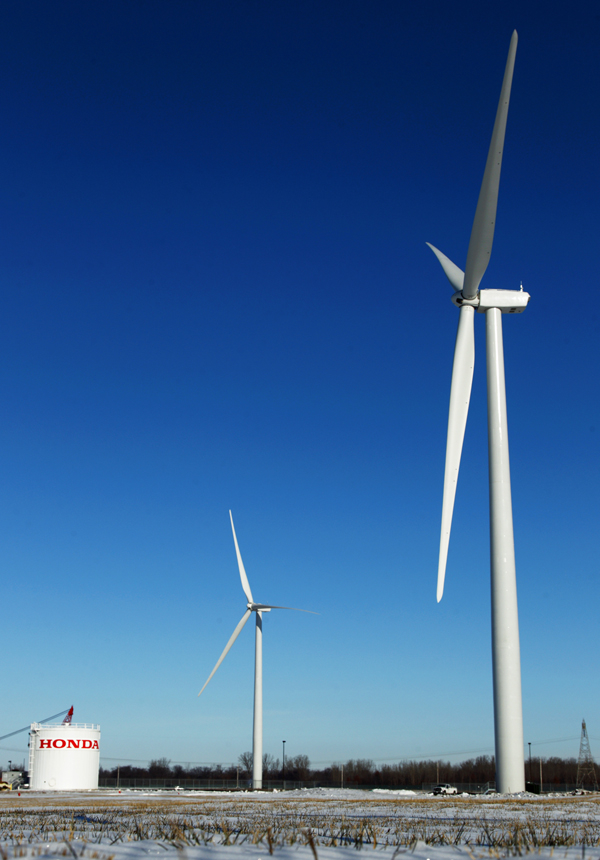
In addition to Marysville, one of the largest manufacturing facilities under a single roof in the U.S., Honda operates the Anna engine complex, a full-assembly facility at East Liberty, an R&D center near Marysville, and a transmission plant at Russells Point. It was at Russells Point last year that Honda took another transformative step by putting up a pair of wind turbines to help meet its massive need for electricity. Owned by ConEd Solutions and installed by Minnesota-based Juhl Energy, the 260-foot-high towers, each equipped with three blades more than half a football field long, supply about 10,000 megawatt hours a year—or about 10% of the plant’s power.

Today the turbines stand as a symbol of Honda’s loyalties in a contentious political fight over the future of renewable-energy policy in Ohio—one with national implications. In 2008 the state legislature passed one of the most ambitious renewable-energy laws in the U.S. The original legislation required utilities to get 25% of their power from renewable- and other clean-energy sources by 2025, while cutting their customers’ power usage by 22%. (Today Ohio gets just 1% of its total energy from renewables, according to the EPA, and 70% of its electricity comes from coal-fired power plants.)

However, in June, Ohio became the first state in the U.S. to roll back clean-energy mandates when Republican Gov. John Kasich—running for reelection in November—signed a bill called SB 310 into state law. The bill, which freezes standards for two years, was backed by deep-pocketed Ohio-based utilities and conservative groups. Coming just a week after the EPA announced tough new rules on carbon emissions from power plants, the freeze threw into question the future of government-supported renewable-energy markets nationwide.

Environmentalists and renewable-power providers fear that Ohio could be the spearhead for pushing back other states’ mandates for renewables. Despite five years of relatively robust investment in renewables here, the presence in Ohio of two of the nation’s largest utilities (AEP and FirstEnergy), along with the legacy coal industry (Ohio produced 26 million tons of coal in 2012), makes it a prime battleground for the struggle between clean energy and cheap, dirty coal. “This is ground zero,” says Sierra Club Ohio energy director Dan Sawmiller.

But there’s an interesting twist to the conflict: The environmental groups have been joined in their opposition to SB 310 by a less obvious ally—big manufacturers. The Ohio Manufacturers Association came out against SB 310, as did a handful of large companies such as Anheuser-Busch and, yes, Honda.

That’s not as surprising as it might sound. Auto manufacturing, one of the most energy-intensive businesses in the world, is gradually but decisively reducing its energy use and obtaining more of it from cleaner sources. Honda has trumpeted its “Green Factory” initiative, saying it plans to lower CO2 emissions from its plants 30% by 2020, compared with 2000 levels. And the carmaker has made it clear that it wants to cut its consumption of power from fossil fuels in order to be a better corporate citizen and to reap the accompanying good PR—as long as it makes good business sense. “Honda is always looking for opportunities to improve our efficiency and cost,” says Karen Heyob, the director of facility management for Honda North America. “I’m happy to say that we’ve kept energy usage stable this year despite significantly expanding our operations.”

MORE WITH LESS A look back at 30 years of energy use by U.S. manufacturers shows a peak in the mid-1990s. Gains in efficiency are helping to keep power use down despite a recent surge in activity
MORE WITH LESS A look back at 30 years of energy use by U.S. manufacturers shows a peak in the mid-1990s. Gains in efficiency are helping to keep power use down despite a recent surge in activityGraphic Source:

The embrace of clean energy by industry is hardly a Honda-only trend. Manufacturers of products from camshafts to catheters are finding that using energy more efficiently—and reducing their reliance on traditional, utility-centric, fossil-fuel-dominated resources—is good not only for the corporate image, but also for the bottom line. Prodded by government regulations, shareholder unrest, and a changing energy landscape, the manufacturing sector is transforming the way it sources and uses energy.

This transformation is being driven by forces both outside and inside the walls of manufacturing plants. The external factors are well documented: Falling prices for natural gas and renewable energy have made clean, distributed (i.e., located at or close to the plant) electricity generation a compelling business case. The effects of the shale gas bonanza on U.S. manufacturing are somewhat in dispute, but there is no question that low-cost natural gas is providing a competitive advantage to companies that make stuff in the U.S. According to the U.S. Manufacturing Purchasing Managers Index, a measure developed by financial research firm Markit, manufacturing activity in the U.S. in September reached its highest point in more than four years. Factory employment, though still well below pre-2008 levels, is surging as well, reaching its highest level since March 2012. A large part of the increase can be attributed to inexpensive natural gas.

The use of renewable energy in manufacturing, meanwhile, hovers at 8% to 9%, and it’s not guaranteed to soar. A June study by the International Renewable Energy Agency found that the figure could grow to more than a quarter by 2030, or a third if some form of carbon pricing takes effect—or, under current deployment plans and government policies, it could stagnate at 10%. Those are global figures; the U.S., with accelerating coal plant retirement and tightening government regulations of carbon emissions from power generation, should see increases at the high end of that scale.

What’s happening inside today’s manufacturing plants is more complicated but ultimately equally transformative. Simply put, a confluence of technological advances in networks, wireless sensors, virtualization, and monitoring equipment is enabling improvements in manufacturing efficiency, energy conservation, and quality control that were hardly conceivable just a few years ago. Greater efficiency combined with cheaper renewable power sources is a powerful formula.

The benefits of alternative energy are not evenly distributed across all manufacturing locations, of course. Honda’s Ohio complex, for example, is within the service area of Buckeye Power, a rural electricity co-op that has been untouched by utility deregulation and still gets the bulk of its power from coal. Honda had to reach a power purchase agreement with Buckeye in order to erect the Russells Point turbines. But now every megawatt that Honda generates from wind is one that doesn’t derive from coal.

On a recent evening the turbines turned lazily in the breeze while casting long shadows across the adjoining cornfields. It’s a good bet that Honda will soon be adding more turbines to its facilities. Moving from centralized coal plants to distributed power generation from renewable sources benefits manufacturers because users control the assets, and long-term prices are fixed. What’s more, shifting to clean energy now mitigates the risk of future carbon taxes or other forms of carbon pricing, says Barry McClelland, Honda’s longtime energy and operations chief, who retired in June but still heads the energy committee of the Ohio Manufacturers Association. “Honda’s view is you’ve got to go with the change,” says McClelland. Perhaps if Honda leads the way, others in Ohio will follow.

This story is from the October 27, 2014 issue of Fortune.
About the Author
By Richard Martin
See full bioRight Arrow Button Icon

Latest in

Finance
Lorem ipsum dolor sit amet, consectetur adipiscing elit, sed do eiusmod tempor incididunt ut labore et dolore magna aliqua. Ut enim ad minim veniam
By Fortune Editors
October 20, 2025
Finance
Lorem ipsum dolor sit amet, consectetur adipiscing elit, sed do eiusmod tempor incididunt ut labore et dolore magna aliqua. Ut enim ad minim veniam
By Fortune Editors
October 20, 2025
Finance
Lorem ipsum dolor sit amet, consectetur adipiscing elit, sed do eiusmod tempor incididunt ut labore et dolore magna aliqua. Ut enim ad minim veniam
By Fortune Editors
October 20, 2025
Finance
Lorem ipsum dolor sit amet, consectetur adipiscing elit, sed do eiusmod tempor incididunt ut labore et dolore magna aliqua. Ut enim ad minim veniam
By Fortune Editors
October 20, 2025
Finance
Lorem ipsum dolor sit amet, consectetur adipiscing elit, sed do eiusmod tempor incididunt ut labore et dolore magna aliqua. Ut enim ad minim veniam
By Fortune Editors
October 20, 2025
Finance
Lorem ipsum dolor sit amet, consectetur adipiscing elit, sed do eiusmod tempor incididunt ut labore et dolore magna aliqua. Ut enim ad minim veniam
By Fortune Editors
October 20, 2025

Most Popular

Finance
Lorem ipsum dolor sit amet, consectetur adipiscing elit, sed do eiusmod tempor incididunt ut labore et dolore magna aliqua. Ut enim ad minim veniam
By Fortune Editors
October 20, 2025
Finance
Lorem ipsum dolor sit amet, consectetur adipiscing elit, sed do eiusmod tempor incididunt ut labore et dolore magna aliqua. Ut enim ad minim veniam
By Fortune Editors
October 20, 2025
Finance
Lorem ipsum dolor sit amet, consectetur adipiscing elit, sed do eiusmod tempor incididunt ut labore et dolore magna aliqua. Ut enim ad minim veniam
By Fortune Editors
October 20, 2025
Finance
Lorem ipsum dolor sit amet, consectetur adipiscing elit, sed do eiusmod tempor incididunt ut labore et dolore magna aliqua. Ut enim ad minim veniam
By Fortune Editors
October 20, 2025
Finance
Lorem ipsum dolor sit amet, consectetur adipiscing elit, sed do eiusmod tempor incididunt ut labore et dolore magna aliqua. Ut enim ad minim veniam
By Fortune Editors
October 20, 2025
Finance
Lorem ipsum dolor sit amet, consectetur adipiscing elit, sed do eiusmod tempor incididunt ut labore et dolore magna aliqua. Ut enim ad minim veniam
By Fortune Editors
October 20, 2025
Fortune Secondary Logo
Rankings
  • 100 Best Companies
  • Fortune 500
  • Global 500
  • Fortune 500 Europe
  • Most Powerful Women
  • World's Most Admired Companies
  • See All Rankings
  • Lists Calendar
Sections
  • Finance
  • Fortune Crypto
  • Features
  • Leadership
  • Health
  • Commentary
  • Success
  • Retail
  • Mpw
  • Tech
  • Lifestyle
  • CEO Initiative
  • Asia
  • Politics
  • Conferences
  • Europe
  • Newsletters
  • Personal Finance
  • Environment
  • Magazine
  • Education
Customer Support
  • Frequently Asked Questions
  • Customer Service Portal
  • Privacy Policy
  • Terms Of Use
  • Single Issues For Purchase
  • International Print
Commercial Services
  • Advertising
  • Fortune Brand Studio
  • Fortune Analytics
  • Fortune Conferences
  • Business Development
  • Group Subscriptions
About Us
  • About Us
  • Press Center
  • Work At Fortune
  • Terms And Conditions
  • Site Map
  • About Us
  • Press Center
  • Work At Fortune
  • Terms And Conditions
  • Site Map
  • Facebook icon
  • Twitter icon
  • LinkedIn icon
  • Instagram icon
  • Pinterest icon

Latest in

Markets are jittery as the global oil crisis bleeds into a global debt selloff, while Trump weighs new military options on Iran
EnergyOil
Markets are jittery as the global oil crisis bleeds into a global debt selloff, while Trump weighs new military options on Iran
By Jason MaMay 17, 2026
2 hours ago
CDC to escalate Ebola response after WHO declares emergency
HealthHealth
CDC to escalate Ebola response after WHO declares emergency
By Jessica Nix and BloombergMay 17, 2026
3 hours ago
Four crew members ejected safely after two Navy jets collide and crash during air show in Idaho
North AmericaMilitary
Four crew members ejected safely after two Navy jets collide and crash during air show in Idaho
By The Associated PressMay 17, 2026
4 hours ago
Gundlach says it’s ‘just not possible’ for the Fed to cut rates
EconomyFederal Reserve
Gundlach says it’s ‘just not possible’ for the Fed to cut rates
By Jordan Fitzgerald, Sam Kim and BloombergMay 17, 2026
5 hours ago
Supply shocks weren’t random. They were strategic—and should be seen as ‘supply coercion’ instead, former Fed official says 
Economysupply chains
Supply shocks weren’t random. They were strategic—and should be seen as ‘supply coercion’ instead, former Fed official says 
By Jason MaMay 17, 2026
5 hours ago
U.S. says China to buy $17 billion of agricultural goods annually
EconomyChina
U.S. says China to buy $17 billion of agricultural goods annually
By Yash Roy and BloombergMay 17, 2026
7 hours ago

Most Popular

Microsoft AI chief gives it 18 months—for all white-collar work to be automated by AI
AI
Microsoft AI chief gives it 18 months—for all white-collar work to be automated by AI
By Jake AngeloMay 16, 2026
2 days ago
Former top Russian official admits the country is over Putin and can 'imagine a future without him' — even elites bail as Kremlin seizes their assets 
Politics
Former top Russian official admits the country is over Putin and can 'imagine a future without him' — even elites bail as Kremlin seizes their assets 
By Jason MaMay 16, 2026
1 day ago
The Bezos family just donated $100 million to help achieve one of Mayor Zohran Mamdani’s top campaign promises
Politics
The Bezos family just donated $100 million to help achieve one of Mayor Zohran Mamdani’s top campaign promises
By Jake AngeloMay 12, 2026
5 days ago
SpaceX heads into a record-shattering IPO with the 'deepest moat that exists today' as investors vow to 'never bet against Elon'
Innovation
SpaceX heads into a record-shattering IPO with the 'deepest moat that exists today' as investors vow to 'never bet against Elon'
By Jason MaMay 16, 2026
1 day ago
'No one was coming to save me': How Reese Witherspoon built a $900 million company from a problem Hollywood wouldn't fix
Success
'No one was coming to save me': How Reese Witherspoon built a $900 million company from a problem Hollywood wouldn't fix
By Sydney LakeMay 17, 2026
15 hours ago
The top foreign holders of U.S. debt may soon dump Treasury bonds and bring their money back home, potentially spiking borrowing costs
Economy
The top foreign holders of U.S. debt may soon dump Treasury bonds and bring their money back home, potentially spiking borrowing costs
By Jason MaMay 17, 2026
8 hours ago

© 2026 Fortune Media IP Limited. All Rights Reserved. Use of this site constitutes acceptance of our Terms of Use and Privacy Policy | CA Notice at Collection and Privacy Notice | Do Not Sell/Share My Personal Information
FORTUNE is a trademark of Fortune Media IP Limited, registered in the U.S. and other countries. FORTUNE may receive compensation for some links to products and services on this website. Offers may be subject to change without notice.