• Home
  • Latest
  • Fortune 500
  • Finance
  • Tech
  • Leadership
  • Lifestyle
  • Rankings
  • Multimedia
FinanceEurozone

Greece: this time is different. It just isn’t any less dangerous

By
Geoffrey Smith
Geoffrey Smith
Down Arrow Button Icon
By
Geoffrey Smith
Geoffrey Smith
Down Arrow Button Icon
January 8, 2015, 12:18 PM ET
Alexis Tsipras, the leader of SYRIZA (Coalition of the
ATHENS, ATTICA, GREECE - 2014/11/27: Alexis Tsipras, the leader of SYRIZA (Coalition of the Radical Left) and current leader of the Greek Opposition, is pictured at the beginning of the protest march. Tens of thousands Greeks followed the call by Greek Trade Union for a one day general strike and protest march to the Greek parliament. They protested against the austerity measures by the Greek government. (Photo by Michael Debets/Pacific Press/LightRocket via Getty Images)Photograph by Michael Debets — Pacific Press LightRocket via Getty Images

It’s fair to say that this iteration of the Greek debt crisis is different. But that doesn’t justify the kind of complacency financial markets are showing.

Things may indeed be different in the details from 2012, when Greece nearly left the currency union, dragging half a dozen other countries with it. The problem is, the big picture has changed, if anything, for the worse. This time is just as dangerous as last time because the Eurozone still doesn’t have the political institutions to back its currency, and probably never will have.

True, the worst phase of the crisis in 2012 led it to create the European Stability Mechanism, a €500 billion ($600 billion) safety net for governments that accepted the doctrine of aid in return for structural reforms and budgetary austerity. It also adopted, at least in principle, a mechanism for vetting each other’s budgets. And those of a charitable disposition can also believe that the Eurozone’s banks are now solvent after big capital increases in the last three years.

Most of all, there was European Central Bank President Mario Draghi’s promise to do “whatever it takes” to keep the Eurozone together, a comment has been widely understood as a blanket underwriting of all Eurozone sovereigns.

For all those reasons, financial markets (and, to judge by German media reports, Chancellor Angela Merkel and her entourage) believe that, even if a new radical left-wing government in Greece wins the Jan. 25 elections, walks away from its debts and leaves the Eurozone, the rest of the union would be able to survive.

This is why people are still willing to buy 10-year Italian government bonds at a yield of only 1.85%, despite the fact that its economy, like its population, is dying, and even though Prime Minister Matteo Renzi has yet to deliver any sort of reform that will allow the country to grow out of a debt that now totals 133% of gross domestic product.


Breakup risk? What breakup risk? Italian bond yields since Draghi's "whatever it takes" moment.
What breakup risk? Italian bond yields since Draghi’s “whatever it takes” moment.


The problem is, the big flaws in the Eurozone’s institutional architecture haven’t been fixed. There’s still no single Treasury, no pooling of debt liabilities, no single Eurozone economic policy: nothing to force the people of Germany, Finland, the Netherlands, et al., to stand behind the debts of Greece, Portugal or Italy.

This means that the only effective firewall the Eurozone has in the event of a Greek exit standing is the ECB’s “Outright Monetary Transactions” program, which has never been tested, and is currently in legal limbo due to a preliminary opinion by Germany’s Constitutional Court that it violates the German constitution. (Ex-IMF official Alessandro Leipold argues the point well here.)

But even if OMTs are legal, the ECB will only buy a government’s bonds if it accepts in return a formal adjustment program with lots of unpopular conditions that will prolong the seemingly endless economic pain. OMT was designed to stop markets expelling well-meaning members from the Eurozone by accident. It wasn’t designed to cope with governments which have a clear democratic mandate to overthrow the austerity doctrine.

Simon Tilford, deputy director of the Center for European Reform, a London-based think tank, points out that governments accepted harsh bailout terms in 2010 and 2011 because they knew they had no alternative, and because “a recovery seemed just around the corner.” After four years of recession and stagnation, Tilford says, that no longer holds, which is why Syriza is leading in the polls, and why a majority of Italians–according to some polls–want out of the euro altogether.

With the revolt against austerity spreading, Antonio Fatas, a professor at INSEAD business school in Singapore, thinks Berlin might try to make an example of Syriza and force Greece out of the Eurozone in order to scare other countries back into line. That applies to Italy and Spain, where another radical left party, Podemos, is currently heading the polls.

“If Spaniards see bad things happening in Greece (after a Euro exit), you can guarantee that they won’t vote for Podemos,” he says.

Such thinking, he says, may explain recent comments out of Berlin playing down the risks of a “Grexit”.

Draghi made a big deal in 2012 of the euro being an ‘irreversible’ project. But if Greece leaves, under any circumstances, then so can other countries, and it would be folly not to expect markets to test that thesis with Italy, Portugal or any country that hasn’t proved it can grow in the 21st century. Even if that bet fails, it will take the Eurozone at least another year to get over the volatility and uncertainty.

There is arguably a bigger gap between Syriza and the German-led creditors than in any previous comparable bailout negotiations, and domestic politics has moved against the Euro project in both Greece and Germany in the last four years. Merkel, Tilford notes, is already “running scared of the Alternative für Deutschland,” an anti-euro party with stubbornly high poll ratings, and will find it hard to get anywhere near to Tsipras’ demand that over half of Greece’s bail-out debts are written down.

The Eurozone is going to need all its capacity for negotiation and compromise to avoid a blow-up—and that’s assuming it still wants to.
About the Author
By Geoffrey Smith
See full bioRight Arrow Button Icon

Latest in Finance

Finance
Lorem ipsum dolor sit amet, consectetur adipiscing elit, sed do eiusmod tempor incididunt ut labore et dolore magna aliqua. Ut enim ad minim veniam
By Fortune Editors
October 20, 2025
Finance
Lorem ipsum dolor sit amet, consectetur adipiscing elit, sed do eiusmod tempor incididunt ut labore et dolore magna aliqua. Ut enim ad minim veniam
By Fortune Editors
October 20, 2025
Finance
Lorem ipsum dolor sit amet, consectetur adipiscing elit, sed do eiusmod tempor incididunt ut labore et dolore magna aliqua. Ut enim ad minim veniam
By Fortune Editors
October 20, 2025
Finance
Lorem ipsum dolor sit amet, consectetur adipiscing elit, sed do eiusmod tempor incididunt ut labore et dolore magna aliqua. Ut enim ad minim veniam
By Fortune Editors
October 20, 2025
Finance
Lorem ipsum dolor sit amet, consectetur adipiscing elit, sed do eiusmod tempor incididunt ut labore et dolore magna aliqua. Ut enim ad minim veniam
By Fortune Editors
October 20, 2025
Finance
Lorem ipsum dolor sit amet, consectetur adipiscing elit, sed do eiusmod tempor incididunt ut labore et dolore magna aliqua. Ut enim ad minim veniam
By Fortune Editors
October 20, 2025

Most Popular

Finance
Lorem ipsum dolor sit amet, consectetur adipiscing elit, sed do eiusmod tempor incididunt ut labore et dolore magna aliqua. Ut enim ad minim veniam
By Fortune Editors
October 20, 2025
Finance
Lorem ipsum dolor sit amet, consectetur adipiscing elit, sed do eiusmod tempor incididunt ut labore et dolore magna aliqua. Ut enim ad minim veniam
By Fortune Editors
October 20, 2025
Finance
Lorem ipsum dolor sit amet, consectetur adipiscing elit, sed do eiusmod tempor incididunt ut labore et dolore magna aliqua. Ut enim ad minim veniam
By Fortune Editors
October 20, 2025
Finance
Lorem ipsum dolor sit amet, consectetur adipiscing elit, sed do eiusmod tempor incididunt ut labore et dolore magna aliqua. Ut enim ad minim veniam
By Fortune Editors
October 20, 2025
Finance
Lorem ipsum dolor sit amet, consectetur adipiscing elit, sed do eiusmod tempor incididunt ut labore et dolore magna aliqua. Ut enim ad minim veniam
By Fortune Editors
October 20, 2025
Finance
Lorem ipsum dolor sit amet, consectetur adipiscing elit, sed do eiusmod tempor incididunt ut labore et dolore magna aliqua. Ut enim ad minim veniam
By Fortune Editors
October 20, 2025
Fortune Secondary Logo
Rankings
  • 100 Best Companies
  • Fortune 500
  • Global 500
  • Fortune 500 Europe
  • Most Powerful Women
  • Future 50
  • World’s Most Admired Companies
  • See All Rankings
Sections
  • Finance
  • Fortune Crypto
  • Features
  • Leadership
  • Health
  • Commentary
  • Success
  • Retail
  • Mpw
  • Tech
  • Lifestyle
  • CEO Initiative
  • Asia
  • Politics
  • Conferences
  • Europe
  • Newsletters
  • Personal Finance
  • Environment
  • Magazine
  • Education
Customer Support
  • Frequently Asked Questions
  • Customer Service Portal
  • Privacy Policy
  • Terms Of Use
  • Single Issues For Purchase
  • International Print
Commercial Services
  • Advertising
  • Fortune Brand Studio
  • Fortune Analytics
  • Fortune Conferences
  • Business Development
  • Group Subscriptions
About Us
  • About Us
  • Editorial Calendar
  • Press Center
  • Work At Fortune
  • Diversity And Inclusion
  • Terms And Conditions
  • Site Map
  • About Us
  • Editorial Calendar
  • Press Center
  • Work At Fortune
  • Diversity And Inclusion
  • Terms And Conditions
  • Site Map
  • Facebook icon
  • Twitter icon
  • LinkedIn icon
  • Instagram icon
  • Pinterest icon

Latest in Finance

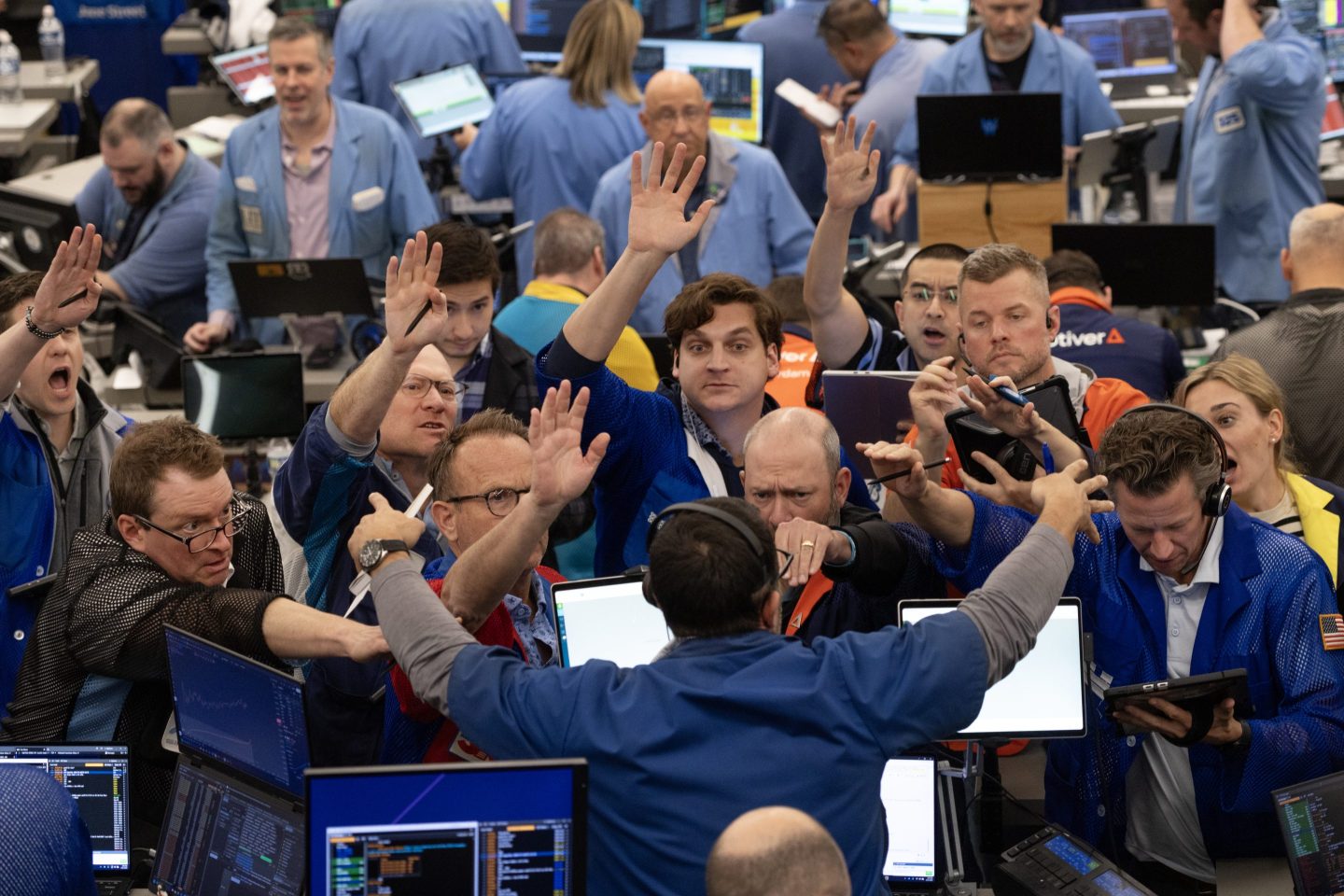
Traders signal offers in the S&P options trading pit at the Cboe Global Markets exchange on March 31, 2026 in Chicago, Illinois.
EnergyIran
Markets rally hard on Iran’s promise to play nice at Hormuz as its leaders pocket billions from the disruption
By Eva RoytburgApril 2, 2026
29 minutes ago
Jack Dorsey and Roelof Botha think AI can make middle management obsolete 
AIBlock
Jack Dorsey and Roelof Botha think AI can make middle management obsolete 
By Jacqueline MunisApril 2, 2026
37 minutes ago
A woman looks concerned as she fills up at a gas station
Economygas prices
The Iran war is effectively a ‘tax’ on US households that could accelerate the economy’s widening K shape, Moody’s says
By Tristan BoveApril 2, 2026
43 minutes ago
jobless
Economyunemployment
Jobless claims fall 9,000 as overall layoffs remain low across the economy
By Matt Ott and The Associated PressApril 2, 2026
1 hour ago
Asian man talking on the phone with his laptop in his lap
SuccessWealth
Gen Z millionaires are rushing into crypto—and they blame the risky bet on FOMO, or fear of missing out
By Preston ForeApril 2, 2026
2 hours ago
Top CD rates from major banks April 2, 2026: Chase CDs, Bank of America CDs, Citibank CDs, and more
Personal FinanceCertificates of Deposit (CDs)
Top CD rates from major banks on April 2, 2026: Chase CDs, Bank of America CDs, Citibank CDs, and more
By Joseph HostetlerApril 2, 2026
2 hours ago

Most Popular

Gen Z fled San Francisco for Texas and Florida. Now they’re turning ‘welcomer cities’ into the next big tech towns
Real Estate
Gen Z fled San Francisco for Texas and Florida. Now they’re turning ‘welcomer cities’ into the next big tech towns
By Fortune EditorsApril 2, 2026
10 hours ago
Current price of gold as of April 1, 2026
Personal Finance
Current price of gold as of April 1, 2026
By Fortune EditorsApril 1, 2026
1 day ago
Two-thirds of parents say their adult Gen Z kids still rely on them financially  for support—even though it's putting them under strain
Success
Two-thirds of parents say their adult Gen Z kids still rely on them financially  for support—even though it's putting them under strain
By Fortune EditorsMarch 31, 2026
2 days ago
Current price of oil as of April 1, 2026
Personal Finance
Current price of oil as of April 1, 2026
By Fortune EditorsApril 1, 2026
1 day ago
Jerome Powell says the $39 trillion national debt is ‘not unsustainable,’ but warns the trajectory ‘will not end well’
Economy
Jerome Powell says the $39 trillion national debt is ‘not unsustainable,’ but warns the trajectory ‘will not end well’
By Fortune EditorsMarch 30, 2026
3 days ago
Deutsche Bank asked AI if it’s true that AI will solve the economy’s inflation problems. The robots answered
Economy
Deutsche Bank asked AI if it’s true that AI will solve the economy’s inflation problems. The robots answered
By Fortune EditorsApril 1, 2026
22 hours ago

© 2026 Fortune Media IP Limited. All Rights Reserved. Use of this site constitutes acceptance of our Terms of Use and Privacy Policy | CA Notice at Collection and Privacy Notice | Do Not Sell/Share My Personal Information
FORTUNE is a trademark of Fortune Media IP Limited, registered in the U.S. and other countries. FORTUNE may receive compensation for some links to products and services on this website. Offers may be subject to change without notice.