• Home
  • Latest
  • Fortune 500
  • Finance
  • Tech
  • Leadership
  • Lifestyle
  • Rankings
  • Multimedia

Trendingnow

1

The U.S. spent $30 billion to ditch textbooks for laptops and tablets: The result is the first generation less cognitively capable than their parents

2

Current price of oil as of July 13, 2026

3

Current price of silver as of Monday, July 13, 2026

1

The U.S. spent $30 billion to ditch textbooks for laptops and tablets: The result is the first generation less cognitively capable than their parents

2

Current price of oil as of July 13, 2026

3

Current price of silver as of Monday, July 13, 2026
Leadership

Religious freedom laws: Once unifying, but now divisive

Claire Zillman
By
Claire Zillman
Claire Zillman
Editor, Leadership
Down Arrow Button Icon
Claire Zillman
By
Claire Zillman
Claire Zillman
Editor, Leadership
Down Arrow Button Icon
April 2, 2015, 9:17 PM ET
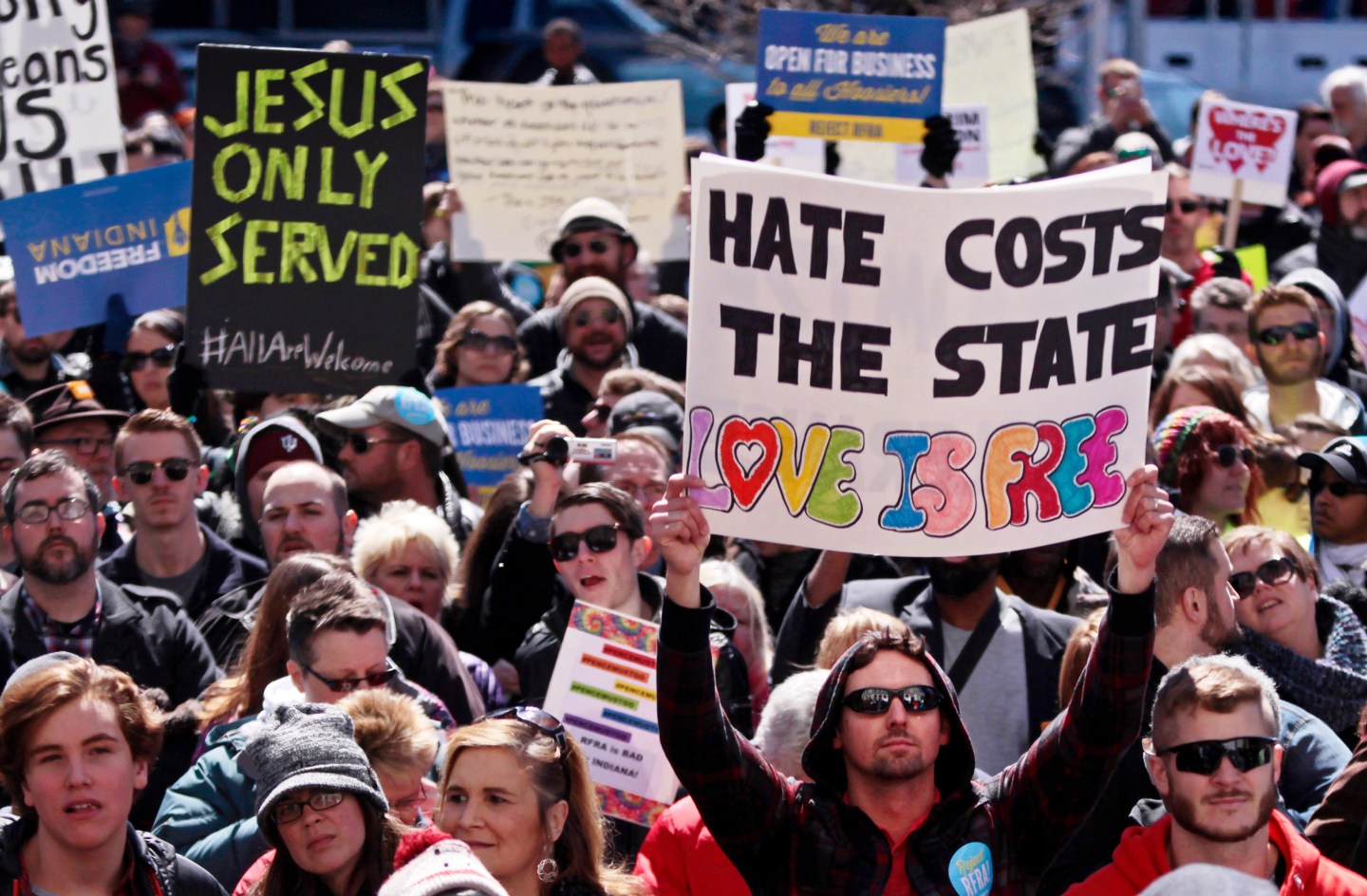
Demonstrators gather to protest a controversial religious freedom bill in Indianapolis
Demonstrators gather at Monument Circle to protest a controversial religious freedom bill recently signed by Governor Mike Pence, during a rally in Indianapolis March 28, 2015. More than 2,000 people gathered at the Indiana State Capital Saturday to protest Indiana?s newly signed Religious Freedom Restoration Act saying it would promote discrimination against individuals based on sexual orientation. REUTERS/Nate Chute - RTR4VA9QPhotograph by Nathan Chute — Reuters
Add Fortune on Google for similar content.

The controversial religious freedom laws in Indiana and Arkansas have divided the nation into two separate camps: one that sees the laws as protecting religious freedom from government intrusion and another that believes they license discrimination against gays and lesbians.

It’s ironic then that a federal law considered to be a unifying force served as the model.

Indiana Gov. Mike Pence and Arkansas Gov. Asa Hutchinson have pointed to the Religious Freedom Restoration Act, a federal law passed in 1993 under President Bill Clinton, as the blueprint for their states’ religious freedom bills. When Clinton signed the law into effect more than two decades ago, the measure was seen as anything but divisive; in fact, it gained wide support.

Watch a clip of the ceremony here:

The catalyst for the so-called RFRA legislation was a 1990 Supreme Court decision in the Employment Division of Oregon v. Smith case brought by two Native Americans who’d been fired from a private drug rehabilitation organization for ingesting peyote during a religious ceremony. They filed a lawsuit after the State of Oregon denied their request for unemployment benefits, citing a state law disqualifying employees discharged for work-related “misconduct.” The Supreme Court eventually sided with the state, ruling that officials could enforce laws even if it hindered individuals or groups from practicing their faith.

Three years later, courts had ruled against people in as many as 50 cases who had claimed religious arguments against the government, Clinton said in signing RFRA into law in 1993. Vice President Al Gore listed a series of horror stories. Coroners conducted autopsies on people whose religion barred them, he said. City rezoning excluded churches in certain neighborhoods, requiring residents to travel longer distances to attend services. Local governments dictated the design of houses of worship, overriding the wishes of the congregations.

RFRA landed on Clinton’s desk after gaining approval with a 97-3 vote in the Senate and a voice vote in the House. At the signing, Clinton and Gore praised the coalition of religious and civil rights groups that had come together to back the legislation. Sixty-eight groups had signed on to the bill.

“You know when you have the National Association of Evangelicals and the American Civil Liberties Union; the National Islamic Prison Association and B’nai B’rith; the Traditional Values Coalition and People for The American Way; we’re doing something right here today,” Gore said at the time.

Clinton said that passing legislation aimed at overturning the Supreme Court rulings was “a power that’s rightly, hesitantly and infrequently exercised by the United States Congress,” but one that was “clearly called for” in the case involving the Native Americans in Oregon. As he signed RFRA, Clinton said the new law “basically says [that] the government should be held to a very high level of proof before it interferes with someone’s free exercise of religion. This judgement is shared by the people of the United States as well as by the Congress. We believe strongly that we can never—we can never—be too vigilant in this work.”

He spoke with stirring rhetoric about the vital role the free exercise of religion had played in American history, saying “it’s been called the first freedom, that which originally sparked the development of the full range of the Bill of Rights”—and credited it with producing the “oldest democracy now in history and probably the most truly multiethnic society on the face of the earth.”

(A 1997 decision by the Supreme Court kept the law Clinton signed from being applied to the federal government, which prompted states to introduce the Act at a more local level.)

The theme of unity that surrounded RFRA in the early 1990s has been blatantly absent from this week’s discussions about the laws in Indiana and Arkansas. That’s partly because the state laws are not identical to the federal legislation. And of course, the huge advancement in LGBT rights and the growing acceptance of same-sex marriage provide a wholly different backdrop to the recent legislation than the one present in 1993.

On Thursday, the state legislatures of Indiana and Arkansas passed and both governors signed “fixes” to their state RFRA laws to align them more closely with Congress’s 1993 version, but even those tweaks were polarizing. Liberal critics say that the new versions didn’t go far enough to ban discrimination while social conservatives said the changes watered down the legislation.


 

About the Author
Claire Zillman
By Claire ZillmanEditor, Leadership
LinkedIn iconTwitter icon

Claire Zillman is a senior editor at Fortune, overseeing leadership stories. 

See full bioRight Arrow Button Icon
Add Fortune on Google for similar content.

Latest in Leadership

Finance
Lorem ipsum dolor sit amet, consectetur adipiscing elit, sed do eiusmod tempor incididunt ut labore et dolore magna aliqua. Ut enim ad minim veniam
By Fortune Editors
October 20, 2025
Finance
Lorem ipsum dolor sit amet, consectetur adipiscing elit, sed do eiusmod tempor incididunt ut labore et dolore magna aliqua. Ut enim ad minim veniam
By Fortune Editors
October 20, 2025
Finance
Lorem ipsum dolor sit amet, consectetur adipiscing elit, sed do eiusmod tempor incididunt ut labore et dolore magna aliqua. Ut enim ad minim veniam
By Fortune Editors
October 20, 2025
Finance
Lorem ipsum dolor sit amet, consectetur adipiscing elit, sed do eiusmod tempor incididunt ut labore et dolore magna aliqua. Ut enim ad minim veniam
By Fortune Editors
October 20, 2025
Finance
Lorem ipsum dolor sit amet, consectetur adipiscing elit, sed do eiusmod tempor incididunt ut labore et dolore magna aliqua. Ut enim ad minim veniam
By Fortune Editors
October 20, 2025
Finance
Lorem ipsum dolor sit amet, consectetur adipiscing elit, sed do eiusmod tempor incididunt ut labore et dolore magna aliqua. Ut enim ad minim veniam
By Fortune Editors
October 20, 2025

Most Popular

Finance
Lorem ipsum dolor sit amet, consectetur adipiscing elit, sed do eiusmod tempor incididunt ut labore et dolore magna aliqua. Ut enim ad minim veniam
By Fortune Editors
October 20, 2025
Finance
Lorem ipsum dolor sit amet, consectetur adipiscing elit, sed do eiusmod tempor incididunt ut labore et dolore magna aliqua. Ut enim ad minim veniam
By Fortune Editors
October 20, 2025
Finance
Lorem ipsum dolor sit amet, consectetur adipiscing elit, sed do eiusmod tempor incididunt ut labore et dolore magna aliqua. Ut enim ad minim veniam
By Fortune Editors
October 20, 2025
Finance
Lorem ipsum dolor sit amet, consectetur adipiscing elit, sed do eiusmod tempor incididunt ut labore et dolore magna aliqua. Ut enim ad minim veniam
By Fortune Editors
October 20, 2025
Finance
Lorem ipsum dolor sit amet, consectetur adipiscing elit, sed do eiusmod tempor incididunt ut labore et dolore magna aliqua. Ut enim ad minim veniam
By Fortune Editors
October 20, 2025
Finance
Lorem ipsum dolor sit amet, consectetur adipiscing elit, sed do eiusmod tempor incididunt ut labore et dolore magna aliqua. Ut enim ad minim veniam
By Fortune Editors
October 20, 2025
Fortune Secondary Logo
Rankings
  • 100 Best Companies
  • Fortune 500
  • Global 500
  • Fortune 500 Europe
  • Most Powerful Women
  • World's Most Admired Companies
  • See All Rankings
  • Lists Calendar
Sections
  • Finance
  • Fortune Crypto
  • Features
  • Leadership
  • Health
  • Commentary
  • Success
  • Retail
  • Mpw
  • Tech
  • Lifestyle
  • CEO Initiative
  • Asia
  • Politics
  • Conferences
  • Europe
  • Newsletters
  • Personal Finance
  • Environment
  • Magazine
  • Education
Customer Support
  • Frequently Asked Questions
  • Customer Service Portal
  • Privacy Policy
  • Terms Of Use
  • Single Issues For Purchase
  • International Print
Commercial Services
  • Advertising
  • Fortune Brand Studio
  • Fortune Analytics
  • Fortune Conferences
  • Business Development
  • Group Subscriptions
About Us
  • About Us
  • Press Center
  • Work At Fortune
  • Terms And Conditions
  • Site Map
  • About Us
  • Press Center
  • Work At Fortune
  • Terms And Conditions
  • Site Map
  • Facebook icon
  • Twitter icon
  • LinkedIn icon
  • Instagram icon
  • Pinterest icon

Latest in Leadership

How Adobe’s CMO is preparing for the AI-powered era of brand discovery
C-SuiteCMO
How Adobe’s CMO is preparing for the AI-powered era of brand discovery
By Ruth UmohJuly 14, 2026
3 minutes ago
Elon Musk and Sam Altman are accusing each other of scamming investors as SpaceX and OpenAI jockey to lead AI revolution
AIBillionaires
Elon Musk and Sam Altman are accusing each other of scamming investors as SpaceX and OpenAI jockey to lead AI revolution
By Marco Quiroz-GutierrezJuly 13, 2026
11 hours ago
na
North AmericaEducation
‘We devalued the trades’: A Native American graduation miracle that isn’t what it seems
By Savannah Peters and The Associated PressJuly 13, 2026
14 hours ago
t
North AmericaElections
Trump floats Lindsey Graham’s sister as interim Senate replacement; Scott Bessent reportedly fields calls
By Meg Kinnard and The Associated PressJuly 13, 2026
15 hours ago
Jason Kidd, COO of Chipotle
SuccessThe Promotion Playbook
Chipotle’s COO takes employees to dinner every week to spot his next leaders—here are the 4 traits he’s seeking
By Emma BurleighJuly 13, 2026
15 hours ago
b
CommentaryWorld Cup
Columbia Business School professors: What the Balogun red card can teach us about AI and judgment
By Oded Netzer, Christopher Frank and Paul MagnoneJuly 13, 2026
15 hours ago

Most Popular

The U.S. spent $30 billion to ditch textbooks for laptops and tablets: The result is the first generation less cognitively capable than their parents
Innovation
The U.S. spent $30 billion to ditch textbooks for laptops and tablets: The result is the first generation less cognitively capable than their parents
By Sasha RogelbergJuly 12, 2026
2 days ago
Current price of oil as of July 13, 2026
Personal Finance
Current price of oil as of July 13, 2026
By Joseph HostetlerJuly 13, 2026
21 hours ago
Current price of silver as of Monday, July 13, 2026
Personal Finance
Current price of silver as of Monday, July 13, 2026
By Joseph HostetlerJuly 13, 2026
21 hours ago
Trump embraces Australian retirement system backed by Larry Fink
Personal Finance
Trump embraces Australian retirement system backed by Larry Fink
By Brianna Sosa and BloombergJuly 12, 2026
1 day ago
How Pete Hegseth's DEI order just put Scouting America's future at stake
North America
How Pete Hegseth's DEI order just put Scouting America's future at stake
By Seth T. Kannarr, Derek H. Alderman and The ConversationJuly 13, 2026
12 hours ago
Ex-PepsiCo CEO Indra Nooyi worked from midnight until 5 a.m. as a receptionist to pay for her Yale degree—and she says ‘respect went up’ because of it
Success
Ex-PepsiCo CEO Indra Nooyi worked from midnight until 5 a.m. as a receptionist to pay for her Yale degree—and she says ‘respect went up’ because of it
By Preston ForeJuly 6, 2026
8 days ago

© 2026 Fortune Media IP Limited. All Rights Reserved. Use of this site constitutes acceptance of our Terms of Use and Privacy Policy | CA Notice at Collection and Privacy Notice | Do Not Sell/Share My Personal Information
FORTUNE is a trademark of Fortune Media IP Limited, registered in the U.S. and other countries. FORTUNE may receive compensation for some links to products and services on this website. Offers may be subject to change without notice.