• Home
  • Latest
  • Fortune 500
  • Finance
  • Tech
  • Leadership
  • Lifestyle
  • Rankings
  • Multimedia
RetailCommentary

Coffee snobs: This brew may get pricey, thanks to climate change

By
Alessandro Craparo
Alessandro Craparo
Down Arrow Button Icon
By
Alessandro Craparo
Alessandro Craparo
Down Arrow Button Icon
June 2, 2015, 7:06 AM ET
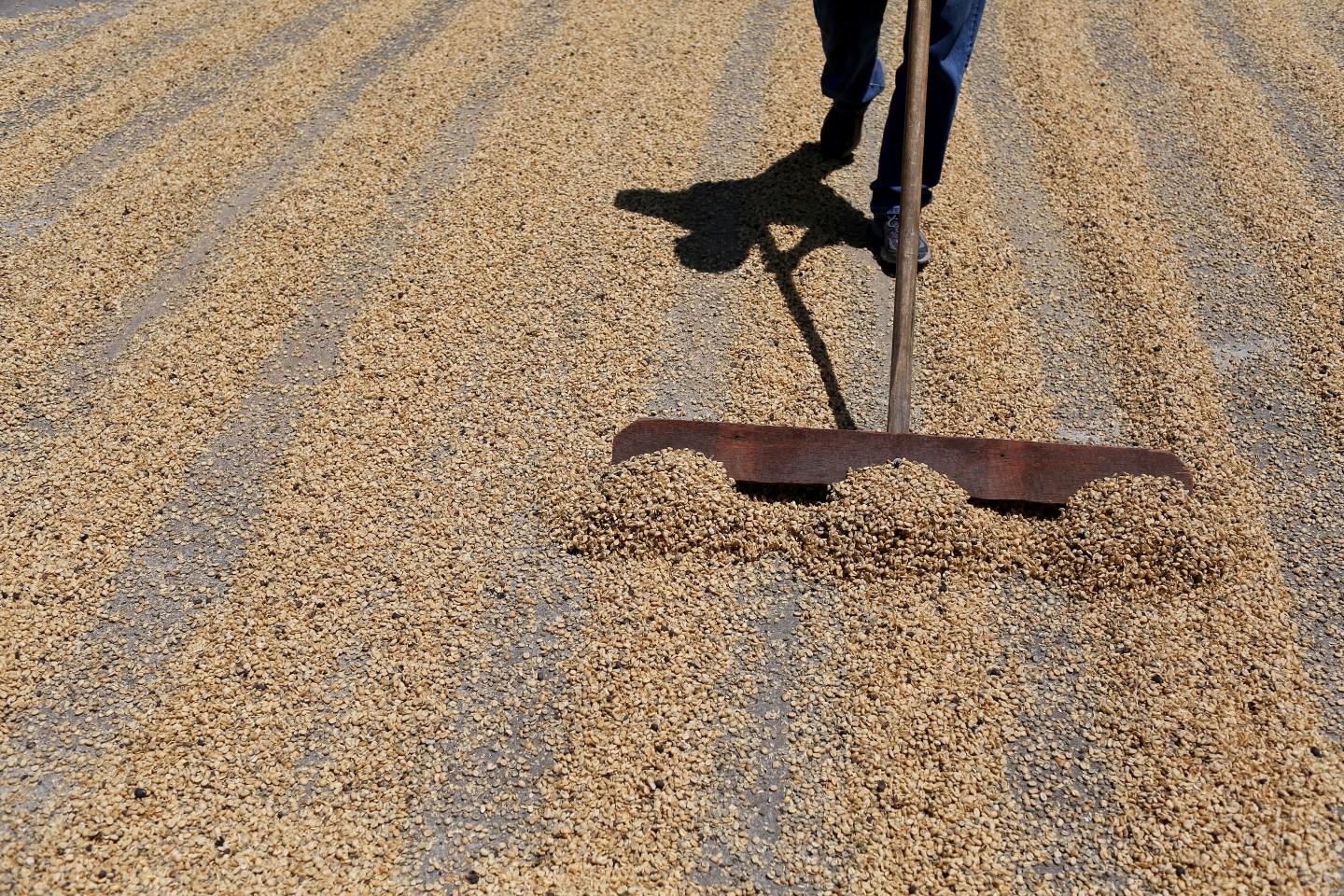
<> on March 26, 2015 in San Jose, Costa Rica.
Caption:ALAJUELA, COSTA RICA - MARCH 25: A worker demonstrates for tourists the process of using a rake as part of the drying green coffee beans under the sun at the Doka Estate coffee farm on March 25, 2015 in Alajuela, Costa Rica. The farm is one of many that produce high quality coffee that is exported to the United States where a panel of government-appointed scientists at the Dietary Guidelines Advisory Committee charged with proposing changes to U.S. dietary guidelines announced recently that three to five cups of coffee daily do not have long-term health risks, and help reduce the risk for heart disease and type 2 diabetes. (Photo by Joe Raedle/Getty Images) Photograph by Joe Raedle — Getty Images

We have known for some time that coffee is a climate-sensitive crop. Now we have the first global evidence that increasing minimum, or night-time, temperatures are having the hardest impact on your daily brew.

A warmer world with soaring day time temperatures has been linked to the decline of many plant and animal species. Unless climate change can be mitigated, or farmers can find ways to adapt, the future for many crops including coffee looks bleak.

Coffea arabica and Coffea robusta are the most popular forms of coffee in the world. Due to the quality, arabica achieves a much higher price premium.

Coffea arabica, which accounts for most of the world’s production, is grown throughout the highland tropics of Africa, typically between 1000 and 2300 metres above sea level. Most is grown in Tanzania, Kenya and Ethiopia.

In the past, heat and drought stress were typically noted as the major constraints that affected coffee production. Now it appears that steadily increasing night-time temperatures are actually having the greatest impact.

The crop is comfortable in a marginal temperature bracket ranging between 18 to 21°C. Outside of this temperature bracket the plant’s metabolic processes begin to change. This subsequently has a negative impact on yield and quality.

Every 1°C rise in minimum temperature will result in annual yield losses of approximately 137 kg per hectare. This is roughly 60% of the average smallholder farmer’s current production in Tanzania, on which our study is based. Tanzania was used as a reference because it has many valuable climate and yield datasets which are often not recorded or are subsequently lost. It is also similar to many other African nations in terms of its coffee production.

Coffee is Tanzania’s most important export crop, generating average export earnings in the order of $100 million per annum. Grown predominantly by smallholder farmers, coffee is usually inter-cropped with other subsistence crops like beans, maize and bananas.

Yields are currently 50% lower than they were in 1960. If we project this into the future, without substantial adaptation strategies, coffee production could drop to critical levels in Tanzania.

Naturally, the decline in yields is not solely due to minimum temperature increases. All aspects of climate change variables play a role but rising minimum temperatures certainly have the greatest influence.

Land availability, lack of resources, overpopulation and the sensitivity of arabica make coffee growing in the tropics a fickle business. As temperatures increase, producers within the growing band of 1000 to 1300 metres above sea level in many areas of the globe are struggling to manage sufficient quality and yields. Even farmers at 1500 metres above sea level, such as those on Mt. Kilimanjaro are becoming marginal.

Moving higher upslope in pursuit of cooler temperatures is rarely feasible. Despite the fact that most highland areas are already overpopulated and that most of these regions are encroaching on protected forests, it’s not feasible for farmers to just pick up and move on.

While most governments have invested heavily in the coffee industry, few have implemented adaptation strategies to help farmers cope with changing conditions.

Dr Piet van Asten, International Institute of Tropical Agriculture, highlights the challenge:

The industry is aware of the impact of climate change on coffee production, but they need hard data to prove to regional decision makers how urgently climate adaptation strategies need to be put in place.

Shade-grown coffee is a common agro-forestry practice with benefits for ecosystems and biodiversity, as shade trees provide a habitat for native birds, insects and wildlife.

Shade-grown coffee also benefits the farmer through crop protection and diversity, strengthening their livelihoods. Managed effectively shade grown coffee could positively influence coffee production.

But the right type of shade for coffee needs to be chosen. Strategic shading is needed, such as selecting trees that provide a high enough canopy to help reduce the daytime maximum temperatures while allowing the night-time terrestrial radiation to escape back through the atmosphere.

Other adaptation strategies such as breeding coffee that is less susceptible to climate change is an ongoing process. But this could take several decades. More extreme measures such as switching to a hardier species of coffee, such as the lower quality Robusta, or moving in altitude or latitude do not pose attractive options either.

It’s not just the Tanzanian highlands at risk. Attention should also be drawn to the arabica growing regions of Brazil, Colombia, Costa Rica, Ethiopia and Kenya. Evidence shows these areas have followed strikingly similar minimum temperature trends.

The coffee in each region exists within its own unique niche. In order to be effective, site-specific adaptation strategies need to be implemented. Hopefully these hard numbers encourage the public and private-sectors to invest in climate change adaptation strategies that will better sustain this important industry and the livelihoods of millions of smallholder farmers who depend on it.

Alessandro Craparo is International Institute of Tropical Agriculture Research Fellow at University of the Witwatersrand.

This article was originally published on The Conversation.
Read the original article.
About the Author
By Alessandro Craparo
See full bioRight Arrow Button Icon

Latest in Retail

Finance
Lorem ipsum dolor sit amet, consectetur adipiscing elit, sed do eiusmod tempor incididunt ut labore et dolore magna aliqua. Ut enim ad minim veniam
By Fortune Editors
October 20, 2025
Finance
Lorem ipsum dolor sit amet, consectetur adipiscing elit, sed do eiusmod tempor incididunt ut labore et dolore magna aliqua. Ut enim ad minim veniam
By Fortune Editors
October 20, 2025
Finance
Lorem ipsum dolor sit amet, consectetur adipiscing elit, sed do eiusmod tempor incididunt ut labore et dolore magna aliqua. Ut enim ad minim veniam
By Fortune Editors
October 20, 2025
Finance
Lorem ipsum dolor sit amet, consectetur adipiscing elit, sed do eiusmod tempor incididunt ut labore et dolore magna aliqua. Ut enim ad minim veniam
By Fortune Editors
October 20, 2025
Finance
Lorem ipsum dolor sit amet, consectetur adipiscing elit, sed do eiusmod tempor incididunt ut labore et dolore magna aliqua. Ut enim ad minim veniam
By Fortune Editors
October 20, 2025
Finance
Lorem ipsum dolor sit amet, consectetur adipiscing elit, sed do eiusmod tempor incididunt ut labore et dolore magna aliqua. Ut enim ad minim veniam
By Fortune Editors
October 20, 2025

Most Popular

Finance
Lorem ipsum dolor sit amet, consectetur adipiscing elit, sed do eiusmod tempor incididunt ut labore et dolore magna aliqua. Ut enim ad minim veniam
By Fortune Editors
October 20, 2025
Finance
Lorem ipsum dolor sit amet, consectetur adipiscing elit, sed do eiusmod tempor incididunt ut labore et dolore magna aliqua. Ut enim ad minim veniam
By Fortune Editors
October 20, 2025
Finance
Lorem ipsum dolor sit amet, consectetur adipiscing elit, sed do eiusmod tempor incididunt ut labore et dolore magna aliqua. Ut enim ad minim veniam
By Fortune Editors
October 20, 2025
Finance
Lorem ipsum dolor sit amet, consectetur adipiscing elit, sed do eiusmod tempor incididunt ut labore et dolore magna aliqua. Ut enim ad minim veniam
By Fortune Editors
October 20, 2025
Finance
Lorem ipsum dolor sit amet, consectetur adipiscing elit, sed do eiusmod tempor incididunt ut labore et dolore magna aliqua. Ut enim ad minim veniam
By Fortune Editors
October 20, 2025
Finance
Lorem ipsum dolor sit amet, consectetur adipiscing elit, sed do eiusmod tempor incididunt ut labore et dolore magna aliqua. Ut enim ad minim veniam
By Fortune Editors
October 20, 2025
Fortune Secondary Logo
Rankings
  • 100 Best Companies
  • Fortune 500
  • Global 500
  • Fortune 500 Europe
  • Most Powerful Women
  • Future 50
  • World’s Most Admired Companies
  • See All Rankings
Sections
  • Finance
  • Fortune Crypto
  • Features
  • Leadership
  • Health
  • Commentary
  • Success
  • Retail
  • Mpw
  • Tech
  • Lifestyle
  • CEO Initiative
  • Asia
  • Politics
  • Conferences
  • Europe
  • Newsletters
  • Personal Finance
  • Environment
  • Magazine
  • Education
Customer Support
  • Frequently Asked Questions
  • Customer Service Portal
  • Privacy Policy
  • Terms Of Use
  • Single Issues For Purchase
  • International Print
Commercial Services
  • Advertising
  • Fortune Brand Studio
  • Fortune Analytics
  • Fortune Conferences
  • Business Development
  • Group Subscriptions
About Us
  • About Us
  • Editorial Calendar
  • Press Center
  • Work At Fortune
  • Diversity And Inclusion
  • Terms And Conditions
  • Site Map
  • About Us
  • Editorial Calendar
  • Press Center
  • Work At Fortune
  • Diversity And Inclusion
  • Terms And Conditions
  • Site Map
  • Facebook icon
  • Twitter icon
  • LinkedIn icon
  • Instagram icon
  • Pinterest icon

Latest in Retail

retail sales
EconomyConsumer Spending
Retail sales tick up 0.6% in February before Iran war, gas price spike
By Anne D'Innocenzio and The Associated PressApril 1, 2026
4 hours ago
Gen Z shoppers are actually more deliberate than baby boomers and agonize over their cart for days
RetailGen Z
Gen Z shoppers are actually more deliberate than baby boomers and agonize over their cart for days
By Jeena Sharma and Retail BrewApril 1, 2026
6 hours ago
Hershey is moving back to the original recipe for Reese’s Peanut Butter Cups after the chocolate’s grandson blasted them last month
Lawchocolate
Hershey is moving back to the original recipe for Reese’s Peanut Butter Cups after the chocolate’s grandson blasted them last month
By The Associated Press and Dee-Ann DurbinApril 1, 2026
7 hours ago
Five hard lessons from Allbirds’ 99% stock plunge and $39 million fire sale
Retailchief executive officer (CEO)
Five hard lessons from Allbirds’ 99% stock plunge and $39 million fire sale
By Phil WahbaApril 1, 2026
8 hours ago
The beauty counter is now on your For You page as Ulta Beauty joins TikTok Shop, betting on the platform reshaping how America consumes
RetailTikTok
The beauty counter is now on your For You page as Ulta Beauty joins TikTok Shop, betting on the platform reshaping how America consumes
By Catherina GioinoMarch 31, 2026
1 day ago
McCormick combines with Unilever’s food division and adds Hellmann’s and Knorr to its brands
Arts & EntertainmentUnilever
McCormick combines with Unilever’s food division and adds Hellmann’s and Knorr to its brands
By The Associated PressMarch 31, 2026
1 day ago

Most Popular

Jerome Powell says the $39 trillion national debt is ‘not unsustainable,’ but warns the trajectory ‘will not end well’
Economy
Jerome Powell says the $39 trillion national debt is ‘not unsustainable,’ but warns the trajectory ‘will not end well’
By Fortune EditorsMarch 30, 2026
2 days ago
Two-thirds of parents say their adult Gen Z kids still rely on them financially  for support—even though it's putting them under strain
Success
Two-thirds of parents say their adult Gen Z kids still rely on them financially  for support—even though it's putting them under strain
By Fortune EditorsMarch 31, 2026
1 day ago
Kevin O'Leary says if you earn $68,000 a year and follow this rule, you'll retire a millionaire
Personal Finance
Kevin O'Leary says if you earn $68,000 a year and follow this rule, you'll retire a millionaire
By Fortune EditorsMarch 31, 2026
1 day ago
A man used AI to call 3,000 Irish bartenders to track the cost of Guinness. Now pubs are lowering their prices to compete
AI
A man used AI to call 3,000 Irish bartenders to track the cost of Guinness. Now pubs are lowering their prices to compete
By Fortune EditorsMarch 30, 2026
2 days ago
Hiring just hit a level not seen since the economy was ‘closed down literally’ during COVID, top economist says
Economy
Hiring just hit a level not seen since the economy was ‘closed down literally’ during COVID, top economist says
By Fortune EditorsMarch 31, 2026
1 day ago
Markets cheer as Trump threatens to abandon Iran war, but Jamie Dimon sides with allies: ‘Win this thing and clean up the straits’
Energy
Markets cheer as Trump threatens to abandon Iran war, but Jamie Dimon sides with allies: ‘Win this thing and clean up the straits’
By Fortune EditorsMarch 31, 2026
1 day ago

© 2026 Fortune Media IP Limited. All Rights Reserved. Use of this site constitutes acceptance of our Terms of Use and Privacy Policy | CA Notice at Collection and Privacy Notice | Do Not Sell/Share My Personal Information
FORTUNE is a trademark of Fortune Media IP Limited, registered in the U.S. and other countries. FORTUNE may receive compensation for some links to products and services on this website. Offers may be subject to change without notice.