
• Home
  • Latest
  • Fortune 500
  • Finance
  • Tech
  • Leadership
  • Lifestyle
  • Rankings
  • Multimedia

Trendingnow

1

MacKenzie Scott alone accounted for one-third of America's $19.2 billion in megagifts last year

2

As Big Tech showers employees with perks to win the talent war, Nvidia built a nearly $5 trillion company by making people pay for their own lunch

3

Philanthropy leader at Warren Buffett and Bill Gates’ Giving Pledge says children of billionaires are pushing them to give their wealth away faster

1

MacKenzie Scott alone accounted for one-third of America's $19.2 billion in megagifts last year

2

As Big Tech showers employees with perks to win the talent war, Nvidia built a nearly $5 trillion company by making people pay for their own lunch

3

Philanthropy leader at Warren Buffett and Bill Gates’ Giving Pledge says children of billionaires are pushing them to give their wealth away faster
Commentary

Surprise! You’re getting paid more than you think

By
Donald R. Grimes
Donald R. Grimes
Down Arrow Button Icon
By
Donald R. Grimes
Donald R. Grimes
Down Arrow Button Icon
June 11, 2015, 4:14 PM ET
157292981
Paying cashPhotograph by Guillermo Perales Gonzalez — Getty Images
Add Fortune on Google for similar content.

Last month’s US employment report, released on Friday, contained a lot of good news.

First, monthly jobs growth exceeded expectations, as employers hired 280,000 people. Second, the labor force participation rate ticked up, indicating that people who had stopped looking for work were becoming more optimistic about finding a job and thus had resumed their search for one.

Finally, average hourly earnings for all production and non-supervisory workers in the private sector grew by 2%, compared with May 2014.

Some people may question why wage growth of 2% would be considered good news. The reason is there was no rise in prices over that period, so the average real wage also grew by about 2%. And it is the real wage, rather than nominal pay without accounting for inflation, that ultimately determines the living standards of the American worker.

While the first two highlights from the jobs report are indeed good news, this last one might be its most important takeaway – though it’s been true for a few months now. We’ve been reading articles for years about how stagnant wages have been without focusing on the impact of the lack of inflation. In other words, while we’re not making a lot more money, it should feel like more because consumer prices have barely budged since the financial crisis – by that measure, wages for most workers are the highest they’ve been in decades.

This matters because it suggests the economy is in better shape than we think and may be what the Federal Reserve has in mind as it considers raising rates this year, with many (including the International Monetary Fund) urging the central bank to wait until 2016.

One of the biggest risks, however, concerns productivity, which is truly stagnant. That and take-home pay are highly correlated, so if productivity doesn’t pick up, the rise in real wages may well evaporate.

The real wage story

The consumer price inflation data for May will not be released until later this month, so the balance of this essay will focus on the real wage rate in the private sector through April – although I would not expect the story to change once we can evaluate the latest data. (Hourly wage data for government workers are not available.)

I would also like to focus on the economic prospects of middle- and lower-income workers, so I will be looking at the earnings of those in production and non-supervisory roles. This group accounts for 82% of all private sector workers, who on average earned US$20.91 an hour in April.

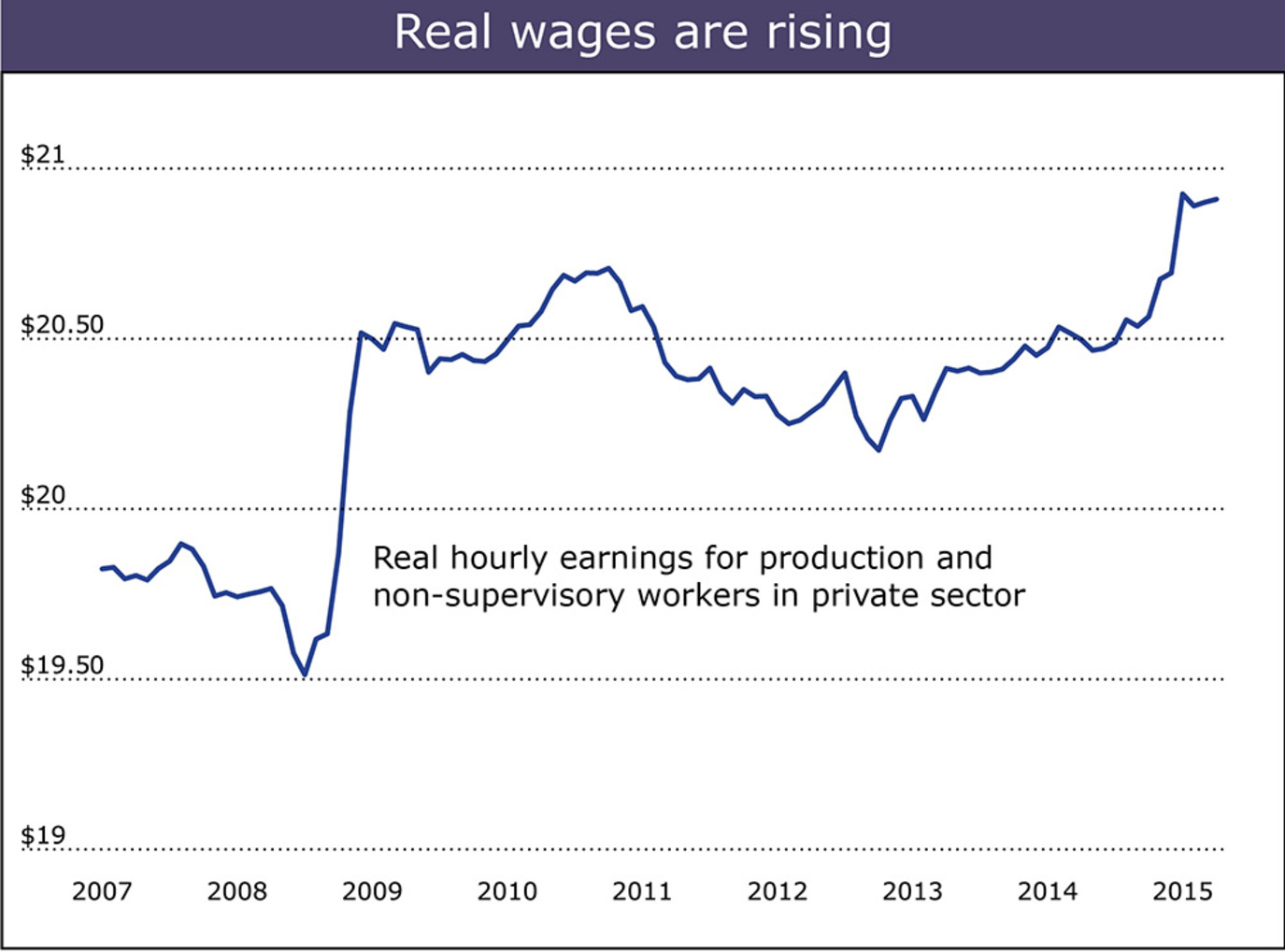
The average hourly real wage for this group since 2007 is shown below (converted to April 2015 dollars). The shape of this graph undoubtedly will surprise many readers given the widely held believe that the middle class has been falling behind economically.
 

GRAPH1

The average hourly real wage did decline during the “Great Recession” and again in 2011 and 2012, but since falling to its recent low of $20.17 in October 2012 it has increased, first at a modest pace and then more rapidly since September as price inflation disappeared.

Perhaps even more surprising for most people is that the average real wage for these employees is now at the highest level since March 1979, although it is still 8.2% below the all-time peak ($22.27) reached in January 1973.

The average real wage for middle-class workers declined during the second half of the 1970s, the 1980s and the first half of the 1990s, reaching a low of $17.97 in April 1995 (data go back to 1964). Since then, wages have tended to slowly increase, with the largest gains when price inflation disappears and the greatest losses occurring when it spikes upward.

Widespread gains

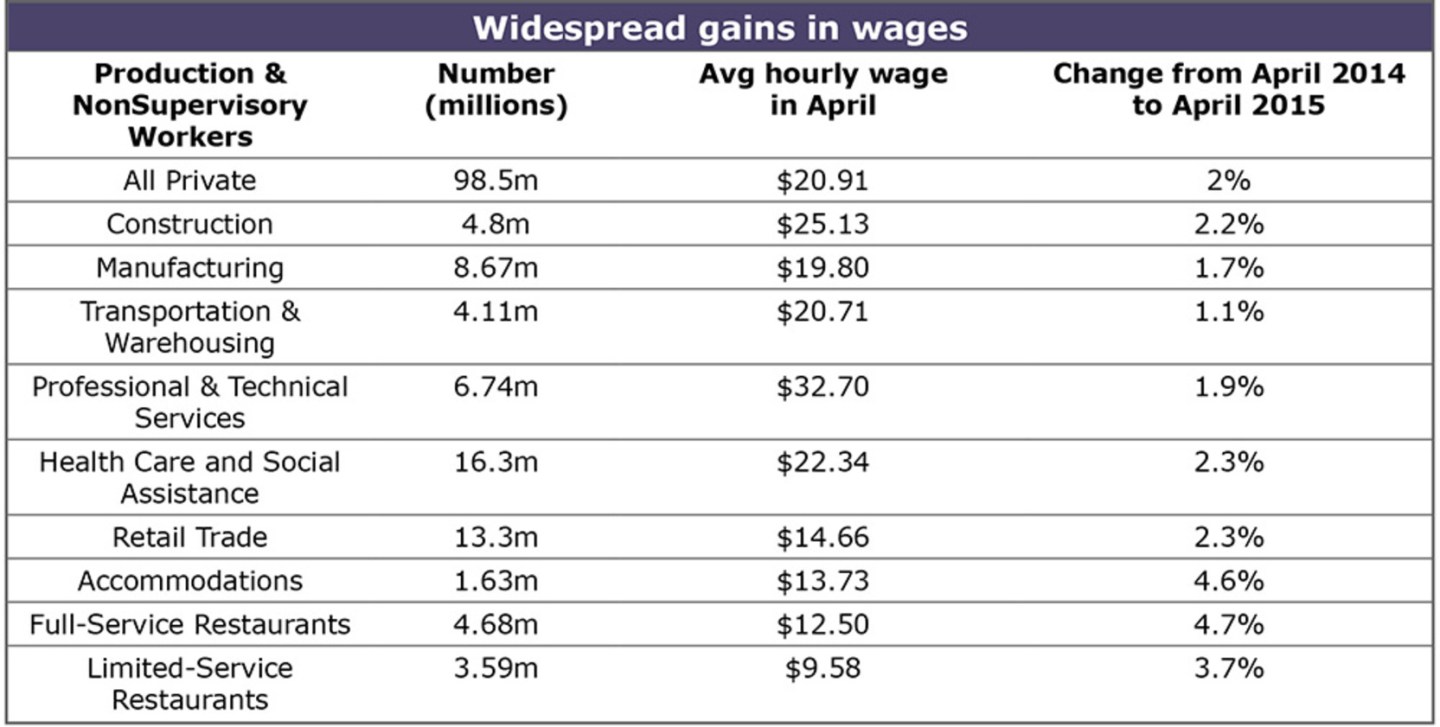
That brings us back to the most recent figures. During the 12 months through April, average hourly real earnings for production and non-supervisory workers increased by 2%. These wage gains are fairly widespread among industries, as is shown in this table.
 

GRAPH2

Moreover, the greatest wage gains occurred in some of the lowest-wage industries: in retail trade (up 2.3%), accommodations (4.6%), full-service restaurants (4.7%) and fast food restaurants (3.7%). Clearly some of the lowest-paid workers in America have enjoyed some very substantial real wage gains during the past year.

Real wage gains have also far outstripped productivity gains. From the first quarter of 2014 to the first quarter of this year (most recent data), labor productivity in the non-farm business sector increased by only 0.3%, compared with real wage growth of 1.9% for private sector production and non-supervisory workers over the same period.

The poor rate of productivity growth has been a feature of the current economic recovery. Over the past five years, from the first quarter of 2010 to the first quarter of 2015, output per labor hour has increased by only 2.8%, or 0.6% per year. Over the long run, productivity growth puts a cap on the maximum rate of growth in the real hourly wage rate – meaning if productivity doesn’t start rising, neither will wages.

Why real wage growth is poorly understood

So why are people so convinced that middle- and low-wage workers have been losing ground?

Many people point to the fact that the real hourly wage is less than it was in 1973, but that reflects the decline that occurred between 1973 and 1995. Since then, the average hourly wages have been on a slow upward trend, averaging 0.76% per year – not much, but positive all the same. And as I’ve shown, those gains accelerated in the past year year, with even larger ones in lower-wage industries.

Perhaps the recent wage gains have yet to sink into people’s consciousness, and thus their assessment of the economy will shortly improve. Also, millions of people are still unemployed or have dropped out of the labor force, and their income has not benefited from the increase in average wages.

Or perhaps people are unhappy because they are comparing their financial situation with higher-income households, who have done even better, although income inequality is only slightly worse than it was in 2000, when the middle class seemed much happier (see the excellent work of Berkeley’s Emmanuel Saez).

Or maybe it’s something as simple as our spending desires outpacing the growth in the real wage rate. People clearly were spending a lot of borrowed money through 2007, when the financial crisis sharply curtailed many people’s ability to borrow and spend.

What I do know, however, is that unless productivity growth improves, the real wage gains that the data show will prove fleeting. And then we really will be in a world of hurt.

Donald R. Grimes is a senior research associate at the Institute for Research on labor, employment and the economy at University of Michigan. This article was originally published on The Conversation. Read the original article.


About the Author
By Donald R. Grimes
See full bioRight Arrow Button Icon
Add Fortune on Google for similar content.

Latest in Commentary

Finance
Lorem ipsum dolor sit amet, consectetur adipiscing elit, sed do eiusmod tempor incididunt ut labore et dolore magna aliqua. Ut enim ad minim veniam
By Fortune Editors
October 20, 2025
Finance
Lorem ipsum dolor sit amet, consectetur adipiscing elit, sed do eiusmod tempor incididunt ut labore et dolore magna aliqua. Ut enim ad minim veniam
By Fortune Editors
October 20, 2025
Finance
Lorem ipsum dolor sit amet, consectetur adipiscing elit, sed do eiusmod tempor incididunt ut labore et dolore magna aliqua. Ut enim ad minim veniam
By Fortune Editors
October 20, 2025
Finance
Lorem ipsum dolor sit amet, consectetur adipiscing elit, sed do eiusmod tempor incididunt ut labore et dolore magna aliqua. Ut enim ad minim veniam
By Fortune Editors
October 20, 2025
Finance
Lorem ipsum dolor sit amet, consectetur adipiscing elit, sed do eiusmod tempor incididunt ut labore et dolore magna aliqua. Ut enim ad minim veniam
By Fortune Editors
October 20, 2025
Finance
Lorem ipsum dolor sit amet, consectetur adipiscing elit, sed do eiusmod tempor incididunt ut labore et dolore magna aliqua. Ut enim ad minim veniam
By Fortune Editors
October 20, 2025

Most Popular

Finance
Lorem ipsum dolor sit amet, consectetur adipiscing elit, sed do eiusmod tempor incididunt ut labore et dolore magna aliqua. Ut enim ad minim veniam
By Fortune Editors
October 20, 2025
Finance
Lorem ipsum dolor sit amet, consectetur adipiscing elit, sed do eiusmod tempor incididunt ut labore et dolore magna aliqua. Ut enim ad minim veniam
By Fortune Editors
October 20, 2025
Finance
Lorem ipsum dolor sit amet, consectetur adipiscing elit, sed do eiusmod tempor incididunt ut labore et dolore magna aliqua. Ut enim ad minim veniam
By Fortune Editors
October 20, 2025
Finance
Lorem ipsum dolor sit amet, consectetur adipiscing elit, sed do eiusmod tempor incididunt ut labore et dolore magna aliqua. Ut enim ad minim veniam
By Fortune Editors
October 20, 2025
Finance
Lorem ipsum dolor sit amet, consectetur adipiscing elit, sed do eiusmod tempor incididunt ut labore et dolore magna aliqua. Ut enim ad minim veniam
By Fortune Editors
October 20, 2025
Finance
Lorem ipsum dolor sit amet, consectetur adipiscing elit, sed do eiusmod tempor incididunt ut labore et dolore magna aliqua. Ut enim ad minim veniam
By Fortune Editors
October 20, 2025
Fortune Secondary Logo
Rankings
  • 100 Best Companies
  • Fortune 500
  • Global 500
  • Fortune 500 Europe
  • Most Powerful Women
  • World's Most Admired Companies
  • See All Rankings
  • Lists Calendar
Sections
  • Finance
  • Fortune Crypto
  • Features
  • Leadership
  • Health
  • Commentary
  • Success
  • Retail
  • Mpw
  • Tech
  • Lifestyle
  • CEO Initiative
  • Asia
  • Politics
  • Conferences
  • Europe
  • Newsletters
  • Personal Finance
  • Environment
  • Magazine
  • Education
Customer Support
  • Frequently Asked Questions
  • Customer Service Portal
  • Privacy Policy
  • Terms Of Use
  • Single Issues For Purchase
  • International Print
Commercial Services
  • Advertising
  • Fortune Brand Studio
  • Fortune Analytics
  • Fortune Conferences
  • Business Development
  • Group Subscriptions
About Us
  • About Us
  • Press Center
  • Work At Fortune
  • Terms And Conditions
  • Site Map
  • About Us
  • Press Center
  • Work At Fortune
  • Terms And Conditions
  • Site Map
  • Facebook icon
  • Twitter icon
  • LinkedIn icon
  • Instagram icon
  • Pinterest icon

Latest in Commentary

senate
CommentaryCongress
One rare bipartisan AI bill is moving through Congress. Here’s why it deserves to pass
By Neil Björkman and Betsy BrewerJuly 1, 2026
9 hours ago
I know how Gen Z can survive the ‘jobpocalypse’ because I built an AI company — in 2015
CommentaryCareers
I know how Gen Z can survive the ‘jobpocalypse’ because I built an AI company — in 2015
By Jeremy FainJuly 1, 2026
10 hours ago
mr
Commentary250 Years of Innovation
America needs 3.8 million manufacturing workers. This CEO has a blueprint to find them
By Mark RayfieldJuly 1, 2026
10 hours ago
usa
Commentary250 Years of Innovation
America at 250: why the Constitution was built to restrain government, not celebrate majority rule
By Steve H. HankeJuly 1, 2026
10 hours ago
t
CommentaryMedia
Netflix could turn NBC into its biggest bet yet — and this time, the math actually works
By Jeffrey Sonnenfeld and Steven TianJune 30, 2026
1 day ago
wb
CommentaryLeadership
I grew BDO from $600 million to $3.4 billion. Here’s the 3-part formula that made it possible
By Wayne BersonJune 30, 2026
1 day ago

Most Popular

MacKenzie Scott alone accounted for one-third of America's $19.2 billion in megagifts last year
Success
MacKenzie Scott alone accounted for one-third of America's $19.2 billion in megagifts last year
By Sydney LakeJune 25, 2026
7 days ago
As Big Tech showers employees with perks to win the talent war, Nvidia built a nearly $5 trillion company by making people pay for their own lunch
Big Tech
As Big Tech showers employees with perks to win the talent war, Nvidia built a nearly $5 trillion company by making people pay for their own lunch
By Marco Quiroz-GutierrezJuly 1, 2026
13 hours ago
Philanthropy leader at Warren Buffett and Bill Gates’ Giving Pledge says children of billionaires are pushing them to give their wealth away faster
Success
Philanthropy leader at Warren Buffett and Bill Gates’ Giving Pledge says children of billionaires are pushing them to give their wealth away faster
By Preston ForeJune 27, 2026
4 days ago
Elon Musk on MacKenzie Scott giving away $26 billion of her fortune: 'Sadly,' it makes the world a worse place
Success
Elon Musk on MacKenzie Scott giving away $26 billion of her fortune: 'Sadly,' it makes the world a worse place
By Sydney LakeJune 29, 2026
2 days ago
The Supreme Court's birthright citizenship ruling hands the U.S. economy a $7.7 trillion win
Newsletters
The Supreme Court's birthright citizenship ruling hands the U.S. economy a $7.7 trillion win
By Diane BradyJuly 1, 2026
11 hours ago
The U.S. Army is opening military bases to private billions — here's why that changes everything for the next 250 years
Commentary
The U.S. Army is opening military bases to private billions — here's why that changes everything for the next 250 years
By Marc AndersenJune 30, 2026
1 day ago

© 2026 Fortune Media IP Limited. All Rights Reserved. Use of this site constitutes acceptance of our Terms of Use and Privacy Policy | CA Notice at Collection and Privacy Notice | Do Not Sell/Share My Personal Information
FORTUNE is a trademark of Fortune Media IP Limited, registered in the U.S. and other countries. FORTUNE may receive compensation for some links to products and services on this website. Offers may be subject to change without notice.