• Home
  • Latest
  • Fortune 500
  • Finance
  • Tech
  • Leadership
  • Lifestyle
  • Rankings
  • Multimedia
LeadershipFinancial Reform

A new Glass-Steagall for banks: One giant step for Congress, one small step for us all

By
Eleanor Bloxham
Eleanor Bloxham
Down Arrow Button Icon
By
Eleanor Bloxham
Eleanor Bloxham
Down Arrow Button Icon
July 20, 2015, 11:48 AM ET
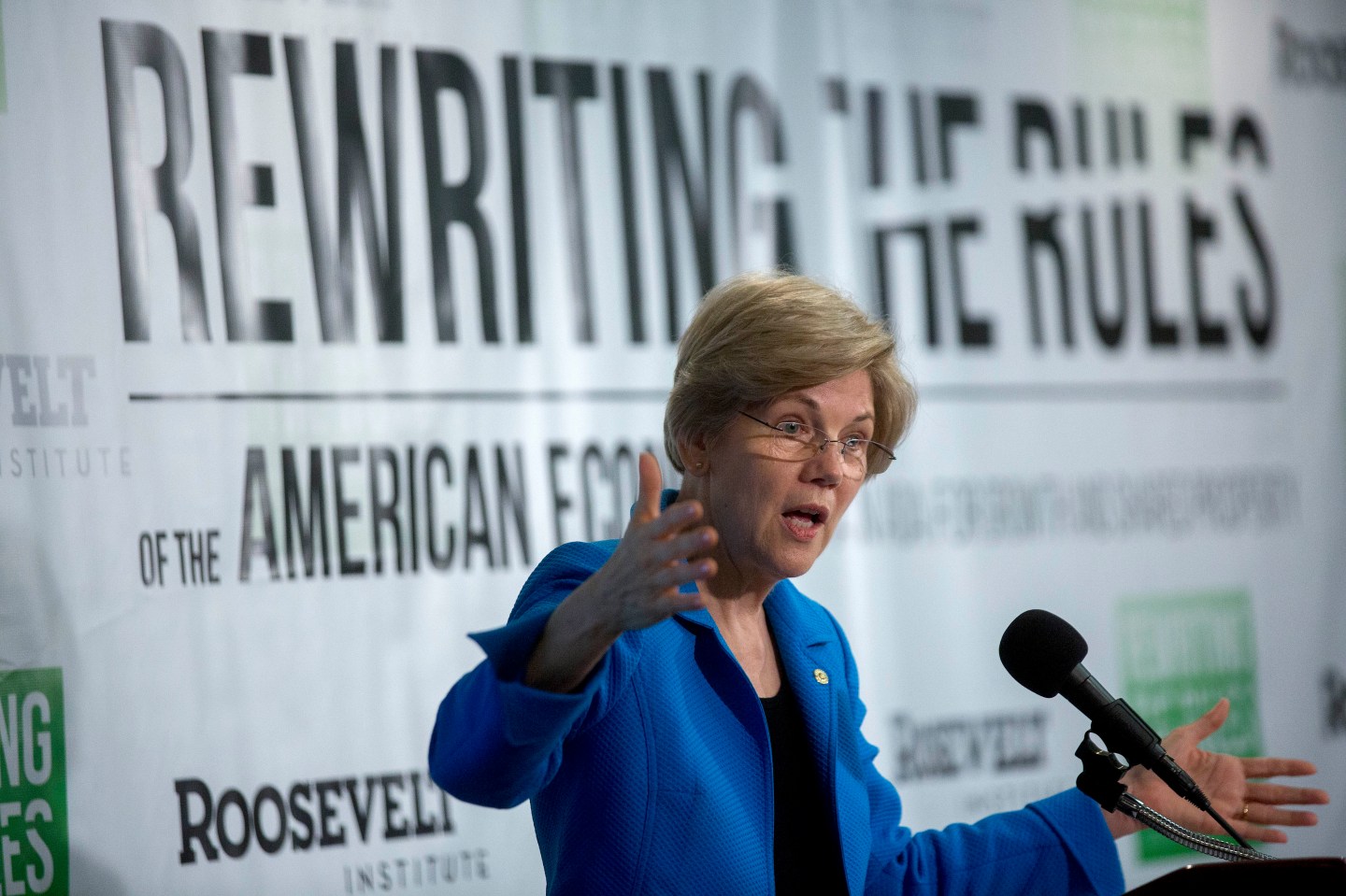
Senator Elizabeth Warren (D-Mass.) speaks during a Roosevelt Institute event at the National Press Club in Washington, D.C. on May 12.
Senator Elizabeth Warren (D-Mass.) speaks during a Roosevelt Institute event at the National Press Club in Washington, D.C. on May 12.Photograph by Andrew Harrer — Bloomberg via Getty Images

It looks like corporate governance just might be a hot topic for the Democratic presidential primary debates. Who’d have guessed?

Senators Elizabeth Warren, John McCain, Maria Cantwell, and Angus King have proposed a new Glass-Steagall bill. The measure would reinstate many of the features of the original Glass-Steagall banking act of 1933, a Depression-era law that prevented commercial banks from taking on business ordinarily done at investment banks. The new bill will also address risky activities that bankers had not dreamed up 80 years ago.

The new Glass-Steagall specifically addresses the governance of banks with insured deposits. The idea is that a bank should not use our deposits in ways that put the bank or the economy at undue risk.

The Democratic presidential candidates are taking sides in the debate. Bernie Sanders and Marvin O’Malley support a new Glass-Steagall. But, according to press reports last week, Hillary Clinton will not, even though the bill addresses the use of derivatives, something she expressed concerns about in November of 2007. Perhaps Clinton is looking ahead to the general elections. But if you are seeking election as a Democratic Party candidate, a failure to endorse Glass-Stegall could be a risky bet of its own—a gamble, perhaps, that money will trump voters in the upcoming Democratic primaries.

The reasons for the new bill are many. In addition to all the arguments of fairness and prudence, there are many practical, boots-on-the-ground reasons Congress should pass it now.

Boards of directors are responsible for setting the risk appetite of a company. And they can’t do that effectively in a firm with wildly different risk attributes. In the last eight years, post-financial crisis, boards at the largest banks that have both significant depository and investment banking arms have had the opportunity to show us they can excel at effectively managing this tricky balance—and they have failed to do that. J.P. Morgan’s (JPM) London Whale trading debacle was just one notable example. Post-crisis, the largest U.S. banks have treated us to a continual stream of operations failures and manipulations du jour. Earlier this month, one head of a systemically important financial institution (SIFI) expressed to me his astonishment at the ongoing ethical lapses. It is impossible to create the kind of safe banks we need as depository institutions if they also engage in unfettered speculation.

Regulators and others have continued to express concern about the cultures at the banks. William Dudley, president and CEO of the Federal Reserve Bank of New York spoke last year on “Enhancing Financial Stability by Improving Culture in the Financial Services Industry.”

Pre-crisis, I witnessed the way in which the mergers of traditional and investment banks created negative cultural shifts. At Citigroup (C), after the Salomon Smith-Barney merger, for example, the aggressive, transaction-oriented nature of investment banking began running roughshod over the more genteel business of corporate relationship management. As a result, relationships were out. Quick bucks were in. And along the way, the company lost one of its greatest attributes: a culture of strategic inquiry.

A recent survey supports the culture concerns. Fortune’s Stephen Gandel reported in May that according to a survey by law firm Labaton Sucharow and the University of Notre Dame, “About a third of Wall Streeter’s higher paid employees say they have witnessed or know of illegal activity at their firms. One in five of the survey’s respondents said they believed a little bending of the rules, either ethical or legal, was necessary to be successful on Wall Street.” And to boot, regulators may be completely in the dark. According to the survey, 25% of employees making over $500,000 believed they “have signed or have been asked to sign agreements with their employers banning them from reporting to regulators on illegal behavior they witness at their jobs.”

It’s true that when the financial crisis erupted in 2007, Glass-Steagall was not the first fix that leapt to my mind. I’d been warning since the late 1990s that loan securitizations were bad economic moves for commercial banks while lining the pockets of the investment banks that sold them. Those securitizations were fueling a risky lending boom without adding value to the economy. Commercial banks had poorly designed compensation programs that encouraged risky lending, loan sales, and securitization. Investment bankers were overpaid based on the value they created for customers. And some corporate treasurers and CFOs had only just begun to be leery of investment banking products, following purchases of derivatives and illiquid instruments that they and their boards did not understand.

Opponents of the new bill say the return of Glass-Steagall is not necessary. They argue variously that the 1999 repeal of the original bill did not single-handedly cause the last financial crisis or that it did not contribute to the crisis at all. But how relevant is that?

Analogizing, we can argue whether or not pollution has contributed to climate change, and how much, but we are still left with the harms of pollution and the realities of rising seas. Similarly, we can argue about whether, or how much, the repeal of Glass-Steagall contributed to the last crisis (Public Citizen’s Bart Naylor does a good job of this in his paper, “Safety Glass”), but that doesn’t absolve us of the responsibility to address the harms caused by its repeal—and the damages caused by the crisis.

Another line detractors use is that reinstating Glass-Steagall would actually make things worse. A Morningstar columnist wrote last week that if Glass-Steagall had been in place, Goldman Sachs (GS) and Morgan Stanley (MS) might have failed. Sure, investors in those stocks would have lost a lot of money, but why should their misfortune trump the fortunes of everyone else? In fact, all else being equal, if the board and investors of Goldman and Morgan Stanley really believed their firms could fail, they’d be more likely to encourage better risk management than if they didn’t. Why should society provide a smooth unwind and special access to liquidity to volatile trading firms?

In 2013, the economist Dean Baker wrote, “What is striking about the argument on re-instating Glass-Steagall is that there really is no downside. The banks argue that it will be inconvenient to separate their divisions, but companies sell off divisions all the time.”

The new Glass-Steagall is necessary but not sufficient. Its future, however, is uncertain. As Will Rogers famously remarked, “The short memories of the American voters is what keeps our politicians in office.”

Eleanor Bloxham is CEO of The Value Alliance and Corporate Governance Alliance (http://www.thevaluealliance.com), an independent board education and advisory firm she founded in 1999. She has been a regular contributor to Fortune since April 2010 and has advised analysts, regulators, shareholders and banks of every size on the economics of financial services.


About the Author
By Eleanor Bloxham
See full bioRight Arrow Button Icon

Latest in Leadership

Finance
Lorem ipsum dolor sit amet, consectetur adipiscing elit, sed do eiusmod tempor incididunt ut labore et dolore magna aliqua. Ut enim ad minim veniam
By Fortune Editors
October 20, 2025
Finance
Lorem ipsum dolor sit amet, consectetur adipiscing elit, sed do eiusmod tempor incididunt ut labore et dolore magna aliqua. Ut enim ad minim veniam
By Fortune Editors
October 20, 2025
Finance
Lorem ipsum dolor sit amet, consectetur adipiscing elit, sed do eiusmod tempor incididunt ut labore et dolore magna aliqua. Ut enim ad minim veniam
By Fortune Editors
October 20, 2025
Finance
Lorem ipsum dolor sit amet, consectetur adipiscing elit, sed do eiusmod tempor incididunt ut labore et dolore magna aliqua. Ut enim ad minim veniam
By Fortune Editors
October 20, 2025
Finance
Lorem ipsum dolor sit amet, consectetur adipiscing elit, sed do eiusmod tempor incididunt ut labore et dolore magna aliqua. Ut enim ad minim veniam
By Fortune Editors
October 20, 2025
Finance
Lorem ipsum dolor sit amet, consectetur adipiscing elit, sed do eiusmod tempor incididunt ut labore et dolore magna aliqua. Ut enim ad minim veniam
By Fortune Editors
October 20, 2025

Most Popular

Finance
Lorem ipsum dolor sit amet, consectetur adipiscing elit, sed do eiusmod tempor incididunt ut labore et dolore magna aliqua. Ut enim ad minim veniam
By Fortune Editors
October 20, 2025
Finance
Lorem ipsum dolor sit amet, consectetur adipiscing elit, sed do eiusmod tempor incididunt ut labore et dolore magna aliqua. Ut enim ad minim veniam
By Fortune Editors
October 20, 2025
Finance
Lorem ipsum dolor sit amet, consectetur adipiscing elit, sed do eiusmod tempor incididunt ut labore et dolore magna aliqua. Ut enim ad minim veniam
By Fortune Editors
October 20, 2025
Finance
Lorem ipsum dolor sit amet, consectetur adipiscing elit, sed do eiusmod tempor incididunt ut labore et dolore magna aliqua. Ut enim ad minim veniam
By Fortune Editors
October 20, 2025
Finance
Lorem ipsum dolor sit amet, consectetur adipiscing elit, sed do eiusmod tempor incididunt ut labore et dolore magna aliqua. Ut enim ad minim veniam
By Fortune Editors
October 20, 2025
Finance
Lorem ipsum dolor sit amet, consectetur adipiscing elit, sed do eiusmod tempor incididunt ut labore et dolore magna aliqua. Ut enim ad minim veniam
By Fortune Editors
October 20, 2025
Fortune Secondary Logo
Rankings
  • 100 Best Companies
  • Fortune 500
  • Global 500
  • Fortune 500 Europe
  • Most Powerful Women
  • Future 50
  • World’s Most Admired Companies
  • See All Rankings
Sections
  • Finance
  • Fortune Crypto
  • Features
  • Leadership
  • Health
  • Commentary
  • Success
  • Retail
  • Mpw
  • Tech
  • Lifestyle
  • CEO Initiative
  • Asia
  • Politics
  • Conferences
  • Europe
  • Newsletters
  • Personal Finance
  • Environment
  • Magazine
  • Education
Customer Support
  • Frequently Asked Questions
  • Customer Service Portal
  • Privacy Policy
  • Terms Of Use
  • Single Issues For Purchase
  • International Print
Commercial Services
  • Advertising
  • Fortune Brand Studio
  • Fortune Analytics
  • Fortune Conferences
  • Business Development
  • Group Subscriptions
About Us
  • About Us
  • Editorial Calendar
  • Press Center
  • Work At Fortune
  • Diversity And Inclusion
  • Terms And Conditions
  • Site Map
  • About Us
  • Editorial Calendar
  • Press Center
  • Work At Fortune
  • Diversity And Inclusion
  • Terms And Conditions
  • Site Map
  • Facebook icon
  • Twitter icon
  • LinkedIn icon
  • Instagram icon
  • Pinterest icon

Latest in Leadership

Microsoft just turned 51. Here’s a look at an iconic 1978 photo of its first employees and where they are now
Big TechMicrosoft
Microsoft just turned 51. Here’s a look at an iconic 1978 photo of its first employees and where they are now
By Marco Quiroz-GutierrezApril 4, 2026
58 minutes ago
stressed student
Personal FinanceColleges and Universities
College grads in ‘AI-proof’ careers like psychology and education are seeing negative returns on their degrees
By Jake AngeloApril 4, 2026
1 hour ago
Delta CEO Ed Bastian
Successsuccess
How Delta uses Tom Brady to train its 100,000 workforce on leadership and a winner’s mindset
By Emma BurleighApril 4, 2026
2 hours ago
Scott Kupor sits at a table gesturing with both hands.
PoliticsLabor
The Trump administration is blurring the public and private sector workforce, and OPM director Scott Kupor won’t rule out conflict of interest risks
By Sasha RogelbergApril 4, 2026
3 hours ago
alex
AIInfrastructure
AI’s next frontier is the real world
By Alex IsraelApril 4, 2026
3 hours ago
workers
AIdisruption
A Yale economist says AGI won’t automate most jobs—because they’re not worth the trouble
By Nick LichtenbergApril 4, 2026
4 hours ago

Most Popular

Google CEO Sundar Pichai says we’re just a decade away from a new normal of extraterrestrial data centers
Innovation
Google CEO Sundar Pichai says we’re just a decade away from a new normal of extraterrestrial data centers
By Fortune EditorsApril 3, 2026
1 day ago
Gen Z fled San Francisco for Texas and Florida. Now they’re turning ‘welcomer cities’ into the next big tech towns
Real Estate
Gen Z fled San Francisco for Texas and Florida. Now they’re turning ‘welcomer cities’ into the next big tech towns
By Fortune EditorsApril 2, 2026
2 days ago
The Walmart billionaires next door: Quiet backlash is brewing against the heirs who remade the retailer’s hometown
Magazine
The Walmart billionaires next door: Quiet backlash is brewing against the heirs who remade the retailer’s hometown
By Fortune EditorsApril 3, 2026
1 day ago
Major 4-day workweek study suggests that when we work 5 days we spend one doing basically nothing
Success
Major 4-day workweek study suggests that when we work 5 days we spend one doing basically nothing
By Fortune EditorsApril 2, 2026
2 days ago
Current price of oil as of April 3, 2026
Personal Finance
Current price of oil as of April 3, 2026
By Fortune EditorsApril 3, 2026
23 hours ago
Current price of silver as of Friday, April 3, 2026
Personal Finance
Current price of silver as of Friday, April 3, 2026
By Fortune EditorsApril 3, 2026
24 hours ago

© 2026 Fortune Media IP Limited. All Rights Reserved. Use of this site constitutes acceptance of our Terms of Use and Privacy Policy | CA Notice at Collection and Privacy Notice | Do Not Sell/Share My Personal Information
FORTUNE is a trademark of Fortune Media IP Limited, registered in the U.S. and other countries. FORTUNE may receive compensation for some links to products and services on this website. Offers may be subject to change without notice.