• Home
  • Latest
  • Fortune 500
  • Finance
  • Tech
  • Leadership
  • Lifestyle
  • Rankings
  • Multimedia

Trendingnow

1

Shark Tank's Kevin O'Leary says if he were 25 today, he'd chase these two booming opportunities in the world of AI

2

Even as Elon Musk calls philanthropy ‘very hard,’ everyday Americans gave a record $617 billion—despite feeling the squeeze over the cost of living

3

The stock market is about to suffer a 'snapback' and will lose much of this year's gains as 'speculation is hitting extreme levels,' BofA warns

1

Shark Tank's Kevin O'Leary says if he were 25 today, he'd chase these two booming opportunities in the world of AI

2

Even as Elon Musk calls philanthropy ‘very hard,’ everyday Americans gave a record $617 billion—despite feeling the squeeze over the cost of living

3

The stock market is about to suffer a 'snapback' and will lose much of this year's gains as 'speculation is hitting extreme levels,' BofA warns
Commentary

What internationalization of China’s yuan means for the world economy

By
Linda Lim
Linda Lim
and
Bethany Cianciolo
Bethany Cianciolo
Down Arrow Button Icon
By
Linda Lim
Linda Lim
and
Bethany Cianciolo
Bethany Cianciolo
Down Arrow Button Icon
November 2, 2015, 11:23 AM ET
Photograph by Lucas Schifres — Getty Images
Add Fortune on Google for similar content.

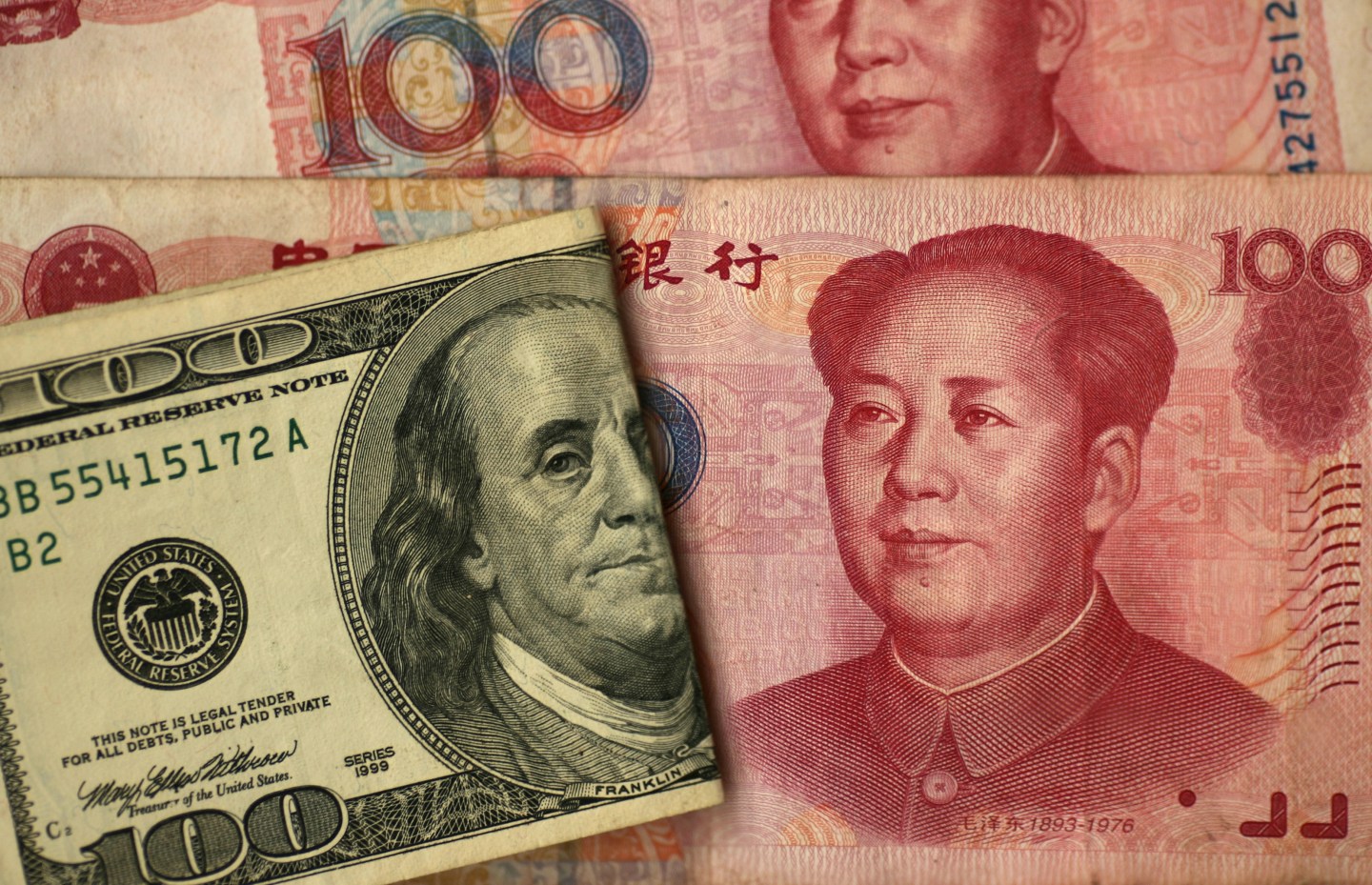
China’s currency, the yuan, recently (and briefly) became the world’s fourth-most-used form of payment, behind the U.S. dollar, euro and pound sterling, having (marginally) pushed past the Japanese yen.

Last week, China’s central bank discussed whether to make an explicit pledge to dismantle the capital controls that prevent the yuan from becoming fully convertible with other currencies at rates determined by the market.

Does all this mean the yuan’s heyday has finally arrived? Hardly.

As we will see, there is less significance to this phenomenon — and talk of the yuan becoming an “official IMF reserve currency” — than media headlines suggest.

A drop in the bucket

The yuan still accounts for a small fraction of world payments, 2.45%, to be precise in September after edging up to 2.79% — and fourth place — a month earlier. This is less than a third of the pound’s 9% share, a tenth of the euro’s 29% and a drop in the bucket of the dollar’s 43%.

Another measure of a currency’s international prevalence is in foreign exchange reserves, which result from the accumulation of export surpluses.

The yuan accounts for just 1% of other countries’ allocated reserves, compared with 64% for the dollar, even though China accounts for the same share of world trade (about 12%) as the U.S.

In other words, the yuan is underrepresented in payments and reserves relative to its share of world trade, while the dollar is similarly overrepresented, due to the popularity among investors and governments of the U.S.’ broad, liquid and secure capital markets.

Market forces alone should lead one to expect the yuan’s share to rise and the dollar’s to fall over time.

Matching the currency used in payments and receipts in trade and investment reduces transaction costs, currency risk and volatility exposure, so more people will want to use the yuan as their transactions with China increase.

A shift away from trade

China’s share of world GDP (13.3% in nominal terms as of 2014) will likely rise as its economy continues to outpace the average of other large economies. But use of the yuan for payments and reserves may increase at a slower pace as China shifts away from an economy fueled by trade.

This is because China plans to reduce its reliance on export-led growth and increase domestic consumption as a share of GDP (which is currently very low).

Though there are few signs of this happening so far, the plan, if successful, means that trade as a share of GDP will begin to shrink. And that will likely mean slower growth in use of the yuan than in the recent past.

The difficult road to becoming a reserve currency

To become an “official” IMF-endorsed “reserve currency,” China has to meet various criteria that would make the yuan “freely usable”: that is, readily bought and sold by anyone at any time.

These criteria include a market-determined interest rate, exchange rate flexibility and convertibility, a more open capital account, and a significant share of official reserves, international banking liabilities and global debt securities. While many steps have been taken in these directions, including very recently, none of these criteria is close to being fully achieved.

All this requires politically and technically difficult domestic financial market reforms and liberalization. Such reforms reduce the government’s ability to establish policies that reduce volatility and encourage growth. That’s because of what is known as the “trilemma” of international finance, in which only two of the three goals of monetary policy — control of interest rates, exchange rate flexibility and capital mobility – can be achieved at the same time.

Market manipulations

The Chinese government’s own reactions to this past summer’s financial market turmoil suggest that it is not ready to undertake or complete many of the required reforms.

Its interventions show that it is not yet willing to allow market forces to rule in its currency and financial markets. This includes its effort to halt the precipitous decline of an overvalued stock market — which it itself had previously boosted — and to devalue the yuan by the largest amount in two decades.

Trust must be earned

Even if the IMF designates the yuan as a reserve currency, this does not mean that its use as such will rise quickly or greatly. World central banks and individual investors will only increase their use and holdings of yuan if they have confidence in the currency.

And that won’t happen until Chinese financial markets develop the depth, diversity, transparency and security that have kept the dollar reigning supreme as the world’s preferred reserve currency, even as the U.S. share of global trade and investment has declined.

Governments are understandably reluctant to hold reserves in a politically managed rather than market-determined currency.

The trust of market actors has to be earned over time and cannot be merely conferred by an international body like the IMF.

Benefits and disadvantages

There are some benefits when a currency becomes more widely used in the global monetary system — its “internationalization” — regardless of whether it gets the IMF’s imprimatur.

One benefit is “seignorage,” which is the revenue the issuer gets from the value of a currency over and above the cost of producing it. Others include a looser (more stimulative) monetary policy, enabling (marginally) faster growth, and the ability to borrow and invest internationally in one’s own currency, thus avoiding currency risk.

But there are also disadvantages, including losing control over the effectiveness of monetary policy and exposing the domestic economy to destabilizing (and increasingly volatile) global capital flows.

This is why small open economies like Singapore and Switzerland, whose currencies are popular with international investors, have long resisted internationalization. In contrast, China seems to regard reserve currency status as desirable for its own sake, as a “status good” conferring an assumed prestige that it craves.

In the longer run, both China and the world economy stand to gain from increased international use of the yuan. China will benefit from the domestic financial market reforms that internationalization will require, and the rest of the world will get a more diverse basket of currencies to choose from to finance trade and investment and hold reserves, reducing the current overdependence on the U.S. dollar.

This should also help us avoid the chronic and excessive trade and financial imbalances among countries.

But before we can get there, China needs to follow through on major reforms of its domestic financial system, which will not be quick, easy or certain.

Linda Lim is a professor of strategy at the University of Michigan. This piece was originally published on The Conversation.


The Conversation

About the Authors
By Linda Lim
See full bioRight Arrow Button Icon
By Bethany Cianciolo
See full bioRight Arrow Button Icon
Add Fortune on Google for similar content.

Latest in Commentary

Finance
Lorem ipsum dolor sit amet, consectetur adipiscing elit, sed do eiusmod tempor incididunt ut labore et dolore magna aliqua. Ut enim ad minim veniam
By Fortune Editors
October 20, 2025
Finance
Lorem ipsum dolor sit amet, consectetur adipiscing elit, sed do eiusmod tempor incididunt ut labore et dolore magna aliqua. Ut enim ad minim veniam
By Fortune Editors
October 20, 2025
Finance
Lorem ipsum dolor sit amet, consectetur adipiscing elit, sed do eiusmod tempor incididunt ut labore et dolore magna aliqua. Ut enim ad minim veniam
By Fortune Editors
October 20, 2025
Finance
Lorem ipsum dolor sit amet, consectetur adipiscing elit, sed do eiusmod tempor incididunt ut labore et dolore magna aliqua. Ut enim ad minim veniam
By Fortune Editors
October 20, 2025
Finance
Lorem ipsum dolor sit amet, consectetur adipiscing elit, sed do eiusmod tempor incididunt ut labore et dolore magna aliqua. Ut enim ad minim veniam
By Fortune Editors
October 20, 2025
Finance
Lorem ipsum dolor sit amet, consectetur adipiscing elit, sed do eiusmod tempor incididunt ut labore et dolore magna aliqua. Ut enim ad minim veniam
By Fortune Editors
October 20, 2025

Most Popular

Finance
Lorem ipsum dolor sit amet, consectetur adipiscing elit, sed do eiusmod tempor incididunt ut labore et dolore magna aliqua. Ut enim ad minim veniam
By Fortune Editors
October 20, 2025
Finance
Lorem ipsum dolor sit amet, consectetur adipiscing elit, sed do eiusmod tempor incididunt ut labore et dolore magna aliqua. Ut enim ad minim veniam
By Fortune Editors
October 20, 2025
Finance
Lorem ipsum dolor sit amet, consectetur adipiscing elit, sed do eiusmod tempor incididunt ut labore et dolore magna aliqua. Ut enim ad minim veniam
By Fortune Editors
October 20, 2025
Finance
Lorem ipsum dolor sit amet, consectetur adipiscing elit, sed do eiusmod tempor incididunt ut labore et dolore magna aliqua. Ut enim ad minim veniam
By Fortune Editors
October 20, 2025
Finance
Lorem ipsum dolor sit amet, consectetur adipiscing elit, sed do eiusmod tempor incididunt ut labore et dolore magna aliqua. Ut enim ad minim veniam
By Fortune Editors
October 20, 2025
Finance
Lorem ipsum dolor sit amet, consectetur adipiscing elit, sed do eiusmod tempor incididunt ut labore et dolore magna aliqua. Ut enim ad minim veniam
By Fortune Editors
October 20, 2025
Fortune Secondary Logo
Rankings
  • 100 Best Companies
  • Fortune 500
  • Global 500
  • Fortune 500 Europe
  • Most Powerful Women
  • World's Most Admired Companies
  • See All Rankings
  • Lists Calendar
Sections
  • Finance
  • Fortune Crypto
  • Features
  • Leadership
  • Health
  • Commentary
  • Success
  • Retail
  • Mpw
  • Tech
  • Lifestyle
  • CEO Initiative
  • Asia
  • Politics
  • Conferences
  • Europe
  • Newsletters
  • Personal Finance
  • Environment
  • Magazine
  • Education
Customer Support
  • Frequently Asked Questions
  • Customer Service Portal
  • Privacy Policy
  • Terms Of Use
  • Single Issues For Purchase
  • International Print
Commercial Services
  • Advertising
  • Fortune Brand Studio
  • Fortune Analytics
  • Fortune Conferences
  • Business Development
  • Group Subscriptions
About Us
  • About Us
  • Press Center
  • Work At Fortune
  • Terms And Conditions
  • Site Map
  • About Us
  • Press Center
  • Work At Fortune
  • Terms And Conditions
  • Site Map
  • Facebook icon
  • Twitter icon
  • LinkedIn icon
  • Instagram icon
  • Pinterest icon

Latest in Commentary

t
CommentaryParenting
Babylist CEO: The Trump Accounts gold rush is overlooking moms
By Natalie GordonJuly 6, 2026
3 hours ago
e
CommentaryCorporate Governance
SpaceX’s supervoting shares put a decades-old governance debate back in play
By Jeffrey Sonnenfeld and Steven TianJuly 6, 2026
4 hours ago
katie
CommentaryData centers
Katie McGinty: The energy economy’s biggest waste problem is already inside the system
By Kathleen “Katie” McGintyJuly 6, 2026
11 hours ago
cc
CommentaryEducation
Former Trump official: Washington finally let Pell Grants pay for welding school, then buried the idea in 85 pages of red tape
By Caroline CasagrandeJuly 6, 2026
13 hours ago
k
CommentaryBox office
How Hollywood’s youngest filmmakers are exposing Gen Z’s real problem with AI
By Reid LitmanJuly 5, 2026
1 day ago
k
Commentary250 Years of Innovation
Media leadership unity in defying Trump’s assault on free speech: standing tall against historic comparisons
By Jeffrey Sonnenfeld, Jeff Bewkes, Kay Koplovitz, Tom Glocer and Marvin KalbJuly 4, 2026
2 days ago

Most Popular

Shark Tank's Kevin O'Leary says if he were 25 today, he'd chase these two booming opportunities in the world of AI
AI
Shark Tank's Kevin O'Leary says if he were 25 today, he'd chase these two booming opportunities in the world of AI
By Marco Quiroz-GutierrezJuly 5, 2026
1 day ago
Even as Elon Musk calls philanthropy ‘very hard,’ everyday Americans gave a record $617 billion—despite feeling the squeeze over the cost of living
Success
Even as Elon Musk calls philanthropy ‘very hard,’ everyday Americans gave a record $617 billion—despite feeling the squeeze over the cost of living
By Preston ForeJuly 4, 2026
3 days ago
The stock market is about to suffer a 'snapback' and will lose much of this year's gains as 'speculation is hitting extreme levels,' BofA warns
Investing
The stock market is about to suffer a 'snapback' and will lose much of this year's gains as 'speculation is hitting extreme levels,' BofA warns
By Jason MaJuly 5, 2026
1 day ago
Egg companies made $1.22 billion in profit off a $6 carton — now they’re buying their way out of a price-fixing case with 53 million donated eggs
Law
Egg companies made $1.22 billion in profit off a $6 carton — now they’re buying their way out of a price-fixing case with 53 million donated eggs
By Wyatte Grantham-Philips and The Associated PressJuly 2, 2026
4 days ago
Gen Z was 'jaded about employment before we ever entered the workforce'—now psychologists say the stare has hardened into something worse
Economy
Gen Z was 'jaded about employment before we ever entered the workforce'—now psychologists say the stare has hardened into something worse
By Nick LichtenbergJuly 6, 2026
15 hours ago
Meet the Zillennials: The luckiest micro-generation in the workforce, born between 1993 and 1998
AI
Meet the Zillennials: The luckiest micro-generation in the workforce, born between 1993 and 1998
By Nick LichtenbergJuly 3, 2026
4 days ago

© 2026 Fortune Media IP Limited. All Rights Reserved. Use of this site constitutes acceptance of our Terms of Use and Privacy Policy | CA Notice at Collection and Privacy Notice | Do Not Sell/Share My Personal Information
FORTUNE is a trademark of Fortune Media IP Limited, registered in the U.S. and other countries. FORTUNE may receive compensation for some links to products and services on this website. Offers may be subject to change without notice.