• Home
  • Latest
  • Fortune 500
  • Finance
  • Tech
  • Leadership
  • Lifestyle
  • Rankings
  • Multimedia

Exclusive

An hour in the Oval Office with President Trump Fortune Editor-in-Chief: Alyson Shontell sat down with President Trump in the Oval Office for an hour. Tariffs, Intel, AI, Boeing, Iran—and the question every CEO eventually has to answer: who's next?

An hour in the Oval Office with President Trump Fortune Editor-in-Chief: Alyson Shontell sat down with President Trump in the Oval Office for an hour. Tariffs, Intel, AI, Boeing, Iran—and the question every CEO eventually has to answer: who's next?

An hour in the Oval Office with President Trump Fortune Editor-in-Chief: Alyson Shontell sat down with President Trump in the Oval Office for an hour. Tariffs, Intel, AI, Boeing, Iran—and the question every CEO eventually has to answer: who's next?

An hour in the Oval Office with President Trump Fortune Editor-in-Chief: Alyson Shontell sat down with President Trump in the Oval Office for an hour. Tariffs, Intel, AI, Boeing, Iran—and the question every CEO eventually has to answer: who's next?

An hour in the Oval Office with President Trump Fortune Editor-in-Chief: Alyson Shontell sat down with President Trump in the Oval Office for an hour. Tariffs, Intel, AI, Boeing, Iran—and the question every CEO eventually has to answer: who's next?

An hour in the Oval Office with President Trump Fortune Editor-in-Chief: Alyson Shontell sat down with President Trump in the Oval Office for an hour. Tariffs, Intel, AI, Boeing, Iran—and the question every CEO eventually has to answer: who's next?

An hour in the Oval Office with President Trump Fortune Editor-in-Chief: Alyson Shontell sat down with President Trump in the Oval Office for an hour. Tariffs, Intel, AI, Boeing, Iran—and the question every CEO eventually has to answer: who's next?

An hour in the Oval Office with President Trump Fortune Editor-in-Chief: Alyson Shontell sat down with President Trump in the Oval Office for an hour. Tariffs, Intel, AI, Boeing, Iran—and the question every CEO eventually has to answer: who's next?

An hour in the Oval Office with President Trump Fortune Editor-in-Chief: Alyson Shontell sat down with President Trump in the Oval Office for an hour. Tariffs, Intel, AI, Boeing, Iran—and the question every CEO eventually has to answer: who's next?

An hour in the Oval Office with President Trump Fortune Editor-in-Chief: Alyson Shontell sat down with President Trump in the Oval Office for an hour. Tariffs, Intel, AI, Boeing, Iran—and the question every CEO eventually has to answer: who's next?

FinanceInvestors Guide

Why Time is Running Out for the Oil Giants

By
Cyrus Sanati
Cyrus Sanati
Down Arrow Button Icon
By
Cyrus Sanati
Cyrus Sanati
Down Arrow Button Icon
December 4, 2015, 3:22 PM ET
Fracking In California Under Spotlight As Some Local Municipalities Issue Bans
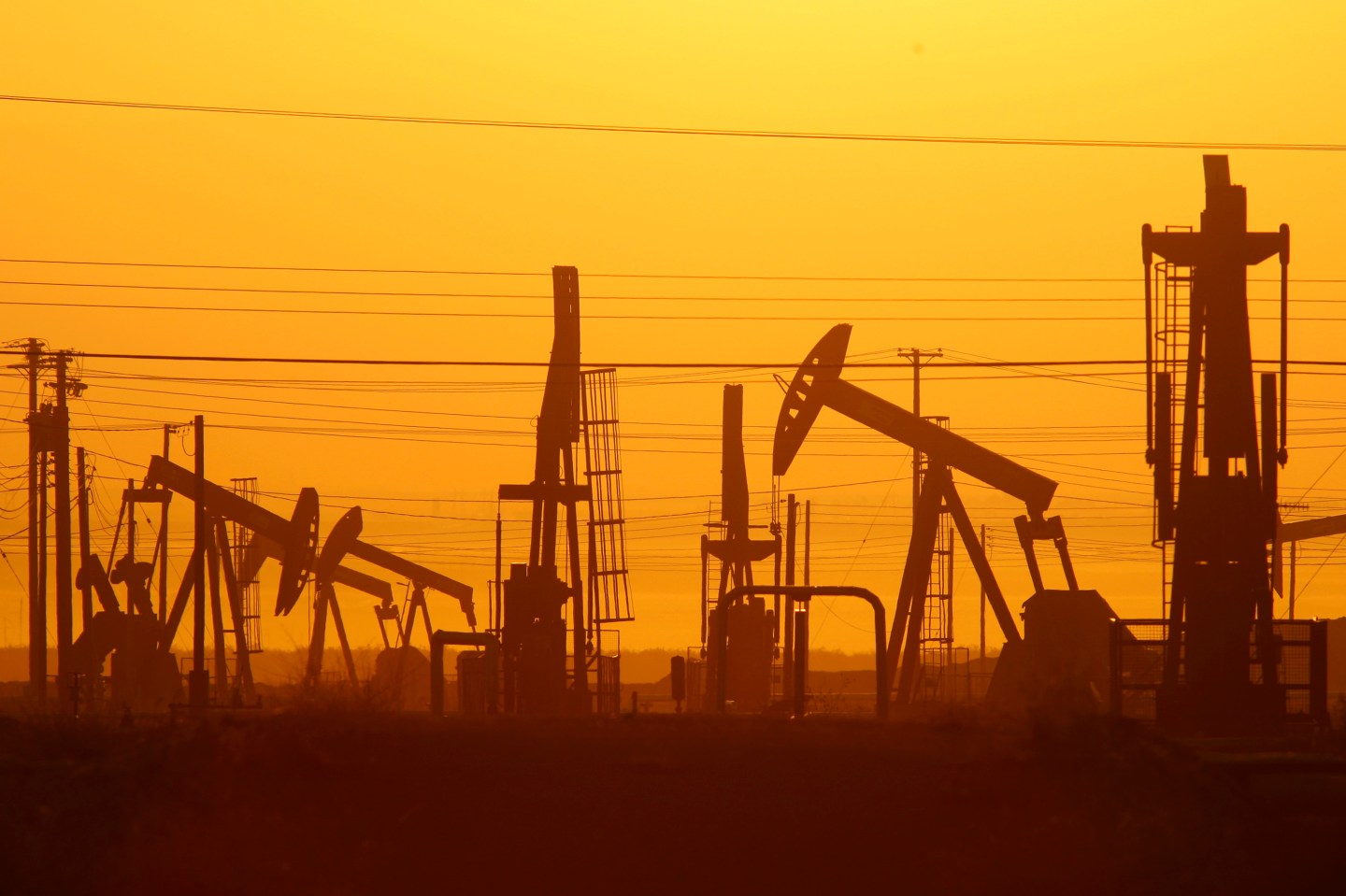
LOST HILLS, CA - MARCH 24: Pump jacks are seen at dawn in an oil field over the Monterey Shale formation where gas and oil extraction using hydraulic fracturing, or fracking, is on the verge of a boom on March 24, 2014 near Lost Hills, California. Critics of fracking in California cite concerns over water usage and possible chemical pollution of ground water sources as California farmers are forced to leave unprecedented expanses of fields fallow in one of the worst droughts in California history. Concerns also include the possibility of earthquakes triggered by the fracking process which injects water, sand and various chemicals under high pressure into the ground to break the rock to release oil and gas for extraction though a well. The 800-mile-long San Andreas Fault runs north and south on the western side of the Monterey Formation in the Central Valley and is thought to be the most dangerous fault in the nation. Proponents of the fracking boom saying that the expansion of petroleum extraction is good for the economy and security by developing more domestic energy sources and increasing gas and oil exports. (Photo by David McNew/Getty Images)Photo by David McNew via Getty Images

Time may be almost up for America’s beleaguered and highly-leveraged energy industry.

Consolidation, hostile takeovers, bankruptcies, decreased production, MLP implosions, massive layoffs, and crashing asset prices are all on the agenda for 2016 now that Opec failed to agree to any meaningful production cuts at the oil cartel’s semi-annual meeting in Vienna on Friday. Talk of a possible cut in Saudi oil production yesterday turned out to be nothing more than a bullish fantasy. The Kingdom has neither the need nor the desire to cut its production and will continue with the so-called “lower for longer” strategy until it achieves its ultimate goal of securing oil’s future in the world energy mix.

It’s been over a year now since Saudi Arabia started flooding the international oil markets with cheap crude, sending oil prices crashing across the globe. Despite that, the US energy industry held up in 2015. The thanks most goes to Wall Street. Unlike in the 1980s, producers in the past decade or so have had access to an array of financing and hedging options designed to keep them pumping in times of trouble.

For example, many energy companies this time around hedged, or sold forward, a large amount of their future production back when oil prices were much higher. They did this by entering into swap agreements with the big banks, like JPMorgan, Citigroup, Morgan Stanley and Goldman Sachs, which took the other side of the bet. This has provided a cushion to lower revenues, allowing oil companies to continue producing even in a low oil price environment. Another big change is the availability of capital. Energy companies have access to a gusher of yield-hungry private capital that simply wasn’t available to them thirty years ago. Securitization and junk bonds have opened the energy market to many new investors, making them less reliant on bank funding.

But Wall Street can’t save the energy industry all on its own. It has bought it some time, but bankers can’t force the Saudis to pump less oil or push the Chinese to import more of it. Eventually, all the easy private equity cash will dry up and the hedges will roll off, leaving the industry totally exposed to market prices.

Indeed, oil companies have hedged only 11% of next year’s production, according to a recent study of 48 firms published by IHS Energy, a consultancy. That’s down from the current five-year average of around 60%. Those companies buying hedges for next year are currently locking in prices in and around $50 a barrel, a trader with knowledge of the market told Fortune. That stands in stark contrast to the $80 to $100 a barrel hedges that protected oil companies earlier this year.

We are also seeing some desperate cost cutting moves in the oil patch. For example, last week, Schlumberger (SLB), the largest oilfield service provider, told oilfield equipment makers they were retroactively applying a 10% discount to all invoices received after October 1st, according to an email sent to a supplier, which was reviewed by Fortune. It is one thing to renegotiate the terms of a contract for future services, but it’s quite another to unilaterally change payment terms for services already rendered. Schlumberger offered their suppliers a couple of other options, but the theme was the same – less money for the same work.

The letter implies that Schlumberger has come under intense pressure from its customers (the oil companies) to cut its prices. That makes sense when you start to crack open the financials for some of these companies. What will strike you first off the bat is their cash flow–or the lack of it. At the end of the second quarter of this year, some 44 producers with heavy exposure to the shale industry, spent an average of 83 cents out of every dollar they took in on debt repayment, according to a recent analysis conducted by the Energy Information Agency, the statistical arm of the US Department of Energy. That compares to 58 cents of every dollar spent during the same time last year and about 44 cents in early 2012.

Ultimately, it will be debt that does the industry in–there is simply too much of it out there. In the last five years, oil producers have issued more than $250 billion worth of risky junk bonds to fuel its ambitions. That money is now helping to keep the industry on life support but things aren’t looking good. The number of energy companies filing for bankruptcy has grown every quarter in 2015 and will continue to grow through 2016.

So what will this debt-fueled apocalypse look like? Take Samson Resources, an oil producer backed by private equity giant KKR. Samson filed for bankruptcy in September looking to restructure some $3.25 billion worth of debt. Much of that debt originates from the $7.2 billion leverage buyout of the company, which was led by KKR back in 2011. KKR’s valuation models clearly didn’t take into account oil prices falling in to the $30s.

But Samson was able to work out a deal with its junior bondholders, whereby they would swap their debt for equity, thus avoiding liquidation. In exchange, these bondholders, which include large investment firms like Silver Point Capital, Cerberus Capital Management, and Anschutz Investment, agreed to forgive $1 billion in debt and promised to recapitalize the company with a cash injection of around half a billion dollars. Equity holders, namely KKR, and unsecured creditors, those who bought Samson’s junk bonds, get nothing.

Samson will probably go down as one of the lucky ones when all is said and done. The company’s management somehow convinced bondholders that Samson was not only worth saving but that it was also worth double-downing on. This shows that there are still investors out there who believe the industry can make it through the current Saudi oil storm in one piece. So while we will undoubtedly see a lot of bankruptcies in the energy space next year, it doesn’t mean that all is lost.

This takes us back to the oil price. If oil beats expectations, and trades between $60 and $80 a barrel throughout the year, we will still see some bankruptcies, but they’ll look more like Samson and less like Lehman Brothers. The December 2016 WTI oil futures contract is currently trading around $49 a barrel, with the near in months trading at a discount. While that is stronger than today’s market price of around $40 a barrel, it’s still pretty weak. With the Saudi’s refusing to budge and Iran set to renter the market sometime this spring, we will just see more, not less, supply. So energy investors need to brace themselves–2016 is going to be rough.
About the Author
By Cyrus Sanati
See full bioRight Arrow Button Icon

Latest in Finance

Finance
Lorem ipsum dolor sit amet, consectetur adipiscing elit, sed do eiusmod tempor incididunt ut labore et dolore magna aliqua. Ut enim ad minim veniam
By Fortune Editors
October 20, 2025
Finance
Lorem ipsum dolor sit amet, consectetur adipiscing elit, sed do eiusmod tempor incididunt ut labore et dolore magna aliqua. Ut enim ad minim veniam
By Fortune Editors
October 20, 2025
Finance
Lorem ipsum dolor sit amet, consectetur adipiscing elit, sed do eiusmod tempor incididunt ut labore et dolore magna aliqua. Ut enim ad minim veniam
By Fortune Editors
October 20, 2025
Finance
Lorem ipsum dolor sit amet, consectetur adipiscing elit, sed do eiusmod tempor incididunt ut labore et dolore magna aliqua. Ut enim ad minim veniam
By Fortune Editors
October 20, 2025
Finance
Lorem ipsum dolor sit amet, consectetur adipiscing elit, sed do eiusmod tempor incididunt ut labore et dolore magna aliqua. Ut enim ad minim veniam
By Fortune Editors
October 20, 2025
Finance
Lorem ipsum dolor sit amet, consectetur adipiscing elit, sed do eiusmod tempor incididunt ut labore et dolore magna aliqua. Ut enim ad minim veniam
By Fortune Editors
October 20, 2025

Most Popular

Finance
Lorem ipsum dolor sit amet, consectetur adipiscing elit, sed do eiusmod tempor incididunt ut labore et dolore magna aliqua. Ut enim ad minim veniam
By Fortune Editors
October 20, 2025
Finance
Lorem ipsum dolor sit amet, consectetur adipiscing elit, sed do eiusmod tempor incididunt ut labore et dolore magna aliqua. Ut enim ad minim veniam
By Fortune Editors
October 20, 2025
Finance
Lorem ipsum dolor sit amet, consectetur adipiscing elit, sed do eiusmod tempor incididunt ut labore et dolore magna aliqua. Ut enim ad minim veniam
By Fortune Editors
October 20, 2025
Finance
Lorem ipsum dolor sit amet, consectetur adipiscing elit, sed do eiusmod tempor incididunt ut labore et dolore magna aliqua. Ut enim ad minim veniam
By Fortune Editors
October 20, 2025
Finance
Lorem ipsum dolor sit amet, consectetur adipiscing elit, sed do eiusmod tempor incididunt ut labore et dolore magna aliqua. Ut enim ad minim veniam
By Fortune Editors
October 20, 2025
Finance
Lorem ipsum dolor sit amet, consectetur adipiscing elit, sed do eiusmod tempor incididunt ut labore et dolore magna aliqua. Ut enim ad minim veniam
By Fortune Editors
October 20, 2025
Fortune Secondary Logo
Rankings
  • 100 Best Companies
  • Fortune 500
  • Global 500
  • Fortune 500 Europe
  • Most Powerful Women
  • World's Most Admired Companies
  • See All Rankings
  • Lists Calendar
Sections
  • Finance
  • Fortune Crypto
  • Features
  • Leadership
  • Health
  • Commentary
  • Success
  • Retail
  • Mpw
  • Tech
  • Lifestyle
  • CEO Initiative
  • Asia
  • Politics
  • Conferences
  • Europe
  • Newsletters
  • Personal Finance
  • Environment
  • Magazine
  • Education
Customer Support
  • Frequently Asked Questions
  • Customer Service Portal
  • Privacy Policy
  • Terms Of Use
  • Single Issues For Purchase
  • International Print
Commercial Services
  • Advertising
  • Fortune Brand Studio
  • Fortune Analytics
  • Fortune Conferences
  • Business Development
  • Group Subscriptions
About Us
  • About Us
  • Press Center
  • Work At Fortune
  • Terms And Conditions
  • Site Map
  • About Us
  • Press Center
  • Work At Fortune
  • Terms And Conditions
  • Site Map
  • Facebook icon
  • Twitter icon
  • LinkedIn icon
  • Instagram icon
  • Pinterest icon

Latest in Finance

John Ketchum, CEO of NextEra Energy, speaks during BlackRock's 2026 Infrastructure Summit in Washington, DC, on March 11, 2026. Photographer: Daniel Heuer/Bloomberg via Getty Images
EnergyNextEra Energy
NextEra’s $67 billion Dominion takeover creates the world’s largest utility—just in time to win the AI data-center power surge
By Jordan BlumMay 18, 2026
2 hours ago
Employers are quietly pausing 401(k) matches again. The last time this happened was the 2008 recession and Covid
Personal Finance401(k)
Employers are quietly pausing 401(k) matches again. The last time this happened was the 2008 recession and Covid
By Courtney Vinopal and HR BrewMay 18, 2026
3 hours ago
Harvard University banners hang in front of a building
CryptoCryptocurrency
Harvard sold off its entire $87 million Ethereum stake just one quarter after buying it
By Jack KubinecMay 18, 2026
3 hours ago
Interior view of the New York Stock Exchange
Economyinvestors
New York Fed warns about $69 trillion foreign investment ‘burden’ on U.S. economy
By Tristan BoveMay 18, 2026
3 hours ago
President Donald Trump speaks to the media aboard Air Force One on May 15, 2026.
EconomyDonald Trump
While Trump insisted the Iran war would end ‘soon,’ an account in his name was buying millions in oil, defense and gold
By Eva RoytburgMay 18, 2026
4 hours ago
Ryanair’s CFO says the airline has plans for an ‘armageddon situation’ as the jet fuel crisis threatens weaker European airlines this winter
EnergyAirline industry
Ryanair’s CFO says the airline has plans for an ‘armageddon situation’ as the jet fuel crisis threatens weaker European airlines this winter
By Marco Quiroz-GutierrezMay 18, 2026
4 hours ago

Most Popular

The top foreign holders of U.S. debt may soon dump Treasury bonds and bring their money back home, potentially spiking borrowing costs
Economy
The top foreign holders of U.S. debt may soon dump Treasury bonds and bring their money back home, potentially spiking borrowing costs
By Jason MaMay 17, 2026
1 day ago
Microsoft AI chief gives it 18 months—for all white-collar work to be automated by AI
AI
Microsoft AI chief gives it 18 months—for all white-collar work to be automated by AI
By Jake AngeloMay 16, 2026
2 days ago
The Bezos family just donated $100 million to help achieve one of Mayor Zohran Mamdani’s top campaign promises
Politics
The Bezos family just donated $100 million to help achieve one of Mayor Zohran Mamdani’s top campaign promises
By Jake AngeloMay 12, 2026
6 days ago
SpaceX heads into a record-shattering IPO with the 'deepest moat that exists today' as investors vow to 'never bet against Elon'
Innovation
SpaceX heads into a record-shattering IPO with the 'deepest moat that exists today' as investors vow to 'never bet against Elon'
By Jason MaMay 16, 2026
2 days ago
'No one was coming to save me': How Reese Witherspoon built a $900 million company from a problem Hollywood wouldn't fix
Success
'No one was coming to save me': How Reese Witherspoon built a $900 million company from a problem Hollywood wouldn't fix
By Sydney LakeMay 17, 2026
1 day ago
Mamdani's New York is coming to tax your private jet. Here's how to prepare
Personal Finance
Mamdani's New York is coming to tax your private jet. Here's how to prepare
By Greg RaiffMay 16, 2026
3 days ago

© 2026 Fortune Media IP Limited. All Rights Reserved. Use of this site constitutes acceptance of our Terms of Use and Privacy Policy | CA Notice at Collection and Privacy Notice | Do Not Sell/Share My Personal Information
FORTUNE is a trademark of Fortune Media IP Limited, registered in the U.S. and other countries. FORTUNE may receive compensation for some links to products and services on this website. Offers may be subject to change without notice.