• Home
  • Latest
  • Fortune 500
  • Finance
  • Tech
  • Leadership
  • Lifestyle
  • Rankings
  • Multimedia

Trendingnow

1

As Big Tech showers employees with perks to win the talent war, Nvidia built a nearly $5 trillion company by making people pay for their own lunch

2

MacKenzie Scott alone accounted for one-third of America's $19.2 billion in megagifts last year

3

The Supreme Court's birthright citizenship ruling hands the U.S. economy a $7.7 trillion win

1

As Big Tech showers employees with perks to win the talent war, Nvidia built a nearly $5 trillion company by making people pay for their own lunch

2

MacKenzie Scott alone accounted for one-third of America's $19.2 billion in megagifts last year

3

The Supreme Court's birthright citizenship ruling hands the U.S. economy a $7.7 trillion win
Financefinancial regulation

The Big Short: What Hollywood and Michael Lewis Get Wrong About the Financial Crisis

By
Chris Matthews
Chris Matthews
Down Arrow Button Icon
By
Chris Matthews
Chris Matthews
Down Arrow Button Icon
December 12, 2015, 10:05 AM ET
"The Big Short" New York Premiere - Outside Arrivals
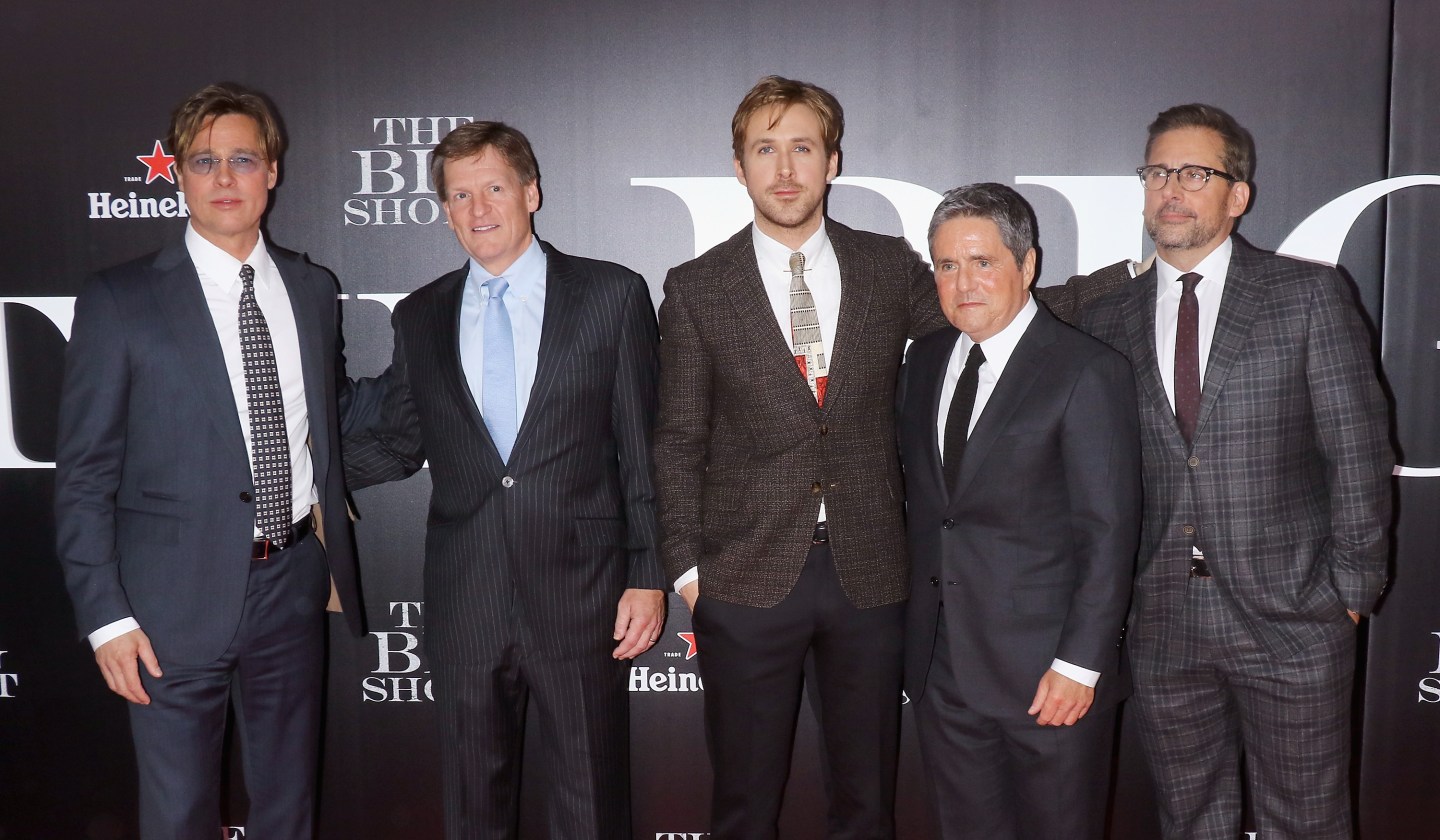
NEW YORK, NY - NOVEMBER 23: Actor Brad Pitt, writer Michael Lewis, actor Ryan Gosling, chairman and CEO of Paramount Pictures Brad Grey and actor Steve Carell attend the "The Big Short" New York premiere at Ziegfeld Theater on November 23, 2015 in New York City. (Photo by Jim Spellman/WireImage)Jim Spellman—WireImage
Add Fortune on Google for similar content.

In the afterward of his 2010 account of the subprime mortgage meltdown, The Big Short, author Michael Lewis laments his inability to fashion the tale into a comedy, as he had done in all his previous work. This makes complete sense on the surface. How could a subprime mortgage meltdown, which helped trigger the worst financial crisis in three generations, be funny?

The fact that the subject matter of The Big Short is so serious is one reason eyebrows were raised when Adam McKay, director of such goofball comedies as Anchorman and Step Brothers, was picked to adapt Lewis’ bestselling account of the years leading up to the crash of 2008 into a movie.

Don’t underestimate McKay’s serious side, however. Whatever the adaptation’s flaws, the director is up to the task. The same goes for actor Steve Carrell, who is best known for his comedic roles like that of Michael Scott in the hit NBC series The Office but pulls off the role of earnest money manager Steve Eisman with aplomb.

At the same time, Lewis’ afterward belies the fact that his book and the subject matter are often very funny. Lewis is a talented reporter and writer, but what makes his work exceptional is his ability to demystify the world of high finance, while making it seem fun in process. That’s why aspiring bond salesmen saw Lewis’ first book, Liar’s Poker, more as a guide to succeeding on Wall Street than as a cautionary tale. Sure, Wall Street may be cutthroat and the mistakes made there have the potential to create widespread harm, but it sure is filled with a bunch of characters who know how to have a good time.

The film version of The Big Short succeeds on this score too. Making a movie about mortgage-backed securities and exotic financial instruments is no easy feat, unless you’re prepared to bore your audience to tears. To avoid this, McKay uses some clever tricks, like cutting away to a scene featuring bombshell Margo Robbie sipping champagne in a bathtub at the moment in the story when the concept of a collateralized debt obligation needs to be explained.

But in the end, the subject matter that the film tackles is so dense that nearly every scene ends up being expository in one way or another. Writing a book, Lewis has the luxury of weaving in narrative vignettes that show why the handful of visionaries like Steve Eisman and Dr. Michael Berry, who foresaw the financial crisis, were so unique and brilliant. McKay tries to be faithful to Lewis’ style, but in a film time is a limited commodity. McKay cuts many of the more entertaining parts of the book to make time to explain the central theme of Lewis’ story, which happens to have mostly to do with esoteric financial instruments.

Which raises the question of why, exactly, would McKay choose this volume (off all books) to turn into a movie (of all media?). The answer is politics. As McKay has explained in interviews, he remains incensed that bankers and financiers weren’t hauled off to jail by the dozen after the crisis, and that the financial regulatory reform that was passed wasn’t more robust. McKay, a Bernie Sanders donor, told The Hollywood Reporter that he thought the movie might, “start some conversations” and possibly re-focus American anger over the economy away from side issues like immigration and trade policy to what he sees as the real problem: a corrupt financial system.

Some reviewers like the New York Post‘s Kyle Smith argue that McKay corrupted Lewis’ “deeply engaging” book with ham-fisted moralizing that oversimplifies the crisis as simply the fault of greedy bankers. But an honest reading of Lewis’ book will reveal that he and McKay basically agree that the financial crisis and the great recession should be blamed on the financial services industry. Lewis, in fact, sees the story of the financial crisis beginning when he first started working on Wall Street in the mid-1980s, just when investment banks a) starting going public and b) began to use more sophisticated instruments like derivatives and mortgage-backed securities.

Lewis’ insights into the evolution of the financial services industry are vital, and he does point to causes of instability in financial markets. But Lewis’ book is the story of just one part of a crisis that was much more global in nature than many Americans realize.

Both in the film and the movie, when one bond salesman is asked who exactly is buying all these mortgage bonds filled with loans destined to fail, he says, simply: Dusseldorf. And there is truth in this bit of misdirection. A lot of the people who were buying this stuff were foreigners—Germans, Japanese, and investors from various emerging markets whose domestic policy had created large trade surpluses and a massive demand for safe securities in which to invest these surpluses. As Raghuram Rajan, the current Governor of the Bank of India, has put it:

So long as large countries like Germany and Japan are structurally inclined—indeed required—to export, global supply washes around the world looking for countries that have the weakest [financial regulations] or the least discipline, tempting them to spend until they simply cannot afford it and succumb to crisis.

This sort of analysis of the macroeconomic causes of the crisis is missing from Lewis’ book and therefore McKay’s film. It’s not so much that The Big Short gets the financial crisis wrong, but that it’s an incomplete view, and viewers and readers risk thinking that preventing the next crisis is simply a matter of strengthening domestic regulations. In fact, preventing the next crisis will demand just as much international cooperation as it does reform at home.
About the Author
By Chris Matthews
See full bioRight Arrow Button Icon
Add Fortune on Google for similar content.

Latest in Finance

Finance
Lorem ipsum dolor sit amet, consectetur adipiscing elit, sed do eiusmod tempor incididunt ut labore et dolore magna aliqua. Ut enim ad minim veniam
By Fortune Editors
October 20, 2025
Finance
Lorem ipsum dolor sit amet, consectetur adipiscing elit, sed do eiusmod tempor incididunt ut labore et dolore magna aliqua. Ut enim ad minim veniam
By Fortune Editors
October 20, 2025
Finance
Lorem ipsum dolor sit amet, consectetur adipiscing elit, sed do eiusmod tempor incididunt ut labore et dolore magna aliqua. Ut enim ad minim veniam
By Fortune Editors
October 20, 2025
Finance
Lorem ipsum dolor sit amet, consectetur adipiscing elit, sed do eiusmod tempor incididunt ut labore et dolore magna aliqua. Ut enim ad minim veniam
By Fortune Editors
October 20, 2025
Finance
Lorem ipsum dolor sit amet, consectetur adipiscing elit, sed do eiusmod tempor incididunt ut labore et dolore magna aliqua. Ut enim ad minim veniam
By Fortune Editors
October 20, 2025
Finance
Lorem ipsum dolor sit amet, consectetur adipiscing elit, sed do eiusmod tempor incididunt ut labore et dolore magna aliqua. Ut enim ad minim veniam
By Fortune Editors
October 20, 2025

Most Popular

Finance
Lorem ipsum dolor sit amet, consectetur adipiscing elit, sed do eiusmod tempor incididunt ut labore et dolore magna aliqua. Ut enim ad minim veniam
By Fortune Editors
October 20, 2025
Finance
Lorem ipsum dolor sit amet, consectetur adipiscing elit, sed do eiusmod tempor incididunt ut labore et dolore magna aliqua. Ut enim ad minim veniam
By Fortune Editors
October 20, 2025
Finance
Lorem ipsum dolor sit amet, consectetur adipiscing elit, sed do eiusmod tempor incididunt ut labore et dolore magna aliqua. Ut enim ad minim veniam
By Fortune Editors
October 20, 2025
Finance
Lorem ipsum dolor sit amet, consectetur adipiscing elit, sed do eiusmod tempor incididunt ut labore et dolore magna aliqua. Ut enim ad minim veniam
By Fortune Editors
October 20, 2025
Finance
Lorem ipsum dolor sit amet, consectetur adipiscing elit, sed do eiusmod tempor incididunt ut labore et dolore magna aliqua. Ut enim ad minim veniam
By Fortune Editors
October 20, 2025
Finance
Lorem ipsum dolor sit amet, consectetur adipiscing elit, sed do eiusmod tempor incididunt ut labore et dolore magna aliqua. Ut enim ad minim veniam
By Fortune Editors
October 20, 2025
Fortune Secondary Logo
Rankings
  • 100 Best Companies
  • Fortune 500
  • Global 500
  • Fortune 500 Europe
  • Most Powerful Women
  • World's Most Admired Companies
  • See All Rankings
  • Lists Calendar
Sections
  • Finance
  • Fortune Crypto
  • Features
  • Leadership
  • Health
  • Commentary
  • Success
  • Retail
  • Mpw
  • Tech
  • Lifestyle
  • CEO Initiative
  • Asia
  • Politics
  • Conferences
  • Europe
  • Newsletters
  • Personal Finance
  • Environment
  • Magazine
  • Education
Customer Support
  • Frequently Asked Questions
  • Customer Service Portal
  • Privacy Policy
  • Terms Of Use
  • Single Issues For Purchase
  • International Print
Commercial Services
  • Advertising
  • Fortune Brand Studio
  • Fortune Analytics
  • Fortune Conferences
  • Business Development
  • Group Subscriptions
About Us
  • About Us
  • Press Center
  • Work At Fortune
  • Terms And Conditions
  • Site Map
  • About Us
  • Press Center
  • Work At Fortune
  • Terms And Conditions
  • Site Map
  • Facebook icon
  • Twitter icon
  • LinkedIn icon
  • Instagram icon
  • Pinterest icon

Latest in Finance

Trump’s 927-page disclosure is just a normal Tuesday for direct indexing and crypto wealth managers
InvestingDonald Trump
Trump’s 927-page disclosure is just a normal Tuesday for direct indexing and crypto wealth managers
By Catherina GioinoJuly 1, 2026
4 hours ago
US President Donald Trump sits in silence with his hands folded on top of each other.
CryptoDonald Trump
Inside Trump’s $1.4 billion crypto empire: Altcoins, Bitcoin—and a stake in Michael Saylor’s Strategy
By Camila Grigera NaónJuly 1, 2026
6 hours ago
Mark Zandi, Moody's chief economist.
EconomyU.S. economy
‘It’s fair to ask whether it was worth it’: The Iran war has cost Americans $1,000 per household—and that’s a conservative estimate, Mark Zandi says
By Tristan BoveJuly 1, 2026
9 hours ago
Melania Trump NFT earnings surge 28x in 2025 as the First Lady rakes in nearly $17 million in total earnings, filing shows
PoliticsDonald Trump
Melania Trump NFT earnings surge 28x in 2025 as the First Lady rakes in nearly $17 million in total earnings, filing shows
By Mia OsmonbekovJuly 1, 2026
9 hours ago
Donald Trump sits at his desk in the Oval Office, smiling and with his hands folded in front of him.
PoliticsDonald Trump
Trump got a $78K pension from the Screen Actors Guild in 2025 because he appeared in Home Alone 2 in 1992
By Sasha RogelbergJuly 1, 2026
10 hours ago
Current price of Bitcoin for July 1, 2026
Personal FinanceCryptocurrency
Current price of Bitcoin for July 1, 2026
By Joseph HostetlerJuly 1, 2026
14 hours ago

Most Popular

As Big Tech showers employees with perks to win the talent war, Nvidia built a nearly $5 trillion company by making people pay for their own lunch
Big Tech
As Big Tech showers employees with perks to win the talent war, Nvidia built a nearly $5 trillion company by making people pay for their own lunch
By Marco Quiroz-GutierrezJuly 1, 2026
20 hours ago
MacKenzie Scott alone accounted for one-third of America's $19.2 billion in megagifts last year
Success
MacKenzie Scott alone accounted for one-third of America's $19.2 billion in megagifts last year
By Sydney LakeJune 25, 2026
7 days ago
The Supreme Court's birthright citizenship ruling hands the U.S. economy a $7.7 trillion win
Newsletters
The Supreme Court's birthright citizenship ruling hands the U.S. economy a $7.7 trillion win
By Diane BradyJuly 1, 2026
18 hours ago
Philanthropy leader at Warren Buffett and Bill Gates’ Giving Pledge says children of billionaires are pushing them to give their wealth away faster
Success
Philanthropy leader at Warren Buffett and Bill Gates’ Giving Pledge says children of billionaires are pushing them to give their wealth away faster
By Preston ForeJune 27, 2026
5 days ago
Elon Musk on MacKenzie Scott giving away $26 billion of her fortune: 'Sadly,' it makes the world a worse place
Success
Elon Musk on MacKenzie Scott giving away $26 billion of her fortune: 'Sadly,' it makes the world a worse place
By Sydney LakeJune 29, 2026
2 days ago
Current price of oil as of July 1, 2026
Personal Finance
Current price of oil as of July 1, 2026
By Joseph HostetlerJuly 1, 2026
14 hours ago

© 2026 Fortune Media IP Limited. All Rights Reserved. Use of this site constitutes acceptance of our Terms of Use and Privacy Policy | CA Notice at Collection and Privacy Notice | Do Not Sell/Share My Personal Information
FORTUNE is a trademark of Fortune Media IP Limited, registered in the U.S. and other countries. FORTUNE may receive compensation for some links to products and services on this website. Offers may be subject to change without notice.