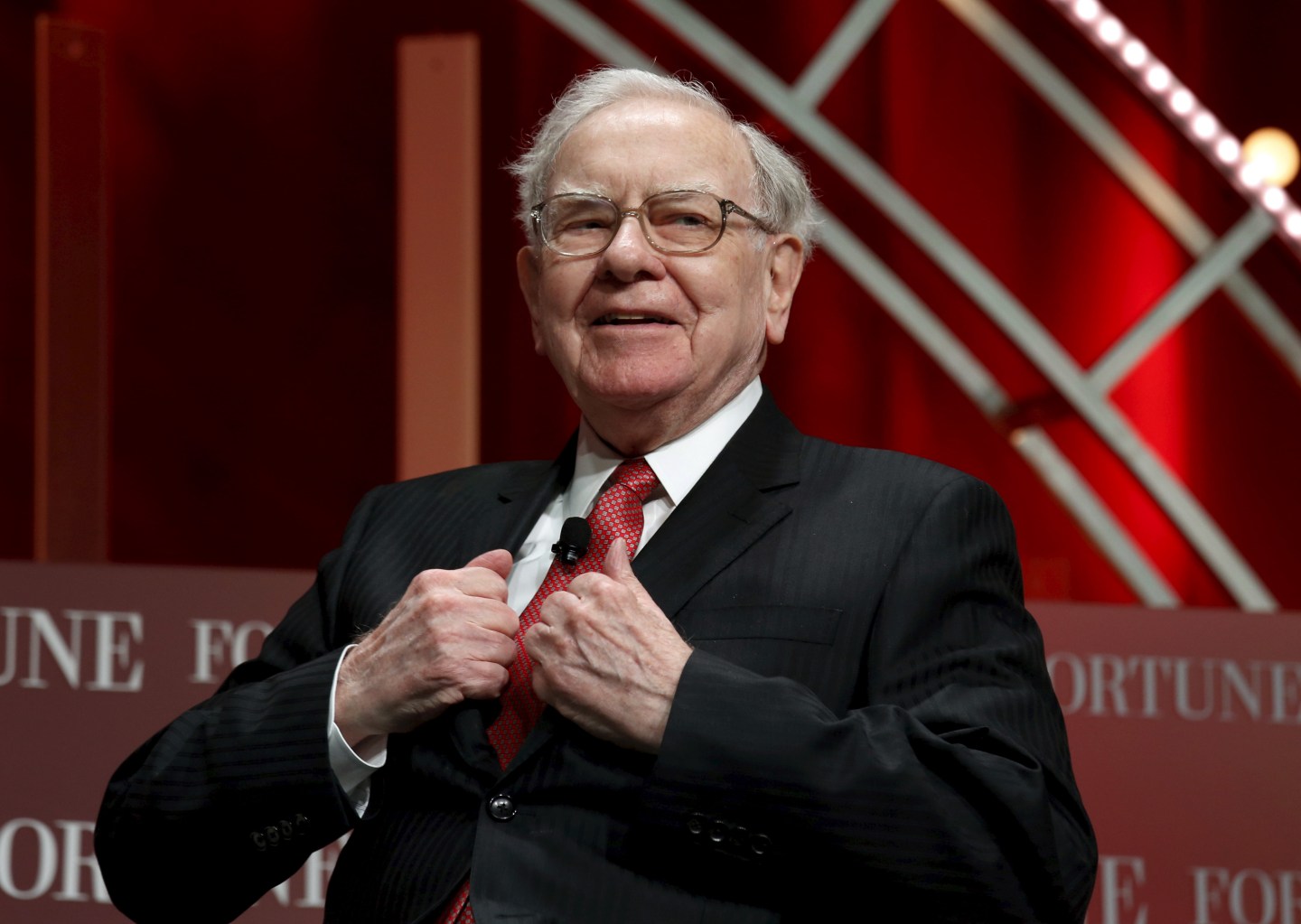
Warren Buffett outperformed the broader market last year, by his own measure, even if his company’s performance fell short of its recent standard.
Releasing both its results for 2015 and CEO Buffett’s annual letter to shareholders this morning, Berkshire Hathaway (BRKA) reported a 6.4% gain in book value—the financial metric that Buffett has always used as a rough indicator of how the huge and ever expanding conglomerate is progressing.
Berkshire’s increase in book value was good enough to beat the 1.4% market return of the S&P 500 with dividends included (a victory that Buffett always covets). Still, Berkshire’s 6.4% rise was well below the 13% average gain in book value the company rang up in the six previous years of the recovery. Indeed, the market seemed to have something like that in mind when it sent both Berkshire A and B stocks down by 12.5% in 2015.
A primary reason for the so-so financial results is that 2015 was a down year in profits for Berkshire’s large insurance operations. They earned $4.9 billion in 2015 vs. $5.2 billion the year before, with claim costs at Geico and a slide in reinsurance profits both hurting.
On the other hand, the insurance businesses, in total, ended 2015 with nearly $88 billion in “float” against the $84 billion held at the end of 2014. Float is money Berkshire doesn’t own but has the opportunity to use advantageously—to fund investments, most particularly—while the process of claim payments is playing out. Float has been rising at Berkshire for eons, but Buffett began a couple of years ago to warn that future gains would be tough to get. But still they’ve kept coming.
In 2015, all of Berkshire’s other businesses—a railroad; utilities and energy; manufacturing, service, and retail; financial and financial products; and investments and derivatives—were more profitable than in 2014.
Interspersed in those businesses are many Berkshire subsidiaries related to the housing industry, which is enjoying a recovery. Among these operations are Clayton Homes (manufactured housing), Berkshire Hathaway HomeServices (real estate brokerages), Shaw (carpets), Benjamin Moore (paints), and Johns Manville (building materials). The profits of some of these individual companies are not spelled out in Berkshire’s report. But Clayton’s are. Its pre-tax profits were up more than 25% in 2015.
Among Berkshire’s businesses, the fact that investments and derivatives gained in profits in 2015 sounds counterintuitive, since it is well-known that Berkshire’s four largest investments did not have a great 2015. Wells Fargo (WFC) and Coca-Cola (KO) spent the year going nowhere, and IBM (IBM) and American Express (AXP) fell sharply. But Berkshire was not a seller of those stocks, so no realized losses hit the company’s bottom line.
Furthermore, Berkshire got a wild-card boost to its returns in 2015: a non-cash accounting write-up of $6.8 billion on its serial investments in the common stocks of, first, Heinz and later, Kraft Heinz (KHC).
Buffett, now into his 52nd year of running Berkshire and no fan of accounting artificialities at any time, speaks derisively of the write-up in his annual letter to shareholders: “That leaves us with our Kraft Heinz holding carried on our balance sheet at a value many billions above our cost and many billions below its market value, an outcome only an accountant could love.” To pin down the mathematics behind that quote, Berkshire’s cost to date for its Kraft Heinz common-stock investment is $9.8 billion; the balance sheet value of the investment at yearend 2015 was $15.7 billion; and the current market value of Berkshire’s 27% stake in Kraft Heinz is about $25.5 billion.
For his annual letter to shareholders—always awaited avidly by Berkshire followers—Buffett mentally surveyed all of the conglomerate’s facts and called 2015 a “good” year. His prize exhibit was a turnaround at Berkshire’s biggest non-insurance operation: BNSF railroad. Referring back to BNSF’s poor performance in 2014, Buffett complimented its management for having “dramatically” improved its service to customers in 2015. The job was costly: BNSF’s capital expenditures during 2015 were $5.8 billion—“far and away” a single-year record for a railroad, Buffett said.
Setting another record, however, BNSF made $6.8 billion in pre-tax profits in 2015, up from $6.2 billion in 2014. Lower fuel costs helped. The gain, in any event, made BNSF the hero of the non-insurance group that Buffett calls the “Powerhouse Five,” whose other members include Berkshire Hathaway Energy, Marmon, Lubrizol and IMC (formerly known as Iscar). Their total 2015 pre-tax profits—obviously helped greatly by BNSF’s $600 million jump—were $13.1 billion, against $12.4 billion the previous year.
And for 2016, the moniker will be the Powerhouse Six, with the addition of Precision Castparts Corp., a Fortune 500 company (No. 302) that specializes in complex metal components for aircraft but also has enough oil-patch business to have been knocked around in the stock market in 2014 and 2015. Mark Donegan, the CEO of PCC, and Buffett were brought together in Omaha last year by Todd Combs, one of the two money-managers who assist Buffett in investing Berkshire’s money and who had earlier put some of the approximately $9 billion he manages into PCC.
Donegan and Buffett liked each other right away, and before long Buffett was negotiating to buy the entirety of PCC. The deal was signed in August 2015, but not consummated until January of this year. Buffett paid $32.7 billion for PCC, most of it in cash. That used up a good chunk of the $72 billion in cash that Berkshire was holding at the end of 2015. But Buffett, never wanting to be the least pinched for funds, built up Berkshire’s cash simultaneously, by engineering a new $10 billion bank loan.
In buying PCC, Berkshire got a company that for the 12 months ending last September had $9.7 billion in revenues and $1.3 billion in profits. As a comparison, Berkshire for the full year of 2015 had revenues of nearly $211 billion and profits of $24 billion. That level of revenues will place Berkshire, as usual, in the top 10 of the Fortune 500 (where last year it ranked fourth).
And earnings-per-share? Buffett has always considered that indicator meaningless for Berkshire, because it does not include unrealized gains and losses—most notably those in Berkshire’s huge portfolio of stocks. For the record, though, earnings-per-share for Berkshire’s A stock in 2015 were $14,656, against a closing price yesterday for those shares of $198,190.50.
That price—to mention a highly relevant fact—is about 127% of Berkshire’s book value per share at the end of 2015, whose amount was $155,501. The figure, of course, is different by now, having been both increased over two months by Berkshire profits and reduced by lower prices for the stocks in the company’s portfolio.
But the point is that 127% is not far above the 120% level—price per-share vs. book value per-share—at which Buffett and the Berkshire board of directors have said the company would buy in its own stock. No Berkshire purchases geared to this metric have yet happened. Instead, the market’s estimates of what the 120% level might be acts as a kind of floor down to which the price of the stock has been known to almost descend.
In 2016, so far, the low price for Berkshire A has been $186,900. We now know, with the release of Berkshire’s yearend book-value figures, that price was just a hair above the 120% level.
Buffett’s willingness to buy at 120% of Berkshire’s book value reflects his conviction that Berkshire’s intrinsic value—that is, its real value as opposed to its accounting value—is far higher than 120% of book. The gap he perceives exists because the value of many companies that Berkshire has bought—companies like Geico and See’s Candies and Marmon and many others—are by accounting rules carried on Berkshire’s balance sheet at their cost and not at the higher value they have ascended to during their Berkshire years. To be sure, some Berkshire companies have lost value. Accounting rules say the value of these losers must be written down, and at Berkshire, as at every company, they are.
Buffett has never been willing to give the world his estimate of Berkshire’s intrinsic value. But neither has he been shy about saying that 120% of book value would be an attractive price. Which is why Berkshire has said it would step up and buy at that level. It is also why investors sometimes stand in the way of Berkshire purchases by themselves buying the merchandise before it falls to Buffett’s price.
In some ways, the most important announcement in the annual letter this year (no, there was nothing about who might some day succeed Buffett) was not financial but rather Buffett’s disclosure that Berkshire’s annual meeting this year (it’s on April 30) would be webcast. The webcast site will be Yahoo Finance, and the event will remain available for 30 days after the meeting.
In the past, Buffett has always resisted the idea of a webcast or any means of publicly broadcasting the annual meeting. Why? Well, for sure, he has enjoyed having multitudes of shareholders troop to Omaha to be at the event in person.
But last year’s assemblage of more than 40,000 attendees filled every corner of CenturyLink’s vast auditorium and spilled, besides, into an adjoining hotel. So the decision of Buffett and the Berkshire board this year was to webcast the meeting in hopes of perhaps slightly cutting down the crowd.
Buffett adds in the annual letter that there is a second, more important reason to webcast. That’s the advanced age of the two people who share the stage at the meeting: Buffett himself, who is 85, and Charlie Munger, Berkshire’s outspoken vice-chairman, who is 92. All shareholders, not just those who make it to Omaha, Buffett says, should have a chance to observe how the two men look and sound and to ascertain that they haven’t “drifted off into la-la land.”
But be kind, Buffett concludes: “Allow for the fact that we didn’t look that impressive when we were at our best.”
The author of this article, Carol J. Loomis, is a retired senior editor-at-large of Fortune. She is also a longtime friend of Warren Buffett’s, a Berkshire Hathaway shareholder, and the pro bono editor of Buffett’s annual shareholder letter.