• Home
  • Latest
  • Fortune 500
  • Finance
  • Tech
  • Leadership
  • Lifestyle
  • Rankings
  • Multimedia
Commentary

This Can Be Hillary Clinton’s Secret Weapon In Tonight’s Debate

By
Brian Uzzi
Brian Uzzi
Down Arrow Button Icon
By
Brian Uzzi
Brian Uzzi
Down Arrow Button Icon
March 9, 2016, 7:00 PM ET
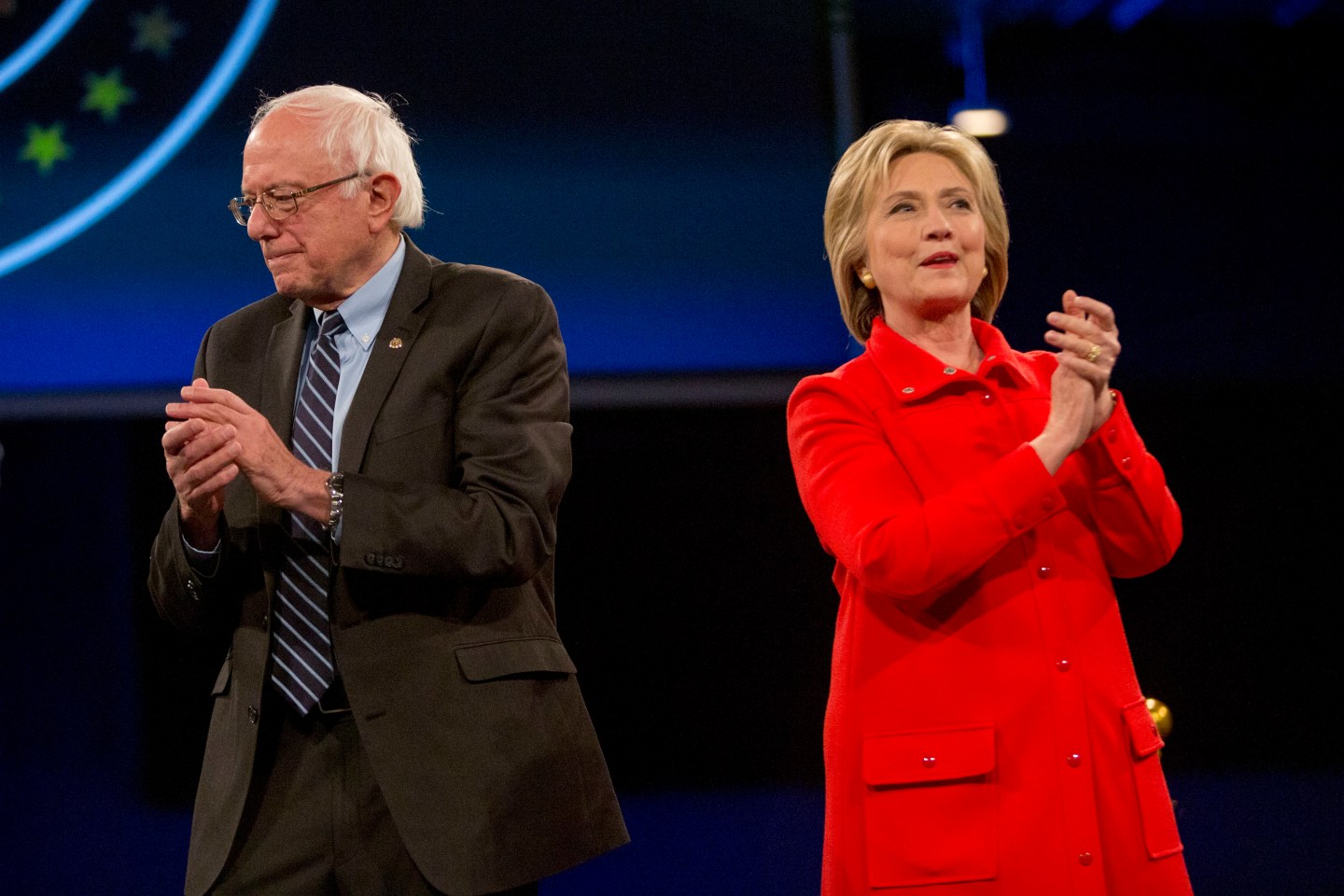
Presidential Candidates Speak At Iowa Democratic Party Jefferson-Jackson Dinner
Hillary Clinton, former Secretary of State and 2016 Democratic presidential candidate, right, and Senator Bernie Sanders, an independent from Vermont and 2016 Democratic presidential candidate, applaud and stand on stage together during candidate introductions at the Jefferson-Jackson Dinner in Des Moines, Iowa, U.S., on Saturday, Oct. 24, 2015. With Vice President Joe Biden officially out of the presidential race, the nation's first nominating contest between front-runner Clinton and Sanders is gaining steam, according to a new Bloomberg Politics/Des Moines Register Iowa Poll. Photographer: Daniel Acker/Bloomberg via Getty ImagesPhotograph by Daniel Acker — Bloomberg via Getty Images

As the Democrat presidential candidates face off tonight, a little-known linguistic technique may hold the key to how truthful and trustworthy they appear to voters. Rather than honing the content of what they have to say (which voters probably know by now), candidates would do well to focus on how they say it — especially to match their rivals’ speech patterns.

This is the debater’s secret weapon known as “language style matching,” which can enhance trust and believability for the person who speaks second, such as in a rebuttal. The secret, grounded in research published by my colleagues and I in Personality and Social Psychology Bulletin, is not just to launch in with one’s own views or to attack the opponent who spoke first. Rather, the candidate speaking second who can match the opponent’s language style gains the advantage.

The trick is to focus on the auxiliary words that don’t add much meaning, such as: especially, also, all, besides, must, might, about, our, anybody, perhaps, etc. These words don’t add or change content, but they can make the speaker’s meaning easier to process and also influence whether the speaker is perceived to be truthful and deserving of voters’ trust.

Let’s assume Bernie Sanders, when asked to explain his stance on gun control, is challenged about protecting gun manufacturers and sellers from lawsuits. And let’s assume he says, as he did in the recent Michigan debate: “What you’re really talking about is ending gun manufacturing in America.” If Hilary Clinton, who favors tougher gun control, were to use the language style matching technique, her rebuttal to Sanders’ would be more persuasive to voters if she matched his language construction, such as to say, “What you’re really talking about is…” By contrast, if Clinton mismatched and phrased her rebuttal differently — for example, “I believe that …” or “The American people want…”— then in terms of listeners’ linguistic processing, it would be less effective.

The reason? The first person to speak establishes the pattern for listeners. If the second person to speak doesn’t follow that pattern, it takes more effort for listeners to mentally process the message. When messages are harder to process, there is a tendency for listeners to look for fault in the message and holes in the argument. Skepticism, once invoked, undercuts the speaker’s perceived truthfulness. Disconnect also can lead to misinterpretation.

The pattern resets with each new question asked. So when it’s Clinton’s turn to speak, she would set the pattern that Sanders would need to mimic.

Linguistic style matching is most effective with two opponents in a debate. More broadly, this makes things a little trickier for the current slate of Republican candidates, such as in the most recent debate in Detroit among frontrunner Donald Trump, Sens. Ted Cruz and Marco Rubio, and Gov. John Kasich. When a debate turns raucous, making it difficult for people to follow, candidates can end up hurting themselves.

But even in a multi-person debate, there is room for linguistic style matching, which could be a real “secret weapon” for those who do their homework. For example, on the much-debated topic of immigration, Trump has repeated the phrase, “I will build a wall…” referring to his proposal to stop illegal immigration from Mexico into the United States. The recurrent linguistic match up of “I” and the “wall” can prime voters’ minds to process issues related to the wall in terms of “I” not “we.” Opponents may capitalize on the expected mental association between a familiar content and style by matching Trump’s linguistic style; for example, saying “I (rather than “we”) will reform immigration laws…

The challenge is that language style matching goes against most people’s desire to distance or distinguish themselves from their opponents. If candidate A uses “I” frequently, candidate B may prefer to use “we.” Rather than contrasting the two candidates in voters’ mind, the mix of linguistic styles often ends up backfiring.

Although counterintuitive, this strategy has been substantiated in research using machine learning and natural language processes techniques to analyze presidential debates from 1976 to 2012, and in lab experiments based on employee-employer negotiations. Those who used language style matching were more apt to come out the winner in the debate or negotiating contest.

This linguistic secret weapon could be most useful in the months ahead after each party has chosen its nominee, and the Republican and Democrat candidates go head-to-head in debates before the November election. History serves up a powerful lesson: Even Ronald Reagan, who won in a landslide over incumbent Jimmy Carter in 1980, did not fare well in debates when his linguistic style clashed with Carter’s. When Reagan’s style matched, he performed better.

In the final race for the White House in November, language style matching may be even more important because by that time, stances on the issues will be well known to voters. With little to be gained by reiterating “content,” the candidate who focuses on linguistics could gain the upper hand — and voters’ trust.

Brian Uzzi is a professor at the Kellogg School of Management at Northwestern University and a scientist and speaker on leadership, social networks and new media. He is the director of the Northwestern Institute on Complex Systems and Data Science and co-chair for the 2nd Annual International Computational Social Science Summit held this June 2016.


About the Author
By Brian Uzzi
See full bioRight Arrow Button Icon

Latest in Commentary

Finance
Lorem ipsum dolor sit amet, consectetur adipiscing elit, sed do eiusmod tempor incididunt ut labore et dolore magna aliqua. Ut enim ad minim veniam
By Fortune Editors
October 20, 2025
Finance
Lorem ipsum dolor sit amet, consectetur adipiscing elit, sed do eiusmod tempor incididunt ut labore et dolore magna aliqua. Ut enim ad minim veniam
By Fortune Editors
October 20, 2025
Finance
Lorem ipsum dolor sit amet, consectetur adipiscing elit, sed do eiusmod tempor incididunt ut labore et dolore magna aliqua. Ut enim ad minim veniam
By Fortune Editors
October 20, 2025
Finance
Lorem ipsum dolor sit amet, consectetur adipiscing elit, sed do eiusmod tempor incididunt ut labore et dolore magna aliqua. Ut enim ad minim veniam
By Fortune Editors
October 20, 2025
Finance
Lorem ipsum dolor sit amet, consectetur adipiscing elit, sed do eiusmod tempor incididunt ut labore et dolore magna aliqua. Ut enim ad minim veniam
By Fortune Editors
October 20, 2025
Finance
Lorem ipsum dolor sit amet, consectetur adipiscing elit, sed do eiusmod tempor incididunt ut labore et dolore magna aliqua. Ut enim ad minim veniam
By Fortune Editors
October 20, 2025

Most Popular

Finance
Lorem ipsum dolor sit amet, consectetur adipiscing elit, sed do eiusmod tempor incididunt ut labore et dolore magna aliqua. Ut enim ad minim veniam
By Fortune Editors
October 20, 2025
Finance
Lorem ipsum dolor sit amet, consectetur adipiscing elit, sed do eiusmod tempor incididunt ut labore et dolore magna aliqua. Ut enim ad minim veniam
By Fortune Editors
October 20, 2025
Finance
Lorem ipsum dolor sit amet, consectetur adipiscing elit, sed do eiusmod tempor incididunt ut labore et dolore magna aliqua. Ut enim ad minim veniam
By Fortune Editors
October 20, 2025
Finance
Lorem ipsum dolor sit amet, consectetur adipiscing elit, sed do eiusmod tempor incididunt ut labore et dolore magna aliqua. Ut enim ad minim veniam
By Fortune Editors
October 20, 2025
Finance
Lorem ipsum dolor sit amet, consectetur adipiscing elit, sed do eiusmod tempor incididunt ut labore et dolore magna aliqua. Ut enim ad minim veniam
By Fortune Editors
October 20, 2025
Finance
Lorem ipsum dolor sit amet, consectetur adipiscing elit, sed do eiusmod tempor incididunt ut labore et dolore magna aliqua. Ut enim ad minim veniam
By Fortune Editors
October 20, 2025
Fortune Secondary Logo
Rankings
  • 100 Best Companies
  • Fortune 500
  • Global 500
  • Fortune 500 Europe
  • Most Powerful Women
  • Future 50
  • World’s Most Admired Companies
  • See All Rankings
Sections
  • Finance
  • Fortune Crypto
  • Features
  • Leadership
  • Health
  • Commentary
  • Success
  • Retail
  • Mpw
  • Tech
  • Lifestyle
  • CEO Initiative
  • Asia
  • Politics
  • Conferences
  • Europe
  • Newsletters
  • Personal Finance
  • Environment
  • Magazine
  • Education
Customer Support
  • Frequently Asked Questions
  • Customer Service Portal
  • Privacy Policy
  • Terms Of Use
  • Single Issues For Purchase
  • International Print
Commercial Services
  • Advertising
  • Fortune Brand Studio
  • Fortune Analytics
  • Fortune Conferences
  • Business Development
  • Group Subscriptions
About Us
  • About Us
  • Editorial Calendar
  • Press Center
  • Work At Fortune
  • Diversity And Inclusion
  • Terms And Conditions
  • Site Map
  • About Us
  • Editorial Calendar
  • Press Center
  • Work At Fortune
  • Diversity And Inclusion
  • Terms And Conditions
  • Site Map
  • Facebook icon
  • Twitter icon
  • LinkedIn icon
  • Instagram icon
  • Pinterest icon

Latest in Commentary

wyle
CommentaryTV
What HBO’s ‘The Pitt’ gets right—and wrong—about treating alcohol use disorder
By Jonathan Hunt-GlassmanApril 2, 2026
3 hours ago
nic
CommentaryInsider trading
Prediction markets caught insider traders in real time. Congress wants to shut them down anyway
By Nic PuckrinApril 2, 2026
4 hours ago
elon
CommentarySpaceX
The SpaceX IPO is great — but it won’t deliver 100x returns 
By Jeffrey StewartApril 1, 2026
17 hours ago
gary
Commentaryregulation
The biggest mistake CEOs make with AI has nothing to do with the technology
By Gary ShapiroApril 1, 2026
1 day ago
trump
CommentaryEPA
The EPA just valued a human life at $0. That’s not just a moral crisis — it’s a market crisis
By Andrew BeharApril 1, 2026
1 day ago
dressel
Commentaryhistory
AI can’t remember what your company learned the hard way 
By Jason DresselApril 1, 2026
1 day ago

Most Popular

Gen Z fled San Francisco for Texas and Florida. Now they’re turning ‘welcomer cities’ into the next big tech towns
Real Estate
Gen Z fled San Francisco for Texas and Florida. Now they’re turning ‘welcomer cities’ into the next big tech towns
By Fortune EditorsApril 2, 2026
9 hours ago
Current price of gold as of April 1, 2026
Personal Finance
Current price of gold as of April 1, 2026
By Fortune EditorsApril 1, 2026
1 day ago
Two-thirds of parents say their adult Gen Z kids still rely on them financially  for support—even though it's putting them under strain
Success
Two-thirds of parents say their adult Gen Z kids still rely on them financially  for support—even though it's putting them under strain
By Fortune EditorsMarch 31, 2026
2 days ago
Current price of oil as of April 1, 2026
Personal Finance
Current price of oil as of April 1, 2026
By Fortune EditorsApril 1, 2026
1 day ago
Jerome Powell says the $39 trillion national debt is ‘not unsustainable,’ but warns the trajectory ‘will not end well’
Economy
Jerome Powell says the $39 trillion national debt is ‘not unsustainable,’ but warns the trajectory ‘will not end well’
By Fortune EditorsMarch 30, 2026
3 days ago
2 years after Musk challenged Zuckerberg to a cage match, they were texting about DOGE and a joint OpenAI bid, court records reveal
Law
2 years after Musk challenged Zuckerberg to a cage match, they were texting about DOGE and a joint OpenAI bid, court records reveal
By Fortune EditorsMarch 31, 2026
2 days ago

© 2026 Fortune Media IP Limited. All Rights Reserved. Use of this site constitutes acceptance of our Terms of Use and Privacy Policy | CA Notice at Collection and Privacy Notice | Do Not Sell/Share My Personal Information
FORTUNE is a trademark of Fortune Media IP Limited, registered in the U.S. and other countries. FORTUNE may receive compensation for some links to products and services on this website. Offers may be subject to change without notice.