• Home
  • Latest
  • Fortune 500
  • Finance
  • Tech
  • Leadership
  • Lifestyle
  • Rankings
  • Multimedia
TechDefense

Inside the Navy’s New Autonomous Sub-Hunting Warship

By
Clay Dillow
Clay Dillow
Down Arrow Button Icon
By
Clay Dillow
Clay Dillow
Down Arrow Button Icon
April 8, 2016, 3:05 PM ET
DARPA

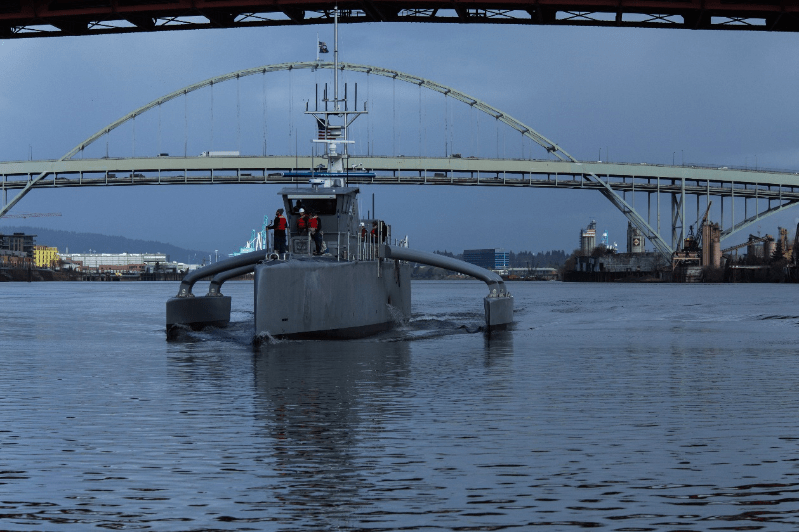
The U.S. Navy has christened the world’s largest unmanned surface vessel, a 132-foot submarine-hunting robotic warship that the Pentagon hopes to eventually field in large numbers. The unarmed prototype—dubbed “Sea Hunter”—is capable of plying large swaths of ocean searching for potential undersea threats, all without a human crew or even direct human intervention.

“It’s not just a remote controlled boat,” DARPA program manager Scott Littlefield told reporters earlier this week ahead of Sea Hunter’s christening. While Sea Hunter’s human handlers will oversee the vessel’s operations from afar, the ship will navigate itself through open waters relying on its own sensors and programming. In other words, “the human being is in control, but not joy sticking the vessel around,” he said.

The Defense Advanced Research Projects Agency, or DARPA, which developed the vessel along with Virginia-based Leidos (LDOS), calls it the Anti-Submarine Warfare Continuous Trail Unmanned Vessel, or ACTUV (pronounced, “active”). Its anti-submarine role serves a growing need for the U.S. Navy as countries like China and Russia introduce quieter and stealthier diesel-powered submarines. But Pentagon officials say an autonomous surface vessel of ACTUV’s size and capability could fulfill a number of roles for the Navy including mine detection and clearing. The deployment of fleets of robotic warships would mark a significant shift in the way autonomous systems are used by the military at sea, and could potentially alter the fundamental makeup of the future U.S. Navy fleet.

Get Data Sheet, Fortune’s technology newsletter.

During its upcoming trials humans will remain onboard the Sea Hunter as a safety net, but once the system’s reliability is established an onboard human presence will no longer be necessary. The operator station visible atop the vessel is removable, and the interior of the ship, while accessible for maintenance, is not designed to accommodate a crew. It will carry no weapons, though Pentagon officials acknowledge that future autonomous warships certainly may. Rather than proving that Sea Hunter itself is ready for war, the two-year test period will prove the technologies onboard, including that the autonomous navigation and piloting technologies underpinning the ACTUV program are ready to be used by the Navy in real-world scenarios.

While the Navy currently deploys unmanned systems—both in the air and in the water—they are largely remotely piloted and operate within close proximity to manned vessels. Sea Hunter can carry 40 tons of fuel and cover 10,000 nautical miles cruising at 12 knots, allowing it to operate far from conventional fleets or coastlines for two or three months at a time with no direct human intervention. Its trimaran design–the central hull flanked by outboard pontoons–provides stability in all kinds of weather and can survive waves up to 20 feet high, making the robotic ship effective in conditions that manned surface ships would typically avoid.

Sea Hunter will detect other surface ship traffic or obstacles via cameras and other onboard sensors, making its way across the ocean in much the same way Google’s self-driving cars operate amid other vehicles on the road. Additional sensors will scan the depths below, looking (and listening) for potential undersea threats.

In speed tests, the vessel has reached 27 knots—or roughly 31 miles per hour—fast enough to keep up with any conventional submarine the Navy deems worth tracking. That mix of speed, endurance, and autonomy could let vessels like Sea Hunter track subs for months at a time at a fraction of the cost of a crewed sub-hunting vessel. The Pentagon thinks it could produce ships like Sea Hunter for $20 million dollars each and operate them for between $15,000 and $20,000 a day (compared with well over $1 billion dollars for a modern Arleigh Burke class destroyer, which can cost hundreds of thousands of dollars per day to operate).

Meanwhile the need for better sub-hunting capabilities is very real. China, in particular, has upped its undersea warfare game substantially over the past decade, and occasionally reminds the U.S. Navy of the fact. National security news site Defense One notes two such incidents in recent years—one in 2006 when a Chinese sub surfaced just a few miles from the aircraft carrier USS Kitty Hawk, and another incident in October when a Chinese attack submarine first tailed the aircraft carrier USS Ronald Reagan off the coast of Japan and then executed a maneuver simulating a missile attack.

For more about robotic autonomy, watch:

Chinese muscle-flexing aside, something like Sea Hunter fits squarely into an ongoing Pentagon strategy aimed at offsetting military manpower with better technology, including what the Pentagon likes to call “manned-unmanned teaming.” Future unmanned warships based on ACTUV technologies could operate in conjunction with manned ships as well as manned and unmanned aircraft to detect threats, assign targets, share information, and generally keep crewed vessels out of harm’s way.

“I have been waiting for this day for a long time,” Work, one of the offset strategy’s biggest champions, said at Sea Hunter’s christening ceremony. “We are in a period of incredible technological flux. Advances in A.I., autonomous control systems, advanced computing, big data, learning machines, intuitive visualization tool, metamaterial, miniaturization are leading us toward great human-machine collaboration, in business and manufacturing, and in warfare.”

Those remarks echo similar comments Work made last month in which he described a relatively near-term future in which unmanned and autonomous F-16 fighter jets would fly alongside manned F-35 fighters in combat. While that future is a little farther away, Work says he hopes to see the Sea Hunter join the Navy’s Japan-based 7th fleet for further testing after its trials with DARPA and the Navy wrap up in a couple of years. After that, fleets of autonomous warships could be on the water in relatively short order.

“I would like to see unmanned flotillas operating in the western Pacific and the Persian Gulf within five years,” Work told Reuters.

About the Author
By Clay Dillow
See full bioRight Arrow Button Icon

Latest in Tech

Finance
Lorem ipsum dolor sit amet, consectetur adipiscing elit, sed do eiusmod tempor incididunt ut labore et dolore magna aliqua. Ut enim ad minim veniam
By Fortune Editors
October 20, 2025
Finance
Lorem ipsum dolor sit amet, consectetur adipiscing elit, sed do eiusmod tempor incididunt ut labore et dolore magna aliqua. Ut enim ad minim veniam
By Fortune Editors
October 20, 2025
Finance
Lorem ipsum dolor sit amet, consectetur adipiscing elit, sed do eiusmod tempor incididunt ut labore et dolore magna aliqua. Ut enim ad minim veniam
By Fortune Editors
October 20, 2025
Finance
Lorem ipsum dolor sit amet, consectetur adipiscing elit, sed do eiusmod tempor incididunt ut labore et dolore magna aliqua. Ut enim ad minim veniam
By Fortune Editors
October 20, 2025
Finance
Lorem ipsum dolor sit amet, consectetur adipiscing elit, sed do eiusmod tempor incididunt ut labore et dolore magna aliqua. Ut enim ad minim veniam
By Fortune Editors
October 20, 2025
Finance
Lorem ipsum dolor sit amet, consectetur adipiscing elit, sed do eiusmod tempor incididunt ut labore et dolore magna aliqua. Ut enim ad minim veniam
By Fortune Editors
October 20, 2025

Most Popular

Finance
Lorem ipsum dolor sit amet, consectetur adipiscing elit, sed do eiusmod tempor incididunt ut labore et dolore magna aliqua. Ut enim ad minim veniam
By Fortune Editors
October 20, 2025
Finance
Lorem ipsum dolor sit amet, consectetur adipiscing elit, sed do eiusmod tempor incididunt ut labore et dolore magna aliqua. Ut enim ad minim veniam
By Fortune Editors
October 20, 2025
Finance
Lorem ipsum dolor sit amet, consectetur adipiscing elit, sed do eiusmod tempor incididunt ut labore et dolore magna aliqua. Ut enim ad minim veniam
By Fortune Editors
October 20, 2025
Finance
Lorem ipsum dolor sit amet, consectetur adipiscing elit, sed do eiusmod tempor incididunt ut labore et dolore magna aliqua. Ut enim ad minim veniam
By Fortune Editors
October 20, 2025
Finance
Lorem ipsum dolor sit amet, consectetur adipiscing elit, sed do eiusmod tempor incididunt ut labore et dolore magna aliqua. Ut enim ad minim veniam
By Fortune Editors
October 20, 2025
Finance
Lorem ipsum dolor sit amet, consectetur adipiscing elit, sed do eiusmod tempor incididunt ut labore et dolore magna aliqua. Ut enim ad minim veniam
By Fortune Editors
October 20, 2025
Fortune Secondary Logo
Rankings
  • 100 Best Companies
  • Fortune 500
  • Global 500
  • Fortune 500 Europe
  • Most Powerful Women
  • Future 50
  • World’s Most Admired Companies
  • See All Rankings
Sections
  • Finance
  • Fortune Crypto
  • Features
  • Leadership
  • Health
  • Commentary
  • Success
  • Retail
  • Mpw
  • Tech
  • Lifestyle
  • CEO Initiative
  • Asia
  • Politics
  • Conferences
  • Europe
  • Newsletters
  • Personal Finance
  • Environment
  • Magazine
  • Education
Customer Support
  • Frequently Asked Questions
  • Customer Service Portal
  • Privacy Policy
  • Terms Of Use
  • Single Issues For Purchase
  • International Print
Commercial Services
  • Advertising
  • Fortune Brand Studio
  • Fortune Analytics
  • Fortune Conferences
  • Business Development
  • Group Subscriptions
About Us
  • About Us
  • Editorial Calendar
  • Press Center
  • Work At Fortune
  • Diversity And Inclusion
  • Terms And Conditions
  • Site Map
  • About Us
  • Editorial Calendar
  • Press Center
  • Work At Fortune
  • Diversity And Inclusion
  • Terms And Conditions
  • Site Map
  • Facebook icon
  • Twitter icon
  • LinkedIn icon
  • Instagram icon
  • Pinterest icon

Latest in Tech

Jack Dorsey and Roelof Botha think AI can make middle management obsolete 
AIBlock
Jack Dorsey and Roelof Botha think AI can make middle management obsolete 
By Jacqueline MunisApril 2, 2026
2 hours ago
china
AIChina
Meet China’s AI-powered recycling robot that sorts 220 pounds of clothes in 2 to 3 minutes
By Tian MacLeod Ji and The Associated PressApril 2, 2026
2 hours ago
In the age of vibe coding, trust is the real bottleneck
AIEye on AI
In the age of vibe coding, trust is the real bottleneck
By Sharon GoldmanApril 2, 2026
3 hours ago
A photo illustration of two laptops with eyeballs over a red background with alert signs.
CryptoNorth Korea
I knew about North Korean hackers—they still tricked me and got into my computer
By Ben WeissApril 2, 2026
3 hours ago
musk
EconomyIPOs
Elon Musk, world’s first trillionaire: one implication of the massive SpaceX IPO
By Bernard Condon, Ken Sweet and The Associated PressApril 2, 2026
3 hours ago
farley
Future of WorkInfrastructure
Ford CEO Jim Farley says America is sleepwalking past its ‘essential economy’ crisis. Goldman Sachs just showed how big it really is
By Nick LichtenbergApril 2, 2026
7 hours ago

Most Popular

Gen Z fled San Francisco for Texas and Florida. Now they’re turning ‘welcomer cities’ into the next big tech towns
Real Estate
Gen Z fled San Francisco for Texas and Florida. Now they’re turning ‘welcomer cities’ into the next big tech towns
By Fortune EditorsApril 2, 2026
11 hours ago
Current price of gold as of April 1, 2026
Personal Finance
Current price of gold as of April 1, 2026
By Fortune EditorsApril 1, 2026
1 day ago
Two-thirds of parents say their adult Gen Z kids still rely on them financially  for support—even though it's putting them under strain
Success
Two-thirds of parents say their adult Gen Z kids still rely on them financially  for support—even though it's putting them under strain
By Fortune EditorsMarch 31, 2026
2 days ago
Current price of oil as of April 1, 2026
Personal Finance
Current price of oil as of April 1, 2026
By Fortune EditorsApril 1, 2026
1 day ago
Jerome Powell says the $39 trillion national debt is ‘not unsustainable,’ but warns the trajectory ‘will not end well’
Economy
Jerome Powell says the $39 trillion national debt is ‘not unsustainable,’ but warns the trajectory ‘will not end well’
By Fortune EditorsMarch 30, 2026
3 days ago
Deutsche Bank asked AI if it’s true that AI will solve the economy’s inflation problems. The robots answered
Economy
Deutsche Bank asked AI if it’s true that AI will solve the economy’s inflation problems. The robots answered
By Fortune EditorsApril 1, 2026
23 hours ago

© 2026 Fortune Media IP Limited. All Rights Reserved. Use of this site constitutes acceptance of our Terms of Use and Privacy Policy | CA Notice at Collection and Privacy Notice | Do Not Sell/Share My Personal Information
FORTUNE is a trademark of Fortune Media IP Limited, registered in the U.S. and other countries. FORTUNE may receive compensation for some links to products and services on this website. Offers may be subject to change without notice.