• Home
  • Latest
  • Fortune 500
  • Finance
  • Tech
  • Leadership
  • Lifestyle
  • Rankings
  • Multimedia

Trendingnow

1

Microsoft AI chief gives it 18 months—for all white-collar work to be automated by AI

2

Former top Russian official admits the country is over Putin and can 'imagine a future without him' — even elites bail as Kremlin seizes their assets 

3

The Bezos family just donated $100 million to help achieve one of Mayor Zohran Mamdani’s top campaign promises

1

Microsoft AI chief gives it 18 months—for all white-collar work to be automated by AI

2

Former top Russian official admits the country is over Putin and can 'imagine a future without him' — even elites bail as Kremlin seizes their assets 

3

The Bezos family just donated $100 million to help achieve one of Mayor Zohran Mamdani’s top campaign promises
Commentary

Investors Should Listen to Jamie Dimon’s China Warnings

By
Arturo Bris
Arturo Bris
and
Bethany Cianciolo
Bethany Cianciolo
Down Arrow Button Icon
By
Arturo Bris
Arturo Bris
and
Bethany Cianciolo
Bethany Cianciolo
Down Arrow Button Icon
April 19, 2016, 8:00 PM ET
JP Morgan - Most Admired 2016
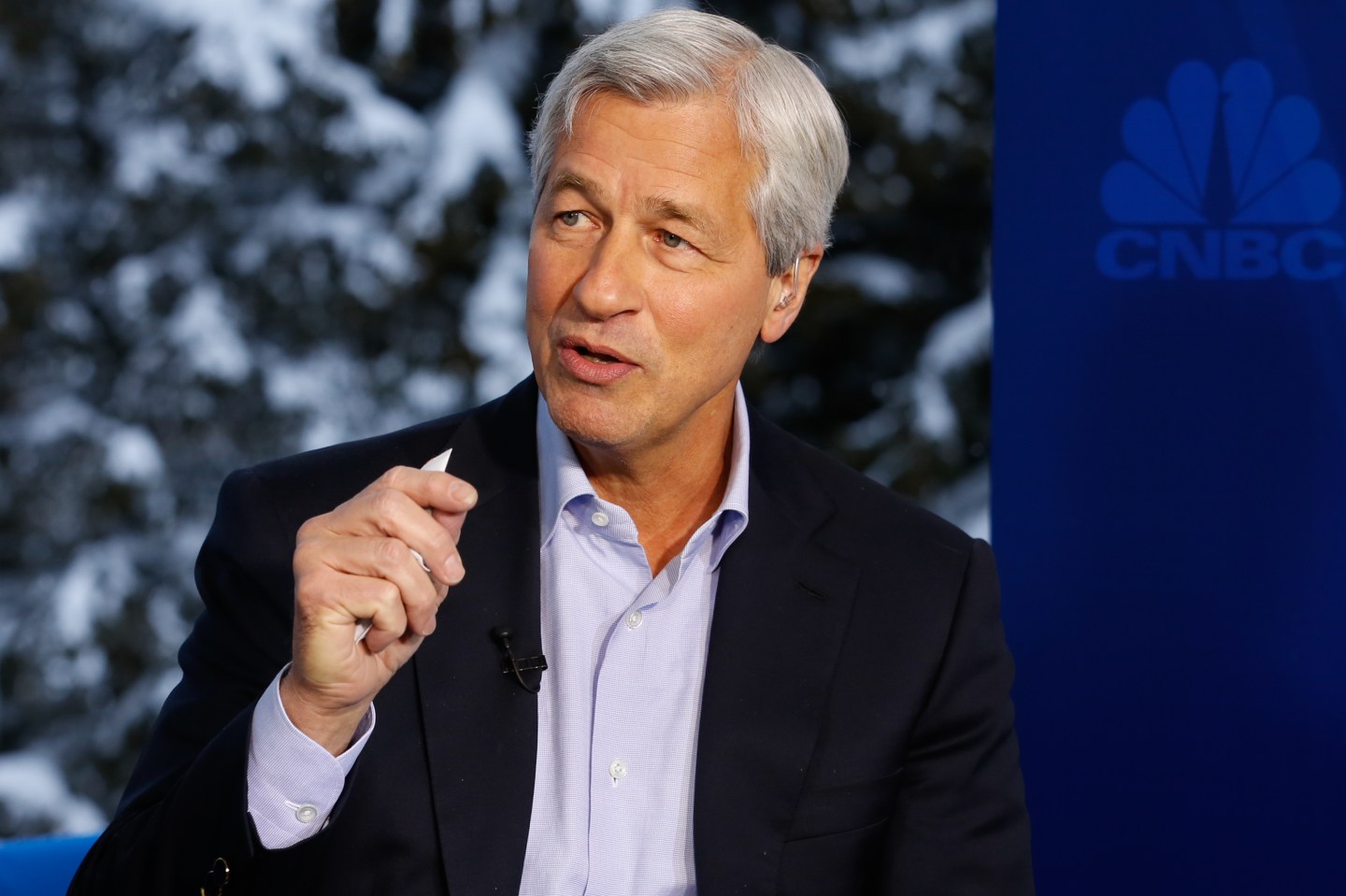
DAVOS 2016; World Economic Forum -- Pictured: Jamie Dimon, chairman, president and CEO of JP Morgan Chase, in an interview at the annual World Economic Forum in Davos, Switzerland, on January 20, 2016 -- (Photo by: David A.Grogan/CNBC/NBCU Photo Bank)Photograph by David A. Grogan — CNBC/NBCU Photo Bank via Getty Images

In a recent letter to JPMorgan Chase (JPM) shareholders, CEO Jamie Dimon issued a warning about the Chinese economy and the potential $4 billion loss that a recession there could bring to the bank, although the CEO said the firm could handle it in the unlikely chance that actually happens. Despite China’s potential and upward trajectory, Dimon states that in short run, the U.S. and the rest of the world may see a major recession with massive defaults and consequently heavy trading losses, and history shows he’s probably right.

China optimists argue that an economy that is expected to grow 7% on average for the next 10 years can’t be considered disappointing, even if that represents a slowdown compared to previous years. The World Bank, one of the more prominent China optimists, says the country has plenty of room for fiscal maneuver and a huge capacity to absorb debt. At the microeconomic level, the expansion of corporate China (33% of all cross-border acquisitions were amassed by Chinese firms in 2015) is providing firms with geographical diversification and management skills they don’t have at home. And because China hasn’t yet resorted to monetary policy as a tool to fight a potential recession as the rest of the world has done, there is a lot of space for policy to take over in case the private sector fails.

What these optimists are ignoring, though, is what the Great Recession of 2008 taught the world about how big crises start and are later amplified: First, there is misbehavior in the private sector, spurred by dysfunctional regulation and permissive regulators. Second, global interconnectivity spreads the crisis outside of a country. Third, paralysis in the financial sector kills household credit and ends up deteriorating people’s quality of life by diminishing investment, contributing to unemployment and, ultimately, leading to poverty.

These ingredients are again at play in the Chinese economy, eight years after the Great Recession. A McKinsey report published in February 2015 showed that in the economies hit worst by the crisis (the U.S., the UK, Spain, and Ireland), homeowners have since borrowed a good deal less, while credit for households almost doubled (from 20% to 38%) in China between 2007 and 2014. Even worse, China’s corporate debt to GDP ratio has now reached an astonishing 125% of GDP, mostly through bank debt. Chinese banks now hold up to 65% of the country’s GDP in debt. Private debt to GDP in China was at about 200% by the end of 2014.

What is most worrisome, though, is that the links between the public and the private sector look a lot like the crony capitalism that was the root of the 1997 Asian financial crisis: government-controlled banks lending money to government-controlled corporations through government-appointed officials, whose businesses depend on government-provided licenses, which rely on government-promoted anti-competition policies.


China is now connected to the rest of the world thanks to the strange rules of the game that the West easily accepted. While foreign competition is very limited inside China, Chinese CEOs and private firms are heavily investing all around the globe. So if something bad happens in China, the rest of the world will suffer. Interestingly, between January 2009 and December 2014, the average correlation between the daily returns of the U.S. and Chinese stock markets was 0.13. The same correlation has doubled since the beginning of 2015. Even if small, a recession in China would have devastating effects on the rest of the world, regardless of the category: product markets, currencies, oil prices, foreign direct investment, stock markets, credit markets, central bank policies, or sovereign debt.

More fundamentally, the Chinese economy is not a normal market economy. Hundreds of years of experience have shown that product and financial markets can’t function without proper institutions, in particular, the rule of law and respect for property rights. China is basically a dictatorship, as are the United Arab Emirates, Singapore, and Venezuela. Like Venezuela, the lack of accountability in the public sector encourages corruption, self-serving policies for political elites, and inefficient decision-making. Unlike the UAE and Singapore, however, property rights are not respected in China, and improvements to the rule of law preclude entrepreneurship.

China is good proof that markets require an institutional environment to guarantee that they work. Economists either believe in markets or they don’t, but there is no halfway. What happened in the Shanghai Stock Exchange last summer is a result of years of market manipulation by Chinese authorities with an attempt to prop up stock prices. The 2008 crises showed the Western world what happens when regulators try to prevent the free flow of information by prohibiting short sales or by imposing severe circuit breakers: The best way to prevent markets from going down is to shut them down—but the active management of markets by regulators leads to disaster.

In the long run, market economies fail without competition, and Chinese companies are not competitive in the strict sense of the word. The largest Chinese banks (which are also the world’s largest banks) operate in a protected market where competition by foreign institutions is prohibited, but they are allowed to compete with international banks overseas. In the agrochemical business, for example, Chemchina—the owner of Pirelli and soon-to-be owner of the Swiss giant Syngenta—operates in a huge market without the threat of foreign competition. Antitrust regulation is applied by a government that is also the owner of most of the country’s monopolies.

Dimon is right to warn about China, as the next financial crisis will surely be named after some Chinese tycoon, firm, or bank.

Arturo Bris is professor of finance at IMD business school and director of the IMD World Competitiveness Center. IMD is a top-ranked business school in Lausanne, Switzerland.
About the Authors
By Arturo Bris
See full bioRight Arrow Button Icon
By Bethany Cianciolo
See full bioRight Arrow Button Icon

Latest in Commentary

Finance
Lorem ipsum dolor sit amet, consectetur adipiscing elit, sed do eiusmod tempor incididunt ut labore et dolore magna aliqua. Ut enim ad minim veniam
By Fortune Editors
October 20, 2025
Finance
Lorem ipsum dolor sit amet, consectetur adipiscing elit, sed do eiusmod tempor incididunt ut labore et dolore magna aliqua. Ut enim ad minim veniam
By Fortune Editors
October 20, 2025
Finance
Lorem ipsum dolor sit amet, consectetur adipiscing elit, sed do eiusmod tempor incididunt ut labore et dolore magna aliqua. Ut enim ad minim veniam
By Fortune Editors
October 20, 2025
Finance
Lorem ipsum dolor sit amet, consectetur adipiscing elit, sed do eiusmod tempor incididunt ut labore et dolore magna aliqua. Ut enim ad minim veniam
By Fortune Editors
October 20, 2025
Finance
Lorem ipsum dolor sit amet, consectetur adipiscing elit, sed do eiusmod tempor incididunt ut labore et dolore magna aliqua. Ut enim ad minim veniam
By Fortune Editors
October 20, 2025
Finance
Lorem ipsum dolor sit amet, consectetur adipiscing elit, sed do eiusmod tempor incididunt ut labore et dolore magna aliqua. Ut enim ad minim veniam
By Fortune Editors
October 20, 2025

Most Popular

Finance
Lorem ipsum dolor sit amet, consectetur adipiscing elit, sed do eiusmod tempor incididunt ut labore et dolore magna aliqua. Ut enim ad minim veniam
By Fortune Editors
October 20, 2025
Finance
Lorem ipsum dolor sit amet, consectetur adipiscing elit, sed do eiusmod tempor incididunt ut labore et dolore magna aliqua. Ut enim ad minim veniam
By Fortune Editors
October 20, 2025
Finance
Lorem ipsum dolor sit amet, consectetur adipiscing elit, sed do eiusmod tempor incididunt ut labore et dolore magna aliqua. Ut enim ad minim veniam
By Fortune Editors
October 20, 2025
Finance
Lorem ipsum dolor sit amet, consectetur adipiscing elit, sed do eiusmod tempor incididunt ut labore et dolore magna aliqua. Ut enim ad minim veniam
By Fortune Editors
October 20, 2025
Finance
Lorem ipsum dolor sit amet, consectetur adipiscing elit, sed do eiusmod tempor incididunt ut labore et dolore magna aliqua. Ut enim ad minim veniam
By Fortune Editors
October 20, 2025
Finance
Lorem ipsum dolor sit amet, consectetur adipiscing elit, sed do eiusmod tempor incididunt ut labore et dolore magna aliqua. Ut enim ad minim veniam
By Fortune Editors
October 20, 2025
Fortune Secondary Logo
Rankings
  • 100 Best Companies
  • Fortune 500
  • Global 500
  • Fortune 500 Europe
  • Most Powerful Women
  • World's Most Admired Companies
  • See All Rankings
  • Lists Calendar
Sections
  • Finance
  • Fortune Crypto
  • Features
  • Leadership
  • Health
  • Commentary
  • Success
  • Retail
  • Mpw
  • Tech
  • Lifestyle
  • CEO Initiative
  • Asia
  • Politics
  • Conferences
  • Europe
  • Newsletters
  • Personal Finance
  • Environment
  • Magazine
  • Education
Customer Support
  • Frequently Asked Questions
  • Customer Service Portal
  • Privacy Policy
  • Terms Of Use
  • Single Issues For Purchase
  • International Print
Commercial Services
  • Advertising
  • Fortune Brand Studio
  • Fortune Analytics
  • Fortune Conferences
  • Business Development
  • Group Subscriptions
About Us
  • About Us
  • Press Center
  • Work At Fortune
  • Terms And Conditions
  • Site Map
  • About Us
  • Press Center
  • Work At Fortune
  • Terms And Conditions
  • Site Map
  • Facebook icon
  • Twitter icon
  • LinkedIn icon
  • Instagram icon
  • Pinterest icon

Latest in Commentary

murdochs
CommentaryMedia
OpenAI paid $100 million for a talk show. James Murdoch is eyeing an even bigger deal. The hot new asset class is humanity
By Lin CherryMay 17, 2026
4 hours ago
dennis
CommentaryAI agents
Freshworks CEO: why agile enterprises are winning the AI race — and what they did differently
By Dennis WoodsideMay 17, 2026
5 hours ago
Mary Moreland-Abbott Executive Vice President of Human Resources.
CommentaryRetirement
Gen X is the most indebted generation in America. Their employers can fix that
By Mary MorelandMay 17, 2026
7 hours ago
liberman
Commentarystart-ups
We watched social media concentrate. The same thing is happening in AI, only at a deeper layer
By David Liberman and Daniil LibermanMay 16, 2026
1 day ago
olivier
CommentaryAnthropic
I’ve been studying Big Tech for a long time. What just happened with Anthropic and the Pentagon terrifies me
By Olivier SylvainMay 16, 2026
1 day ago
lawyer
CommentaryLaw
Would you hire the lawyer who just got sanctioned for using AI?
By Alexandra SmythMay 16, 2026
1 day ago

Most Popular

Microsoft AI chief gives it 18 months—for all white-collar work to be automated by AI
AI
Microsoft AI chief gives it 18 months—for all white-collar work to be automated by AI
By Jake AngeloMay 16, 2026
1 day ago
Former top Russian official admits the country is over Putin and can 'imagine a future without him' — even elites bail as Kremlin seizes their assets 
Politics
Former top Russian official admits the country is over Putin and can 'imagine a future without him' — even elites bail as Kremlin seizes their assets 
By Jason MaMay 16, 2026
19 hours ago
The Bezos family just donated $100 million to help achieve one of Mayor Zohran Mamdani’s top campaign promises
Politics
The Bezos family just donated $100 million to help achieve one of Mayor Zohran Mamdani’s top campaign promises
By Jake AngeloMay 12, 2026
5 days ago
SpaceX heads into a record-shattering IPO with the 'deepest moat that exists today' as investors vow to 'never bet against Elon'
Innovation
SpaceX heads into a record-shattering IPO with the 'deepest moat that exists today' as investors vow to 'never bet against Elon'
By Jason MaMay 16, 2026
1 day ago
Oil markets could be a month away from the moment of truth. Brace for a 'non-linear' price spike and panic buying, analysts warn
Energy
Oil markets could be a month away from the moment of truth. Brace for a 'non-linear' price spike and panic buying, analysts warn
By Jason MaMay 16, 2026
22 hours ago
‘You’re not a hero, you’re a liability’: Shark Tank’s Kevin O’Leary warns Gen Z founders to stop glorifying hustle culture
Future of Work
‘You’re not a hero, you’re a liability’: Shark Tank’s Kevin O’Leary warns Gen Z founders to stop glorifying hustle culture
By Jacqueline MunisMay 16, 2026
1 day ago

© 2026 Fortune Media IP Limited. All Rights Reserved. Use of this site constitutes acceptance of our Terms of Use and Privacy Policy | CA Notice at Collection and Privacy Notice | Do Not Sell/Share My Personal Information
FORTUNE is a trademark of Fortune Media IP Limited, registered in the U.S. and other countries. FORTUNE may receive compensation for some links to products and services on this website. Offers may be subject to change without notice.