• Home
  • Latest
  • Fortune 500
  • Finance
  • Tech
  • Leadership
  • Lifestyle
  • Rankings
  • Multimedia

Exclusive

An hour in the Oval Office with President Trump.

An hour in the Oval Office with President Trump.

An hour in the Oval Office with President Trump.

An hour in the Oval Office with President Trump.

An hour in the Oval Office with President Trump.

An hour in the Oval Office with President Trump.

An hour in the Oval Office with President Trump.

An hour in the Oval Office with President Trump.

An hour in the Oval Office with President Trump.

An hour in the Oval Office with President Trump.

CommentaryAutomation

These Are the Jobs Least Likely to Go to Robots

By
James Manyika
James Manyika
,
Michael Chui
Michael Chui
, and
Mehdi Miremadi
Mehdi Miremadi
Down Arrow Button Icon
By
James Manyika
James Manyika
,
Michael Chui
Michael Chui
, and
Mehdi Miremadi
Mehdi Miremadi
Down Arrow Button Icon
July 11, 2016, 6:00 AM ET
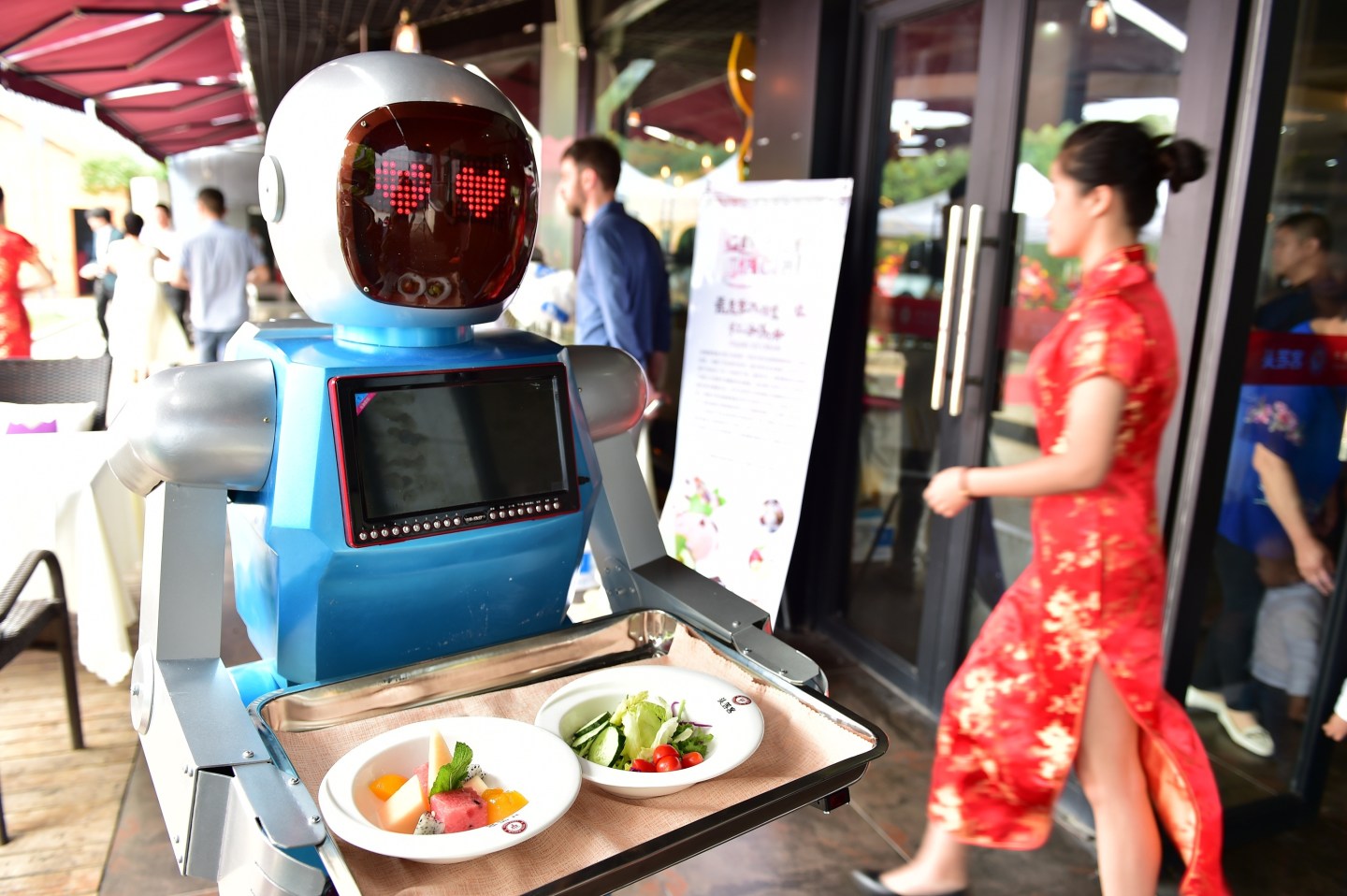
Couple Of Robot Waiters Show In Yiwu's Restaurant
YIWU, CHINA - MAY 18: (CHINA OUT) A "male" robot waiter delivers meals for customers at robot-themed restaurant on May 18, 2015 in Yiwu, Zhejiang province of China. Sophomore Xu Jinjin in 22 years old from Hospitality Management of Yiwu Industrial and Commercial College managed a restaurant where a pair of robot acted as waiters. The "male" one was named "Little Blue" (for in blue color) and the "female" one was "Little Peach" (for in pink) and they could help order meals and then delivered them to customers along the magnetic track and said: "Here're your meals, please enjoy". According to Xu Jinjin, They had contacted with the designer to present more robot waiters to make the restaurant a real one that depends completely on robots. (Photo by ChinaFotoPress/ChinaFotoPress via Getty Images)Photograph by ChinaFotoPress via Getty Images

James Manyika is a senior partner and Michael Chui, Mehdi Miremadi are partners at McKinsey & Company.

Automation is often depicted in news articles and some academic literature as a titanic struggle between man and machine, in which the machine seems destined to win and the only question is how soon to schedule the medal ceremony. As automation in the workplace moves rapidly from science fiction to business fact, we believe the changes it will bring are more nuanced than a simple choice between human and robot. We have examined 2,000-plus work activities in every industry sector across the US economy. Here are eight findings from our research, highlighting the automation potential of each sector—providing some technical indicators as to which occupations are most and least likely to go to a machine.

Just because something can be automated doesn’t mean it will be.

While technical feasibility is a necessary precondition for automation, other factors are required to build a compelling business case. These include the cost of developing and deploying the hardware and the software for automation, and the supply-and-demand dynamics of labor. Replacing human cooks earning $10 per hour with expensive robots may be possible technically, but might not make business sense because it may cost too much and not provide a good return on investment. Regulatory and social issues could also be factors many hospital patients will want a human nurse rather than a robot to care for them when they wake up after surgery.

Certain physical jobs have the highest potential to be automated.

Almost one-fifth of the time spent in US workplaces involves performing physical activities or operating machinery in a predictable environment—that is, specific actions in familiar settings where changes are relatively easy to anticipate. More than three-quarters of such activities could be automated already with today’s technology, and figure prominently in manufacturing and food service, making these sectors the most technically susceptible to automation. Robots on factory floors already do repetitive rote tasks such as product assembly and packaging, while in food service, some restaurants are testing self-service ordering or even robotic servers.

Data collection and processing are ripe for automation, too. Across all occupations in the US economy, workers spend one-third of their time collecting and processing data. Both activities are highly like to be automated and could affect industries, from retail to financial services and insurance. Workers won’t necessarily be out of the job, but their roles may very well change. For example, mortgage brokers spend as much as 90% of their time processing applications, and could instead spend more time advising clients.

Even high-paying jobs will be affected. It’s not just entry-level workers or low-wage clerks who collect and process data; people whose annual incomes exceed $200,000 spend more than 30% of their time doing so, too. That makes activities in these jobs attractive for companies to automate. Overall, the correlation between wages and automatability shows a great deal of variability.

Robots aren’t great at making beds — yet.

For now, activities that require physical movement or operating machinery in unpredictable settings are relatively challenging to automate. Examples include operating a crane on a construction site, collecting trash in public areas, or making beds in hotel rooms. The latter is unpredictable because guests throw pillows in different places, or may leave clothing on their beds, which makes it hard for a robot to carry out maid service. This might change soon, however, as significant research is being devoted to improving the performance of robots in physically unpredictable environments.

Time to become a teacher or dental hygienist?

The hardest activities to automate with the technologies available today are those that involve managing and developing people (9% automation potential), where expertise is applied to decision-making, planning, or creative work (18%), or interacting with customers, suppliers, and other stakeholders (20%). These activities, where experience and age are often an asset, can be as varied as coding software, creating menus, writing promotional materials — or advising customers which color shoes best suit them.

In health care, less than 30% of a registered nurse’s job could be automated, while for dental hygienists, that proportion drops to 13%. Of all the sectors we have examined, among the least susceptible to automation is education. The essence of teaching includes deep expertise and complex interactions with other people for which machines, so far and with few exceptions, receive an incomplete grade.

Machines will change jobs, but they won’t fully take over from humans. The technical feasibility of automation is best analyzed by looking not at occupations as a whole, but at the amount of time spent on individual activities, and the degree to which these could be automated by using technology that currently exists and adapting it to individual work activities. Overall, we find that only about 5% of occupations could be fully automated by adapting current technology. However, today’s technologies could automate 45% of the activities people are paid to perform across all occupations. What’s more, about 60% of all occupations could see 30% or more of their work activities automated.

Click to enlarge.McKinsey Global Institute

Watch this space.

Technology continues to develop and technical feasibility will thus evolve over time. This analysis has focused only on currently available technologies, but our on-going research considers different scenarios for technology development. As technological advances such as machines being able to acquire natural language abilities that match median human capability, the numbers and types of activities that are technically susceptible to automation will increase.

Automation will fundamentally change the nature of organizations. The challenge for managers will be to identify where automation could transform their organizations, and then figure out where to unlock value, given the cost of replacing human labor with machines and the complexity of adapting business processes to a changed workplace. Most benefits may come not from reducing labor costs but from raising productivity through fewer errors, higher output, and improved quality, safety, and speed.


About the Authors
By James Manyika
See full bioRight Arrow Button Icon
By Michael Chui
See full bioRight Arrow Button Icon
By Mehdi Miremadi
See full bioRight Arrow Button Icon

Latest in Commentary

Finance
Lorem ipsum dolor sit amet, consectetur adipiscing elit, sed do eiusmod tempor incididunt ut labore et dolore magna aliqua. Ut enim ad minim veniam
By Fortune Editors
October 20, 2025
Finance
Lorem ipsum dolor sit amet, consectetur adipiscing elit, sed do eiusmod tempor incididunt ut labore et dolore magna aliqua. Ut enim ad minim veniam
By Fortune Editors
October 20, 2025
Finance
Lorem ipsum dolor sit amet, consectetur adipiscing elit, sed do eiusmod tempor incididunt ut labore et dolore magna aliqua. Ut enim ad minim veniam
By Fortune Editors
October 20, 2025
Finance
Lorem ipsum dolor sit amet, consectetur adipiscing elit, sed do eiusmod tempor incididunt ut labore et dolore magna aliqua. Ut enim ad minim veniam
By Fortune Editors
October 20, 2025
Finance
Lorem ipsum dolor sit amet, consectetur adipiscing elit, sed do eiusmod tempor incididunt ut labore et dolore magna aliqua. Ut enim ad minim veniam
By Fortune Editors
October 20, 2025
Finance
Lorem ipsum dolor sit amet, consectetur adipiscing elit, sed do eiusmod tempor incididunt ut labore et dolore magna aliqua. Ut enim ad minim veniam
By Fortune Editors
October 20, 2025

Most Popular

Finance
Lorem ipsum dolor sit amet, consectetur adipiscing elit, sed do eiusmod tempor incididunt ut labore et dolore magna aliqua. Ut enim ad minim veniam
By Fortune Editors
October 20, 2025
Finance
Lorem ipsum dolor sit amet, consectetur adipiscing elit, sed do eiusmod tempor incididunt ut labore et dolore magna aliqua. Ut enim ad minim veniam
By Fortune Editors
October 20, 2025
Finance
Lorem ipsum dolor sit amet, consectetur adipiscing elit, sed do eiusmod tempor incididunt ut labore et dolore magna aliqua. Ut enim ad minim veniam
By Fortune Editors
October 20, 2025
Finance
Lorem ipsum dolor sit amet, consectetur adipiscing elit, sed do eiusmod tempor incididunt ut labore et dolore magna aliqua. Ut enim ad minim veniam
By Fortune Editors
October 20, 2025
Finance
Lorem ipsum dolor sit amet, consectetur adipiscing elit, sed do eiusmod tempor incididunt ut labore et dolore magna aliqua. Ut enim ad minim veniam
By Fortune Editors
October 20, 2025
Finance
Lorem ipsum dolor sit amet, consectetur adipiscing elit, sed do eiusmod tempor incididunt ut labore et dolore magna aliqua. Ut enim ad minim veniam
By Fortune Editors
October 20, 2025
Fortune Secondary Logo
Rankings
  • 100 Best Companies
  • Fortune 500
  • Global 500
  • Fortune 500 Europe
  • Most Powerful Women
  • World's Most Admired Companies
  • See All Rankings
  • Lists Calendar
Sections
  • Finance
  • Fortune Crypto
  • Features
  • Leadership
  • Health
  • Commentary
  • Success
  • Retail
  • Mpw
  • Tech
  • Lifestyle
  • CEO Initiative
  • Asia
  • Politics
  • Conferences
  • Europe
  • Newsletters
  • Personal Finance
  • Environment
  • Magazine
  • Education
Customer Support
  • Frequently Asked Questions
  • Customer Service Portal
  • Privacy Policy
  • Terms Of Use
  • Single Issues For Purchase
  • International Print
Commercial Services
  • Advertising
  • Fortune Brand Studio
  • Fortune Analytics
  • Fortune Conferences
  • Business Development
  • Group Subscriptions
About Us
  • About Us
  • Press Center
  • Work At Fortune
  • Terms And Conditions
  • Site Map
  • About Us
  • Press Center
  • Work At Fortune
  • Terms And Conditions
  • Site Map
  • Facebook icon
  • Twitter icon
  • LinkedIn icon
  • Instagram icon
  • Pinterest icon

Latest in Commentary

shyam
CommentaryHealth
World Economic Forum: women’s health gets only 20% of R&D funding. We must seize this $1 trillion opportunity
By Shyam BishenMay 18, 2026
4 hours ago
murdochs
CommentaryMedia
OpenAI paid $100 million for a talk show. James Murdoch is eyeing an even bigger deal. The hot new asset class is humanity
By Lin CherryMay 17, 2026
19 hours ago
dennis
CommentaryAI agents
Freshworks CEO: why agile enterprises are winning the AI race — and what they did differently
By Dennis WoodsideMay 17, 2026
19 hours ago
Mary Moreland-Abbott Executive Vice President of Human Resources.
CommentaryRetirement
Gen X is the most indebted generation in America. Their employers can fix that
By Mary MorelandMay 17, 2026
21 hours ago
liberman
Commentarystart-ups
We watched social media concentrate. The same thing is happening in AI, only at a deeper layer
By David Liberman and Daniil LibermanMay 16, 2026
2 days ago
olivier
CommentaryAnthropic
I’ve been studying Big Tech for a long time. What just happened with Anthropic and the Pentagon terrifies me
By Olivier SylvainMay 16, 2026
2 days ago

Most Popular

Microsoft AI chief gives it 18 months—for all white-collar work to be automated by AI
AI
Microsoft AI chief gives it 18 months—for all white-collar work to be automated by AI
By Jake AngeloMay 16, 2026
2 days ago
The top foreign holders of U.S. debt may soon dump Treasury bonds and bring their money back home, potentially spiking borrowing costs
Economy
The top foreign holders of U.S. debt may soon dump Treasury bonds and bring their money back home, potentially spiking borrowing costs
By Jason MaMay 17, 2026
14 hours ago
The Bezos family just donated $100 million to help achieve one of Mayor Zohran Mamdani’s top campaign promises
Politics
The Bezos family just donated $100 million to help achieve one of Mayor Zohran Mamdani’s top campaign promises
By Jake AngeloMay 12, 2026
5 days ago
'No one was coming to save me': How Reese Witherspoon built a $900 million company from a problem Hollywood wouldn't fix
Success
'No one was coming to save me': How Reese Witherspoon built a $900 million company from a problem Hollywood wouldn't fix
By Sydney LakeMay 17, 2026
21 hours ago
Former top Russian official admits the country is over Putin and can 'imagine a future without him' — even elites bail as Kremlin seizes their assets 
Politics
Former top Russian official admits the country is over Putin and can 'imagine a future without him' — even elites bail as Kremlin seizes their assets 
By Jason MaMay 16, 2026
1 day ago
SpaceX heads into a record-shattering IPO with the 'deepest moat that exists today' as investors vow to 'never bet against Elon'
Innovation
SpaceX heads into a record-shattering IPO with the 'deepest moat that exists today' as investors vow to 'never bet against Elon'
By Jason MaMay 16, 2026
2 days ago

© 2026 Fortune Media IP Limited. All Rights Reserved. Use of this site constitutes acceptance of our Terms of Use and Privacy Policy | CA Notice at Collection and Privacy Notice | Do Not Sell/Share My Personal Information
FORTUNE is a trademark of Fortune Media IP Limited, registered in the U.S. and other countries. FORTUNE may receive compensation for some links to products and services on this website. Offers may be subject to change without notice.