• Home
  • Latest
  • Fortune 500
  • Finance
  • Tech
  • Leadership
  • Lifestyle
  • Rankings
  • Multimedia

Trendingnow

1

As Big Tech showers employees with perks to win the talent war, Nvidia built a nearly $5 trillion company by making people pay for their own lunch

2

MacKenzie Scott alone accounted for one-third of America's $19.2 billion in megagifts last year

3

The Supreme Court's birthright citizenship ruling hands the U.S. economy a $7.7 trillion win

1

As Big Tech showers employees with perks to win the talent war, Nvidia built a nearly $5 trillion company by making people pay for their own lunch

2

MacKenzie Scott alone accounted for one-third of America's $19.2 billion in megagifts last year

3

The Supreme Court's birthright citizenship ruling hands the U.S. economy a $7.7 trillion win
Commentary

These Cities Could Lead the Driverless Car Revolution

By
Luís Bettencourt
Luís Bettencourt
Down Arrow Button Icon
By
Luís Bettencourt
Luís Bettencourt
Down Arrow Button Icon
October 4, 2016, 2:49 PM ET
US-TRANSPORT-TECHNOLOGY-UBER-AUTO
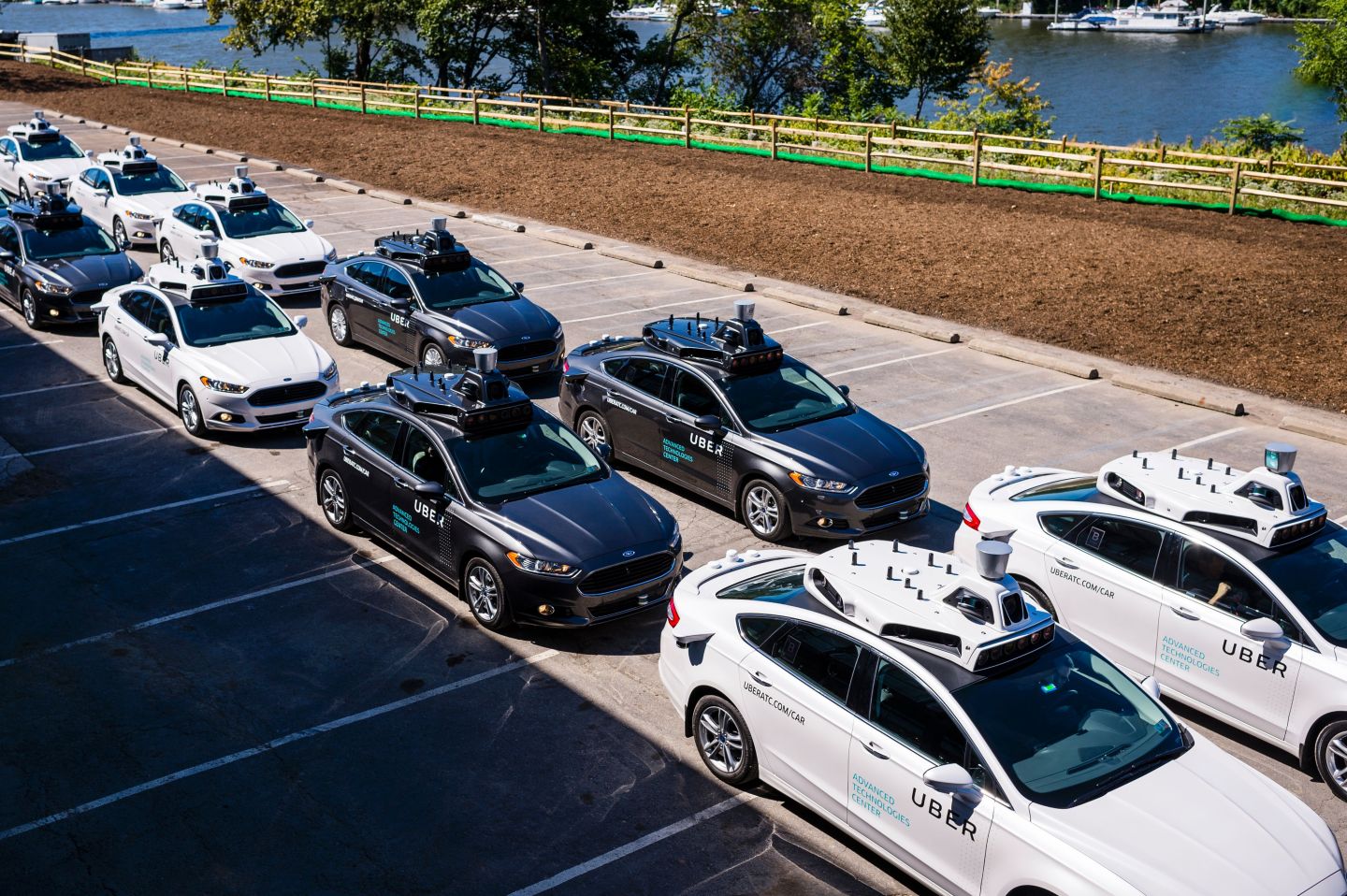
Pilot models of the Uber self-driving car is displayed at the Uber Advanced Technologies Center on September 13, 2016 in Pittsburgh, Pennsylvania. Uber launched a groundbreaking driverless car service, stealing ahead of Detroit auto giants and Silicon Valley rivals with technology that could revolutionize transportation. / AFP / Angelo Merendino (Photo credit should read ANGELO MERENDINO/AFP/Getty Images)Angelo Merendino — AFP/Getty Images
Add Fortune on Google for similar content.

With some cities using autonomous vehicle technology to rethink their public transportation and infrastructure, the federal government is helping encourage the technology’s spread. President Obama announced in a September editorial new federal rules to facilitate the gradual introduction of driverless vehicles on American roads. The plan consists of a 15-point safety assessment of the vehicles and proposes model legislation that states and cities can follow to facilitate their adoption.

The Transportation Department describes autonomous vehicles as “the next revolution in roadway safety,” arguing that most of the 40,000 traffic-related deaths in 2015 could have been avoided if human drivers were replaced by algorithms. It also describes the benefits of providing the elderly, children, and other non-drivers with a cleaner and easier means of transportation. John Zimmer, co-founder of Lyft, imagines the autonomous vehicle as a transformative force to reshape our congested cities, the antidote to its flawed ancestor, the manually controlled car. If, as Zimmer predicts, they will be used as taxis, autonomous cars could dramatically reduce the total number of vehicles on the road, liberating valuable urban space taken up by parking and gas stations.

But if this transformation is to take place, driverless vehicle manufacturers will need to find welcoming locations to test their products. Certain cities are racing to be leaders—and guinea pigs—in this experiment.

Google has had autonomous vehicles driving in the San Francisco Bay Area for years. More recently, it has also been testing cars on the streets of Phoenix, Austin, and Kirkland, Wash. Pittsburgh, home to pioneering self-driving car research at Carnegie Mellon University, has just formed an alliance with Uber to provide a driverless version of its service. Boston has announced a year-long test of autonomous vehicles on its streets in partnership with the World Economic Forum, with the goal of advancing safety, transportation access, and progress toward the organization’s sustainability goals.

Abroad, Singapore is pursuing a strategy to create a “car-light” city, pioneering the world’s first taxi service using autonomous vehicles in a limited circuit. Chinese company Baidu is attempting a similar feat in Beijing. Helsinki is now operating the first autonomous bus system. Cities in Japan and the United Kingdom are performing similar trials with driverless vehicles. Tokyo, the largest metropolitan area in the world, aims to have autonomous vehicles on the roads in time for the 2020 Summer Olympics.

Cities like Pittsburgh, Boston, Singapore, and Tokyo, who can bring together cutting edge research, sophisticated businesses, and strategic visions for improving their urban environments, are likely to emerge as leaders in these transformations.

But how will the advent of widespread autonomous vehicles change our cities?

One scenario is that autonomous vehicles will end up just being improved versions of traditional, manually controlled cars. If this is the case, we’re in trouble. While the car has allowed cities to grow, it has also facilitated suburbanization, segregation, and in some cases, the catastrophic decay of thriving cities.

Nowhere has this been clearer than in Detroit. The car pushed residents from the city center out to its sprawling suburbs, bleeding Motown of capital and eviscerating its tax base. When Detroit became less dense with people and businesses, it lost the socioeconomic interactions that make cities vital and creative places. Over the course of decades, it became a largely dangerous and inhospitable city for remaining residents.

If autonomous vehicles are just going to be greener, safer, and faster cars, then history and urban theory predict that they will generate more travel, not less. This could lead to more Detroit-type situations, but with the right knowledge and action, such a nightmare scenario can be avoided.

The most exciting thing about autonomous vehicles is that they can help us combine what is great about both public transportation and the conventional car. The crucial test will not be in the capabilities of the vehicles themselves, but in how we use them.

Public transportation allows anybody to ride for a small fee. It is also very energy-efficient as a result of aggregating many-person-trips along busy corridors. In high-density areas, it is separated from other land uses. Think of subway trains going underground, thus enabling different use of the land above them.


On the other hand, public transportation can be drab and uncomfortable, and suffer from the last-mile problem, meaning the difficulty commuters have in traveling the final distance from the train or bus stop to their home or office. Cars solve these problems and allow people more space, comfort, and privacy, but at considerable cost and by consuming a gargantuan amount of public space.

A system allowing autonomous vehicles to behave as subways in dense city centers—forming convoys of different vehicles such as private cars, shared vehicles, and ambulances—and as electric cars in suburbs would be the best of both worlds. In turn, this would also stimulate new businesses and technologies that can create jobs—such as the new systems necessary to coordinate traffic, new kinds of smart infrastructure, and new advertisement markets—and grow the economy.

Cities must now think big about such opportunities, with an integrated picture of real people and their real problems front-and-center.

Luís M. A. Bettencourt is a professor of complex systems at the Santa Fe Institute. He is not an investor of the companies mentioned in this article.

About the Author
By Luís Bettencourt
See full bioRight Arrow Button Icon
Add Fortune on Google for similar content.

Latest in Commentary

Finance
Lorem ipsum dolor sit amet, consectetur adipiscing elit, sed do eiusmod tempor incididunt ut labore et dolore magna aliqua. Ut enim ad minim veniam
By Fortune Editors
October 20, 2025
Finance
Lorem ipsum dolor sit amet, consectetur adipiscing elit, sed do eiusmod tempor incididunt ut labore et dolore magna aliqua. Ut enim ad minim veniam
By Fortune Editors
October 20, 2025
Finance
Lorem ipsum dolor sit amet, consectetur adipiscing elit, sed do eiusmod tempor incididunt ut labore et dolore magna aliqua. Ut enim ad minim veniam
By Fortune Editors
October 20, 2025
Finance
Lorem ipsum dolor sit amet, consectetur adipiscing elit, sed do eiusmod tempor incididunt ut labore et dolore magna aliqua. Ut enim ad minim veniam
By Fortune Editors
October 20, 2025
Finance
Lorem ipsum dolor sit amet, consectetur adipiscing elit, sed do eiusmod tempor incididunt ut labore et dolore magna aliqua. Ut enim ad minim veniam
By Fortune Editors
October 20, 2025
Finance
Lorem ipsum dolor sit amet, consectetur adipiscing elit, sed do eiusmod tempor incididunt ut labore et dolore magna aliqua. Ut enim ad minim veniam
By Fortune Editors
October 20, 2025

Most Popular

Finance
Lorem ipsum dolor sit amet, consectetur adipiscing elit, sed do eiusmod tempor incididunt ut labore et dolore magna aliqua. Ut enim ad minim veniam
By Fortune Editors
October 20, 2025
Finance
Lorem ipsum dolor sit amet, consectetur adipiscing elit, sed do eiusmod tempor incididunt ut labore et dolore magna aliqua. Ut enim ad minim veniam
By Fortune Editors
October 20, 2025
Finance
Lorem ipsum dolor sit amet, consectetur adipiscing elit, sed do eiusmod tempor incididunt ut labore et dolore magna aliqua. Ut enim ad minim veniam
By Fortune Editors
October 20, 2025
Finance
Lorem ipsum dolor sit amet, consectetur adipiscing elit, sed do eiusmod tempor incididunt ut labore et dolore magna aliqua. Ut enim ad minim veniam
By Fortune Editors
October 20, 2025
Finance
Lorem ipsum dolor sit amet, consectetur adipiscing elit, sed do eiusmod tempor incididunt ut labore et dolore magna aliqua. Ut enim ad minim veniam
By Fortune Editors
October 20, 2025
Finance
Lorem ipsum dolor sit amet, consectetur adipiscing elit, sed do eiusmod tempor incididunt ut labore et dolore magna aliqua. Ut enim ad minim veniam
By Fortune Editors
October 20, 2025
Fortune Secondary Logo
Rankings
  • 100 Best Companies
  • Fortune 500
  • Global 500
  • Fortune 500 Europe
  • Most Powerful Women
  • World's Most Admired Companies
  • See All Rankings
  • Lists Calendar
Sections
  • Finance
  • Fortune Crypto
  • Features
  • Leadership
  • Health
  • Commentary
  • Success
  • Retail
  • Mpw
  • Tech
  • Lifestyle
  • CEO Initiative
  • Asia
  • Politics
  • Conferences
  • Europe
  • Newsletters
  • Personal Finance
  • Environment
  • Magazine
  • Education
Customer Support
  • Frequently Asked Questions
  • Customer Service Portal
  • Privacy Policy
  • Terms Of Use
  • Single Issues For Purchase
  • International Print
Commercial Services
  • Advertising
  • Fortune Brand Studio
  • Fortune Analytics
  • Fortune Conferences
  • Business Development
  • Group Subscriptions
About Us
  • About Us
  • Press Center
  • Work At Fortune
  • Terms And Conditions
  • Site Map
  • About Us
  • Press Center
  • Work At Fortune
  • Terms And Conditions
  • Site Map
  • Facebook icon
  • Twitter icon
  • LinkedIn icon
  • Instagram icon
  • Pinterest icon

Latest in Commentary

senate
CommentaryCongress
One rare bipartisan AI bill is moving through Congress. Here’s why it deserves to pass
By Neil Björkman and Betsy BrewerJuly 1, 2026
19 hours ago
I know how Gen Z can survive the ‘jobpocalypse’ because I built an AI company — in 2015
CommentaryCareers
I know how Gen Z can survive the ‘jobpocalypse’ because I built an AI company — in 2015
By Jeremy FainJuly 1, 2026
19 hours ago
mr
Commentary250 Years of Innovation
America needs 3.8 million manufacturing workers. This CEO has a blueprint to find them
By Mark RayfieldJuly 1, 2026
19 hours ago
usa
Commentary250 Years of Innovation
America at 250: why the Constitution was built to restrain government, not celebrate majority rule
By Steve H. HankeJuly 1, 2026
19 hours ago
t
CommentaryMedia
Netflix could turn NBC into its biggest bet yet — and this time, the math actually works
By Jeffrey Sonnenfeld and Steven TianJune 30, 2026
2 days ago
wb
CommentaryLeadership
I grew BDO from $600 million to $3.4 billion. Here’s the 3-part formula that made it possible
By Wayne BersonJune 30, 2026
2 days ago

Most Popular

As Big Tech showers employees with perks to win the talent war, Nvidia built a nearly $5 trillion company by making people pay for their own lunch
Big Tech
As Big Tech showers employees with perks to win the talent war, Nvidia built a nearly $5 trillion company by making people pay for their own lunch
By Marco Quiroz-GutierrezJuly 1, 2026
23 hours ago
MacKenzie Scott alone accounted for one-third of America's $19.2 billion in megagifts last year
Success
MacKenzie Scott alone accounted for one-third of America's $19.2 billion in megagifts last year
By Sydney LakeJune 25, 2026
7 days ago
The Supreme Court's birthright citizenship ruling hands the U.S. economy a $7.7 trillion win
Newsletters
The Supreme Court's birthright citizenship ruling hands the U.S. economy a $7.7 trillion win
By Diane BradyJuly 1, 2026
21 hours ago
Current price of oil as of July 1, 2026
Personal Finance
Current price of oil as of July 1, 2026
By Joseph HostetlerJuly 1, 2026
17 hours ago
Philanthropy leader at Warren Buffett and Bill Gates’ Giving Pledge says children of billionaires are pushing them to give their wealth away faster
Success
Philanthropy leader at Warren Buffett and Bill Gates’ Giving Pledge says children of billionaires are pushing them to give their wealth away faster
By Preston ForeJune 27, 2026
5 days ago
Elon Musk on MacKenzie Scott giving away $26 billion of her fortune: 'Sadly,' it makes the world a worse place
Success
Elon Musk on MacKenzie Scott giving away $26 billion of her fortune: 'Sadly,' it makes the world a worse place
By Sydney LakeJune 29, 2026
3 days ago

© 2026 Fortune Media IP Limited. All Rights Reserved. Use of this site constitutes acceptance of our Terms of Use and Privacy Policy | CA Notice at Collection and Privacy Notice | Do Not Sell/Share My Personal Information
FORTUNE is a trademark of Fortune Media IP Limited, registered in the U.S. and other countries. FORTUNE may receive compensation for some links to products and services on this website. Offers may be subject to change without notice.