• Home
  • Latest
  • Fortune 500
  • Finance
  • Tech
  • Leadership
  • Lifestyle
  • Rankings
  • Multimedia

Trendingnow

1

Microsoft AI chief gives it 18 months—for all white-collar work to be automated by AI

2

Despite having a $165 million net worth, Scarlett Johansson says work-life balance doesn’t exist—and the first step to success is admitting that

3

The Bezos family just donated $100 million to help achieve one of Mayor Zohran Mamdani’s top campaign promises

1

Microsoft AI chief gives it 18 months—for all white-collar work to be automated by AI

2

Despite having a $165 million net worth, Scarlett Johansson says work-life balance doesn’t exist—and the first step to success is admitting that

3

The Bezos family just donated $100 million to help achieve one of Mayor Zohran Mamdani’s top campaign promises
Commentary

What Trump’s Presidency Could Mean for the Future of the GOP

By
Chris Baylor
Chris Baylor
and
Bethany Cianciolo
Bethany Cianciolo
Down Arrow Button Icon
By
Chris Baylor
Chris Baylor
and
Bethany Cianciolo
Bethany Cianciolo
Down Arrow Button Icon
November 15, 2016, 2:28 PM ET
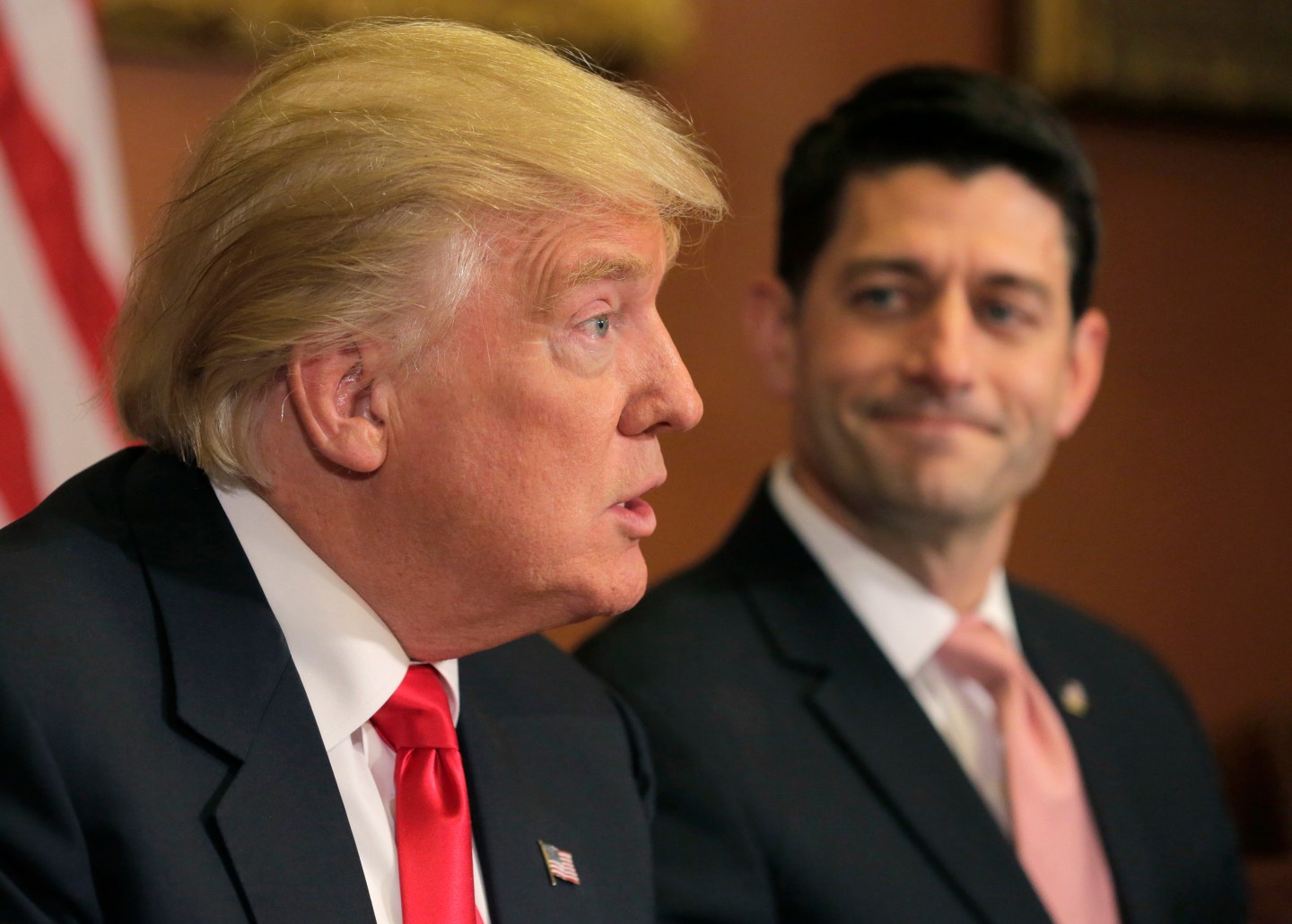
U.S. President-elect Donald Trump meets with Speaker of the House Paul Ryan on Capitol Hill in Washington
U.S. President-elect Donald Trump (L) meets with Speaker of the House Paul Ryan (R-WI) on Capitol Hill in Washington, U.S., November 10, 2016. REUTERS/Joshua Roberts - RTX2T38IJoshua Roberts—Reuters

Against all odds, a progressive Democrat won an election in Republican times and passed several ambitious policies. Though the political climate was polarized and conservatives resilient, the president reformed American economic and foreign policy. Despite a last-minute tour around the country to save his legacy, it was disastrously repudiated in the following presidential election. Sound familiar?

While this could describe Barack Obama, it could also describe Woodrow Wilson. President Wilson lived in a time of Republican dominance, but he was able to exploit temporary weakness in the Republican Party and build cross-party coalitions. With a unified government for six years, he helped to create the Federal Reserve and a proto United Nations. But what some called idealism, others called overreach. Democrats not only lost congressional midterms in 1918, but lost the White House for the next three election cycles. In 1920, Republicans won in a landslide by repudiating the last eight years for a “return to normalcy.” While the Republicans were united in opposition to a Democratic president’s perceived overreach, rejection of a president could not patch over a divided party’s internal conundrums. The threat to Republican dominance did not come from Wilson, but from within.

Along with many other political scientists and prognosticators, results have proven me wrong several times in this electoral cycle. But political scientist Stephen Skowronek’s theory of the presidency suggests that presidential leadership goes in cycles. Several signs indicate that, in spite of impressive victories last week, Republicans could be on the verge of being a repudiated political minority for the next generation. Trump might join presidents like Jimmy Carter and Herbert Hoover, “disjunctive” presidents who sometimes win promising electoral victories, but soon break a cycle in which their party was dominant.

Several commentators are writing that Trump has redefined politics, reversing traditional Republican policies and flipping many of the districts that President Obama won. But in several ways, he fits the pattern of disjunctive presidents at the end of the generation of one party’s dominance. One sign of desperation is appealing so forcefully outside of a party’s base, indicating strategic savvy for minority parties but weakness for a party that is supposedly dominant. Dwindling support for Ronald Reagan’s traditional agenda forced Republicans to make new accommodations, for example. Another sign of desperation is nominating a candidate with tenuous connections to a party. Like Trump, other disjunctive presidents spent much of their career unaffiliated with the party that nominated them (think John Quincy Adams and Hoover). A robust Reagan regime would have nominated someone more obviously committed to its party inheritance.

A final sign of desperation is focus on technique over substantive reform, since efficiency is one of the few platforms everyone can agree on. Disjunctive presidents accept what policies are already in place but promise to run them better. While some of Trump’s promises are too odd to classify, much of his campaign boiled down to “I can do it better than you.” Trump claims to support free trade, but negotiate better trade deals than his predecessors. Although opposed to Obamacare, he insisted on an unspecified form of universal health care coverage during the primary debates. Where Hoover and Carter relied on their engineering expertise, Trump advertises his business background.

Disjunctive presidents pave the way for “reconstructive” presidents like Franklin Roosevelt and Reagan, whose parties enjoyed a long period of dominance. Time and Newsweek have compared Obama to Roosevelt and Reagan, but like Wilson, Obama turned out to be a Democrat in Republican times. For both Obama and Wilson, many of their supporters went back to their usual ways in the next election cycle. Where reconstructive presidents permanently augment their parties, opposition presidents only temporarily win over unreliable constituencies. Trump flipped districts that Obama won in Wisconsin, but many of those same districts had voted for Bush in 2004. Democrats have controlled Congress and the White House more often than they did before Wilson, but firm conservative opposition keeps bouncing back, even after being blamed for the Great Recession.

Opposition parties that are not reconstructing a new cycle have come close to passing the torch, but failed by a razor’s edge (consider the failed candidacies of Richard Nixon, Al Gore, and now Hillary Clinton). Like Warren G. Harding’s admonition to “return to normalcy” after Wilson’s presidency, Trump’s slogan of “make America great again” resonated with a large part of the country nostalgic for the time before Obama. Obama’s signature achievement, the Affordable Care Act, may only survive repeal with a filibuster, a last resort for embattled political minorities.


Other disjunctive presidents like Hoover and Carter started off with impressive victories. While Carter’s election was close, Hoover won 40 states and 58% of the vote. Both won overwhelming majorities in both houses of Congress. Yet, both parties soon lost control not only over the levers of government for the better part of a generation, but the dominant political discourse. Hoover’s name became synonymous with economic disaster and post-Carter Democrats forsook the word “liberal.” Even before hard times confronted the country, these presidents were caught between a party establishment that insisted on its traditional agenda and changing times that called for innovation. Trump and House Speaker Paul Ryan seem poised to get along about as well as Carter and then-House Speaker Tip O’Neill, diverging on approaches to immigration, trade, entitlement reform, and Russia. Disjunctive presidents wrestle with how to honor old party commitments in changing times, aggravating party cleavages to a point of collapse and rewarding the next nominee from another party.

Maybe Trump will be different than earlier disjunctive presidents. After all, he already bypassed party elites with media appeals to an army of unorganized voters that nominated him over establishment figures. While Trump’s recruitment of working class whites was impressive, he will have a difficult time keeping such voters happy while also maintaining the party base most presidents need. Working class votes rejected free market solutions by voting for Trump over the likes of Rand Paul and Ted Cruz, and Trump will split the party in two if he goes too far to accommodate his new recruits. Democrats are already making the case for full-scale transformation, and the Bernie Sanders and Elizabeth Warrens of the party are counting on impending feelings of betrayal among the white working class to inaugurate a new era.

Chris Baylor is a visiting assistant professor at Washington College and author of the forthcoming book, First to the Party: the Group Origins of Party Transformation.
About the Authors
By Chris Baylor
See full bioRight Arrow Button Icon
By Bethany Cianciolo
See full bioRight Arrow Button Icon

Latest in Commentary

Finance
Lorem ipsum dolor sit amet, consectetur adipiscing elit, sed do eiusmod tempor incididunt ut labore et dolore magna aliqua. Ut enim ad minim veniam
By Fortune Editors
October 20, 2025
Finance
Lorem ipsum dolor sit amet, consectetur adipiscing elit, sed do eiusmod tempor incididunt ut labore et dolore magna aliqua. Ut enim ad minim veniam
By Fortune Editors
October 20, 2025
Finance
Lorem ipsum dolor sit amet, consectetur adipiscing elit, sed do eiusmod tempor incididunt ut labore et dolore magna aliqua. Ut enim ad minim veniam
By Fortune Editors
October 20, 2025
Finance
Lorem ipsum dolor sit amet, consectetur adipiscing elit, sed do eiusmod tempor incididunt ut labore et dolore magna aliqua. Ut enim ad minim veniam
By Fortune Editors
October 20, 2025
Finance
Lorem ipsum dolor sit amet, consectetur adipiscing elit, sed do eiusmod tempor incididunt ut labore et dolore magna aliqua. Ut enim ad minim veniam
By Fortune Editors
October 20, 2025
Finance
Lorem ipsum dolor sit amet, consectetur adipiscing elit, sed do eiusmod tempor incididunt ut labore et dolore magna aliqua. Ut enim ad minim veniam
By Fortune Editors
October 20, 2025

Most Popular

Finance
Lorem ipsum dolor sit amet, consectetur adipiscing elit, sed do eiusmod tempor incididunt ut labore et dolore magna aliqua. Ut enim ad minim veniam
By Fortune Editors
October 20, 2025
Finance
Lorem ipsum dolor sit amet, consectetur adipiscing elit, sed do eiusmod tempor incididunt ut labore et dolore magna aliqua. Ut enim ad minim veniam
By Fortune Editors
October 20, 2025
Finance
Lorem ipsum dolor sit amet, consectetur adipiscing elit, sed do eiusmod tempor incididunt ut labore et dolore magna aliqua. Ut enim ad minim veniam
By Fortune Editors
October 20, 2025
Finance
Lorem ipsum dolor sit amet, consectetur adipiscing elit, sed do eiusmod tempor incididunt ut labore et dolore magna aliqua. Ut enim ad minim veniam
By Fortune Editors
October 20, 2025
Finance
Lorem ipsum dolor sit amet, consectetur adipiscing elit, sed do eiusmod tempor incididunt ut labore et dolore magna aliqua. Ut enim ad minim veniam
By Fortune Editors
October 20, 2025
Finance
Lorem ipsum dolor sit amet, consectetur adipiscing elit, sed do eiusmod tempor incididunt ut labore et dolore magna aliqua. Ut enim ad minim veniam
By Fortune Editors
October 20, 2025
Fortune Secondary Logo
Rankings
  • 100 Best Companies
  • Fortune 500
  • Global 500
  • Fortune 500 Europe
  • Most Powerful Women
  • World's Most Admired Companies
  • See All Rankings
  • Lists Calendar
Sections
  • Finance
  • Fortune Crypto
  • Features
  • Leadership
  • Health
  • Commentary
  • Success
  • Retail
  • Mpw
  • Tech
  • Lifestyle
  • CEO Initiative
  • Asia
  • Politics
  • Conferences
  • Europe
  • Newsletters
  • Personal Finance
  • Environment
  • Magazine
  • Education
Customer Support
  • Frequently Asked Questions
  • Customer Service Portal
  • Privacy Policy
  • Terms Of Use
  • Single Issues For Purchase
  • International Print
Commercial Services
  • Advertising
  • Fortune Brand Studio
  • Fortune Analytics
  • Fortune Conferences
  • Business Development
  • Group Subscriptions
About Us
  • About Us
  • Press Center
  • Work At Fortune
  • Terms And Conditions
  • Site Map
  • About Us
  • Press Center
  • Work At Fortune
  • Terms And Conditions
  • Site Map
  • Facebook icon
  • Twitter icon
  • LinkedIn icon
  • Instagram icon
  • Pinterest icon

Latest in Commentary

liberman
Commentarystart-ups
We watched social media concentrate. The same thing is happening in AI, only at a deeper layer
By David Liberman and Daniil LibermanMay 16, 2026
12 hours ago
olivier
CommentaryAnthropic
I’ve been studying Big Tech for a long time. What just happened with Anthropic and the Pentagon terrifies me
By Olivier SylvainMay 16, 2026
13 hours ago
lawyer
CommentaryLaw
Would you hire the lawyer who just got sanctioned for using AI?
By Alexandra SmythMay 16, 2026
15 hours ago
greg
Personal FinanceAviation
Mamdani’s New York is coming to tax your private jet. Here’s how to prepare
By Greg RaiffMay 16, 2026
16 hours ago
chase
CommentaryCities
San Francisco has $2 trillion in AI wealth and can’t fix its own city. That’s every city’s problem
By Chase GarbarinoMay 15, 2026
2 days ago
lori
Commentarymental health
I run Valvoline Instant Oil Change and work with young people every day. They’re in crisis—and we all have to try to help
By Lori FleesMay 15, 2026
2 days ago

Most Popular

Microsoft AI chief gives it 18 months—for all white-collar work to be automated by AI
AI
Microsoft AI chief gives it 18 months—for all white-collar work to be automated by AI
By Jake AngeloMay 16, 2026
13 hours ago
Despite having a $165 million net worth, Scarlett Johansson says work-life balance doesn’t exist—and the first step to success is admitting that
Success
Despite having a $165 million net worth, Scarlett Johansson says work-life balance doesn’t exist—and the first step to success is admitting that
By Preston ForeMay 13, 2026
3 days ago
The Bezos family just donated $100 million to help achieve one of Mayor Zohran Mamdani’s top campaign promises
Politics
The Bezos family just donated $100 million to help achieve one of Mayor Zohran Mamdani’s top campaign promises
By Jake AngeloMay 12, 2026
4 days ago
Meet the 20-year-old CEO who launched a company in high school to solve Gen Z's entry-level job crisis
Future of Work
Meet the 20-year-old CEO who launched a company in high school to solve Gen Z's entry-level job crisis
By Jake AngeloMay 16, 2026
17 hours ago
‘You’re not a hero, you’re a liability’: Shark Tank’s Kevin O’Leary warns Gen Z founders to stop glorifying hustle culture
Future of Work
‘You’re not a hero, you’re a liability’: Shark Tank’s Kevin O’Leary warns Gen Z founders to stop glorifying hustle culture
By Jacqueline MunisMay 16, 2026
13 hours ago
Current price of oil as of May 15, 2026
Personal Finance
Current price of oil as of May 15, 2026
By Joseph HostetlerMay 15, 2026
2 days ago

© 2026 Fortune Media IP Limited. All Rights Reserved. Use of this site constitutes acceptance of our Terms of Use and Privacy Policy | CA Notice at Collection and Privacy Notice | Do Not Sell/Share My Personal Information
FORTUNE is a trademark of Fortune Media IP Limited, registered in the U.S. and other countries. FORTUNE may receive compensation for some links to products and services on this website. Offers may be subject to change without notice.