• Home
  • Latest
  • Fortune 500
  • Finance
  • Tech
  • Leadership
  • Lifestyle
  • Rankings
  • Multimedia

Trendingnow

1

Microsoft AI chief gives it 18 months—for all white-collar work to be automated by AI

2

Former top Russian official admits the country is over Putin and can 'imagine a future without him' — even elites bail as Kremlin seizes their assets 

3

The Bezos family just donated $100 million to help achieve one of Mayor Zohran Mamdani’s top campaign promises

1

Microsoft AI chief gives it 18 months—for all white-collar work to be automated by AI

2

Former top Russian official admits the country is over Putin and can 'imagine a future without him' — even elites bail as Kremlin seizes their assets 

3

The Bezos family just donated $100 million to help achieve one of Mayor Zohran Mamdani’s top campaign promises
Commentary

3 Reasons 2017 Will Be a Pivotal Year for the Euro

By
Robin Huguenot-Noël
Robin Huguenot-Noël
and
Bethany Cianciolo
Bethany Cianciolo
Down Arrow Button Icon
By
Robin Huguenot-Noël
Robin Huguenot-Noël
and
Bethany Cianciolo
Bethany Cianciolo
Down Arrow Button Icon
December 27, 2016, 11:27 AM ET
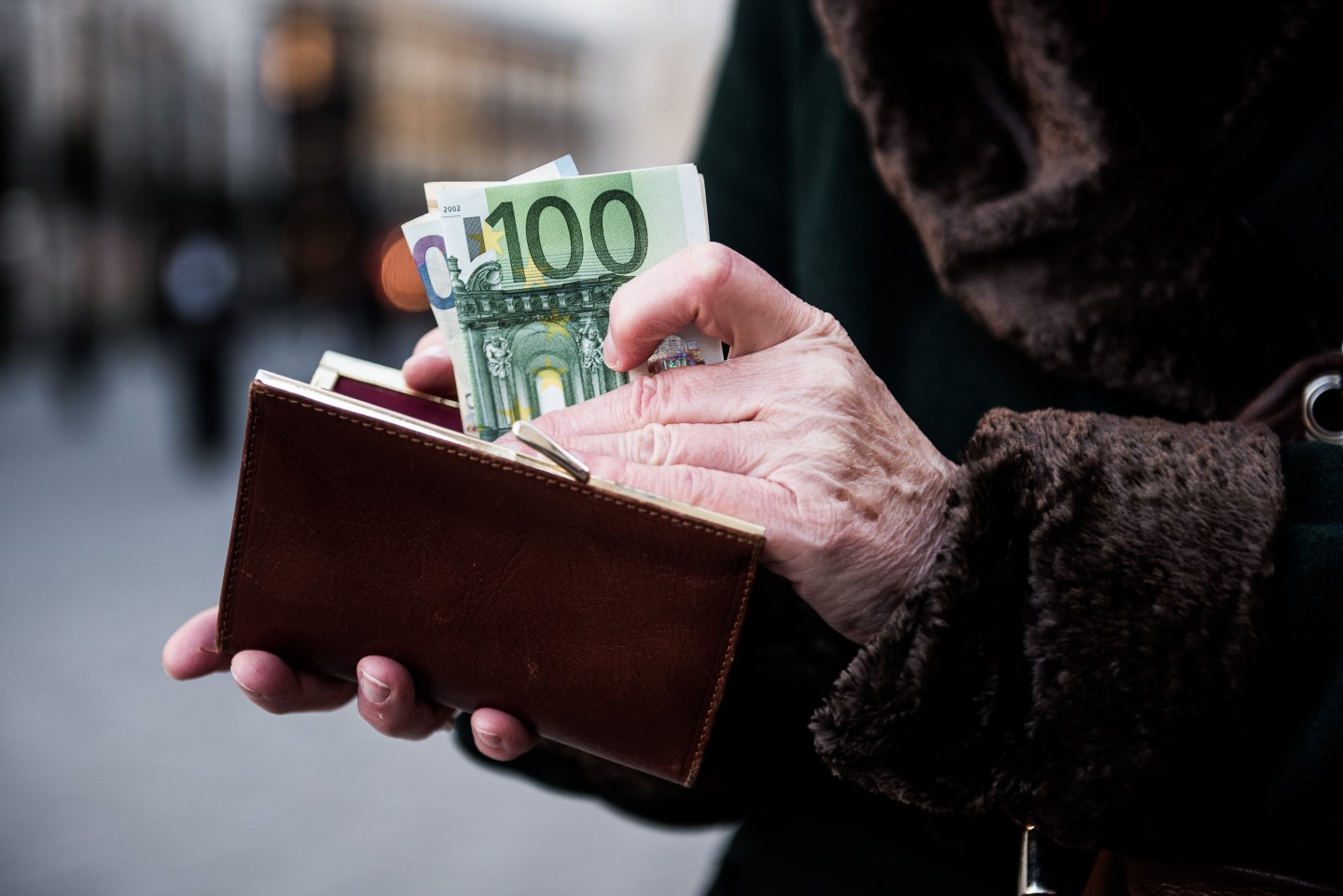
Preparations Ahead Of The 171st Organization Of Petroleum Exporting Countries (OPEC) Conference
A customer places euro banknotes into a purse ahead of the 171st Organization of Petroleum Exporting Countries (OPEC) meeting in Vienna, Austria, on Tuesday, Nov. 29, 2016. An OPEC deal to curtail oil production appeared in jeopardy as Iran said it wont make cuts while Saudi Arabia insisted Tehran must be willing to play a meaningful role in any agreement. Photographer: Akos Stiller/Bloomberg via Getty ImagesAkos Stiller—Bloomberg via Getty Images

The euro has come a long way since its introduction 18 years ago, and has brought a lot of benefits. This has notably led it to expand from 12 to 19 members in the last decade. Despite these achievements, though, 2017 is unlikely to see the euro celebrated across the continent.

The sovereign debt crisis in the Eurozone has shown that the euro area was able to square the circle between resilience and flexibility. On the one hand, euro area members have shown their commitment to preserving the common currency by notably engaging in substantial bailout programs for Greece, Ireland, Portugal, Spain, and Cyprus, agreeing to a partial write-off of the Greek debt, and creating two multi-billion-euro rescue mechanisms: the European Financial Stability Facility (EFSF) and the European Stability Mechanism (ESM).

On the other hand, the countries benefiting from these funds have indicated that they were ready to go through unprecedented fiscal consolidation efforts, accompanied by deep and painful structural reforms, in order to maintain their membership in the common currency. As a result, some substantial progress has been accomplished, including new instruments of governance, economic and fiscal consolidation, as well as increased surveillance by certain macroeconomic indicators, such as the current account balance, real exchange rate, and housing prices. Furthermore, important steps have been achieved in increasing the resilience of the Eurozone by strengthening the supervisory role of the European Central Bank’s (ECB) in the newly created banking union.

Despite the progress made during the crisis, though, the Economic and Monetary Union (EMU) is still fragile, as some of its underlying challenges remain unresolved. In this context, economic and political developments in 2017 could well determine the future of the euro. Here are three reasons why:

Banks’ troubles could destabilize the Eurozone
In the banking sector, non-performing loans are reaching worrying levels in some member states, especially in Cyprus, Greece, and Italy, casting doubts over the resilience of Europe’s banking sector. Speculations about the possible failings of European banks (such as Deutsche Bank or Monte Dei Paschi di Siena) and the political turmoil in individual member states, like Italy, the Netherlands, and possibly France, combined with the looming prospect of Brexit, indicate that the crisis could re-escalate.

On the fiscal side, the severe debt overhang—both in the public and the private sector—and the increasing share of countries with excessive macroeconomic imbalances—Bulgaria, Croatia, Cyprus, France, Italy, and Portugal—are also a possible cause of concern, as they could have detrimental effects on other member states. Finally, sovereign debtors and their national banking systems remain closely linked so that the destabilization of either one could still increase the vulnerability of the other. As long as this vicious circle remains, the euro will remain exposed to financial speculation on the ability of its member states to preserve the integrity of the euro area.

Uneven growth persists
While the financial and banking crisis pushed the EU and its members to address some of the shortcomings of the EMU, its lasting impact on low levels of growth and investment and high levels of unemployment indeed lead to increasing disparities across the continent. Today, the EMU is divided geographically—between North-South and East-West asymmetries—and socially—with an increasing discrepancy in development and inequality levels within and between countries.

At the same time, while most of the decisions taken during the crisis have had direct impact on the everyday realities of numerous Europeans, these decisions have failed to be matched with higher involvement of citizens in the decision-making process (by increasing the accountability of institutions such as the ECB, the ESM, or the European Investment Bank, for example). These social and political anxieties have fueled Eurosceptic tendencies across Europe, which could, in turn, threaten the political acceptability of the euro project. In this context, the greatest challenge facing the euro today lies in its member states’ ability to agree on a collective response to the sense of social and political urgency in some member states.

It’s a big election year for Europe
Next year will be marked by elections in the Netherlands, France, Germany, and most likely, Italy. Will this provide a more or less favorable environment for the euro governance to address these political and social challenges?

The populations’ growing concerns about migration and security issues have pushed economic and fiscal reforms further down the political agenda. Furthermore, as the more favorable conjuncture (low interest rates, favorable exchange rate vis-à-vis the U.S., falling oil prices, etc.) has considerably reduced the sense of emergency created by the financial and economic crisis, it seems highly unlikely that policymakers will introduce long-term reforms with high, short-term political costs before the elections.

In the current political context, ‘populist’ parties, which have identified the euro as one of their main targets, are expected to see their influence and representation increase in these four member states. Assuming that none of these parties manages to ensure enough seats to form a government on its own, the future of the euro’s faith could lie in the way in which mainstream parties will decide to respond to this trend after the election.

On the one hand, the rise of populist forces could push newly elected governments to follow trends toward national retrenchment. On the other hand, progressive leaders may consider that they can no longer afford to wait before engaging the necessary reforms, precisely because they see the danger of rising nationalism becoming more real.

In the first scenario, the temptation to bend to pressures in favor of increased protectionism would not only affect the EU’s ability to achieve a consensus on how to reform the euro, but could also potentially undermine the achievements of the 25-year euro construction project. In the second scenario, though, the post-elections period in four of the six EU founding members could help build a momentum for EMU reform.

The history of the euro has shown that reforms of the common currency first required consensus between France and Germany on which way to go forward. All eyes should now be turned on their (newly elected) leaders’ ability to reconcile the euro with its political maturity.

Robin Huguenot-Noël is a policy analyst at the European Policy Centre.

About the Authors
By Robin Huguenot-Noël
See full bioRight Arrow Button Icon
By Bethany Cianciolo
See full bioRight Arrow Button Icon

Latest in Commentary

Finance
Lorem ipsum dolor sit amet, consectetur adipiscing elit, sed do eiusmod tempor incididunt ut labore et dolore magna aliqua. Ut enim ad minim veniam
By Fortune Editors
October 20, 2025
Finance
Lorem ipsum dolor sit amet, consectetur adipiscing elit, sed do eiusmod tempor incididunt ut labore et dolore magna aliqua. Ut enim ad minim veniam
By Fortune Editors
October 20, 2025
Finance
Lorem ipsum dolor sit amet, consectetur adipiscing elit, sed do eiusmod tempor incididunt ut labore et dolore magna aliqua. Ut enim ad minim veniam
By Fortune Editors
October 20, 2025
Finance
Lorem ipsum dolor sit amet, consectetur adipiscing elit, sed do eiusmod tempor incididunt ut labore et dolore magna aliqua. Ut enim ad minim veniam
By Fortune Editors
October 20, 2025
Finance
Lorem ipsum dolor sit amet, consectetur adipiscing elit, sed do eiusmod tempor incididunt ut labore et dolore magna aliqua. Ut enim ad minim veniam
By Fortune Editors
October 20, 2025
Finance
Lorem ipsum dolor sit amet, consectetur adipiscing elit, sed do eiusmod tempor incididunt ut labore et dolore magna aliqua. Ut enim ad minim veniam
By Fortune Editors
October 20, 2025

Most Popular

Finance
Lorem ipsum dolor sit amet, consectetur adipiscing elit, sed do eiusmod tempor incididunt ut labore et dolore magna aliqua. Ut enim ad minim veniam
By Fortune Editors
October 20, 2025
Finance
Lorem ipsum dolor sit amet, consectetur adipiscing elit, sed do eiusmod tempor incididunt ut labore et dolore magna aliqua. Ut enim ad minim veniam
By Fortune Editors
October 20, 2025
Finance
Lorem ipsum dolor sit amet, consectetur adipiscing elit, sed do eiusmod tempor incididunt ut labore et dolore magna aliqua. Ut enim ad minim veniam
By Fortune Editors
October 20, 2025
Finance
Lorem ipsum dolor sit amet, consectetur adipiscing elit, sed do eiusmod tempor incididunt ut labore et dolore magna aliqua. Ut enim ad minim veniam
By Fortune Editors
October 20, 2025
Finance
Lorem ipsum dolor sit amet, consectetur adipiscing elit, sed do eiusmod tempor incididunt ut labore et dolore magna aliqua. Ut enim ad minim veniam
By Fortune Editors
October 20, 2025
Finance
Lorem ipsum dolor sit amet, consectetur adipiscing elit, sed do eiusmod tempor incididunt ut labore et dolore magna aliqua. Ut enim ad minim veniam
By Fortune Editors
October 20, 2025
Fortune Secondary Logo
Rankings
  • 100 Best Companies
  • Fortune 500
  • Global 500
  • Fortune 500 Europe
  • Most Powerful Women
  • World's Most Admired Companies
  • See All Rankings
  • Lists Calendar
Sections
  • Finance
  • Fortune Crypto
  • Features
  • Leadership
  • Health
  • Commentary
  • Success
  • Retail
  • Mpw
  • Tech
  • Lifestyle
  • CEO Initiative
  • Asia
  • Politics
  • Conferences
  • Europe
  • Newsletters
  • Personal Finance
  • Environment
  • Magazine
  • Education
Customer Support
  • Frequently Asked Questions
  • Customer Service Portal
  • Privacy Policy
  • Terms Of Use
  • Single Issues For Purchase
  • International Print
Commercial Services
  • Advertising
  • Fortune Brand Studio
  • Fortune Analytics
  • Fortune Conferences
  • Business Development
  • Group Subscriptions
About Us
  • About Us
  • Press Center
  • Work At Fortune
  • Terms And Conditions
  • Site Map
  • About Us
  • Press Center
  • Work At Fortune
  • Terms And Conditions
  • Site Map
  • Facebook icon
  • Twitter icon
  • LinkedIn icon
  • Instagram icon
  • Pinterest icon

Latest in Commentary

murdochs
CommentaryMedia
OpenAI paid $100 million for a talk show. James Murdoch is eyeing an even bigger deal. The hot new asset class is humanity
By Lin CherryMay 17, 2026
5 hours ago
dennis
CommentaryAI agents
Freshworks CEO: why agile enterprises are winning the AI race — and what they did differently
By Dennis WoodsideMay 17, 2026
5 hours ago
Mary Moreland-Abbott Executive Vice President of Human Resources.
CommentaryRetirement
Gen X is the most indebted generation in America. Their employers can fix that
By Mary MorelandMay 17, 2026
7 hours ago
liberman
Commentarystart-ups
We watched social media concentrate. The same thing is happening in AI, only at a deeper layer
By David Liberman and Daniil LibermanMay 16, 2026
1 day ago
olivier
CommentaryAnthropic
I’ve been studying Big Tech for a long time. What just happened with Anthropic and the Pentagon terrifies me
By Olivier SylvainMay 16, 2026
1 day ago
lawyer
CommentaryLaw
Would you hire the lawyer who just got sanctioned for using AI?
By Alexandra SmythMay 16, 2026
1 day ago

Most Popular

Microsoft AI chief gives it 18 months—for all white-collar work to be automated by AI
AI
Microsoft AI chief gives it 18 months—for all white-collar work to be automated by AI
By Jake AngeloMay 16, 2026
1 day ago
Former top Russian official admits the country is over Putin and can 'imagine a future without him' — even elites bail as Kremlin seizes their assets 
Politics
Former top Russian official admits the country is over Putin and can 'imagine a future without him' — even elites bail as Kremlin seizes their assets 
By Jason MaMay 16, 2026
19 hours ago
The Bezos family just donated $100 million to help achieve one of Mayor Zohran Mamdani’s top campaign promises
Politics
The Bezos family just donated $100 million to help achieve one of Mayor Zohran Mamdani’s top campaign promises
By Jake AngeloMay 12, 2026
5 days ago
SpaceX heads into a record-shattering IPO with the 'deepest moat that exists today' as investors vow to 'never bet against Elon'
Innovation
SpaceX heads into a record-shattering IPO with the 'deepest moat that exists today' as investors vow to 'never bet against Elon'
By Jason MaMay 16, 2026
1 day ago
Oil markets could be a month away from the moment of truth. Brace for a 'non-linear' price spike and panic buying, analysts warn
Energy
Oil markets could be a month away from the moment of truth. Brace for a 'non-linear' price spike and panic buying, analysts warn
By Jason MaMay 16, 2026
22 hours ago
‘You’re not a hero, you’re a liability’: Shark Tank’s Kevin O’Leary warns Gen Z founders to stop glorifying hustle culture
Future of Work
‘You’re not a hero, you’re a liability’: Shark Tank’s Kevin O’Leary warns Gen Z founders to stop glorifying hustle culture
By Jacqueline MunisMay 16, 2026
1 day ago

© 2026 Fortune Media IP Limited. All Rights Reserved. Use of this site constitutes acceptance of our Terms of Use and Privacy Policy | CA Notice at Collection and Privacy Notice | Do Not Sell/Share My Personal Information
FORTUNE is a trademark of Fortune Media IP Limited, registered in the U.S. and other countries. FORTUNE may receive compensation for some links to products and services on this website. Offers may be subject to change without notice.