• Home
  • Latest
  • Fortune 500
  • Finance
  • Tech
  • Leadership
  • Lifestyle
  • Rankings
  • Multimedia

Trendingnow

1

Microsoft AI chief gives it 18 months—for all white-collar work to be automated by AI

2

Former top Russian official admits the country is over Putin and can 'imagine a future without him' — even elites bail as Kremlin seizes their assets 

3

The Bezos family just donated $100 million to help achieve one of Mayor Zohran Mamdani’s top campaign promises

1

Microsoft AI chief gives it 18 months—for all white-collar work to be automated by AI

2

Former top Russian official admits the country is over Putin and can 'imagine a future without him' — even elites bail as Kremlin seizes their assets 

3

The Bezos family just donated $100 million to help achieve one of Mayor Zohran Mamdani’s top campaign promises
TechQualcomm

Why Qualcomm’s Super Profitable Royalty Business Is Suddenly Under Siege

By
Aaron Pressman
Aaron Pressman
Down Arrow Button Icon
By
Aaron Pressman
Aaron Pressman
Down Arrow Button Icon
January 23, 2017, 5:02 PM ET
Inside The 2014 Consumer Electronics Show
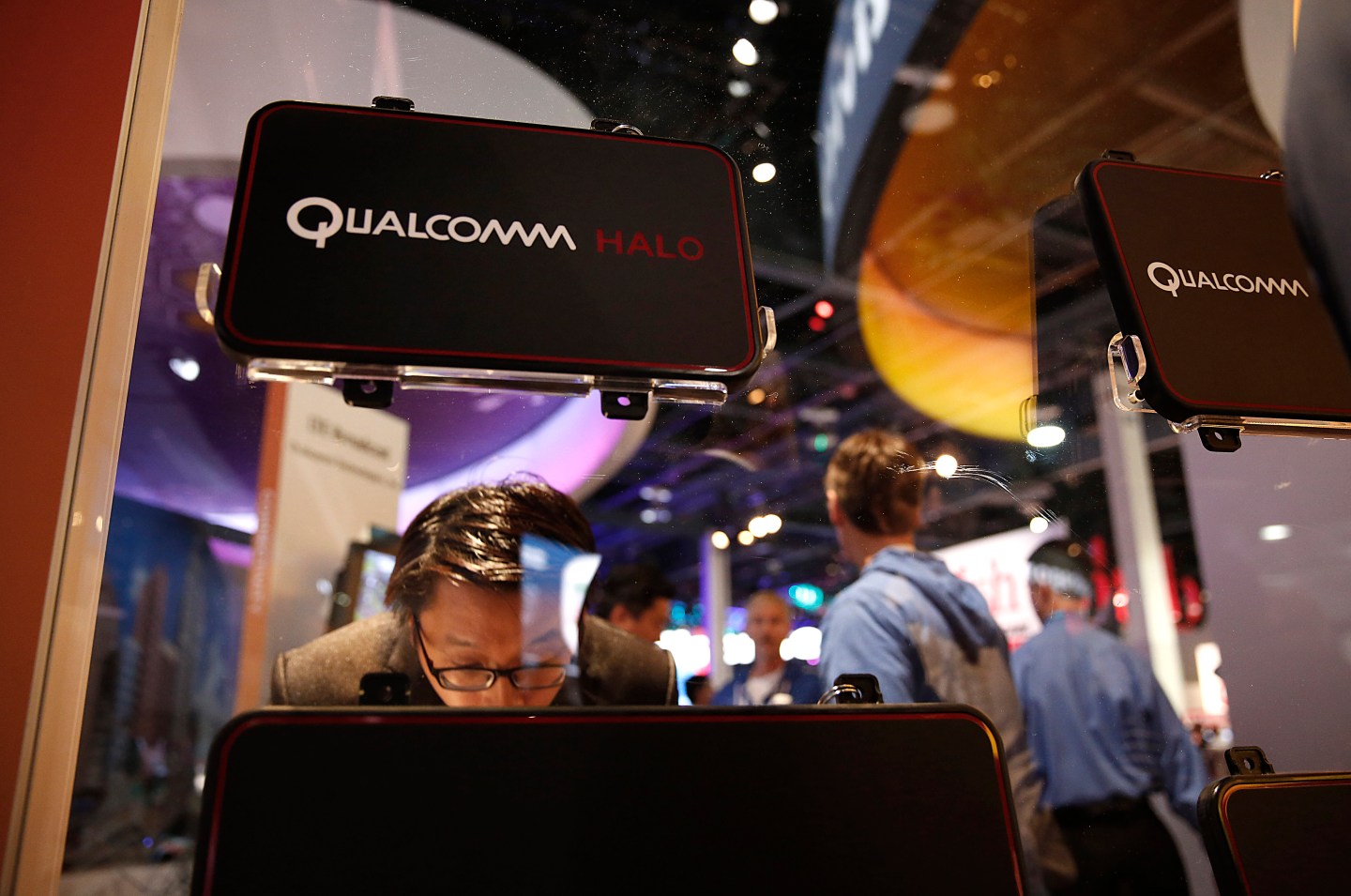
An attendee views the Qualcomm Inc. Halo Wireless Electric Vehicle Charging (WEVC) during the 2014 Consumer Electronics Show (CES) in Las Vegas, Nevada, U.S., on Thursday, Jan. 9, 2014. The CES trade show, which runs until Jan. 10, is the world's largest annual innovation event, offering an array of entrepreneur-focused exhibits, events, and conference sessions for technology entrepreneurs. Photographer: Patrick T. Fallon/Bloomberg via Getty ImagesPhotograph by Patrick T. Fallon — Bloomberg via Getty Images

For every basic iPhone 7 it sells for $649, Apple pays about $15 to Qualcomm in royalties for using the mobile chip maker’s patented wireless technology, according to analysts. Apple pays slightly more in royalties for the higher-end $749 and even more on $849 iPhones, based on their higher prices.

According to its lawsuit against Qualcomm last week and from other recent regulatory cases, Apple may even pay the same royalty rates—or more—for iPhones that don’t use Qualcomm chips. After a five-year exclusivity agreement with Qualcomm expired last year, Apple began using competing wireless modem chips from Intel in about half of its newest iPhones. But Qualcomm seeks royalties under the assumption that any wireless modem chip is relying on many of its related patents.

The somewhat convoluted Qualcomm licensing scheme, in practice, used calculations and discounts related to the cost of making the iPhone along with payments to and from Apple manufacturers like Foxconn (see graphic below). They also involved Qualcomm giving back what Apple characterizes as quarterly rebates tied to other contractual restrictions.

Part of why Apple sued now appears to be that Qualcomm started withholding those rebates last fall that add up about $1 billion.

Get Data Sheet, Fortune’s technology newsletter.

Whatever the case, the royalty arrangement has been incredibly lucrative for Qualcomm. Last year its royalty licensing division reported $6.5 billion of pretax profit on $7.6 billion of revenue. Meanwhile, the company’s chip business itself only made $1.8 billion in pretax profit on $15.4 billion of sales.

Now, with lawsuits filed last week by the Federal Trade Commission and Apple (AAPL) along with a nearly $1 billion fine from the Korea Fair Trade Commission last month, that royalty strategy is under attack. Bernstein Research analyst Stacy Rasgon calls it “a direct assault on the basic structure of Qualcomm’s licensing business model.” Though the legal battles are just now topping the headlines, Apple and other large smart phone makers like Samsung appear to have seen an opening to hit the Qualcomm (QCOM) model after China cracked down on the chipmaker’s allegedly monopolistic practices two years ago, imposing a $975 million fine and forcing new negotiations with device makers.

Full Price Royalties

The core of the new attack from Apple and the FTC is aimed at Qualcomm’s practice of charging royalties based on a device’s total value, as opposed to just the value of the mobile chips inside the device. That means whenever a smart phone maker adds more to a phone, whether for additional storage, an improved camera or a new hardware feature, Qualcomm gets a higher royalty.

Qualcomm has also strengthened its bargaining position by seeking royalties from smart phone makers instead of the companies that make the component mobile chipsets that go in phones.

Typically, companies that make other parts inside smart phones unrelated to Qualcomm’s patents, such as graphics chips or audio decoders, license any relevant patents themselves and pay the royalties directly to the patent owners. The cost of the licensing is based on the price of the particular component, not the overall phone price.

By refusing to make deals directly with mobile chipmakers and forcing smartphone makers to engage, Qualcomm can make it financially difficult for competing chipmakers to displace its chips. Smart phone makers apparently have to pay patent royalties to Qualcomm regardless of which company makes the chips. That’s the move that the Federal Trade Commission dubbed a “tax” by Qualcomm on all cellphones.

And Qualcomm also gained the ability to impose other conditions, conditions that Apple and regulators say thwarted competition—like Apple’s now expired agreement to use only Qualcomm chips in the iPhone for five years. Qualcomm rejected Intel (INTC), Samsung and others when they sought patent licenses directly to cover mobile chipsets they planned to manufacture, the FTC said in its complaint.
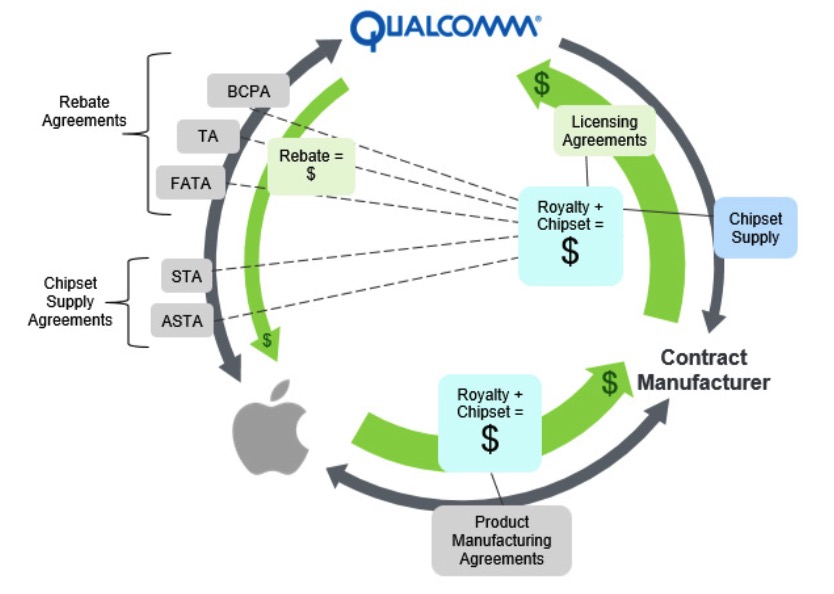
Web of Apple and qualcomm royalty paymets
In its lawsuit against Qualcomm, Apple included a diagram of the complex web of payments around the mobile patent royalties it pays. Source: Apple lawsuit
Apple lawsuit

Qualcomm says that its practices have been misrepresented by Apple and others that are merely seeking to pay less for its valuable technology.

“Apple has intentionally mischaracterized our agreements and negotiations, as well as the enormity and value of the technology we have invented, contributed and shared with all mobile device makers through our licensing program,” Qualcomm general counsel Don Rosenberg said in a statement that went on to accuse Apple of instigating regulatory investigations worldwide. And any chipmaker can choose to incorporate Qualcomm’s patented technologies as long as the phone maker who buys the chips has a licensing agreement, the company argues.

Apple did not respond to a request for comment beyond its lawsuit. Intel declined to comment.

Behind the scenes, relations between Apple and Qualcomm appear to have been rocky from the start. The first iPhone used a wireless chip from Infineon, but Qualcomm required a licensing fee. It negotiated with Apple’s manufacturers instead of Apple, a practice that has continued to the present. Apple says it can’t even see copies of the confidential agreements struck between Foxconn and Qualcomm.

Instead, Apple and Qualcomm made side agreements which paid Apple back for some of the royalty payments passed through Foxconn. The agreements also imposed limits on Apple, such as banning the use in iPhones of a wireless standard, called WiMax, that competed with Qualcomm’s technology.

Apple says it repeatedly tried to enter a direct patent licensing deal with Qualcomm but was turned down. With the last side deal set to expire at the end of 2016, in December Qualcomm asserted in two in-person meetings that Apple was in violation of 20 of its patents. No deal was reached, the last side agreement expired and weeks later Apple and the FTC filed suit.

Essential Patents

The various disputes may come down to how the courts decide to interpret the rules for patents that become part of essential technological standards.

Qualcomm says it has thousands of patents that underlie the basic wireless network standards adopted by mobile carriers, telecom equipment makers, and smartphone manufacturers. As part of the standards process, companies that contribute patented technologies are supposed to agree to license those rights on “fair, reasonable, and non-discriminatory” terms.

Apple and the regulators argue that Qualcomm’s device-level royalties in effect constitute discrimination, because the makers of cheaper smartphones pay far less for access to the same rights as the maker of a high-end device.

For more on Qualcomm’s 5G strategy, watch:

But after finding Qualcomm in violation of its antitrust rules, China’s regulators have since allowed the company to go forward with a 3.5% to 5% per device fee, after certain discounts. To the chipmaker, that’s a vindication of the general approach even for patents involved in industry standards. Apple says Qualcomm offered it the Chinese solution but it rejected the deal as still unfair.

Qualcomm’s stock, which had largely weathered the recent regulatory attacks, plummeted 12% on Monday after Rasgon and other analysts highlighted the seriousness of Apple’s lawsuit. Now it will be up to the courts to decide whether the company’s highly profitable–and controversial–licensing model can live on.


About the Author
By Aaron Pressman
See full bioRight Arrow Button Icon

Latest in Tech

Finance
Lorem ipsum dolor sit amet, consectetur adipiscing elit, sed do eiusmod tempor incididunt ut labore et dolore magna aliqua. Ut enim ad minim veniam
By Fortune Editors
October 20, 2025
Finance
Lorem ipsum dolor sit amet, consectetur adipiscing elit, sed do eiusmod tempor incididunt ut labore et dolore magna aliqua. Ut enim ad minim veniam
By Fortune Editors
October 20, 2025
Finance
Lorem ipsum dolor sit amet, consectetur adipiscing elit, sed do eiusmod tempor incididunt ut labore et dolore magna aliqua. Ut enim ad minim veniam
By Fortune Editors
October 20, 2025
Finance
Lorem ipsum dolor sit amet, consectetur adipiscing elit, sed do eiusmod tempor incididunt ut labore et dolore magna aliqua. Ut enim ad minim veniam
By Fortune Editors
October 20, 2025
Finance
Lorem ipsum dolor sit amet, consectetur adipiscing elit, sed do eiusmod tempor incididunt ut labore et dolore magna aliqua. Ut enim ad minim veniam
By Fortune Editors
October 20, 2025
Finance
Lorem ipsum dolor sit amet, consectetur adipiscing elit, sed do eiusmod tempor incididunt ut labore et dolore magna aliqua. Ut enim ad minim veniam
By Fortune Editors
October 20, 2025

Most Popular

Finance
Lorem ipsum dolor sit amet, consectetur adipiscing elit, sed do eiusmod tempor incididunt ut labore et dolore magna aliqua. Ut enim ad minim veniam
By Fortune Editors
October 20, 2025
Finance
Lorem ipsum dolor sit amet, consectetur adipiscing elit, sed do eiusmod tempor incididunt ut labore et dolore magna aliqua. Ut enim ad minim veniam
By Fortune Editors
October 20, 2025
Finance
Lorem ipsum dolor sit amet, consectetur adipiscing elit, sed do eiusmod tempor incididunt ut labore et dolore magna aliqua. Ut enim ad minim veniam
By Fortune Editors
October 20, 2025
Finance
Lorem ipsum dolor sit amet, consectetur adipiscing elit, sed do eiusmod tempor incididunt ut labore et dolore magna aliqua. Ut enim ad minim veniam
By Fortune Editors
October 20, 2025
Finance
Lorem ipsum dolor sit amet, consectetur adipiscing elit, sed do eiusmod tempor incididunt ut labore et dolore magna aliqua. Ut enim ad minim veniam
By Fortune Editors
October 20, 2025
Finance
Lorem ipsum dolor sit amet, consectetur adipiscing elit, sed do eiusmod tempor incididunt ut labore et dolore magna aliqua. Ut enim ad minim veniam
By Fortune Editors
October 20, 2025
Fortune Secondary Logo
Rankings
  • 100 Best Companies
  • Fortune 500
  • Global 500
  • Fortune 500 Europe
  • Most Powerful Women
  • World's Most Admired Companies
  • See All Rankings
  • Lists Calendar
Sections
  • Finance
  • Fortune Crypto
  • Features
  • Leadership
  • Health
  • Commentary
  • Success
  • Retail
  • Mpw
  • Tech
  • Lifestyle
  • CEO Initiative
  • Asia
  • Politics
  • Conferences
  • Europe
  • Newsletters
  • Personal Finance
  • Environment
  • Magazine
  • Education
Customer Support
  • Frequently Asked Questions
  • Customer Service Portal
  • Privacy Policy
  • Terms Of Use
  • Single Issues For Purchase
  • International Print
Commercial Services
  • Advertising
  • Fortune Brand Studio
  • Fortune Analytics
  • Fortune Conferences
  • Business Development
  • Group Subscriptions
About Us
  • About Us
  • Press Center
  • Work At Fortune
  • Terms And Conditions
  • Site Map
  • About Us
  • Press Center
  • Work At Fortune
  • Terms And Conditions
  • Site Map
  • Facebook icon
  • Twitter icon
  • LinkedIn icon
  • Instagram icon
  • Pinterest icon

Latest in Tech

murdochs
CommentaryMedia
OpenAI paid $100 million for a talk show. James Murdoch is eyeing an even bigger deal. The hot new asset class is humanity
By Lin CherryMay 17, 2026
13 hours ago
dennis
CommentaryAI agents
Freshworks CEO: why agile enterprises are winning the AI race — and what they did differently
By Dennis WoodsideMay 17, 2026
13 hours ago
A man with a headset sits at a desk in a call center.
EconomyAutomation
The AI boom hasn’t stopped U.S. companies from hiring cheap offshore labor, and overseas call center employment is still skyrocketing
By Sasha RogelbergMay 17, 2026
13 hours ago
Zillow CEO doubles down on remote-work model: ‘There is talent everywhere in this country’
Workplace Cultureremote work
Zillow CEO doubles down on remote-work model: ‘There is talent everywhere in this country’
By Marco Quiroz-GutierrezMay 17, 2026
14 hours ago
Stressed job seeker
SuccessGen Z
Gen Z is right about the job hunt—it really is worse than it was for millennials, with nearly 60% of fresh-faced grads frozen out of the workforce
By Emma BurleighMay 17, 2026
14 hours ago
A 45,000-person labor strike at Samsung’s memory chip plants could throw a wrench into the AI boom
EconomySamsung
A 45,000-person labor strike at Samsung’s memory chip plants could throw a wrench into the AI boom
By Catherina GioinoMay 17, 2026
16 hours ago

Most Popular

Microsoft AI chief gives it 18 months—for all white-collar work to be automated by AI
AI
Microsoft AI chief gives it 18 months—for all white-collar work to be automated by AI
By Jake AngeloMay 16, 2026
2 days ago
Former top Russian official admits the country is over Putin and can 'imagine a future without him' — even elites bail as Kremlin seizes their assets 
Politics
Former top Russian official admits the country is over Putin and can 'imagine a future without him' — even elites bail as Kremlin seizes their assets 
By Jason MaMay 16, 2026
1 day ago
The Bezos family just donated $100 million to help achieve one of Mayor Zohran Mamdani’s top campaign promises
Politics
The Bezos family just donated $100 million to help achieve one of Mayor Zohran Mamdani’s top campaign promises
By Jake AngeloMay 12, 2026
5 days ago
SpaceX heads into a record-shattering IPO with the 'deepest moat that exists today' as investors vow to 'never bet against Elon'
Innovation
SpaceX heads into a record-shattering IPO with the 'deepest moat that exists today' as investors vow to 'never bet against Elon'
By Jason MaMay 16, 2026
1 day ago
'No one was coming to save me': How Reese Witherspoon built a $900 million company from a problem Hollywood wouldn't fix
Success
'No one was coming to save me': How Reese Witherspoon built a $900 million company from a problem Hollywood wouldn't fix
By Sydney LakeMay 17, 2026
14 hours ago
The top foreign holders of U.S. debt may soon dump Treasury bonds and bring their money back home, potentially spiking borrowing costs
Economy
The top foreign holders of U.S. debt may soon dump Treasury bonds and bring their money back home, potentially spiking borrowing costs
By Jason MaMay 17, 2026
8 hours ago

© 2026 Fortune Media IP Limited. All Rights Reserved. Use of this site constitutes acceptance of our Terms of Use and Privacy Policy | CA Notice at Collection and Privacy Notice | Do Not Sell/Share My Personal Information
FORTUNE is a trademark of Fortune Media IP Limited, registered in the U.S. and other countries. FORTUNE may receive compensation for some links to products and services on this website. Offers may be subject to change without notice.