• Home
  • Latest
  • Fortune 500
  • Finance
  • Tech
  • Leadership
  • Lifestyle
  • Rankings
  • Multimedia
Leadershipbooks

What Is a Blue Ocean Market?

By
W. Chan Kim
W. Chan Kim
and
Reene Mauborgne
Reene Mauborgne
Down Arrow Button Icon
By
W. Chan Kim
W. Chan Kim
and
Reene Mauborgne
Reene Mauborgne
Down Arrow Button Icon
September 26, 2017, 10:57 AM ET
Courtesy of Blue Ocean Strategy

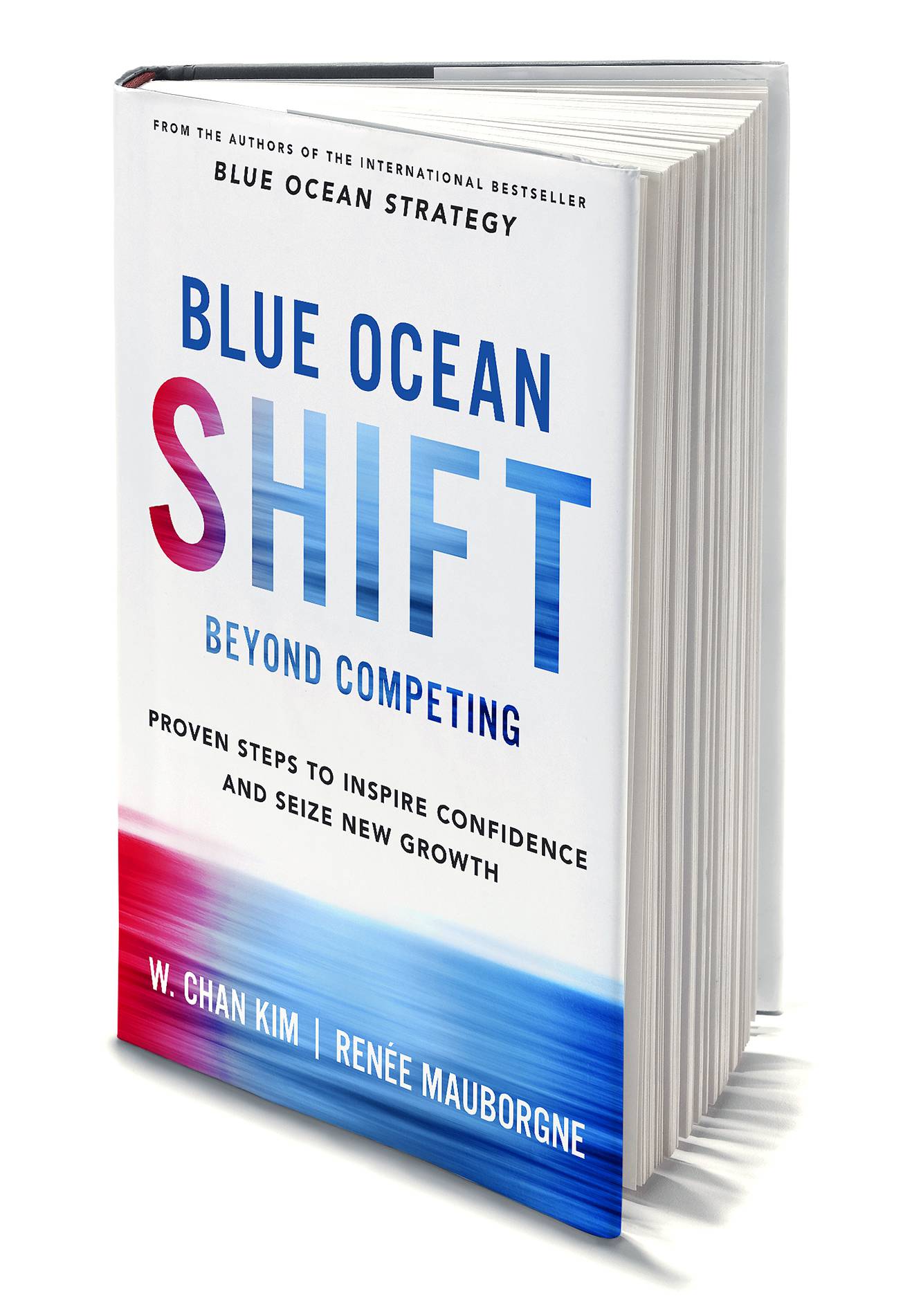
“Blue Ocean Shift: Beyond Competing” is the follow-up to the global best seller “Blue Ocean Strategy” by professors W. Chan Kim and Reene Mauborgne. The books’ central concept is that of “blue oceans”—new markets or innovations devoid of competition that will create new demand. “Blue Ocean Shift” focuses on a systematic process for identifying those unchartered water. Below follows an excerpt.

Before showing you how to make a blue ocean shift—how to move your organization from market competing to market creating—we first need to clarify what market- creating strategy really is and how it works.

We’ve seen a lot of confusion on this through the years, as some people have difficulty understanding how various perspectives on market creation fit together. Some equate market creation with creative destruction or disruption. They think you need to destroy or disrupt an existing market in order to create a new one. Others regard market creation as a matter of innovation, and often see technology as the key to unlocking new markets. Still others view market creation as synonymous with entrepreneurship and believe it to be the domain of entrepreneurs

All these views are partly right. But they are also partly wrong, because each offers an incomplete picture of how markets are created. Without having a complete picture, efforts to make a blue ocean shift will miss many opportunities and may even be misdirected. So here we build a holistic model of market-creating strategy that shows not only the available strategic options and how they produce blue ocean shifts, but also their corresponding growth consequences. Using this model, we can understand how these existing partial views fit together in the big picture.

Read our Q&A with co-author Reene Mauborgne here.

Creative Destruction and Disruptive Innovation Are Only Part of the Picture

In speaking with executives, entrepreneurs, and government leaders, one consistent pattern we’ve observed is how often they associate market creation with the concepts of creative destruction or disruption. Creative destruction is the iconic term coined by the Austrian economist Joseph Schumpeter, who observed that although competition in existing markets is good, diminishing returns eventually set in as buyers’ needs are satisfied and profits are competed away. The real engine of economic growth, he argued, is therefore the creation of new markets. But, in his view, this creation is dependent on destruction.

Destruction occurs when an innovation displaces an earlier technology or an existing product or service. The word displacement is important here because without displacement, creative destruction does not occur. For example, the innovation of digital photography creatively destroyed the photographic film industry by effectively displacing it. So today digital photography is the norm, and photographic film is seldom used.

The concept of disruption echoes Schumpeter’s insight.

The most well-known study on disruption directly relevant to market creation is the influential idea of disruptive innovation. Whereas creative destruction occurs when a superior technology, product, or service comes along and destroys the old with the new, disruptive innovation begins with the arrival of an inferior technology, which then crosses the line from inferior to superior and, in doing so, displaces market leaders.

The classic example here is the disruption and eventual dis- placement of leading disk drive players, which were caught off guard by bottom-up disruptors that initially entered the scene with simpler technology and inferior performance.

The distinguishing insight here is that the technology waltzing into an industry need not be superior, as Schumpeter suggests, but instead can come in as a Trojan horse whose initial inferiority does not appear to threaten the mainstream market. As a result, established players ignore the newcomer until it’s too late. What these ideas have in common, however, is their shared focus on the displacement of existing players and markets.

As business history shows that there are ample cases of both forms of displacement, focusing singly on either creative destruction or disruptive innovation in discussions of market creation would be partial and misleading. Hence, to describe the act of market creation that embraces both forms of displacement, we coined the term disruptive creation. This broader term captures the full, not partial, opportunity space of market creation driven by displacement.

Important as disruptive creation driven by either creative destruction or disruptive innovation is, however, it still misses another universe of market-creating opportunities. As our research shows, many new markets have also been created without disrupting existing ones.

Nondisruptive Creation Also Generates New Markets and Growth

If you have children and live in any one of 147 countries around the world, from the United States, to Afghanistan, to Germany, Japan, or Yemen, you have heard of Sesame Street. Big Bird, Elmo, Ernie, and Bert are just a few of the lovable Muppets that teach preschool children how to count, name their colors and shapes, and recognize the letters of the alphabet. And the best part is that children have so much fun watching the program they don’t even realize how much they’re learning. But parents do, which is why they love it too. It’s the antithesis of what many people associate with education. It seduces and amuses as it educates the very young.

Sesame Street didn’t disrupt any prior market for early childhood education. It didn’t destroy and replace preschools, or libraries, or parents reading bedtime stories to their children. Rather, Sesame Street opened up a new value-cost frontier that unlocked the new market of preschool edutainment that, for the most part, had never existed before. In contrast to “disruptive creation,” Sesame Street is the result of what we call “nondisruptive creation,” as it created new market space without disrupting an existing market.


About the Authors
By W. Chan Kim
See full bioRight Arrow Button Icon
By Reene Mauborgne
See full bioRight Arrow Button Icon

Latest in Leadership

Finance
Lorem ipsum dolor sit amet, consectetur adipiscing elit, sed do eiusmod tempor incididunt ut labore et dolore magna aliqua. Ut enim ad minim veniam
By Fortune Editors
October 20, 2025
Finance
Lorem ipsum dolor sit amet, consectetur adipiscing elit, sed do eiusmod tempor incididunt ut labore et dolore magna aliqua. Ut enim ad minim veniam
By Fortune Editors
October 20, 2025
Finance
Lorem ipsum dolor sit amet, consectetur adipiscing elit, sed do eiusmod tempor incididunt ut labore et dolore magna aliqua. Ut enim ad minim veniam
By Fortune Editors
October 20, 2025
Finance
Lorem ipsum dolor sit amet, consectetur adipiscing elit, sed do eiusmod tempor incididunt ut labore et dolore magna aliqua. Ut enim ad minim veniam
By Fortune Editors
October 20, 2025
Finance
Lorem ipsum dolor sit amet, consectetur adipiscing elit, sed do eiusmod tempor incididunt ut labore et dolore magna aliqua. Ut enim ad minim veniam
By Fortune Editors
October 20, 2025
Finance
Lorem ipsum dolor sit amet, consectetur adipiscing elit, sed do eiusmod tempor incididunt ut labore et dolore magna aliqua. Ut enim ad minim veniam
By Fortune Editors
October 20, 2025

Most Popular

Finance
Lorem ipsum dolor sit amet, consectetur adipiscing elit, sed do eiusmod tempor incididunt ut labore et dolore magna aliqua. Ut enim ad minim veniam
By Fortune Editors
October 20, 2025
Finance
Lorem ipsum dolor sit amet, consectetur adipiscing elit, sed do eiusmod tempor incididunt ut labore et dolore magna aliqua. Ut enim ad minim veniam
By Fortune Editors
October 20, 2025
Finance
Lorem ipsum dolor sit amet, consectetur adipiscing elit, sed do eiusmod tempor incididunt ut labore et dolore magna aliqua. Ut enim ad minim veniam
By Fortune Editors
October 20, 2025
Finance
Lorem ipsum dolor sit amet, consectetur adipiscing elit, sed do eiusmod tempor incididunt ut labore et dolore magna aliqua. Ut enim ad minim veniam
By Fortune Editors
October 20, 2025
Finance
Lorem ipsum dolor sit amet, consectetur adipiscing elit, sed do eiusmod tempor incididunt ut labore et dolore magna aliqua. Ut enim ad minim veniam
By Fortune Editors
October 20, 2025
Finance
Lorem ipsum dolor sit amet, consectetur adipiscing elit, sed do eiusmod tempor incididunt ut labore et dolore magna aliqua. Ut enim ad minim veniam
By Fortune Editors
October 20, 2025
Fortune Secondary Logo
Rankings
  • 100 Best Companies
  • Fortune 500
  • Global 500
  • Fortune 500 Europe
  • Most Powerful Women
  • Future 50
  • World’s Most Admired Companies
  • See All Rankings
Sections
  • Finance
  • Fortune Crypto
  • Features
  • Leadership
  • Health
  • Commentary
  • Success
  • Retail
  • Mpw
  • Tech
  • Lifestyle
  • CEO Initiative
  • Asia
  • Politics
  • Conferences
  • Europe
  • Newsletters
  • Personal Finance
  • Environment
  • Magazine
  • Education
Customer Support
  • Frequently Asked Questions
  • Customer Service Portal
  • Privacy Policy
  • Terms Of Use
  • Single Issues For Purchase
  • International Print
Commercial Services
  • Advertising
  • Fortune Brand Studio
  • Fortune Analytics
  • Fortune Conferences
  • Business Development
  • Group Subscriptions
About Us
  • About Us
  • Editorial Calendar
  • Press Center
  • Work At Fortune
  • Diversity And Inclusion
  • Terms And Conditions
  • Site Map
  • About Us
  • Editorial Calendar
  • Press Center
  • Work At Fortune
  • Diversity And Inclusion
  • Terms And Conditions
  • Site Map
  • Facebook icon
  • Twitter icon
  • LinkedIn icon
  • Instagram icon
  • Pinterest icon

Latest in Leadership

In the age of AI anxiety, the 100 Best Companies to Work For are betting on their people
NewslettersCEO Daily
In the age of AI anxiety, the 100 Best Companies to Work For are betting on their people
By Diane BradyApril 2, 2026
1 hour ago
Gen Z fled San Francisco for Texas and Florida. Now they’re turning ‘welcomer cities’ into the next big tech towns
Real EstateGen Z
Gen Z fled San Francisco for Texas and Florida. Now they’re turning ‘welcomer cities’ into the next big tech towns
By Sydney LakeApril 2, 2026
2 hours ago
Macquarie bets impact investing can fill an Asian financial access gap for the ‘missing middle’
AsiaAustralia
Macquarie bets impact investing can fill an Asian financial access gap for the ‘missing middle’
By Nicholas GordonApril 1, 2026
12 hours ago
jamie dimon
Workplace Culturereturn to office
Jamie Dimon, office-work champion, vows his anti-remote culture ‘would crush you.’ The economy’s top talent begs to differ
By Jake AngeloApril 1, 2026
14 hours ago
Ayesha and Stephen Curry
C-Suitephilanthropy
Warren Buffett revives his legendary charity lunch auction—this time with Stephen Curry. His last one raised $19 million
By Jacqueline MunisApril 1, 2026
15 hours ago
How AI will make your Shake Shack order even faster
NewslettersCIO Intelligence
How AI will make your Shake Shack order even faster
By John KellApril 1, 2026
16 hours ago

Most Popular

Two-thirds of parents say their adult Gen Z kids still rely on them financially  for support—even though it's putting them under strain
Success
Two-thirds of parents say their adult Gen Z kids still rely on them financially  for support—even though it's putting them under strain
By Fortune EditorsMarch 31, 2026
2 days ago
Jerome Powell says the $39 trillion national debt is ‘not unsustainable,’ but warns the trajectory ‘will not end well’
Economy
Jerome Powell says the $39 trillion national debt is ‘not unsustainable,’ but warns the trajectory ‘will not end well’
By Fortune EditorsMarch 30, 2026
3 days ago
Current price of gold as of April 1, 2026
Personal Finance
Current price of gold as of April 1, 2026
By Fortune EditorsApril 1, 2026
20 hours ago
Current price of oil as of April 1, 2026
Personal Finance
Current price of oil as of April 1, 2026
By Fortune EditorsApril 1, 2026
21 hours ago
A man used AI to call 3,000 Irish bartenders to track the cost of Guinness. Now pubs are lowering their prices to compete
AI
A man used AI to call 3,000 Irish bartenders to track the cost of Guinness. Now pubs are lowering their prices to compete
By Fortune EditorsMarch 30, 2026
3 days ago
Hiring just hit a level not seen since the economy was ‘closed down literally’ during COVID, top economist says
Economy
Hiring just hit a level not seen since the economy was ‘closed down literally’ during COVID, top economist says
By Fortune EditorsMarch 31, 2026
2 days ago

© 2026 Fortune Media IP Limited. All Rights Reserved. Use of this site constitutes acceptance of our Terms of Use and Privacy Policy | CA Notice at Collection and Privacy Notice | Do Not Sell/Share My Personal Information
FORTUNE is a trademark of Fortune Media IP Limited, registered in the U.S. and other countries. FORTUNE may receive compensation for some links to products and services on this website. Offers may be subject to change without notice.