• Home
  • Latest
  • Fortune 500
  • Finance
  • Tech
  • Leadership
  • Lifestyle
  • Rankings
  • Multimedia

Trendingnow

1

As Big Tech showers employees with perks to win the talent war, Nvidia built a nearly $5 trillion company by making people pay for their own lunch

2

MacKenzie Scott alone accounted for one-third of America's $19.2 billion in megagifts last year

3

Current price of oil as of July 1, 2026

1

As Big Tech showers employees with perks to win the talent war, Nvidia built a nearly $5 trillion company by making people pay for their own lunch

2

MacKenzie Scott alone accounted for one-third of America's $19.2 billion in megagifts last year

3

Current price of oil as of July 1, 2026
CommentaryPolling

Commentary: It’s Time for Pollsters to Get Honest About the Margin of Error

By
Robert A. Peterson
Robert A. Peterson
and
Bethany Cianciolo
Bethany Cianciolo
Down Arrow Button Icon
By
Robert A. Peterson
Robert A. Peterson
and
Bethany Cianciolo
Bethany Cianciolo
Down Arrow Button Icon
February 21, 2018, 2:42 PM ET
US-POLITICS-VOTE-ALABAMA
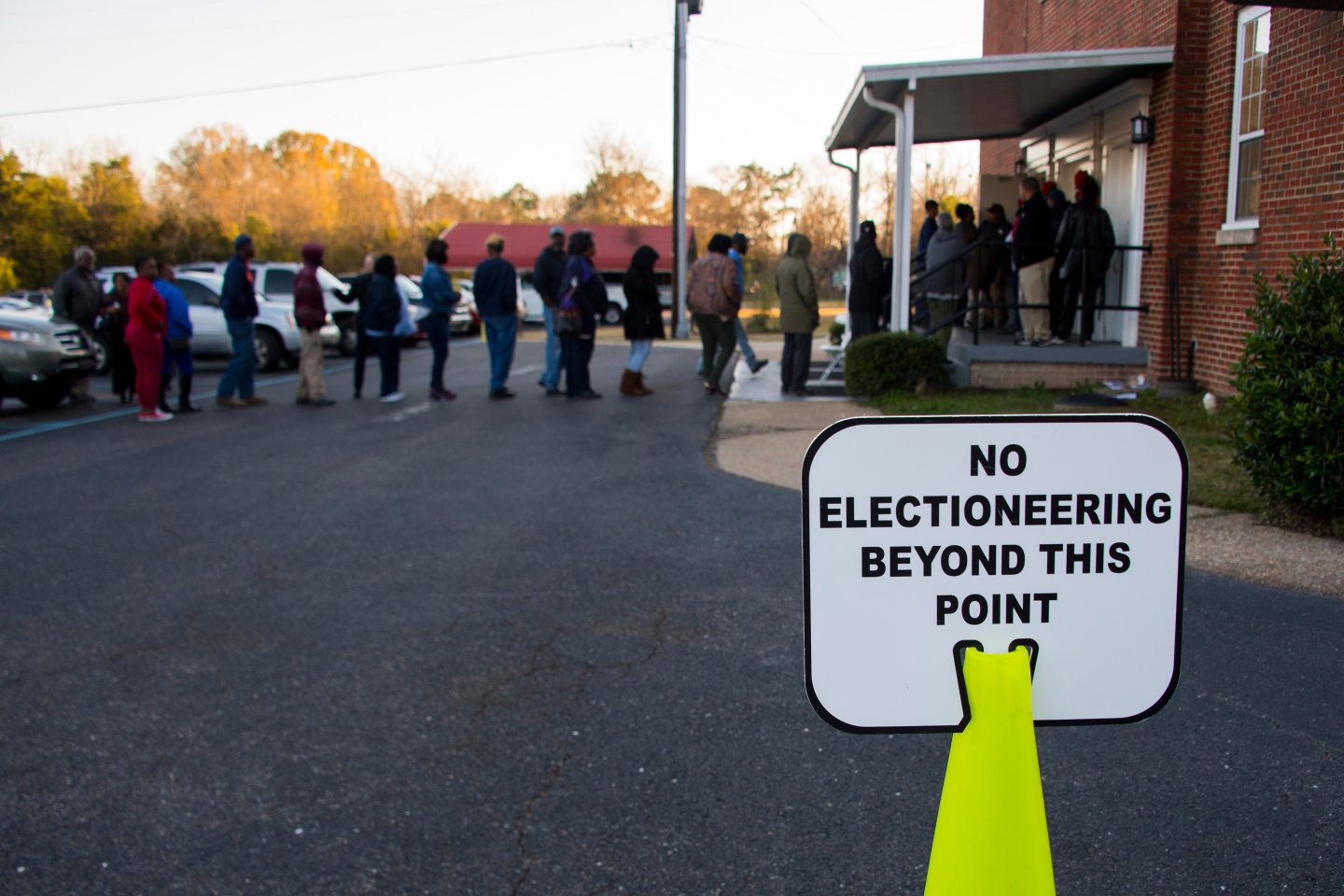
Voters stand in a long line that leads out the door to vote at Beulah Baptist Church polling station in Montgomery, Alabama, on December 12, 2017. The state of Alabama holds a closely-watched special election for US Senate featuring Republican candidate Roy Moore, who is endorsed by President Donald Trump despite being accused of molesting teenaged girls. / AFP PHOTO / JIM WATSON (Photo credit should read JIM WATSON/AFP/Getty Images)Jim Watson—AFP/Getty Images
Add Fortune on Google for similar content.

In 2016, public opinion polling suffered two epic failures. Because polls erred in predicting the winners in both the Brexit referendum and the U.S. presidential election, critics have dissected pollsters’ questions and their methods. But a very insidious source of error has remained hidden from public view: margins of error and the way in which pollsters calculate and present them.

With another important round of elections coming up this year, it’s important for the public to understand the real levels of uncertainty in poll results, and for pollsters to report sampling error more honestly.

We’ve all read the disclaimers such as, “The margin of sampling error is +/- 3 percentage points with a 95% level of confidence.” My research, based on a nationwide survey of more than 1,100 people and forthcoming in an article in the peer-reviewed International Journal of Market Research, has found that such statements influence the level of trust readers place in a poll’s results.

Unfortunately, their trust is misplaced. A dirty secret of the polling business is that reported margins of error are essentially a myth. The manner in which margins are calculated and reported is unrelated to the actual results of the underlying poll. Consequently, these margins are misleading at best and fictitious at worst in representing the precision of the poll.

How can they be unrelated to a poll’s results? Here’s how:

First, the reported margin of sampling error may imply that it pertains to an entire poll. In reality, it is only for a single question, even though my research shows that many of us, 44%, incorrectly think a reported margin pertains to the entire poll.

Second, the single question used to calculate the margin is a fictitious one. It does not reflect the actual response to any question posed in the poll. In other words, the margin of error is based on the hypothetical case of 50% of survey participants answering “Yes” to a yes/no question and 50% answering “No.” It has no relationship to the answers of any question in the poll, and certainly no relationship to the overall margin of error of the poll.

And finally, the formula for calculating the margin arbitrarily assumes that the answer to the fictitious question is 50% “Yes” and 50% “No.” Only if, by chance, were the polled individuals to respond exactly that way would the reported margin be correct for that question.

The rationale offered for reporting margins of error this way is that a 50/50 split has the largest possible margin. If a poll reports the maximum sampling error possible, it is covering the worst-case scenario—for that (fictitious) question.

Except that the poll hasn’t necessarily done so. If a question has more than two possible answers—like, “Don’t Know” in addition to “Yes” and “No”—it requires a different formula. For subgroups such as “males” or “65 and over,” the margins will be larger than that for the overall poll.

Most important, margins of error can be cumulative. Many answers to questions in a poll are related to one another. Collectively, their margins add up to more than that for a single question. In a simple poll with only four questions, and a 95% confidence rate for each one, the total margin of sampling error of the poll might be as large as 19%.

There are more accurate ways for polls to represent their margins of error. One option is to present none at all. A recent Harvard CAPS-Harris Poll did just that.

Another option is to compute the individual sampling error margins for every question in a poll. Pollsters could then work out an average margin across all poll questions. Such estimates would still possess weaknesses, but they would still be superior to the single fictitious margin currently being reported.


Ultimately, pollsters should devise a multi-question approach. Such an approach would simultaneously take into account the number, types, weights, and relationships of questions, along with individual sampling error margins for actual answers and one for the overall poll.

My purpose here is not to point a finger at pollsters, but to point out that myths can have consequences. When polls understate their margins of error, particularly in a close race, the public is being misled by a false sense of precision. That can lead to the “surprising” results we saw in 2016.

Besides, it’s in pollsters’ best interests to present their results in a more ethical way. After the battering they’ve taken recently, doing so would offer them a chance to regain public confidence in the credibility of their polls. The winners would be not just pollsters and the public, but our overall democracy.

Robert A. Peterson is the John T. Stuart III Centennial Chair in Business Administration in the McCombs School of Business at The University of Texas at Austin.


About the Authors
By Robert A. Peterson
See full bioRight Arrow Button Icon
By Bethany Cianciolo
See full bioRight Arrow Button Icon
Add Fortune on Google for similar content.

Latest in Commentary

Finance
Lorem ipsum dolor sit amet, consectetur adipiscing elit, sed do eiusmod tempor incididunt ut labore et dolore magna aliqua. Ut enim ad minim veniam
By Fortune Editors
October 20, 2025
Finance
Lorem ipsum dolor sit amet, consectetur adipiscing elit, sed do eiusmod tempor incididunt ut labore et dolore magna aliqua. Ut enim ad minim veniam
By Fortune Editors
October 20, 2025
Finance
Lorem ipsum dolor sit amet, consectetur adipiscing elit, sed do eiusmod tempor incididunt ut labore et dolore magna aliqua. Ut enim ad minim veniam
By Fortune Editors
October 20, 2025
Finance
Lorem ipsum dolor sit amet, consectetur adipiscing elit, sed do eiusmod tempor incididunt ut labore et dolore magna aliqua. Ut enim ad minim veniam
By Fortune Editors
October 20, 2025
Finance
Lorem ipsum dolor sit amet, consectetur adipiscing elit, sed do eiusmod tempor incididunt ut labore et dolore magna aliqua. Ut enim ad minim veniam
By Fortune Editors
October 20, 2025
Finance
Lorem ipsum dolor sit amet, consectetur adipiscing elit, sed do eiusmod tempor incididunt ut labore et dolore magna aliqua. Ut enim ad minim veniam
By Fortune Editors
October 20, 2025

Most Popular

Finance
Lorem ipsum dolor sit amet, consectetur adipiscing elit, sed do eiusmod tempor incididunt ut labore et dolore magna aliqua. Ut enim ad minim veniam
By Fortune Editors
October 20, 2025
Finance
Lorem ipsum dolor sit amet, consectetur adipiscing elit, sed do eiusmod tempor incididunt ut labore et dolore magna aliqua. Ut enim ad minim veniam
By Fortune Editors
October 20, 2025
Finance
Lorem ipsum dolor sit amet, consectetur adipiscing elit, sed do eiusmod tempor incididunt ut labore et dolore magna aliqua. Ut enim ad minim veniam
By Fortune Editors
October 20, 2025
Finance
Lorem ipsum dolor sit amet, consectetur adipiscing elit, sed do eiusmod tempor incididunt ut labore et dolore magna aliqua. Ut enim ad minim veniam
By Fortune Editors
October 20, 2025
Finance
Lorem ipsum dolor sit amet, consectetur adipiscing elit, sed do eiusmod tempor incididunt ut labore et dolore magna aliqua. Ut enim ad minim veniam
By Fortune Editors
October 20, 2025
Finance
Lorem ipsum dolor sit amet, consectetur adipiscing elit, sed do eiusmod tempor incididunt ut labore et dolore magna aliqua. Ut enim ad minim veniam
By Fortune Editors
October 20, 2025
Fortune Secondary Logo
Rankings
  • 100 Best Companies
  • Fortune 500
  • Global 500
  • Fortune 500 Europe
  • Most Powerful Women
  • World's Most Admired Companies
  • See All Rankings
  • Lists Calendar
Sections
  • Finance
  • Fortune Crypto
  • Features
  • Leadership
  • Health
  • Commentary
  • Success
  • Retail
  • Mpw
  • Tech
  • Lifestyle
  • CEO Initiative
  • Asia
  • Politics
  • Conferences
  • Europe
  • Newsletters
  • Personal Finance
  • Environment
  • Magazine
  • Education
Customer Support
  • Frequently Asked Questions
  • Customer Service Portal
  • Privacy Policy
  • Terms Of Use
  • Single Issues For Purchase
  • International Print
Commercial Services
  • Advertising
  • Fortune Brand Studio
  • Fortune Analytics
  • Fortune Conferences
  • Business Development
  • Group Subscriptions
About Us
  • About Us
  • Press Center
  • Work At Fortune
  • Terms And Conditions
  • Site Map
  • About Us
  • Press Center
  • Work At Fortune
  • Terms And Conditions
  • Site Map
  • Facebook icon
  • Twitter icon
  • LinkedIn icon
  • Instagram icon
  • Pinterest icon

Latest in Commentary

rn
CommentaryCryptocurrency
Former Iran director at NSC: Crypto legislation is a ticket to sanctions evasion
By Richard NephewJuly 2, 2026
15 minutes ago
m
CommentaryManufacturing
McKinsey chairs: Building a more resilient industrial base may require $2 trillion in investment
By Eric Kutcher and Shubham SinghalJuly 2, 2026
22 minutes ago
em
Commentary250 Years of Innovation
America’s 250th birthday has Elon Musk and a record IPO. Its 15th had Alexander Hamilton — and a stock market bubble
By Owen LamontJuly 2, 2026
4 hours ago
paramount
CommentaryAntitrust
How Paramount’s theater commitments could boost local economies across the nation
By Ike BrannonJuly 2, 2026
4 hours ago
elon
CommentaryChina
China has 400 private space companies. The West is barely paying attention
By Rainer ZitelmannJuly 2, 2026
6 hours ago
senate
CommentaryCongress
One rare bipartisan AI bill is moving through Congress. Here’s why it deserves to pass
By Neil Björkman and Betsy BrewerJuly 1, 2026
1 day ago

Most Popular

As Big Tech showers employees with perks to win the talent war, Nvidia built a nearly $5 trillion company by making people pay for their own lunch
Big Tech
As Big Tech showers employees with perks to win the talent war, Nvidia built a nearly $5 trillion company by making people pay for their own lunch
By Marco Quiroz-GutierrezJuly 1, 2026
1 day ago
MacKenzie Scott alone accounted for one-third of America's $19.2 billion in megagifts last year
Success
MacKenzie Scott alone accounted for one-third of America's $19.2 billion in megagifts last year
By Sydney LakeJune 25, 2026
7 days ago
Current price of oil as of July 1, 2026
Personal Finance
Current price of oil as of July 1, 2026
By Joseph HostetlerJuly 1, 2026
1 day ago
Philanthropy leader at Warren Buffett and Bill Gates’ Giving Pledge says children of billionaires are pushing them to give their wealth away faster
Success
Philanthropy leader at Warren Buffett and Bill Gates’ Giving Pledge says children of billionaires are pushing them to give their wealth away faster
By Preston ForeJune 27, 2026
5 days ago
The Supreme Court's birthright citizenship ruling hands the U.S. economy a $7.7 trillion win
Newsletters
The Supreme Court's birthright citizenship ruling hands the U.S. economy a $7.7 trillion win
By Diane BradyJuly 1, 2026
1 day ago
Trump got a $78K pension from the Screen Actors Guild in 2025 because he appeared in Home Alone 2 in 1992
Politics
Trump got a $78K pension from the Screen Actors Guild in 2025 because he appeared in Home Alone 2 in 1992
By Sasha RogelbergJuly 1, 2026
22 hours ago

© 2026 Fortune Media IP Limited. All Rights Reserved. Use of this site constitutes acceptance of our Terms of Use and Privacy Policy | CA Notice at Collection and Privacy Notice | Do Not Sell/Share My Personal Information
FORTUNE is a trademark of Fortune Media IP Limited, registered in the U.S. and other countries. FORTUNE may receive compensation for some links to products and services on this website. Offers may be subject to change without notice.