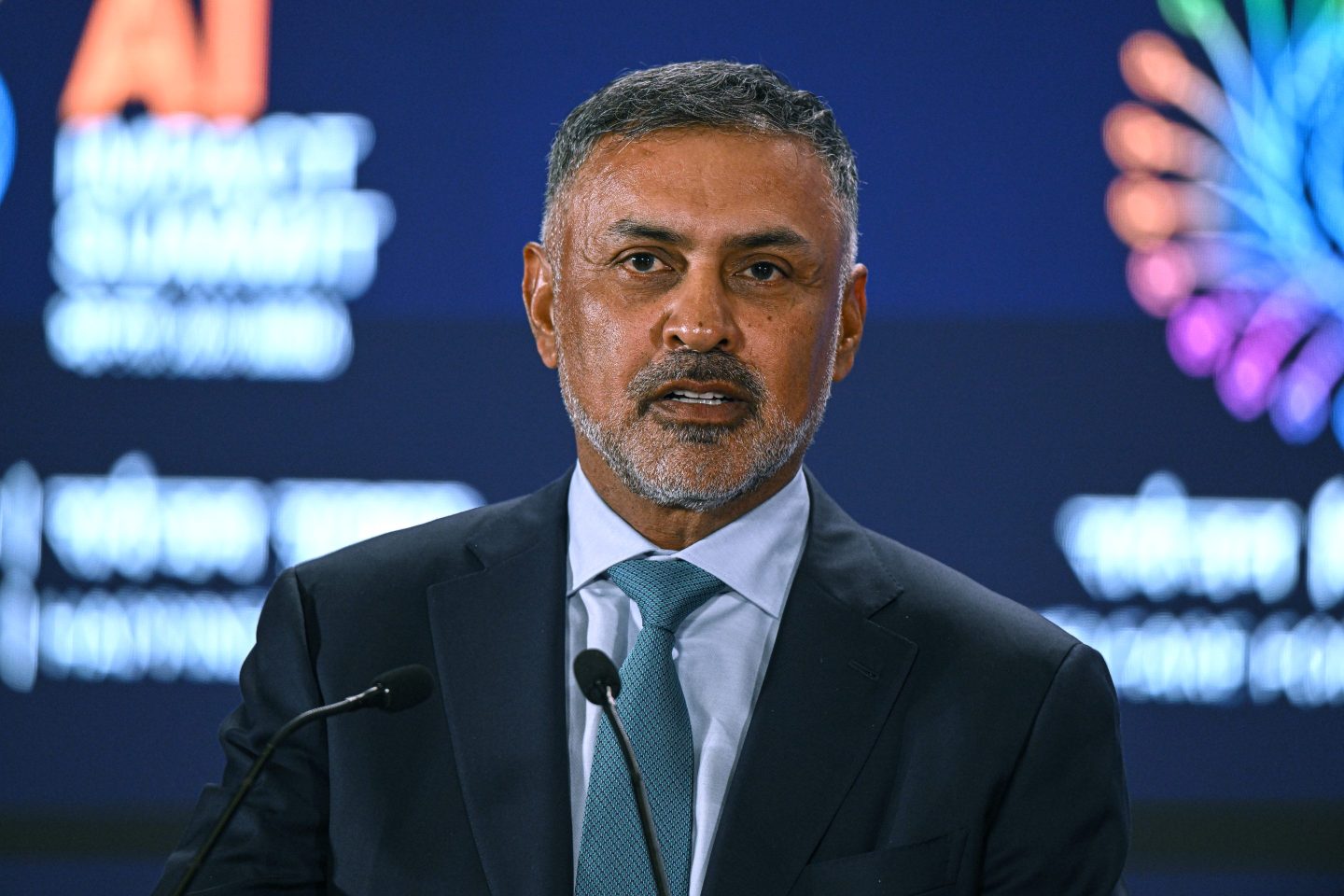
Antonio Neri began his journey at Hewlett Packard as a call-center agent helping customers troubleshoot problems with their servers and printers.
Now, 23 years later, Neri is the CEO of Hewlett Packard Enterprise (HPE), a role he took over from Meg Whitman, who stepped down in February. As CEO, Whitman oversaw one of the biggest corporate overhauls in history: the carving of HP into two separate companies in the fall of 2015, leaving HPE handling data center technology while HP, Inc. is focused on personal computers and printers.
After the epic split, Whitman spent the remainder of her tenure divesting of parts of HPE’s business it no longer wanted, like its software business that it spun off to U.K.-based software firm Micro Focus in a deal worth about $8.8 billion.
Now, Neri has the tough job of navigating the $24 billion enterprise giant in a rapidly changing technology landscape. Companies today are increasingly buying on-demand computing from companies like Amazon and Microsoft instead of traditional data center servers and storage.
And while HPE’s overall sales grew nearly 10% year-over-year in its latest quarter to $7.47 billion, comments from Neri about a “challenging second-half” of the year and that its rate of growth will “moderate given tougher compares” was enough to spook investors, who sent the company’s shares down nearly 10% the day after announcing earnings, to $15.70.
Part of Neri’s plan to revamp HPE involves a so-called hybrid IT model, in which companies operate their computing in both their own data centers and those of cloud computing providers.
Like rivals including Dell Technologies and Cisco, HPE also hopes that the rise of Internet-connected devices, like factory machinery or elevators that are tethered to the web, will result in more companies processing information right at the assembly line or on the machines themselves, instead of sending the data off to the their in-house data centers and those of cloud giants. That’s one of the reason’s why HPE said this week that it plans to spend $4 billion over the next 4 years on technology initiatives intended to facilitate that growing trend.
In this edited interview with Fortune, Neri discusses the massive changes at HPE, cloud computing, and the company’s decision to stop selling barebone servers to cloud giants and instead focus on selling more expensive hardware to conventional businesses. It’s a strategic shift for HPE, Neri notes, due partly because of giant web companies like Microsoft and Facebook increasingly designing their own servers and using Asian contract manufacturers to build the machines. These web and cloud giants are doing so to save money while getting better performance (using custom software) that matches their individual needs.
Fortune: There’s been an impression over the years that HPE’s technology prowess has suffered as the company dealt with multiple CEOs and several complicated financial transactions.
Neri: We never lost the prowess—it was not highlighted as much as before.
Why wasn’t it highlighted?
Because CEOs come with different perspectives and they want to highlight the things that they believe will make a difference. I’m a technologist, an engineer. In fact, I’m actually the fifth CEO within the company. If you go back in history, William [Hewlett] and David [Packard] were the first two. Then we had John Young, who was an engineer, and then we had Lewis Platt. From Lew Platt until today, all [of HP’s] CEOs came from the outside.
So you had Carly Fiorina, Mark Hurd, Léo Apotheker ,and even Meg [Whitman] for that matter. And Dion [Weisler, the current HP, Inc. CEO] also came from the outside. So HPE and the board basically decided that this is the time to go back to our technology roots. It was the right move in the context of our strategy.
It feels like this positioning of HPE returning to its technology roots has really amplified after the split.
If we go back to the beginning of Meg’s journey here, she had a very tough situation. She had to reignite innovation, bring back the companies with customers and products, and repair the balance sheet—there was a lot of complexity. And HPE had three CEOs in a year [prior to Whitman becoming CEO in 2011], that’s not good. And then there was little bit of drama in the 2000s.
The drama being the Autonomy acquisition [HP’s disastrous $11 billion purchase of the U.K. software company]?
Autonomy and other things. But fundamentally she had to put in place a turnaround plan. So the first two years was: “Let’s focus on a few things, let’s invest in R and D [research and development], let’s make sure we stabilize the company. Let’s make sure we bring the companies back to the partners, which is the largest route to market we have, and let’s repair the balance sheet.” After that, we understood what’s going on in the market and the fact that an IT supermarket is not the right way to construct yourself.
What is an IT supermarket?
Where basically you can offer anything to everyone. And it’s hard to do because disruption is happening everywhere and it’s hard to compete in every market at the speed that the market is demanding. You can’t focus in the morning on a $49 printer and then in the afternoon on a $2 million super computer. These are two different products, two different dynamics. At the same time the cloud was exploding, mobile products were exploding, new apps were created, and there was data created all over the place. Now we’re creating data at a pace we have never seen before.
There was a lot of value trapped inside the company, and that’s why we decided to create two independent, very focused companies in their respective markets so they had the ability to compete. That’s why HPE and HP, Inc were separated. At HPE we said: “Okay, we have to formalize the businesses inside the company. We want to be focused and to take advantage of the explosion of the ‘edge’ and the long-term opportunities it has.”
What does the “edge” refer to?
Anything outside the data center. As I think about the future, I think about the use cases that we see with everything being hyper connected. Everything is generating data and everything is computing—even a small sensor is doing something—it’s creating a small amount of data.
Think about the economics—think about the amount of data we create, there is not enough bandwidth, and it is extremely expensive and there are latency and regulatory issues you have to deal with it.
How important are the public cloud providers in this world?
They are going to be a major component of the system.
But do you believe they will be the stars of the solar system, in which everything revolves around them?
I don’t think so. There will be a role, but I don’t think it will be “sun and the earth” kind of a thing. I think they’re realizing that while they have a beneficial model, they have to get closer with things that are happening. So, with self-driving cars, the moment you have 10,000 autonomous cars, there is no bandwidth in the cloud that will be able to help manage these 10,000 cars. In this case, the car will talk to the next car and say, “Hey, I’m here I want to turn left while you’re going to turn right.”
This is an example of a latency problem. For manufacturers, it is the same thing. Why go back to a cloud when you can process all the data right there in the [manufacturing] line, where it makes sense.
And your business strategy requires deeper partnerships with the cloud providers?
Absolutely.
So who are your deepest partnerships with right now?
We have a partnership with Microsoft (MSFT) Azure, and we both share an interest in hybrid IT.
How tough is Dell/EMC as a competitor in the server business given that recent analyst reports have said they are now No. 1 in that market?
They have been trading storage profitability for compute [server growth]. And we have done the opposite. So if you look at the last four quarters, we grew faster in storage than they did and they grew faster in total compute than we did. [Neri then went on to say that because HPE decided to abandon its business of selling cheaper, generic servers to cloud computing companies, Dell Technologies has taken advantage and increased its sales of barebone servers to these tech companies.]
Are you saying that when you lost that business to Microsoft, Dell/EMC took it over?
We didn’t lose, we decided not to take it.
Who did the break up?
We did the break up.
You did the break up?
Absolutely, we were the ones that decided not to participate in that growth area because financially it doesn’t make any sense.
Did they beg you to reconsider that?
No, I mean as a partner we have discussions and they were understandable, but obviously they wanted us to be there because it gives them more leverage. [Microsoft declined to comment to Fortune on the matter]
These people [cloud computing companies] are building their own [hardware], so long term it doesn’t matter. So what they’re doing is digging a hole that’s bigger and bigger. It’s just a timing issue. We decided to exit that space, and I think other people will also do so.
Do you see competition from Asian contract hardware manufacturers like Quanta?
No, we don’t, generally speaking. They don’t have services capabilities [Enterprise service agreements and additional software features that conventional businesses typically want, but cloud computing giants appear to be forgoing in favor of their own custom-built software and gear]. For you to focus on the enterprise, you need to have services capabilities and you need software to make it work.
What I see is, potentially, competitors like Huawei in the telecommunications segment. This market is super competitive. We decided to pivot to the new things, where we can add value, where we can grow and expand profitable share versus share for the sake of share.