• Home
  • Latest
  • Fortune 500
  • Finance
  • Tech
  • Leadership
  • Lifestyle
  • Rankings
  • Multimedia

Exclusive

An hour in the Oval Office with President Trump Fortune Editor-in-Chief: Alyson Shontell sat down with President Trump in the Oval Office for an hour. Tariffs, Intel, AI, Boeing, Iran—and the question every CEO eventually has to answer: who's next?

An hour in the Oval Office with President Trump Fortune Editor-in-Chief: Alyson Shontell sat down with President Trump in the Oval Office for an hour. Tariffs, Intel, AI, Boeing, Iran—and the question every CEO eventually has to answer: who's next?

An hour in the Oval Office with President Trump Fortune Editor-in-Chief: Alyson Shontell sat down with President Trump in the Oval Office for an hour. Tariffs, Intel, AI, Boeing, Iran—and the question every CEO eventually has to answer: who's next?

An hour in the Oval Office with President Trump Fortune Editor-in-Chief: Alyson Shontell sat down with President Trump in the Oval Office for an hour. Tariffs, Intel, AI, Boeing, Iran—and the question every CEO eventually has to answer: who's next?

An hour in the Oval Office with President Trump Fortune Editor-in-Chief: Alyson Shontell sat down with President Trump in the Oval Office for an hour. Tariffs, Intel, AI, Boeing, Iran—and the question every CEO eventually has to answer: who's next?

An hour in the Oval Office with President Trump Fortune Editor-in-Chief: Alyson Shontell sat down with President Trump in the Oval Office for an hour. Tariffs, Intel, AI, Boeing, Iran—and the question every CEO eventually has to answer: who's next?

An hour in the Oval Office with President Trump Fortune Editor-in-Chief: Alyson Shontell sat down with President Trump in the Oval Office for an hour. Tariffs, Intel, AI, Boeing, Iran—and the question every CEO eventually has to answer: who's next?

An hour in the Oval Office with President Trump Fortune Editor-in-Chief: Alyson Shontell sat down with President Trump in the Oval Office for an hour. Tariffs, Intel, AI, Boeing, Iran—and the question every CEO eventually has to answer: who's next?

An hour in the Oval Office with President Trump Fortune Editor-in-Chief: Alyson Shontell sat down with President Trump in the Oval Office for an hour. Tariffs, Intel, AI, Boeing, Iran—and the question every CEO eventually has to answer: who's next?

An hour in the Oval Office with President Trump Fortune Editor-in-Chief: Alyson Shontell sat down with President Trump in the Oval Office for an hour. Tariffs, Intel, AI, Boeing, Iran—and the question every CEO eventually has to answer: who's next?

Commentary

The Wayfair Walkout and the Rise of Activist Capitalism

By
John Paul Rollert
John Paul Rollert
Down Arrow Button Icon
By
John Paul Rollert
John Paul Rollert
Down Arrow Button Icon
July 13, 2019, 8:00 AM ET
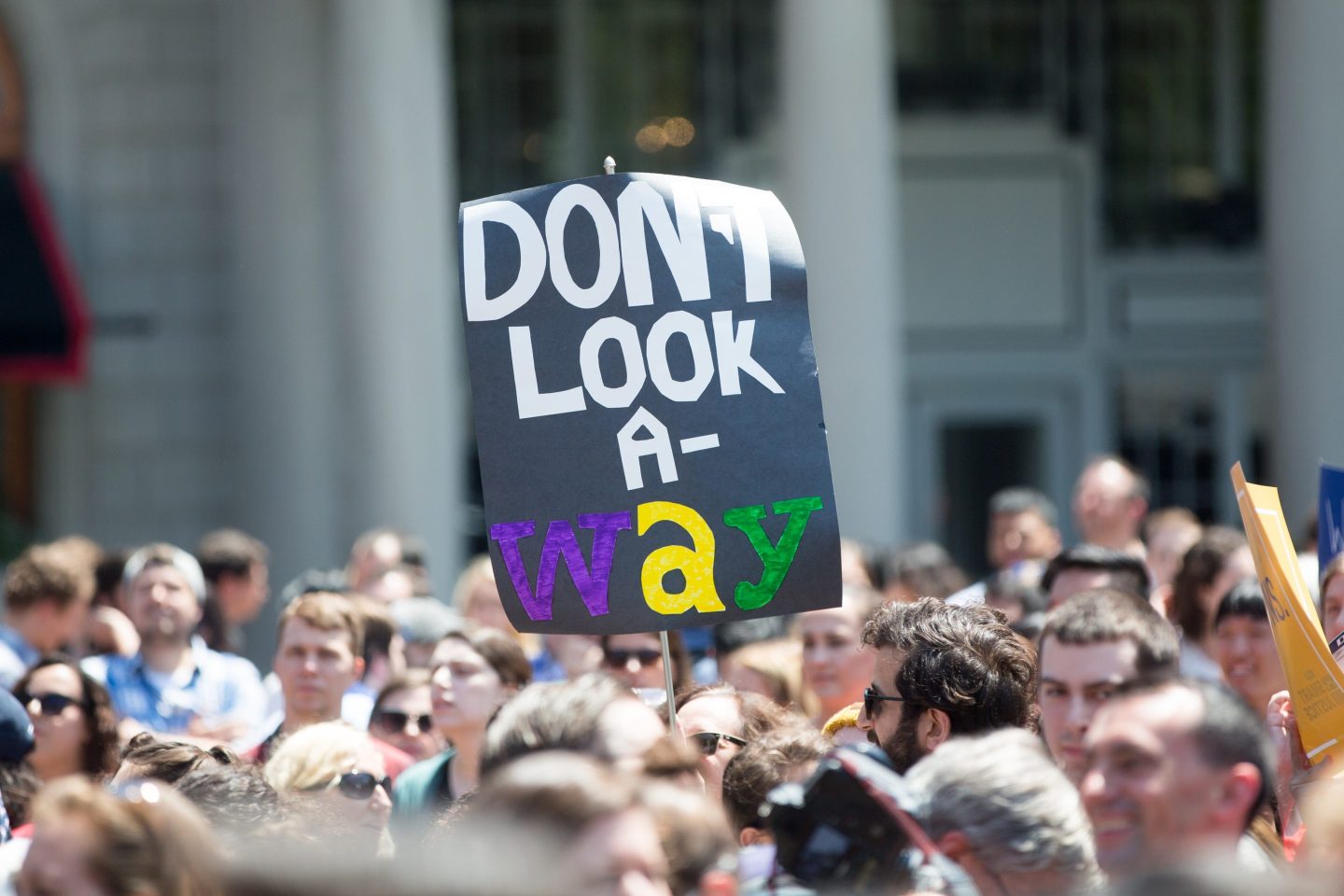
Wayfair employees protesting in Copley Square on June 26, 2019, in Boston.
Scott Eisen—Getty Images

Wayfair recently found itself the subject of unwanted attention when word leaked online that it had received a $200,000 order to supply furniture to one of the detention centers in Texas that have become a flashpoint for American politics amid reports of overcrowding and unhygienic conditions. Wayfair’s CEO, Niraj Shah, was initially caught flat-footed by the criticism, as employees staged a walkout in late June that drew support from Sen. Elizabeth Warren and Rep. Alexandria Ocasio-Cortez. 

The walkout hardly received universal approval. “It would be one thing if the protests were against the sale of stun guns and rubber hoses to camp supervisors,” Politico’s Jack Shafer wrote in a representative critique. “But they’re protesting the sale of bedding! Can they really believe that nobody should sell bedding to the camp operators?”

Shafer has a point. But whatever one thinks of the tactical wisdom of the protestors, events like the Wayfair walkout tell us a lot about how capitalism is becoming an accomplice for social change. Consider the various types of commercial demonstrations we’ve seen in the past decade. There are consumers protesting public officials by exerting pressure on private companies, as with the #GrabYourWallet protest that compelled Nordstrom to stop carrying Ivanka Trump’s clothing line. There are corporations pushing back against government policies, such as the boycott threats by major companies in 2015 that forced lawmakers in Indiana to amend a religious liberty law to protect the rights of LGBT Americans. And there are examples of employees attempting to change company policy by withholding work, such as the worldwide walkouts last November by Google workers in protest of the company’s handling of sexual harassment.

In all of these cases, it is the threat of losing money—whether in the form of sales, tax receipts, or lost work—that compels entities to act. Such protests, of course, are nothing new, but what has made them especially attractive in recent years is the indispensable role social media has played in broadcasting and bolstering such efforts.

Consider the timeline of the Wayfair walkout. The first tweet about the leaked contract to supply detention centers was sent at 10:45 a.m. Eastern Time on June 25. By 11:38 a.m., disgruntled employees had set up a @wayfairwalkout account and were promoting a protest for the very next day. The following afternoon, fewer than 27 hours after the original tweet, the walkout was underway in Boston with coverage by a phalanx of major media outlets.

Such efforts have not been without controversy, but whatever one thinks about them in any specific instance probably says more about a person’s political opinions than the phenomenon of activist capitalism, which is a bipartisan affair. Indeed, less than a week after the Wayfair walkout, conservatives were calling for a boycott of Nike for its perceived anti-American bias in suspending production of a line of shoes featuring the 13-star version of the American flag. Right-wing superstars such as Sen. Ted Cruz and Fox News host Laura Ingraham pledged they would no longer buy Nike products. 

The message of the boycott was clear: Nike was being a bad citizen, and consumers should use their pocketbooks to teach the company an important lesson in civics.

The rise of social media-amplified efforts to use labor and purchasing power to bring about social change is an extraordinary development in contemporary capitalism. Such initiatives represent more decentralized and thoroughly democratic examples of the kind of exercises in monetary might long employed by wealthy individuals to change the world around them.

If we accept the notion that millionaires and billionaires can use the power of their purses to disproportionately shape society—whether by setting the culture of private companies, establishing philanthropic institutions, or using money as a carrot or cudgel to achieve political aims—the idea that there is anything wrong with small platoons of Americans joining together to work toward their own vision of an ideal world seems unsporting to say the least. 

Indeed, the fact that any single individual might ever have so great a say in public affairs has always been the oligarchic defect of meritocratic societies, and the possibility that the mass communication tools freely afforded by social media can rebalance the scales in favor of social change by the many, rather than the few, seems like a shot in the arm for democracy.

Are there dangers posed by the rise of activist capitalism? Sure, but they aren’t altogether different than any other threats posed by allowing the wealth of single individuals to shape the public sphere. We freely allow that private money will embolden social movements, influence institutional decision-making, underwrite the arts and sciences, and, most importantly, help to determine the aim and scope of American politics. Since money can give anyone a megaphone in the public square, the really important question is: Who gets to hold it?

Increasingly, by pooling their labor and purchasing power, a larger number of Americans are claiming their time at that megaphone. They are noisy, to be sure, and taken at once, their messages can be confusing, but if you listen closely you just might hear something extraordinary: the announcement of a new chapter in the history of American capitalism.  

John Paul Rollert is an adjunct associate professor at the University of Chicago Booth School of Business. He also writes the In-House Ethicist column for the Chicago Booth Review. You can follow him on Twitter @jprollert.


About the Author
By John Paul Rollert
See full bioRight Arrow Button Icon

Latest in Commentary

Finance
Lorem ipsum dolor sit amet, consectetur adipiscing elit, sed do eiusmod tempor incididunt ut labore et dolore magna aliqua. Ut enim ad minim veniam
By Fortune Editors
October 20, 2025
Finance
Lorem ipsum dolor sit amet, consectetur adipiscing elit, sed do eiusmod tempor incididunt ut labore et dolore magna aliqua. Ut enim ad minim veniam
By Fortune Editors
October 20, 2025
Finance
Lorem ipsum dolor sit amet, consectetur adipiscing elit, sed do eiusmod tempor incididunt ut labore et dolore magna aliqua. Ut enim ad minim veniam
By Fortune Editors
October 20, 2025
Finance
Lorem ipsum dolor sit amet, consectetur adipiscing elit, sed do eiusmod tempor incididunt ut labore et dolore magna aliqua. Ut enim ad minim veniam
By Fortune Editors
October 20, 2025
Finance
Lorem ipsum dolor sit amet, consectetur adipiscing elit, sed do eiusmod tempor incididunt ut labore et dolore magna aliqua. Ut enim ad minim veniam
By Fortune Editors
October 20, 2025
Finance
Lorem ipsum dolor sit amet, consectetur adipiscing elit, sed do eiusmod tempor incididunt ut labore et dolore magna aliqua. Ut enim ad minim veniam
By Fortune Editors
October 20, 2025

Most Popular

Finance
Lorem ipsum dolor sit amet, consectetur adipiscing elit, sed do eiusmod tempor incididunt ut labore et dolore magna aliqua. Ut enim ad minim veniam
By Fortune Editors
October 20, 2025
Finance
Lorem ipsum dolor sit amet, consectetur adipiscing elit, sed do eiusmod tempor incididunt ut labore et dolore magna aliqua. Ut enim ad minim veniam
By Fortune Editors
October 20, 2025
Finance
Lorem ipsum dolor sit amet, consectetur adipiscing elit, sed do eiusmod tempor incididunt ut labore et dolore magna aliqua. Ut enim ad minim veniam
By Fortune Editors
October 20, 2025
Finance
Lorem ipsum dolor sit amet, consectetur adipiscing elit, sed do eiusmod tempor incididunt ut labore et dolore magna aliqua. Ut enim ad minim veniam
By Fortune Editors
October 20, 2025
Finance
Lorem ipsum dolor sit amet, consectetur adipiscing elit, sed do eiusmod tempor incididunt ut labore et dolore magna aliqua. Ut enim ad minim veniam
By Fortune Editors
October 20, 2025
Finance
Lorem ipsum dolor sit amet, consectetur adipiscing elit, sed do eiusmod tempor incididunt ut labore et dolore magna aliqua. Ut enim ad minim veniam
By Fortune Editors
October 20, 2025
Fortune Secondary Logo
Rankings
  • 100 Best Companies
  • Fortune 500
  • Global 500
  • Fortune 500 Europe
  • Most Powerful Women
  • World's Most Admired Companies
  • See All Rankings
  • Lists Calendar
Sections
  • Finance
  • Fortune Crypto
  • Features
  • Leadership
  • Health
  • Commentary
  • Success
  • Retail
  • Mpw
  • Tech
  • Lifestyle
  • CEO Initiative
  • Asia
  • Politics
  • Conferences
  • Europe
  • Newsletters
  • Personal Finance
  • Environment
  • Magazine
  • Education
Customer Support
  • Frequently Asked Questions
  • Customer Service Portal
  • Privacy Policy
  • Terms Of Use
  • Single Issues For Purchase
  • International Print
Commercial Services
  • Advertising
  • Fortune Brand Studio
  • Fortune Analytics
  • Fortune Conferences
  • Business Development
  • Group Subscriptions
About Us
  • About Us
  • Press Center
  • Work At Fortune
  • Terms And Conditions
  • Site Map
  • About Us
  • Press Center
  • Work At Fortune
  • Terms And Conditions
  • Site Map
  • Facebook icon
  • Twitter icon
  • LinkedIn icon
  • Instagram icon
  • Pinterest icon

Latest in Commentary

charlie
CommentarySoftware
Anaplan CEO: AI isn’t eating software. It’s sorting it
By Charlie GottdienerMay 18, 2026
7 hours ago
shyam
CommentaryHealth
World Economic Forum: women’s health gets only 20% of R&D funding. We must seize this $1 trillion opportunity
By Shyam BishenMay 18, 2026
14 hours ago
murdochs
CommentaryMedia
OpenAI paid $100 million for a talk show. James Murdoch is eyeing an even bigger deal. The hot new asset class is humanity
By Lin CherryMay 17, 2026
1 day ago
dennis
CommentaryAI agents
Freshworks CEO: why agile enterprises are winning the AI race — and what they did differently
By Dennis WoodsideMay 17, 2026
1 day ago
Mary Moreland-Abbott Executive Vice President of Human Resources.
CommentaryRetirement
Gen X is the most indebted generation in America. Their employers can fix that
By Mary MorelandMay 17, 2026
1 day ago
liberman
Commentarystart-ups
We watched social media concentrate. The same thing is happening in AI, only at a deeper layer
By David Liberman and Daniil LibermanMay 16, 2026
2 days ago

Most Popular

The top foreign holders of U.S. debt may soon dump Treasury bonds and bring their money back home, potentially spiking borrowing costs
Economy
The top foreign holders of U.S. debt may soon dump Treasury bonds and bring their money back home, potentially spiking borrowing costs
By Jason MaMay 17, 2026
1 day ago
Microsoft AI chief gives it 18 months—for all white-collar work to be automated by AI
AI
Microsoft AI chief gives it 18 months—for all white-collar work to be automated by AI
By Jake AngeloMay 16, 2026
2 days ago
The Bezos family just donated $100 million to help achieve one of Mayor Zohran Mamdani’s top campaign promises
Politics
The Bezos family just donated $100 million to help achieve one of Mayor Zohran Mamdani’s top campaign promises
By Jake AngeloMay 12, 2026
6 days ago
'No one was coming to save me': How Reese Witherspoon built a $900 million company from a problem Hollywood wouldn't fix
Success
'No one was coming to save me': How Reese Witherspoon built a $900 million company from a problem Hollywood wouldn't fix
By Sydney LakeMay 17, 2026
1 day ago
SpaceX heads into a record-shattering IPO with the 'deepest moat that exists today' as investors vow to 'never bet against Elon'
Innovation
SpaceX heads into a record-shattering IPO with the 'deepest moat that exists today' as investors vow to 'never bet against Elon'
By Jason MaMay 16, 2026
2 days ago
Gen X is the most indebted generation in America. Their employers can fix that
Commentary
Gen X is the most indebted generation in America. Their employers can fix that
By Mary MorelandMay 17, 2026
1 day ago

© 2026 Fortune Media IP Limited. All Rights Reserved. Use of this site constitutes acceptance of our Terms of Use and Privacy Policy | CA Notice at Collection and Privacy Notice | Do Not Sell/Share My Personal Information
FORTUNE is a trademark of Fortune Media IP Limited, registered in the U.S. and other countries. FORTUNE may receive compensation for some links to products and services on this website. Offers may be subject to change without notice.