• Home
  • Latest
  • Fortune 500
  • Finance
  • Tech
  • Leadership
  • Lifestyle
  • Rankings
  • Multimedia

Trendingnow

1

Microsoft AI chief gives it 18 months—for all white-collar work to be automated by AI

2

Former top Russian official admits the country is over Putin and can 'imagine a future without him' — even elites bail as Kremlin seizes their assets 

3

The Bezos family just donated $100 million to help achieve one of Mayor Zohran Mamdani’s top campaign promises

1

Microsoft AI chief gives it 18 months—for all white-collar work to be automated by AI

2

Former top Russian official admits the country is over Putin and can 'imagine a future without him' — even elites bail as Kremlin seizes their assets 

3

The Bezos family just donated $100 million to help achieve one of Mayor Zohran Mamdani’s top campaign promises
MagazineSlack

Slack Spreads Its Wings: What’s Next for the Newly Public Company

Michal Lev-Ram
By
Michal Lev-Ram
Michal Lev-Ram
Special Correspondent
Down Arrow Button Icon
Michal Lev-Ram
By
Michal Lev-Ram
Michal Lev-Ram
Special Correspondent
Down Arrow Button Icon
August 27, 2019, 6:30 AM ET

When Stewart Butterfield, chief executive of workplace messaging service Slack, flew to New York City for his company’s public stock market debut in June, he didn’t just bring his leadership team and some key customers to help celebrate. He also brought his mother, Norma Butterfield. 

“The big thing for me is, I got my mom to come,” the CEO told the audience at Fortune’s recent Brainstorm Tech conference in Aspen. “She got to ring the bell to open our shares for trading.”

The ceremonious milestone inside the New York Stock Exchange was more than a financial event for Slack. It was a bar mitzvah of sorts: a step from adolescence to adulthood for the buzzy tool that lets workers message one another, share and collaborate on documents, and manage projects, among other tasks that are key to getting work done. 

SLA09.19-Slack Butterfly
Illustration by Chris Gash

Slack had ample reason to grow up. Initially popular with Silicon Valley startups, the company has more recently attracted larger corporate customers, many of which are accustomed to working with vendors that are equally big—and public. “It gives us some credibility,” Butterfield said about Slack becoming a publicly traded company, during his onstage interview. 

According to the CEO, some of Slack’s bigger customers had been asking for the company’s financial records. Now they’ll have access to details like revenue and profit—and risks to the business—on a quarterly basis. 

To be sure, customers weren’t the only ones clamoring for Slack to go public. So were its early private investors, who have so far made a killing on the company. On June 20, Slack’s impressive first day as a publicly listed company, shares opened at $38.50, 48% above the reference price of $26 that had been set by the NYSE the day before. That gave Slack a valuation of about $20 billion, nearly tripling its value as a private company. The stock has since fluctuated, with Slack’s market cap dipping to around $15 billion in early August.

“It gives us some credibility.” —Slack CEO Stewart Butterfield on his company’s recent high-profile public listing

Despite the success of its “direct listing”—an unconventional method of going public without issuing new shares or working with an underwriter—Slack now faces even higher expectations of growth and the same powerful nemesis: Microsoft. The tech giant, based in Redmond, Wash., recently bragged that its rival workplace chat service, Microsoft Teams, now has 13 million daily active users, compared with Slack’s 10 million. The news sent Slack’s shares tumbling almost 4% in one day. 

Butterfield’s response to the competition is that a smaller, more focused company can have an advantage over a larger incumbent that has dozens of products. The bigger you get, says Butterfield, the harder it is to emphasize quality and user experience. 

Comparing Microsoft’s numbers with Slack’s is difficult for several reasons. For starters, Slack contends that its service isn’t just another chat tool for businesses. Rather, it’s in a category by itself, the company says, because it shifts communication from one-to-one, like email, which creates silos of information, to group “channels” that make sharing information and working together easy. The average user, according to Slack, keeps the app open for nine hours daily on her computer or mobile phone, and engages with it for about 90 minutes. 

There is another reason that makes apples-to-apples comparisons tricky. Teams is bundled with Office 365, a subscription-based version of Microsoft’s key workplace applications. An employer can have Teams, in other words, without even knowing it, much less using it. Slack, on the other hand, is sold as a stand-alone service and is not folded in with other products. Critics say that Microsoft’s user numbers for Teams are therefore inflated. 

But Jared Spataro, corporate vice president of Microsoft’s 365 division, says these questions about bundling are exactly why the company decided to publish its number of daily active users—not just overall customers. “The 13 million people who are using Teams— from our perspective, it doesn’t matter if they got it bundled or free,” says Spataro. “They’re using the product.” 

The number of hours that Microsoft’s customers spend on Teams daily is unclear, however. Unlike Slack, Microsoft wouldn’t say.
In any case, analysts agree that Teams is the greatest threat to Slack. William Blair analyst Bhavan Suri states the obvious in a recent report: “Microsoft is well-capitalized and has a significant presence in many large enterprises.”

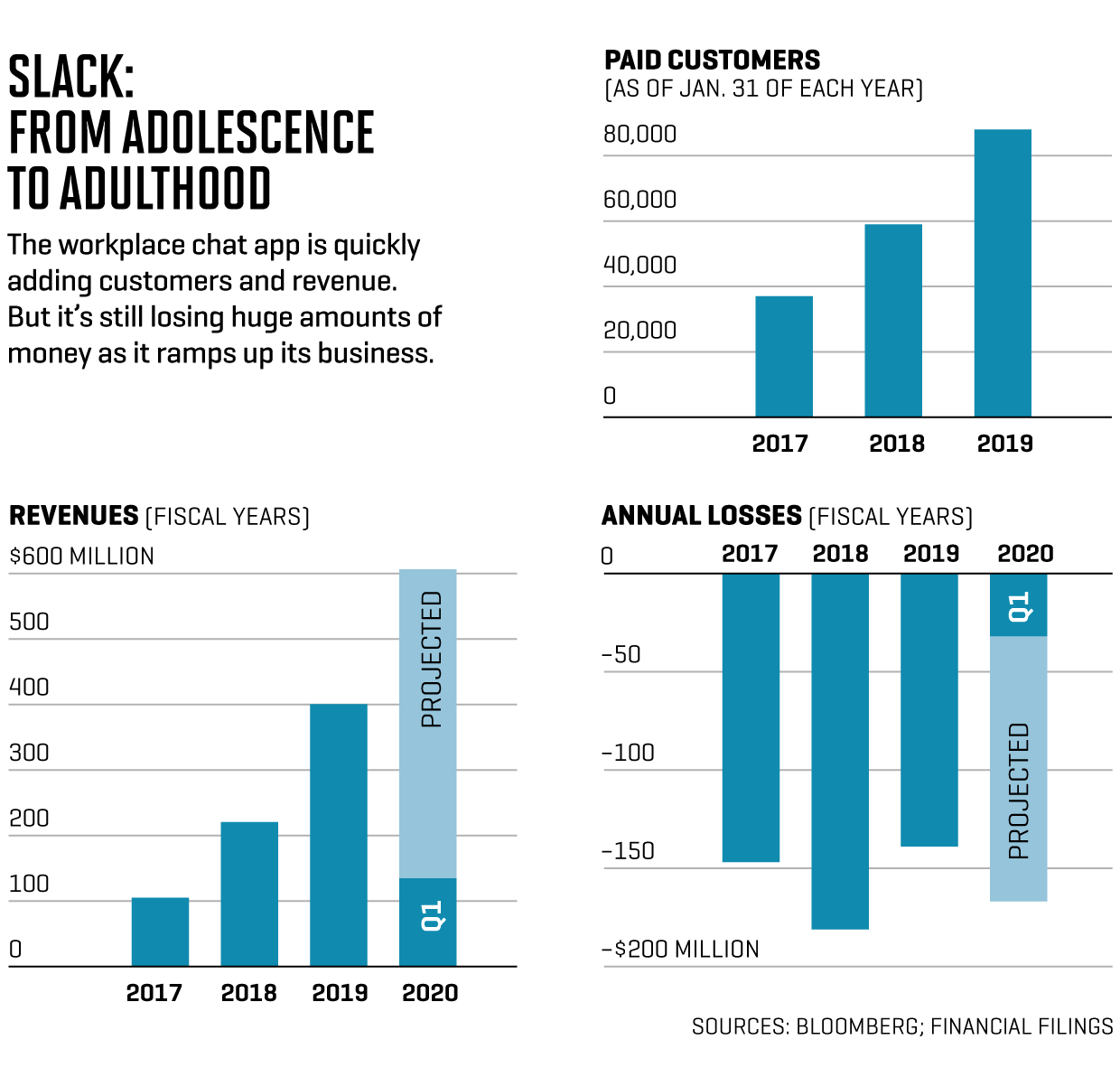
While Microsoft is a highly profitable machine that can easily plow cash into improving and promoting Teams, Slack is losing money. It hemorrhaged $139 million in its latest fiscal year on $400 million in revenue. But here’s the good news for Slack: Its roster of paying customers was up nearly 50% during that period compared with the year before, a growth rate that many other enterprise tech players, large and small, would envy. That kind of momentum is Slack’s ticket to achieving profitability, assuming it can continue at a similar pace. 

Slack’s trajectory hasn’t always been so clear. Butterfield, 46, started Tiny Speck, a maker of online games, in San Francisco in 2009. He pivoted to Slack, the chat tool his team had created to communicate internally, in 2014, when it became clear that the original game idea wouldn’t catch on. The Canadian-born chief executive officer now splits his time between the San Francisco Bay Area and New York City, along with Slack’s other major hubs and visits to its customers, who are located across 150 countries.

It’s not Butterfield’s first time in the spotlight. Previously, he cofounded photo-sharing site Flickr, a hot startup during the post–­Internet bubble era. Yahoo eventually bought the service in 2005 for a reported $35 million (a respectable “exit” at the time). Butterfield stayed on at Yahoo as general manager of Flickr, but he left three years later, disenchanted with the web portal’s bureaucracy, lack of innovation, and huge size. 

It’s no surprise, then, that despite Slack’s rapid growth and its transition from private to public, Butterfield remains convinced that being bigger isn’t always better. His customers tend to agree. 

“Slack is a very nimble company,” says Vijay Sankaran, chief information officer at financial services firm TD Ameritrade, where 11,000 employees have access to the chat app. “We’ve got a direct relationship with the CEO. We work with the product engineering team. That’s a real strength of theirs.”

Kaitlin Norris, “culture strategist” at e-­commerce company Shopify, another customer, says she has asked for—and received—specific new features from Slack for her company’s 4,000 workers. She is currently waiting for Butterfield’s crew to create a feature that would let employees manually organize channels, tabs created for specific projects or topics, which otherwise appear in alphabetical order on the service. 

SLA09.19-Stewart and Mom Norma Selfie
Slack CEO Stewart Butterfield and his mother, Norma Butterfield, in June outside the New York Stock Exchange, celebrating the direct listing of Slack’s shares.
Courtesy of Steward Butterfield

Much of Slack’s appeal to customers is that it integrates with online services from other companies. There are more than 1,500 such apps on the platform, from videoconferencing service Zoom to Google Drive, the online storage service that enables users to collaborate on documents. And Slack offers its customers tools that let them easily develop their own features that can be tied into Slack. Shopify, for example, has created an artificial intelligence–based bot called Tally that tracks what employees spend and allows them to file their expense reports, all within Slack.

“Slack acts like a pseudo operating system for the modern enterprise” that lets businesses access all their apps in one place, writes Suri, the William Blair analyst.

If becoming the one-stop shop for corporate software sounds a lot like Microsoft’s pitch, it is and it isn’t. Ironically, for Slack to succeed, at least in the eyes of Wall Street, it will need to become an enterprise giant much like its rival. But Butterfield is convinced he can continue to push the company into adulthood without forgetting its roots—the simplicity that helped Slack catch on in the first place.

A version of this article appears in the September 2019 issue of Fortune with the headline “Slack Spreads Its Wings.”

More must-read stories from Fortune:

—The economy is in code yellow for a recession based on these 9 metrics
—The death of trading: Why more big banks think the business is a losing bet
—Recession watch: 3 ways to reframe your thinking about the next downturn
—What are negative interest rates and why is everybody so worried about them?
—Why WeWork won’t be in the S&P 500 after its IPO
Don’t miss the daily Term Sheet, Fortune’s newsletter on deals and dealmakers.

About the Author
Michal Lev-Ram
By Michal Lev-RamSpecial Correspondent
Twitter icon

Michal Lev-Ram is a special correspondent covering the technology and entertainment sectors for Fortune, writing analysis and longform reporting.

See full bioRight Arrow Button Icon

Latest from the Magazine

Finance
Lorem ipsum dolor sit amet, consectetur adipiscing elit, sed do eiusmod tempor incididunt ut labore et dolore magna aliqua. Ut enim ad minim veniam
By Fortune Editors
October 20, 2025
Finance
Lorem ipsum dolor sit amet, consectetur adipiscing elit, sed do eiusmod tempor incididunt ut labore et dolore magna aliqua. Ut enim ad minim veniam
By Fortune Editors
October 20, 2025
Finance
Lorem ipsum dolor sit amet, consectetur adipiscing elit, sed do eiusmod tempor incididunt ut labore et dolore magna aliqua. Ut enim ad minim veniam
By Fortune Editors
October 20, 2025
Finance
Lorem ipsum dolor sit amet, consectetur adipiscing elit, sed do eiusmod tempor incididunt ut labore et dolore magna aliqua. Ut enim ad minim veniam
By Fortune Editors
October 20, 2025
Finance
Lorem ipsum dolor sit amet, consectetur adipiscing elit, sed do eiusmod tempor incididunt ut labore et dolore magna aliqua. Ut enim ad minim veniam
By Fortune Editors
October 20, 2025
Finance
Lorem ipsum dolor sit amet, consectetur adipiscing elit, sed do eiusmod tempor incididunt ut labore et dolore magna aliqua. Ut enim ad minim veniam
By Fortune Editors
October 20, 2025

Most Popular

Finance
Lorem ipsum dolor sit amet, consectetur adipiscing elit, sed do eiusmod tempor incididunt ut labore et dolore magna aliqua. Ut enim ad minim veniam
By Fortune Editors
October 20, 2025
Finance
Lorem ipsum dolor sit amet, consectetur adipiscing elit, sed do eiusmod tempor incididunt ut labore et dolore magna aliqua. Ut enim ad minim veniam
By Fortune Editors
October 20, 2025
Finance
Lorem ipsum dolor sit amet, consectetur adipiscing elit, sed do eiusmod tempor incididunt ut labore et dolore magna aliqua. Ut enim ad minim veniam
By Fortune Editors
October 20, 2025
Finance
Lorem ipsum dolor sit amet, consectetur adipiscing elit, sed do eiusmod tempor incididunt ut labore et dolore magna aliqua. Ut enim ad minim veniam
By Fortune Editors
October 20, 2025
Finance
Lorem ipsum dolor sit amet, consectetur adipiscing elit, sed do eiusmod tempor incididunt ut labore et dolore magna aliqua. Ut enim ad minim veniam
By Fortune Editors
October 20, 2025
Finance
Lorem ipsum dolor sit amet, consectetur adipiscing elit, sed do eiusmod tempor incididunt ut labore et dolore magna aliqua. Ut enim ad minim veniam
By Fortune Editors
October 20, 2025
Fortune Secondary Logo
Rankings
  • 100 Best Companies
  • Fortune 500
  • Global 500
  • Fortune 500 Europe
  • Most Powerful Women
  • World's Most Admired Companies
  • See All Rankings
  • Lists Calendar
Sections
  • Finance
  • Fortune Crypto
  • Features
  • Leadership
  • Health
  • Commentary
  • Success
  • Retail
  • Mpw
  • Tech
  • Lifestyle
  • CEO Initiative
  • Asia
  • Politics
  • Conferences
  • Europe
  • Newsletters
  • Personal Finance
  • Environment
  • Magazine
  • Education
Customer Support
  • Frequently Asked Questions
  • Customer Service Portal
  • Privacy Policy
  • Terms Of Use
  • Single Issues For Purchase
  • International Print
Commercial Services
  • Advertising
  • Fortune Brand Studio
  • Fortune Analytics
  • Fortune Conferences
  • Business Development
  • Group Subscriptions
About Us
  • About Us
  • Press Center
  • Work At Fortune
  • Terms And Conditions
  • Site Map
  • About Us
  • Press Center
  • Work At Fortune
  • Terms And Conditions
  • Site Map
  • Facebook icon
  • Twitter icon
  • LinkedIn icon
  • Instagram icon
  • Pinterest icon

Latest from the Magazine

Anduril CEO Brian Schimpf
MagazineDefense
Inside Anduril: Meet the quiet engineer-CEO building America’s $31 billion weapons startup
By Allie GarfinkleMay 6, 2026
12 days ago
A Michigan farm town voted down plans for a giant OpenAI-Oracle data center. Weeks later, construction began
MagazineData centers
A Michigan farm town voted down plans for a giant OpenAI-Oracle data center. Weeks later, construction began
By Sharon GoldmanMay 6, 2026
12 days ago
The American Express CEO defied haters who said he’d never have the top job—winning with millennials and Gen Z and trouncing the competition
MagazineAmerican Express
The American Express CEO defied haters who said he’d never have the top job—winning with millennials and Gen Z and trouncing the competition
By Shawn TullyMay 6, 2026
12 days ago
Photo of Marc Benioff
Magazinecommunication
Salesforce CEO Marc Benioff turned his earnings call into a vodcast. Why other Fortune 500 CEOs might follow
By Rachel VentrescaMay 6, 2026
12 days ago
A top Blackstone executive is becoming an unlikely LinkedIn star thanks to his running videos
Magazinecommunication
A top Blackstone executive is becoming an unlikely LinkedIn star thanks to his running videos
By Rachel VentrescaApril 21, 2026
27 days ago
Who’s really in control as AI and Big Tech race ahead?
MagazineEurope
Who’s really in control as AI and Big Tech race ahead?
By Francesca CassidyApril 10, 2026
1 month ago

Most Popular

Microsoft AI chief gives it 18 months—for all white-collar work to be automated by AI
AI
Microsoft AI chief gives it 18 months—for all white-collar work to be automated by AI
By Jake AngeloMay 16, 2026
2 days ago
Former top Russian official admits the country is over Putin and can 'imagine a future without him' — even elites bail as Kremlin seizes their assets 
Politics
Former top Russian official admits the country is over Putin and can 'imagine a future without him' — even elites bail as Kremlin seizes their assets 
By Jason MaMay 16, 2026
1 day ago
The Bezos family just donated $100 million to help achieve one of Mayor Zohran Mamdani’s top campaign promises
Politics
The Bezos family just donated $100 million to help achieve one of Mayor Zohran Mamdani’s top campaign promises
By Jake AngeloMay 12, 2026
5 days ago
The top foreign holders of U.S. debt may soon dump Treasury bonds and bring their money back home, potentially spiking borrowing costs
Economy
The top foreign holders of U.S. debt may soon dump Treasury bonds and bring their money back home, potentially spiking borrowing costs
By Jason MaMay 17, 2026
9 hours ago
SpaceX heads into a record-shattering IPO with the 'deepest moat that exists today' as investors vow to 'never bet against Elon'
Innovation
SpaceX heads into a record-shattering IPO with the 'deepest moat that exists today' as investors vow to 'never bet against Elon'
By Jason MaMay 16, 2026
1 day ago
'No one was coming to save me': How Reese Witherspoon built a $900 million company from a problem Hollywood wouldn't fix
Success
'No one was coming to save me': How Reese Witherspoon built a $900 million company from a problem Hollywood wouldn't fix
By Sydney LakeMay 17, 2026
16 hours ago

© 2026 Fortune Media IP Limited. All Rights Reserved. Use of this site constitutes acceptance of our Terms of Use and Privacy Policy | CA Notice at Collection and Privacy Notice | Do Not Sell/Share My Personal Information
FORTUNE is a trademark of Fortune Media IP Limited, registered in the U.S. and other countries. FORTUNE may receive compensation for some links to products and services on this website. Offers may be subject to change without notice.