• Home
  • Latest
  • Fortune 500
  • Finance
  • Tech
  • Leadership
  • Lifestyle
  • Rankings
  • Multimedia

Trendingnow

1

Microsoft AI chief gives it 18 months—for all white-collar work to be automated by AI

2

Former top Russian official admits the country is over Putin and can 'imagine a future without him' — even elites bail as Kremlin seizes their assets 

3

Meet the 20-year-old CEO who launched a company in high school to solve Gen Z's entry-level job crisis

1

Microsoft AI chief gives it 18 months—for all white-collar work to be automated by AI

2

Former top Russian official admits the country is over Putin and can 'imagine a future without him' — even elites bail as Kremlin seizes their assets 

3

Meet the 20-year-old CEO who launched a company in high school to solve Gen Z's entry-level job crisis
Commentarydiversity and inclusion

Companies must commit to equal pay to make stakeholder capitalism work

By
Katica Roy
Katica Roy
Down Arrow Button Icon
By
Katica Roy
Katica Roy
Down Arrow Button Icon
September 18, 2020, 5:00 AM ET
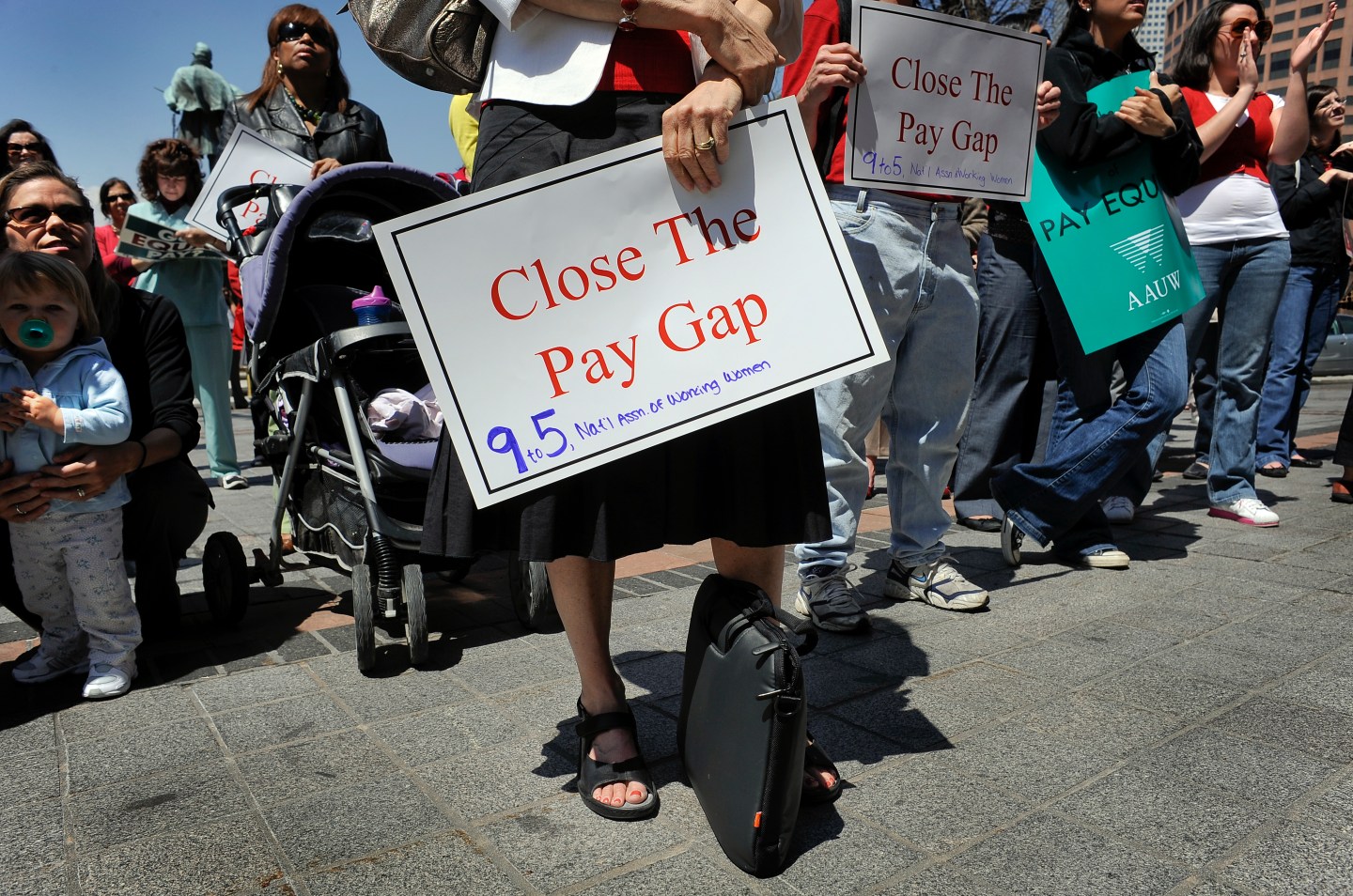
(Photo By Craig F. Walker/The Denver Post via Getty Images)

The U.S. is now experiencing the greatest economic downturn since the Great Depression—with the starkest levels of wealth inequality since the 1920s. We need to act, but how? Perhaps we should heed the significance of today, International Equal Pay Day, to guide our path forward. 

Grounded in the data and the spirit of American resilience, I’m calling for a furthering of the social contract. We the People must unambiguously embrace stakeholder capitalism. Such an embrace would unleash sustainable economic growth for customers, employees, partners, communities, and society at large. This is America’s future.

To accomplish this next stage of capitalism, we must shake ourselves from the binds of a false narrative, the one that pits the interests of stakeholders against the interests of shareholders. This narrative has fueled, albeit inefficiently, American corporations on the taxpayer dime.

If we are serious about digging ourselves out of today’s economic turmoil and creating economic prosperity for all, then we must overhaul our current revenue-and-profits-based performance indicators used to evaluate the success of a corporation. 

Traditional financial reporting took us this far. It’s time to pass the baton. To recalibrate our economy, we need to implement a new set of key performance indicators (KPIs) to measure and track organizational success.

Why stakeholder capitalism clashes with traditional financial reporting

The year 2015 was the first on record that the middle class no longer constituted the majority in the U.S. Now, the top 1% of U.S. families hold more wealth (over $25 trillion) than the entire American middle class ($18 trillion). 

That’s why Americans applauded in August 2019 when the Business Roundtable redefined the universal purpose of a company in pursuit of an economy that serves all stakeholders: customers, employees, suppliers, communities, and shareholders alike. In calling for a new standard of corporate responsibility, top CEOs from around the country recognized that “Americans deserve an economy that allows each person to succeed through hard work and creativity and to lead a life of meaning and dignity.”

Unfortunately, no matter how noble the intentions, businesses cannot and will not realize their newfound purpose until we expand the scope of standard reporting metrics. 

Today’s shareholders evaluate company performance using standard metrics such as revenue, profit, return on capital, margin, share price, and capital efficiency. When a company performs well according to this set of metrics, investors show their support by buying that company’s stock. Existing shareholders are rewarded when stock prices rise, and CEOs reap the benefits via compensation and professional accolade. Expecting CEOs to suddenly shift their focus away from the metrics that shareholders (and by proxy the board of directors) primarily care about goes against the status quo. 

Lest we forget how budding enterprises are funded in the first place: Entrepreneurs succeed in growing their businesses by selling the promise of financial return to investors across the spectrum—angel investors, venture capitalists, retail investors, institutional investors, banks, and other financial institutions.    

And yet, shareholder primacy is a myth we have already busted. In the long term, what’s good for customers, employees, and the community is good for shareholders too. Companies with intersectionality gender equitable workforces (i.e., with equitable rates of pay, promotion, and performance evaluation across gender, race, ethnicity, and age) increase their profitability, return on equity, innovation, productivity, and ability to attract top talent. 

My company, Pipeline, conducted original research across 4,161 companies in 29 countries, subsequently collecting over 1 billion data points, and found that for every 10% increase in intersectional gender equity, businesses see a 1% to 2% increase in revenue. 

Moreover, companies that support diverse, equitable, and inclusive (DEI) workforces not only perform better in good times, they also are better at weathering economic downturns. From 2007 to 2009, the S&P 500 declined 35%. However, businesses where key employee groups (such as women and people of color) said they had “very positive experiences” saw their stocks rise an average of 14.4%. 

DEI businesses beating the market extends beyond the boundaries of a recession too. The stocks of DEI businesses where key employee groups thrived rose 35% between 2006 and 2014, whereas the aggregate S&P 500 rose only 9% during that time.

How to overcome diversity data deficits 

The basis for standard DEI reporting should stem from current Equal Employment Opportunity Commision (EEOC) requirements. As it stands, companies with 100 or more employees must provide data on gender and race broken down across 10 different job classifications every year. 

From here, we must demand a series of updates. First, this data must be made public every year. Today, a mere 4% of companies voluntarily publish their data. Second, we must include pay data to the already required reporting on gender and race across job classifications. Third, we must add a new category of metrics to track the entire employee lifecycle by gender, race, and ethnicity. These metrics include rates of promotion, representation on every step of the corporate ladder, representation on boards, performance evaluation scores, and access to resources, sponsorships, and growth opportunities.  

Now is the time to move from self-reported data and optional reporting to a standard set of key performance indicators that are based on real data. 

At best, the absence of DEI metrics will damper efforts to achieve the ideals of stakeholder capitalism. At worst, it will deepen the growing wealth inequality already undermining our economic prosperity and democracy—in which case everyone is held back. We could, for instance, expand the U.S. economy by $512 billion simply by closing the intersectional gender pay gap (though of course, that would not be simple).

Supporting the next iteration of the great American experiment 

Most of the commitment to DEI has been outward-facing. We’ve seen press releases, such as this one by the Business Roundtable, against racial injustice. We’ve seen over $2.8 billion in donations pour in from large public companies to fight systemic racism. Black squares on social media.  

But where’s the commitment to hire people equitably, to promote them equitably, and to pay them equitably? And where can we find the data to prove companies are making good on these commitments? How can we be certain that companies truly stand for DEI when five of the largest U.S. tech companies represent 22.7% of the S&P 500, and yet less than 3% of workers from the largest tech companies identify as Black? 

For its part, the Business Roundtable has publicly committed to increasing minimum wages, investing in opportunities for employee growth, and expanding affordable access to health care. But where is the data to prove they pay their employees equitably? What about the data to prove they promote people at equitable rates? How will we know that they evaluate performance objectively and in an unbiased manner?  

In the wake of COVID-19’s economic fallout and amid renewed calls for racial justice, we need to raise corporations to a higher calling. Because what’s good for employees, customers, and communities is also good for shareholders. Stakeholder capitalism expands the tax base, increases consumer spending (which drives 70% of the U.S. economy), and brings us one giant step closer toward equity for all. It is the next iteration of American greatness.

Katica Roy is a gender economist and the CEO and founder of Pipeline, a SaaS company that leverages artificial intelligence to identify and drive economic gains through gender equity.


About the Author
By Katica Roy
See full bioRight Arrow Button Icon

Latest in Commentary

Finance
Lorem ipsum dolor sit amet, consectetur adipiscing elit, sed do eiusmod tempor incididunt ut labore et dolore magna aliqua. Ut enim ad minim veniam
By Fortune Editors
October 20, 2025
Finance
Lorem ipsum dolor sit amet, consectetur adipiscing elit, sed do eiusmod tempor incididunt ut labore et dolore magna aliqua. Ut enim ad minim veniam
By Fortune Editors
October 20, 2025
Finance
Lorem ipsum dolor sit amet, consectetur adipiscing elit, sed do eiusmod tempor incididunt ut labore et dolore magna aliqua. Ut enim ad minim veniam
By Fortune Editors
October 20, 2025
Finance
Lorem ipsum dolor sit amet, consectetur adipiscing elit, sed do eiusmod tempor incididunt ut labore et dolore magna aliqua. Ut enim ad minim veniam
By Fortune Editors
October 20, 2025
Finance
Lorem ipsum dolor sit amet, consectetur adipiscing elit, sed do eiusmod tempor incididunt ut labore et dolore magna aliqua. Ut enim ad minim veniam
By Fortune Editors
October 20, 2025
Finance
Lorem ipsum dolor sit amet, consectetur adipiscing elit, sed do eiusmod tempor incididunt ut labore et dolore magna aliqua. Ut enim ad minim veniam
By Fortune Editors
October 20, 2025

Most Popular

Finance
Lorem ipsum dolor sit amet, consectetur adipiscing elit, sed do eiusmod tempor incididunt ut labore et dolore magna aliqua. Ut enim ad minim veniam
By Fortune Editors
October 20, 2025
Finance
Lorem ipsum dolor sit amet, consectetur adipiscing elit, sed do eiusmod tempor incididunt ut labore et dolore magna aliqua. Ut enim ad minim veniam
By Fortune Editors
October 20, 2025
Finance
Lorem ipsum dolor sit amet, consectetur adipiscing elit, sed do eiusmod tempor incididunt ut labore et dolore magna aliqua. Ut enim ad minim veniam
By Fortune Editors
October 20, 2025
Finance
Lorem ipsum dolor sit amet, consectetur adipiscing elit, sed do eiusmod tempor incididunt ut labore et dolore magna aliqua. Ut enim ad minim veniam
By Fortune Editors
October 20, 2025
Finance
Lorem ipsum dolor sit amet, consectetur adipiscing elit, sed do eiusmod tempor incididunt ut labore et dolore magna aliqua. Ut enim ad minim veniam
By Fortune Editors
October 20, 2025
Finance
Lorem ipsum dolor sit amet, consectetur adipiscing elit, sed do eiusmod tempor incididunt ut labore et dolore magna aliqua. Ut enim ad minim veniam
By Fortune Editors
October 20, 2025
Fortune Secondary Logo
Rankings
  • 100 Best Companies
  • Fortune 500
  • Global 500
  • Fortune 500 Europe
  • Most Powerful Women
  • World's Most Admired Companies
  • See All Rankings
  • Lists Calendar
Sections
  • Finance
  • Fortune Crypto
  • Features
  • Leadership
  • Health
  • Commentary
  • Success
  • Retail
  • Mpw
  • Tech
  • Lifestyle
  • CEO Initiative
  • Asia
  • Politics
  • Conferences
  • Europe
  • Newsletters
  • Personal Finance
  • Environment
  • Magazine
  • Education
Customer Support
  • Frequently Asked Questions
  • Customer Service Portal
  • Privacy Policy
  • Terms Of Use
  • Single Issues For Purchase
  • International Print
Commercial Services
  • Advertising
  • Fortune Brand Studio
  • Fortune Analytics
  • Fortune Conferences
  • Business Development
  • Group Subscriptions
About Us
  • About Us
  • Press Center
  • Work At Fortune
  • Terms And Conditions
  • Site Map
  • About Us
  • Press Center
  • Work At Fortune
  • Terms And Conditions
  • Site Map
  • Facebook icon
  • Twitter icon
  • LinkedIn icon
  • Instagram icon
  • Pinterest icon

Latest in Commentary

liberman
Commentarystart-ups
We watched social media concentrate. The same thing is happening in AI, only at a deeper layer
By David Liberman and Daniil LibermanMay 16, 2026
18 hours ago
olivier
CommentaryAnthropic
I’ve been studying Big Tech for a long time. What just happened with Anthropic and the Pentagon terrifies me
By Olivier SylvainMay 16, 2026
19 hours ago
lawyer
CommentaryLaw
Would you hire the lawyer who just got sanctioned for using AI?
By Alexandra SmythMay 16, 2026
21 hours ago
greg
Personal FinanceAviation
Mamdani’s New York is coming to tax your private jet. Here’s how to prepare
By Greg RaiffMay 16, 2026
22 hours ago
chase
CommentaryCities
San Francisco has $2 trillion in AI wealth and can’t fix its own city. That’s every city’s problem
By Chase GarbarinoMay 15, 2026
2 days ago
lori
Commentarymental health
I run Valvoline Instant Oil Change and work with young people every day. They’re in crisis—and we all have to try to help
By Lori FleesMay 15, 2026
2 days ago

Most Popular

Microsoft AI chief gives it 18 months—for all white-collar work to be automated by AI
AI
Microsoft AI chief gives it 18 months—for all white-collar work to be automated by AI
By Jake AngeloMay 16, 2026
19 hours ago
Former top Russian official admits the country is over Putin and can 'imagine a future without him' — even elites bail as Kremlin seizes their assets 
Politics
Former top Russian official admits the country is over Putin and can 'imagine a future without him' — even elites bail as Kremlin seizes their assets 
By Jason MaMay 16, 2026
9 hours ago
Meet the 20-year-old CEO who launched a company in high school to solve Gen Z's entry-level job crisis
Future of Work
Meet the 20-year-old CEO who launched a company in high school to solve Gen Z's entry-level job crisis
By Jake AngeloMay 16, 2026
23 hours ago
The Bezos family just donated $100 million to help achieve one of Mayor Zohran Mamdani’s top campaign promises
Politics
The Bezos family just donated $100 million to help achieve one of Mayor Zohran Mamdani’s top campaign promises
By Jake AngeloMay 12, 2026
4 days ago
‘You’re not a hero, you’re a liability’: Shark Tank’s Kevin O’Leary warns Gen Z founders to stop glorifying hustle culture
Future of Work
‘You’re not a hero, you’re a liability’: Shark Tank’s Kevin O’Leary warns Gen Z founders to stop glorifying hustle culture
By Jacqueline MunisMay 16, 2026
19 hours ago
Despite having a $165 million net worth, Scarlett Johansson says work-life balance doesn’t exist—and the first step to success is admitting that
Success
Despite having a $165 million net worth, Scarlett Johansson says work-life balance doesn’t exist—and the first step to success is admitting that
By Preston ForeMay 13, 2026
4 days ago

© 2026 Fortune Media IP Limited. All Rights Reserved. Use of this site constitutes acceptance of our Terms of Use and Privacy Policy | CA Notice at Collection and Privacy Notice | Do Not Sell/Share My Personal Information
FORTUNE is a trademark of Fortune Media IP Limited, registered in the U.S. and other countries. FORTUNE may receive compensation for some links to products and services on this website. Offers may be subject to change without notice.