
• Home
  • Latest
  • Fortune 500
  • Finance
  • Tech
  • Leadership
  • Lifestyle
  • Rankings
  • Multimedia

Trendingnow

1

MacKenzie Scott alone accounted for one-third of America's $19.2 billion in megagifts last year

2

Philanthropy leader at Warren Buffett and Bill Gates’ Giving Pledge says children of billionaires are pushing them to give their wealth away faster

3

Elon Musk on MacKenzie Scott giving away $26 billion of her fortune: 'Sadly,' it makes the world a worse place

1

MacKenzie Scott alone accounted for one-third of America's $19.2 billion in megagifts last year

2

Philanthropy leader at Warren Buffett and Bill Gates’ Giving Pledge says children of billionaires are pushing them to give their wealth away faster

3

Elon Musk on MacKenzie Scott giving away $26 billion of her fortune: 'Sadly,' it makes the world a worse place
SuccessGen Z

Stop giving Gen Z so much credit for shaking up the workplace. Gen X started it 30 years ago

Hillary Hoffower
By
Hillary Hoffower
Hillary Hoffower
Down Arrow Button Icon
Hillary Hoffower
By
Hillary Hoffower
Hillary Hoffower
Down Arrow Button Icon
July 17, 2022, 8:30 PM ET
SolStock—Getty Images
Add Fortune on Google for similar content.

Gen Z is a puzzle everyone’s trying to figure out at work. They want it all: Purpose! Work-life balance! Flexibility! And if they don’t get it, they’ll leave the door swinging on their way out.

If that narrative sounds a little tired, it’s likely because you first heard it when millennials entered the workforce 15 years ago. They wanted it all, too, facing criticism for jumping from one job to the next in pursuit of a career they loved that still gave them room to breathe.

So are these workplace priorities actually a generational shift, or merely the typical whims of young workers in their first jobs? The question brings up an age-old debate on the legitimacy of generations. Labels for cohorts have long been used by researchers, demographers, and economists to analyze history and perspectives. But many have argued that generations don’t actually exist except in our imaginations, and research from a decade ago has even found that there aren’t many meaningful generational distinctions in workplace attitudes. 

“[Generations are] not natural laws, they’re just ways we have of understanding things,” says Jeffrey Arnett, psychologist and senior research scholar at Clark University. “They can be useful in some ways. But it’s important not to view them as fixed.”

After all, using broad strokes to paint a picture of a cohort can pigeonhole individuals. But we also shouldn’t just shrug off Gen Z’s behaviors as a folly of youth. The question is nuanced.

Arnett’s research, along with additional insights from workplace experts and decades of studies, point to the answer: Gen Z’s attitudes about work are the result of both generational identity and life stage. Yes, the pandemic accelerated desires past generations set into motion and emboldened Gen Z to speak up about them. But still, these are idealistic 20-somethings who have stars in their eyes, who are also eclipsed by economic crises. Millennials have trod this ground before. And some even argue that this workplace idealism began with Gen X 30 years ago. 
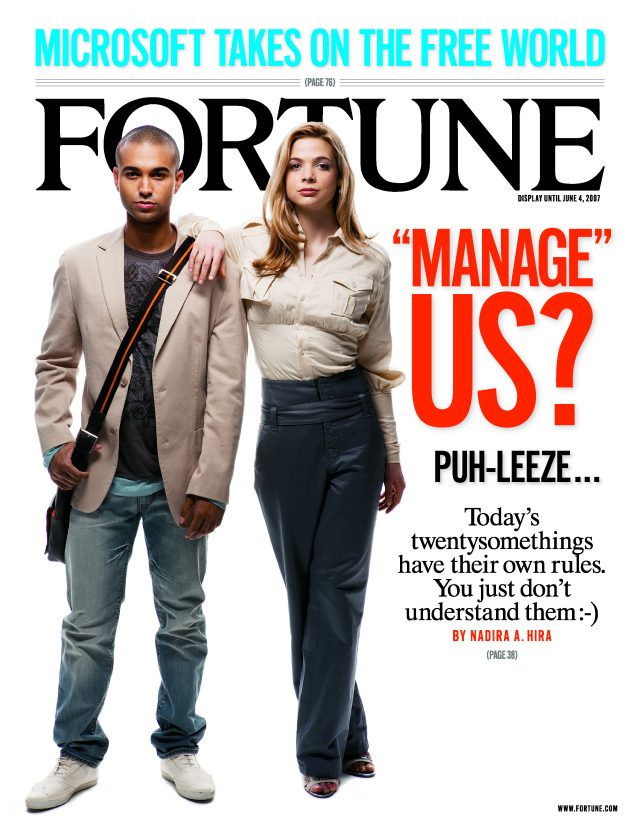
A July 2007 Fortune cover story explored the challenges bosses face trying to manage 20-somethings.

Idealizing passion and flexibility is part of the 20-something life stage, regardless of generation

Today’s idealistic view of work has roots in an economy that began to shift from manufacturing industries to information services and technology in the 1960s, continuing through the next several decades thanks to the rise of automation and a few recessions.

It created a cultural aspiration to find enjoyable work that’s more than just a paycheck, Arnett says: “In that kind of economy, you have a better chance of finding some kind of work that will actually be fun.”

Arnett began studying young adults in the 1990s—Gen Xers beginning their careers during the dot-com bubble. He found that many craved identity-based work: A job that wasn’t just a job, but something they looked forward to when waking up. It was similar to how they viewed love, idealizing a soulmate rather than just a marriage partner. It was a generational shift from how their parents viewed work and love, he says, but one he thought would become the norm for 18- to 25-year-olds in future generations—a life stage he then defined as emerging adulthood.

“Those changes we still have with us today now that we’ve gone from Gen X to millennials and from millennials to Gen Z,” he says.

There’s plenty of research emphasizing how much 20-somethings value enjoyable work—which has variously been defined as “meaning,” “purpose,” or “passion”— to back up Arnett. As cited by Quartz, a 1999 article from the Charlotte Observer reported that Gen X craved fun at work. Millennials took that desire to the next level, a 2017 LinkedIn study found, often picking passion over pay. Now, Gen Z is the generation most likely to say they want better career alignment in their interests and values.

Studies also show a similar track record for another popular young worker priority: flexibility and the work-life balance that comes with it. The same Charlotte Observer article also reported that Gen X wanted flexible schedules. Inc. described millennials as “hell-bent” on flexibility in 2015. Fast forward to the 2020s, and Gen Z is leading the pack with the same demands. 

Arnett finds that the romanticized desire for having a job you’re passionate about wanes as we age. Even in 2017, millennials, the oldest of whom were 36, were already starting to value stability over passion. “In their early 20s, people still dream big,” Arnett says. “People have these ideals, but they eventually have to accommodate themselves to a more accessible reality.” 

The pandemic has made these workplace desires stronger for Gen Z

Since each generation is typically more progressive than the last, the 20-something dreams of purposeful and flexible work have become even more pronounced with each new cohort. That’s especially so with Gen Z, many of whom entered the workforce during the era of remote work and The Great Resignation.

That’s why work-life integration demands are part of a demographic sea change, says Lauren Stiller Rikleen, president at Rikleen Institute for Strategic Leadership and author of You Raised Us, Now Work With Us: Millennials, Career Success, and Building Strong Workplace Teams. Boomers were more focused on surviving in a workforce that lacked guidance and training, she explains, but more workplace support over time has enabled young workers to take their values into the office.

“That means not only the ability to have flexibility around raising a family, but to live a more complete life and think about health and wellness,” Rikleen tells Fortune.

But the generational trendline around some of these work-life changes isn’t happening fast enough for where millennials and Gen Z are today, she says, and Gen Z is more proactive in getting these changes across the line. 

Millennials and Gen Z approached their similar desires differently based on their economic experiences: Graduating into the Great Recession made millennials less inclined to ask for the things they wanted because they just felt lucky to have a job, whereas graduating into the pandemic empowered Gen Z to make autonomous demands.

Gen Z is placing higher priority on pursuing their passions and work-life balance than past generations did at their age after having their career plans upended and experiencing job loss, says Jason Dorsey, Gen Z expert and founder of The Center for Generational Kinetics.

When Gen Z doesn’t work for an employer willing to meet their demands, they have no problem finding a new job. As a result, they have a reputation for being anti-capitalist and anti-work, which may seem at odds with Arnett’s theory of the 20-something’s identity-based work tenet. But herein lies another generational shift: While millennials often view their career as central to their identity, Gen Z feels meaningful work is just one part of who they are.

“Whereas other generations thought that their identity started at 9 a.m. and ended at 5 p.m., Gen Z often feels that their identity starts outside of work,” Dorsey tells Fortune. “That puts less pressure on them to define themselves through their current employment.”

But regardless of life stage or generation, many people have loved the taste of work-life balance the pandemic has given them. Even pre-COVID, Boomers yearned for more unstructured schedules. Arnett believes that older workers would love to choose their own schedules, but that it hasn’t often been possible for them. 

“COVID has really shaken things up,” he says. “It’ll be interesting to see if these younger workers are able to sustain that.”

Sign up for the Fortune Features email list so you don’t miss our biggest features, exclusive interviews, and investigations.


About the Author
Hillary Hoffower
By Hillary Hoffower
Twitter icon
See full bioRight Arrow Button Icon
Add Fortune on Google for similar content.

Latest in Success

Finance
Lorem ipsum dolor sit amet, consectetur adipiscing elit, sed do eiusmod tempor incididunt ut labore et dolore magna aliqua. Ut enim ad minim veniam
By Fortune Editors
October 20, 2025
Finance
Lorem ipsum dolor sit amet, consectetur adipiscing elit, sed do eiusmod tempor incididunt ut labore et dolore magna aliqua. Ut enim ad minim veniam
By Fortune Editors
October 20, 2025
Finance
Lorem ipsum dolor sit amet, consectetur adipiscing elit, sed do eiusmod tempor incididunt ut labore et dolore magna aliqua. Ut enim ad minim veniam
By Fortune Editors
October 20, 2025
Finance
Lorem ipsum dolor sit amet, consectetur adipiscing elit, sed do eiusmod tempor incididunt ut labore et dolore magna aliqua. Ut enim ad minim veniam
By Fortune Editors
October 20, 2025
Finance
Lorem ipsum dolor sit amet, consectetur adipiscing elit, sed do eiusmod tempor incididunt ut labore et dolore magna aliqua. Ut enim ad minim veniam
By Fortune Editors
October 20, 2025
Finance
Lorem ipsum dolor sit amet, consectetur adipiscing elit, sed do eiusmod tempor incididunt ut labore et dolore magna aliqua. Ut enim ad minim veniam
By Fortune Editors
October 20, 2025

Most Popular

Finance
Lorem ipsum dolor sit amet, consectetur adipiscing elit, sed do eiusmod tempor incididunt ut labore et dolore magna aliqua. Ut enim ad minim veniam
By Fortune Editors
October 20, 2025
Finance
Lorem ipsum dolor sit amet, consectetur adipiscing elit, sed do eiusmod tempor incididunt ut labore et dolore magna aliqua. Ut enim ad minim veniam
By Fortune Editors
October 20, 2025
Finance
Lorem ipsum dolor sit amet, consectetur adipiscing elit, sed do eiusmod tempor incididunt ut labore et dolore magna aliqua. Ut enim ad minim veniam
By Fortune Editors
October 20, 2025
Finance
Lorem ipsum dolor sit amet, consectetur adipiscing elit, sed do eiusmod tempor incididunt ut labore et dolore magna aliqua. Ut enim ad minim veniam
By Fortune Editors
October 20, 2025
Finance
Lorem ipsum dolor sit amet, consectetur adipiscing elit, sed do eiusmod tempor incididunt ut labore et dolore magna aliqua. Ut enim ad minim veniam
By Fortune Editors
October 20, 2025
Finance
Lorem ipsum dolor sit amet, consectetur adipiscing elit, sed do eiusmod tempor incididunt ut labore et dolore magna aliqua. Ut enim ad minim veniam
By Fortune Editors
October 20, 2025
Fortune Secondary Logo
Rankings
  • 100 Best Companies
  • Fortune 500
  • Global 500
  • Fortune 500 Europe
  • Most Powerful Women
  • World's Most Admired Companies
  • See All Rankings
  • Lists Calendar
Sections
  • Finance
  • Fortune Crypto
  • Features
  • Leadership
  • Health
  • Commentary
  • Success
  • Retail
  • Mpw
  • Tech
  • Lifestyle
  • CEO Initiative
  • Asia
  • Politics
  • Conferences
  • Europe
  • Newsletters
  • Personal Finance
  • Environment
  • Magazine
  • Education
Customer Support
  • Frequently Asked Questions
  • Customer Service Portal
  • Privacy Policy
  • Terms Of Use
  • Single Issues For Purchase
  • International Print
Commercial Services
  • Advertising
  • Fortune Brand Studio
  • Fortune Analytics
  • Fortune Conferences
  • Business Development
  • Group Subscriptions
About Us
  • About Us
  • Press Center
  • Work At Fortune
  • Terms And Conditions
  • Site Map
  • About Us
  • Press Center
  • Work At Fortune
  • Terms And Conditions
  • Site Map
  • Facebook icon
  • Twitter icon
  • LinkedIn icon
  • Instagram icon
  • Pinterest icon

Latest in Success

U.S. Polo Assn. CEO J. Michael Prince
SuccessThe Promotion Playbook
U.S. Polo Assn. CEO was told he wasn’t right for a promotion—so he ‘outworked’ anyone else who wanted the job for 6 months straight
By Orianna Rosa RoyleJuly 1, 2026
58 minutes ago
Nikesh Arora, chief executive officer at Palo Alto Networks
SuccessJobs
CEO of $248 billion cybersecurity company says workers are about to face a ‘Darwinian moment’ thanks to AI: Evolve or get cut
By Emma BurleighJuly 1, 2026
1 hour ago
I know how Gen Z can survive the ‘jobpocalypse’ because I built an AI company — in 2015
CommentaryCareers
I know how Gen Z can survive the ‘jobpocalypse’ because I built an AI company — in 2015
By Jeremy FainJuly 1, 2026
6 hours ago
mr
Commentary250 Years of Innovation
America needs 3.8 million manufacturing workers. This CEO has a blueprint to find them
By Mark RayfieldJuly 1, 2026
6 hours ago
Photo: Rocks balancing on driftwood, sea in background.
AIMarkets
Leveraged stock bets are ‘very concentrated in the AI ecosystem,’ Goldman Sachs warns
By Jim EdwardsJuly 1, 2026
7 hours ago
Nike’s earning numbers exceeded Wall Street’s expectations. But CEO Elliott Hill’s next test is the World Cup
RetailNike
Nike’s earning numbers exceeded Wall Street’s expectations. But CEO Elliott Hill’s next test is the World Cup
By Mia OsmonbekovJune 30, 2026
20 hours ago

Most Popular

MacKenzie Scott alone accounted for one-third of America's $19.2 billion in megagifts last year
Success
MacKenzie Scott alone accounted for one-third of America's $19.2 billion in megagifts last year
By Sydney LakeJune 25, 2026
6 days ago
Philanthropy leader at Warren Buffett and Bill Gates’ Giving Pledge says children of billionaires are pushing them to give their wealth away faster
Success
Philanthropy leader at Warren Buffett and Bill Gates’ Giving Pledge says children of billionaires are pushing them to give their wealth away faster
By Preston ForeJune 27, 2026
4 days ago
Elon Musk on MacKenzie Scott giving away $26 billion of her fortune: 'Sadly,' it makes the world a worse place
Success
Elon Musk on MacKenzie Scott giving away $26 billion of her fortune: 'Sadly,' it makes the world a worse place
By Sydney LakeJune 29, 2026
2 days ago
As Big Tech showers employees with perks to win the talent war, Nvidia built a nearly $5 trillion company by making people pay for their own lunch
Big Tech
As Big Tech showers employees with perks to win the talent war, Nvidia built a nearly $5 trillion company by making people pay for their own lunch
By Marco Quiroz-GutierrezJuly 1, 2026
9 hours ago
The U.S. Army is opening military bases to private billions — here's why that changes everything for the next 250 years
Commentary
The U.S. Army is opening military bases to private billions — here's why that changes everything for the next 250 years
By Marc AndersenJune 30, 2026
1 day ago
The Supreme Court's birthright citizenship ruling hands the U.S. economy a $7.7 trillion win
Newsletters
The Supreme Court's birthright citizenship ruling hands the U.S. economy a $7.7 trillion win
By Diane BradyJuly 1, 2026
7 hours ago

© 2026 Fortune Media IP Limited. All Rights Reserved. Use of this site constitutes acceptance of our Terms of Use and Privacy Policy | CA Notice at Collection and Privacy Notice | Do Not Sell/Share My Personal Information
FORTUNE is a trademark of Fortune Media IP Limited, registered in the U.S. and other countries. FORTUNE may receive compensation for some links to products and services on this website. Offers may be subject to change without notice.