• Home
  • Latest
  • Fortune 500
  • Finance
  • Tech
  • Leadership
  • Lifestyle
  • Rankings
  • Multimedia

Trendingnow

1

Egg companies made $1.22 billion in profit off a $6 carton — now they’re buying their way out of a price-fixing case with 53 million donated eggs

2

Meet the Zillennials: The luckiest micro-generation in the workforce, born between 1993 and 1998

3

Economists have found an answer to slowing cognitive decline: Avoid retiring early, study finds

1

Egg companies made $1.22 billion in profit off a $6 carton — now they’re buying their way out of a price-fixing case with 53 million donated eggs

2

Meet the Zillennials: The luckiest micro-generation in the workforce, born between 1993 and 1998

3

Economists have found an answer to slowing cognitive decline: Avoid retiring early, study finds
PoliticsRussia
Europe

Russia is skirting sanctions ‘quite successfully.’ Meet the architect of Putin’s economic counterattack

By
Bloomberg
Bloomberg
Down Arrow Button Icon
By
Bloomberg
Bloomberg
Down Arrow Button Icon
July 30, 2022, 2:32 PM ET
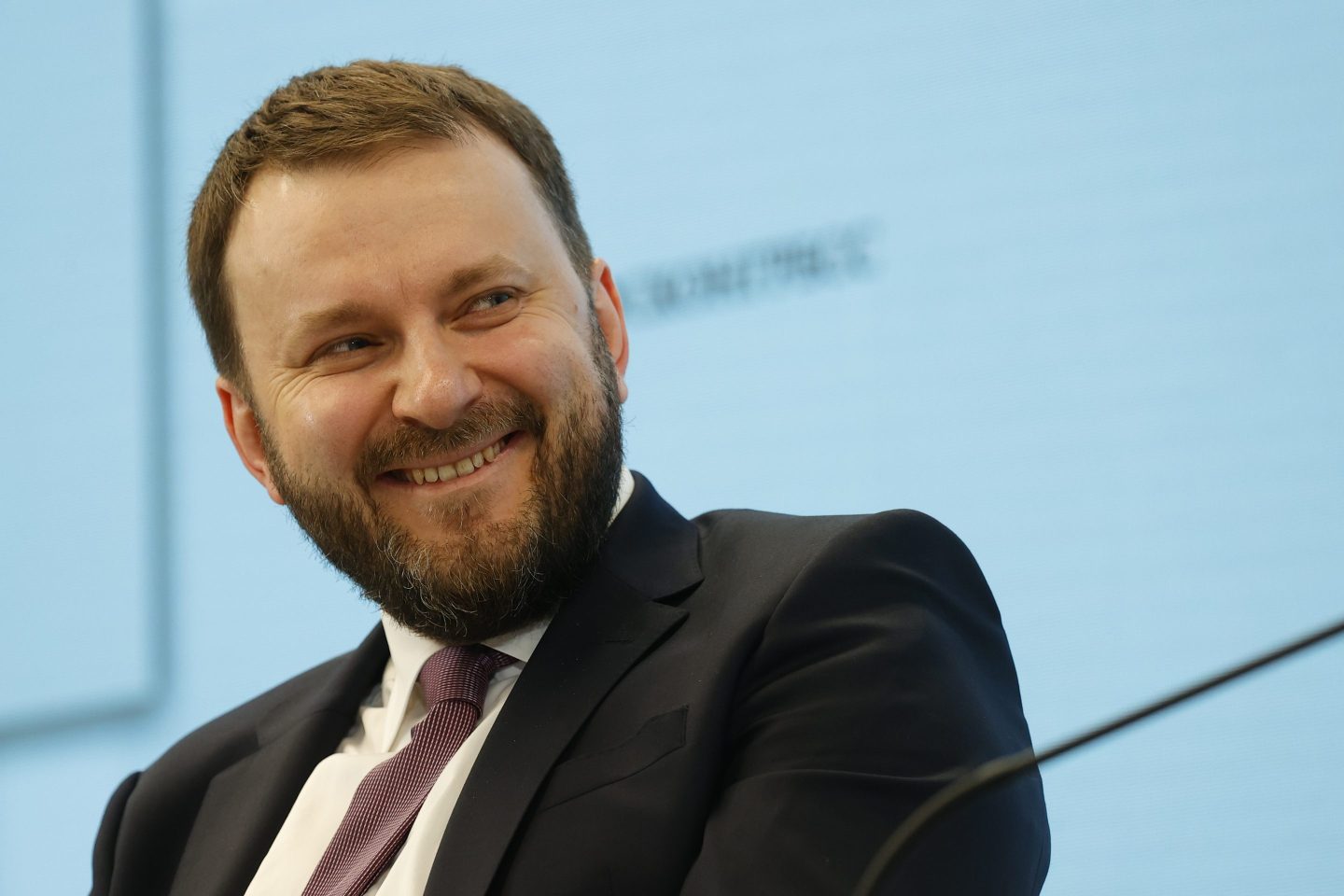
Maxim Oreshkin, an economic adviser to Russian President Vladimir Putin attends St. Petersburg International Economic Forum in St. Petersburg, Russia, on June 17.
Maxim Oreshkin, an economic adviser to Russian President Vladimir Putin attends St. Petersburg International Economic Forum in St. Petersburg, Russia, on June 17.Sefa Karacan—Anadolu Agency/Getty Images
Add Fortune on Google for similar content.

When sanctions made the Fortress Russia he helped build seem less impregnable, Maxim Oreshkin came up with a signature gambit to try and break the economic siege.

Russia’s war on Ukraine wasn’t yet a month old and its blitzkrieg was already turning into a slog. The economic blowback was harsh, too, as the government struggled to avoid a default and the ruble went into in a nosedive.

On March 23, Vladimir Putin struck back, demanding that Russia’s adversaries in Europe pay their massive bills for its natural gas in rubles.

Oreshkin, the president’s 40-year-old economic aide, was author of the gamble to tear up contracts and upend decades of precedent, according to officials familiar with the matter. 

Since the Feb. 24 invasion, he’s emerged as a key member of Putin’s inner circle on economic policy, one of several insiders with western financial experience now helping steer the Kremlin’s response. 

“They are now busy figuring out how to get around the sanctions and are doing it quite successfully,” said Sergei Guriev, an economist who advised the government in the early years of Putin’s rule but later fled to Paris, where he’s now rector of Sciences Po. “But all the money earned goes to fund the war.”

Damage dodged

The defenses have helped the Kremlin avoid the worst of the economic damage feared when the sanctions were first imposed. Forecasters now see a contraction half as deep this year. The ruble has recovered its early losses to become a top performer as tens of billions of dollars and euros flow in for energy and other exports.

By leveraging Russia’s sway over gas supplies to Europe, Oreshkin’s ruble demand allowed Putin to appear to be fighting back against the initial sanctions onslaught. It ultimately forced the EU to back down as most of the major consumers signed up to the new terms that included the requirement to open special accounts with Gazprombank JSC, keeping the lender free of sanctions.

“I consider the effect of using the rubles-for-gas scheme to be positive,” Oreshkin told Bloomberg, declining to comment on his role in devising it. 

He has whispered rhetorical flourishes that then wind up in presidential speeches. He coined a phrase that Putin would soon repeat over and over, describing the seizure of Russia’s international reserves as in fact “a real default” by the US and European Union on their obligations to Russia.

He’s also helped draw up plans to limit the fallout as Russia’s banks are cut off from the SWIFT financial messaging service and pushed back against calls from other influential insiders for more state control as Russia’s economy grows isolated from the world Oreshkin and his allies once sought closer ties with.

Putin brought him along on a recent trip to Iran, which has decades of experience weathering western sanctions. Asked about the Islamic republic’s ideas for overcoming the limits, Oreshkin bragged, “ours are much better.”

A former banker at Societe Generale SA’s Russian unit, he’s now using his western experience to blunt the impact of sanctions. Oreshkin is part of a cadre of officials who’ve long tried to walk a fine line between crafting investor-friendly economic policy and Putin’s growing repression. 

The war has made that balancing act all but impossible, with Oreshkin and his colleagues hit with sanctions as their economic policies serve the Kremlin’s war machine.

Not ‘defensible’

“I can see exactly how somebody from the technocrats would say, ‘Here I am doing this really important thing on payment systems, on banking, this is my area of responsibility. I am maintaining stability and I am going to continue doing it,”’ said Jacob Nell, who as Russia economist at Morgan Stanley once took investors to meet Oreshkin. 

“It was defensible before Feb. 24, but it is not after,” added Nell, who is now a member of an international working group advising the US and Europe on how to design sanctions against Russia

Oreshkin is part of a bridge generation that straddled the end of the Soviet era and spent their teenage years during what became known in Russia as the tumultuous 1990s, a period of hardship and economic daring.

Thirty years Putin’s junior, he was the youngest of two sons in a family of Moscow academics, growing up a world apart from the president’s hardscrabble beginnings in postwar Leningrad.

Technocrat cohort

Oreshkin’s cohort of technocrats includes Bank of Russia Deputy Governor Alexey Zabotkin, 44, and Deputy Finance Minister Vladimir Kolychev, 39. Graduates of elite Russian economic schools, they parlayed jobs at European lenders into a stint at state investment bank VTB Capital, before winning appointments to top state roles.

Forgoing the private sector, they devoted themselves to building up Putin’s financial fortress. The harsher Putin was with critics and rivals abroad and at home, the more indispensable they became in building resiliency to sustain the economy for when the big shocks would come.

During his three-year stint at the Finance Ministry, Oreshkin was among officials who devised a mechanism to divert hundreds of billions of dollars in revenues from oil-and-gas exports into a sovereign fund to help the Kremlin weather crises like the first waves of US and European sanctions over Crimea in 2014.

Years of sanctions-proofing the economy and building up reserves weren’t enough to protect the economy after the invasion, however. The US and its allies froze much of the $600 billion in reserves that Oreshkin’s policies had helped build up. For all his efforts to divert blame, Russia failed to make debt payments and defaulted for the first time in a century. The economy isn’t doing as badly as feared in the wake of the invasion, but it’s still on track for one of the deepest recessions in decades.

Seen as a political lightweight not long ago, Oreshkin in particular has emerged as the economic right-hand man of a president at war.

“Putin still trusts our economists,” said Guriev.

As some powerful Kremlin players have pushed for reasserting state control over the economy, Oreshkin has fought back, so far successfully.

Shrill rhetoric

“Russia is not going to abandon the market economy,” Oreshkin said in reply to questions from Bloomberg. “On the contrary, it’s moving in the opposite direction. Private initiative is now especially encouraged. This is constantly noted by the president in his speeches.”

Still, he and his allies are increasingly adopting the shrill rhetoric of Russia’s once-marginal critics of western capitalism. 

Oreshkin has likened the U.S. currency to “a drug used to addict the whole world.” Aleksey Moiseev, the 49-year-old deputy finance minister and another alum of VTB Capital, has said that the intensity of sanctions amounted to the detonation of a “financial nuclear bomb.”

Rhetoric aside, the anti-crisis measures taken so far largely stick close to the playbook that draws on mainstream economics, with policy makers already dismantling capital controls used to seal off Russia after the invasion. 

That may not be enough to secure their legacy.

“What they did in the first years of their stay at the Ministry of Finance and the central bank has already been canceled,” said Konstantin Sonin, a Moscow-born economist at the University of Chicago who’s long been critical of policies under Putin. “Now their work is no different from the work of highly paid clerks in a government waging a criminal war.”
Sign up for the Fortune Features email list so you don’t miss our biggest features, exclusive interviews, and investigations.
About the Author
By Bloomberg
See full bioRight Arrow Button Icon
Add Fortune on Google for similar content.

Latest in Politics

Finance
Lorem ipsum dolor sit amet, consectetur adipiscing elit, sed do eiusmod tempor incididunt ut labore et dolore magna aliqua. Ut enim ad minim veniam
By Fortune Editors
October 20, 2025
Finance
Lorem ipsum dolor sit amet, consectetur adipiscing elit, sed do eiusmod tempor incididunt ut labore et dolore magna aliqua. Ut enim ad minim veniam
By Fortune Editors
October 20, 2025
Finance
Lorem ipsum dolor sit amet, consectetur adipiscing elit, sed do eiusmod tempor incididunt ut labore et dolore magna aliqua. Ut enim ad minim veniam
By Fortune Editors
October 20, 2025
Finance
Lorem ipsum dolor sit amet, consectetur adipiscing elit, sed do eiusmod tempor incididunt ut labore et dolore magna aliqua. Ut enim ad minim veniam
By Fortune Editors
October 20, 2025
Finance
Lorem ipsum dolor sit amet, consectetur adipiscing elit, sed do eiusmod tempor incididunt ut labore et dolore magna aliqua. Ut enim ad minim veniam
By Fortune Editors
October 20, 2025
Finance
Lorem ipsum dolor sit amet, consectetur adipiscing elit, sed do eiusmod tempor incididunt ut labore et dolore magna aliqua. Ut enim ad minim veniam
By Fortune Editors
October 20, 2025

Most Popular

Finance
Lorem ipsum dolor sit amet, consectetur adipiscing elit, sed do eiusmod tempor incididunt ut labore et dolore magna aliqua. Ut enim ad minim veniam
By Fortune Editors
October 20, 2025
Finance
Lorem ipsum dolor sit amet, consectetur adipiscing elit, sed do eiusmod tempor incididunt ut labore et dolore magna aliqua. Ut enim ad minim veniam
By Fortune Editors
October 20, 2025
Finance
Lorem ipsum dolor sit amet, consectetur adipiscing elit, sed do eiusmod tempor incididunt ut labore et dolore magna aliqua. Ut enim ad minim veniam
By Fortune Editors
October 20, 2025
Finance
Lorem ipsum dolor sit amet, consectetur adipiscing elit, sed do eiusmod tempor incididunt ut labore et dolore magna aliqua. Ut enim ad minim veniam
By Fortune Editors
October 20, 2025
Finance
Lorem ipsum dolor sit amet, consectetur adipiscing elit, sed do eiusmod tempor incididunt ut labore et dolore magna aliqua. Ut enim ad minim veniam
By Fortune Editors
October 20, 2025
Finance
Lorem ipsum dolor sit amet, consectetur adipiscing elit, sed do eiusmod tempor incididunt ut labore et dolore magna aliqua. Ut enim ad minim veniam
By Fortune Editors
October 20, 2025
Fortune Secondary Logo
Rankings
  • 100 Best Companies
  • Fortune 500
  • Global 500
  • Fortune 500 Europe
  • Most Powerful Women
  • World's Most Admired Companies
  • See All Rankings
  • Lists Calendar
Sections
  • Finance
  • Fortune Crypto
  • Features
  • Leadership
  • Health
  • Commentary
  • Success
  • Retail
  • Mpw
  • Tech
  • Lifestyle
  • CEO Initiative
  • Asia
  • Politics
  • Conferences
  • Europe
  • Newsletters
  • Personal Finance
  • Environment
  • Magazine
  • Education
Customer Support
  • Frequently Asked Questions
  • Customer Service Portal
  • Privacy Policy
  • Terms Of Use
  • Single Issues For Purchase
  • International Print
Commercial Services
  • Advertising
  • Fortune Brand Studio
  • Fortune Analytics
  • Fortune Conferences
  • Business Development
  • Group Subscriptions
About Us
  • About Us
  • Press Center
  • Work At Fortune
  • Terms And Conditions
  • Site Map
  • About Us
  • Press Center
  • Work At Fortune
  • Terms And Conditions
  • Site Map
  • Facebook icon
  • Twitter icon
  • LinkedIn icon
  • Instagram icon
  • Pinterest icon

Latest in Politics

ashok
Commentary250 Years of Innovation
The greatest startup in history: What we can learn from America’s founders at today’s AI frontier
By Ashok N. SrivastavaJuly 3, 2026
17 hours ago
t
CryptoWhite House
‘We are in a new era’: Trump’s bombshell $2.2 billion income haul, the ‘Big Player Theory’ and what happens when the president becomes the bubble
By Nick LichtenbergJuly 3, 2026
20 hours ago
Photo: Iranian Supreme Leader Ayatollah Ali Khamenei
PoliticsIran
In Iran, regime officials who survived the war intended to kill them appear in public for dayslong funeral of the late Supreme Leader Khamenei
By Nasser Karimi, Jon Gambrell and The Associated PressJuly 3, 2026
20 hours ago
Photo: Russian President Vladimir Putin Attends ASEAN-Russia Summit
Energyputin
Russians live with fuel shortages and rationing as Putin insists the war against Ukraine will go on
By The Associated PressJuly 3, 2026
21 hours ago
Photo: Ivanka Trump and Jared Kushner
Environmentjared kushner
Police use tear gas and pepper spray against Albanians protesting Trump family plans to develop unspoiled island into a luxury resort
By The Associated PressJuly 3, 2026
21 hours ago
U.S. Treasury Secretary Scott Bessent
EconomyDebt
AI’s $2.2 trillion deficit fix is already half fake, economists say
By Tristan BoveJuly 2, 2026
1 day ago

Most Popular

Egg companies made $1.22 billion in profit off a $6 carton — now they’re buying their way out of a price-fixing case with 53 million donated eggs
Law
Egg companies made $1.22 billion in profit off a $6 carton — now they’re buying their way out of a price-fixing case with 53 million donated eggs
By Wyatte Grantham-Philips and The Associated PressJuly 2, 2026
1 day ago
Meet the Zillennials: The luckiest micro-generation in the workforce, born between 1993 and 1998
AI
Meet the Zillennials: The luckiest micro-generation in the workforce, born between 1993 and 1998
By Nick LichtenbergJuly 3, 2026
23 hours ago
Economists have found an answer to slowing cognitive decline: Avoid retiring early, study finds
Economy
Economists have found an answer to slowing cognitive decline: Avoid retiring early, study finds
By Sasha RogelbergJuly 2, 2026
2 days ago
On Wall Street, analysts increasingly don’t believe the U.S. government’s 'misleading' job numbers
Economy
On Wall Street, analysts increasingly don’t believe the U.S. government’s 'misleading' job numbers
By Jim EdwardsJuly 3, 2026
18 hours ago
$25 billion CEO says one-hour interviews are a waste of time—he puts candidates through six hours of tests and wants them to order wine at lunch
Success
$25 billion CEO says one-hour interviews are a waste of time—he puts candidates through six hours of tests and wants them to order wine at lunch
By Orianna Rosa RoyleJuly 3, 2026
23 hours ago
Current price of oil as of July 2, 2026
Personal Finance
Current price of oil as of July 2, 2026
By Joseph HostetlerJuly 2, 2026
2 days ago

© 2026 Fortune Media IP Limited. All Rights Reserved. Use of this site constitutes acceptance of our Terms of Use and Privacy Policy | CA Notice at Collection and Privacy Notice | Do Not Sell/Share My Personal Information
FORTUNE is a trademark of Fortune Media IP Limited, registered in the U.S. and other countries. FORTUNE may receive compensation for some links to products and services on this website. Offers may be subject to change without notice.