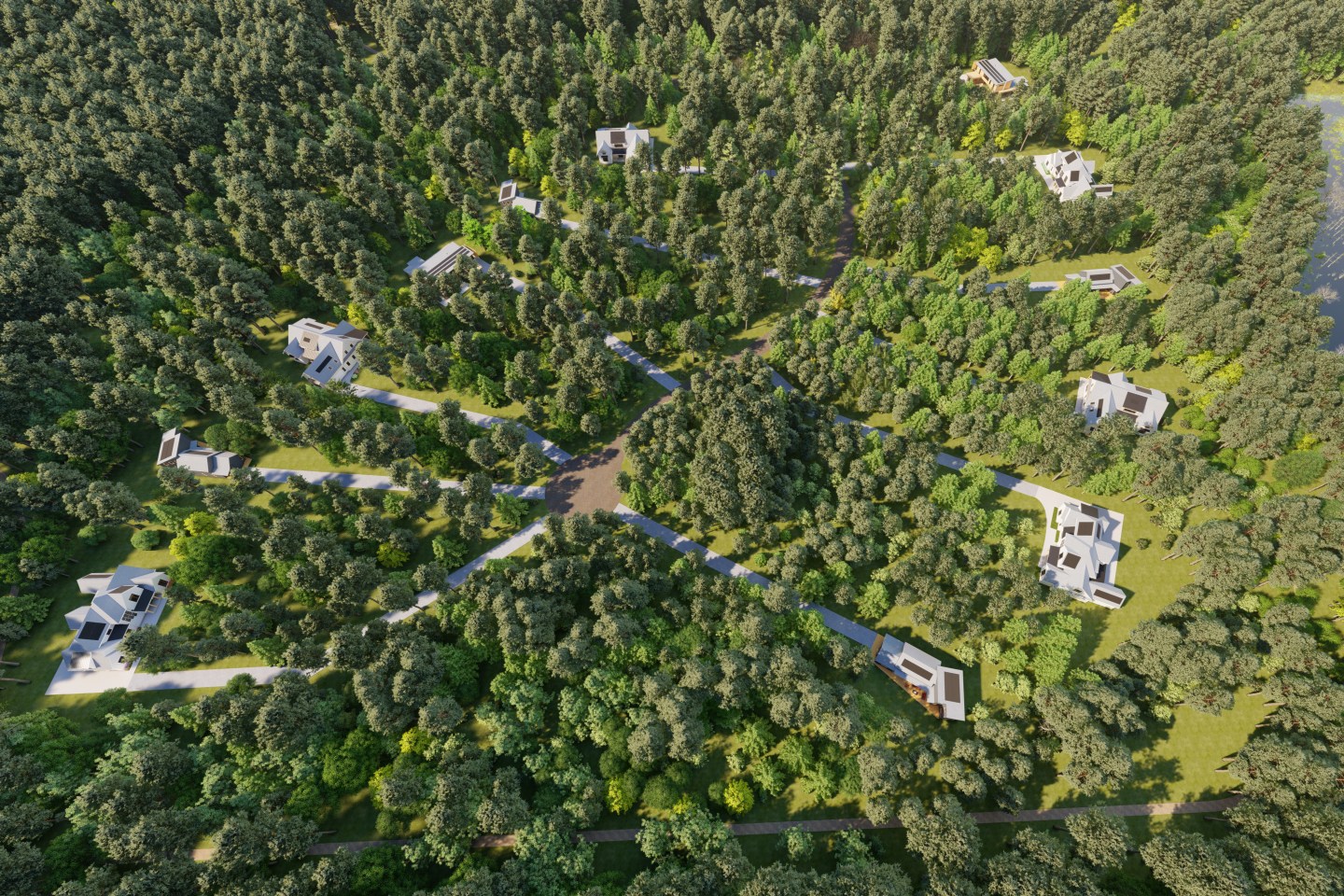
When it comes to sustainable development, cities have overwhelmingly dominated the urban planning narrative. However, global urban growth is largely happening through suburban sprawl, and suburbs are increasingly coming into focus as developers look for ways to house people while preserving biodiversity and addressing climate change.
Suburbia is typically characterized by low-density residential housing, single-use zoning, and a car-centric lifestyle. Such areas can be less efficient and sustainable than higher-density cities because they require greater land use and higher energy and maintenance demands. People are more likely to drive than walk, and the outward expansion of suburbs into exurbs can encroach upon wildlife habitat and remaining natural areas.
Yet the suburbs remain a popular way to live: While the rate of single-family suburban home builds in the U.S. has slowed down in recent months from the record levels seen last year amid the exodus from cities due to the pandemic, the suburbs continue to grow. In large metro suburban counties, home builds increased 5.2% in the first quarter of this year, according to the National Association of Home Builders. Outside the United States, suburban sprawl is prevalent too. In developing countries, 90% of urban growth is horizontal, according to the World Bank.
As a result, urban planners and developers are increasingly turning their focus to building more sustainable suburbs. Hannah Teicher, assistant professor of urban planning at Harvard University’s Graduate School of Design and cochair of the narrative building work group for the Climigration Network, says sprawl flies in the face of sustainability best practices—such as mixed-use, walkable neighborhoods—but there is a chance to reimagine the suburbs.
“There’s a huge opportunity in front of us for someone to step up and take a leadership role in an existing organization, launch a new network or initiative, or even join an existing alliance that focuses on the specific challenges and needs of suburbs,” says Teicher.
Cities around the world have appointed heads of sustainability and chief resilience officers, but Teicher said they can do more to increase awareness of sustainability practices across departments and agencies. She says governments should also upgrade building regulations and incentivize sustainable development.
The rise of net-zero communities
When Norbert Klebl, the former chief financial officer of one of Austria’s leading industrial companies, inadvertently decided to become the developer and environmental master planner in the mid-2000s for GEOS—billed as one of the largest net-zero neighborhoods in the United States—he did not anticipate the uphill multiyear battle involved in educating planning officials in the town of Arvado, Colo., where GEOS would eventually be approved to be built.
“Once we managed to pass a reform to permit GEOS to be built, the next challenge was training a whole host of contractors and subcontractors on the concept of net zero. In essence, we had to create our own subsector to build our project,” Klebl says.
GEOS was launched over 15 years ago, and ultimately new owners came in and nixed the net-zero model.
Still, demand for eco-friendly living is growing. Net-Zero Energy Coalition estimates the U.S. has 5,000 net-zero-energy single-family homes and over 7,000 net-zero multifamily homes. In 2019, 580 energy-efficient communities were undergoing construction in the United States, and the concept is also finding favor on international shores. A Dubai-based developer recently announced plans for XZero City in Kuwait, which would be the world’s largest net-zero community. The developers are billing it as “the most walkable city in the world” and optimizing for density as well as prioritizing green spaces to avoid urban heat islands and mitigate the effect of rising temperatures on the community.
“The appetite for net-zero homes is growing,” says Jodi Bakst, a licensed real estate broker and the developer of Array, a net-zero residential community in North Carolina’s Orange County. Bakst, who is trained in public health and previously worked at the Environmental Protection Agency, says, “While a net-zero home is more expensive to build, it is less expensive to operate. But only a select few understand this premise.”
According to Bakst, homeowners and developers need to be educated on the nuts and bolts of net-zero construction to drive demand, and developers need to be eligible for tax credits for going net-zero to, ultimately, bring down the price of construction. At the same time, a series of reforms need to occur within municipal planning and the home appraisal and lending industries to upgrade building codes and ease the process for financing a net-zero home, she adds.
“There is a green appraiser certification, but there are not enough appraisers with this certification, certainly none in my market. This is because they don’t perceive there is enough demand,” Bakst explains.
Reform at a larger scale
Teicher says that net-zero communities are still far from becoming mainstream offerings, and that they still do not address the need for a holistic, multifaceted approach toward mitigating and reversing climate change.
“A suburb or a one-off residential community within a suburb is part of a larger metropolitan region. You cannot treat suburbs in isolation. We need to think on a larger, integrated, systems level,” says Teicher.
In the meantime, she says people can tackle smaller aspects of sustainability in their everyday lives.
“Car dependence is the biggest issue,” she says. “Transportation emissions tend to dwarf other climate negative agents. It is crucial that we all come together to limit our use of fossil fuels and invest in more environmentally-friendly forms of mobility.”
Communities can also do more to enhance and retain natural biodiversity, according to Sarah Bekessy, an interdisciplinary conservation scientist and professor of sustainability and urban planning at the Royal Melbourne Institute of Technology.
“Biodiversity in nature is an asset with a host of health and environmental benefits, but the urban planning system has historically evolved to facilitate urban development,” Bekessy notes. “Remnant vegetation is seen as a problem, so the de facto solution is stripping it from prime property and offsetting the damage by planting vegetation in cheaper land on city outskirts. We need to reframe the importance of nature in our living spaces.”
Suburban densification can help concentrate transportation services and limit sewage and energy use. Both Teicher and Bekessey cited the urban planning concept of the “15-minute city,” which stipulates that residents should be able to access essential amenities within a 15-minute walk—something they say can apply to suburbs just as much as cities. There are clear signs the urbanization of suburbs is well underway, with hundreds of suburban regional malls being retrofitted into urban-style downtown centers, hybrid medical and education facilities, or stormwater drainage parks.
Ultimately, more sustainable suburban living depends on reprioritization and leadership, Teicher says.
“Climate often fails to make the top bracket when it comes to urban planning priorities,” she adds, “but the creation of a narrative that people are regularly exposed to through the mainstream and social media, one that touches on their direct or lived experience, can inspire a change in how we choose to live.”
This story has been updated to reflect that Hannah Teicher is cochair of the narrative-building work group for the Climigration Network.