The plastics industry says there is a way to help solve the crisis of plastic waste plaguing the planet’s oceans, beaches and lands— recycle it, chemically.
Chemical recycling typically uses heat or chemical solvents to break down plastics into liquid and gas to produce an oil-like mixture or basic chemicals. Industry leaders say that mixture can be made back into plastic pellets to make new products.
“What we are trying to do is really create a circular economy for plastics because we think it is the most viable option for keeping plastic out of the environment,” said Joshua Baca, vice president of the plastics division at the American Chemistry Council, the industry trade association for American chemical companies.
ExxonMobil, New Hope Energy, Nexus Circular, Eastman, Encina and other companies are planning to build large plastics recycling plants. Seven smaller facilities across the United States already recycle plastic into new plastic, according to the ACC. A handful of others convert hard-to-recycle used plastics into alternative transportation fuels for aviation, marine and auto uses.
But environmental groups say advanced recycling is a distraction from real solutions like producing and using less plastic. They suspect the idea of recyclable plastics will enable the steep ramp up in plastic production to continue. And while the amount produced globally grows, recycling rates for plastic waste are abysmally low, especially in the United States.
Plastic packaging, multi-layered films, bags, polystyrene foam and other hard-to-recycle plastic products are piling up in landfills and in the environment, or going to incinerators.
Judith Enck, the founder and president of Beyond Plastics, says plastics recycling doesn’t work and never will. Chemical additives and colorants used to give plastic different properties mean that there are thousands of types, she said. That’s why they can’t be mixed together and recycled in the conventional, mechanical way. Nor is there much of a market for recycled plastic, because virgin plastic is cheap, she said.
So what is more likely to happen than actual recycling, said Enck, a former regional administrator at the U.S. Environmental Protection Agency, is the industry will shift to burning plastics as waste or as fuel.
Lee Bell, a policy advisor for the International Pollutants Elimination Network, thinks chemical recycling is a public relations exercise by the petrochemical industry. The purpose is to dissuade regulators from capping plastics production. Making plastic could become even more important to the fossil fuel industry as climate change puts pressure on their transportation fuels, Bell said.
The industry has made roughly 11 billion metric tons of plastic since 1950, with half of that produced since 2006, according to industrial ecologist Roland Geyer. Global plastic production is expected to more than quadruple by 2050, according to the United Nations Environment Programme and GRID-Arendal in Norway.
The International Organisation for Economic Co-operation and Development says the share of plastic waste that is successfully recycled is projected to rise to 17% in 2060 from 9% in 2019 if no additional policies are enacted to restrain plastic demand and enhance recycling, but that wouldn’t begin to keep up with the projected growth in plastic waste. With more ambitious policies, the amount of plastic waste that is recycled could rise to 40% to 60%, according to OECD.
Two groups working to reduce plastic pollution, the Last Beach Clean Up and Beyond Plastics, estimated that the U.S. rate for recycling plastic waste in 2021 was even lower — 5% to 6%, after China stopped accepting other countries’ waste in 2018.
The U.S. national recycling strategy says no option, including chemical recycling, should be ruled out. The way to think of these new plants, the industry says, is as manufacturing plants. They should be legally defined that way, and not as waste management. About 20 states have adopted laws in the past five years consistent with that wish. Opponents say it’s a way to skirt the more stringent environmental regulations that apply to waste management facilities.
Existing plants
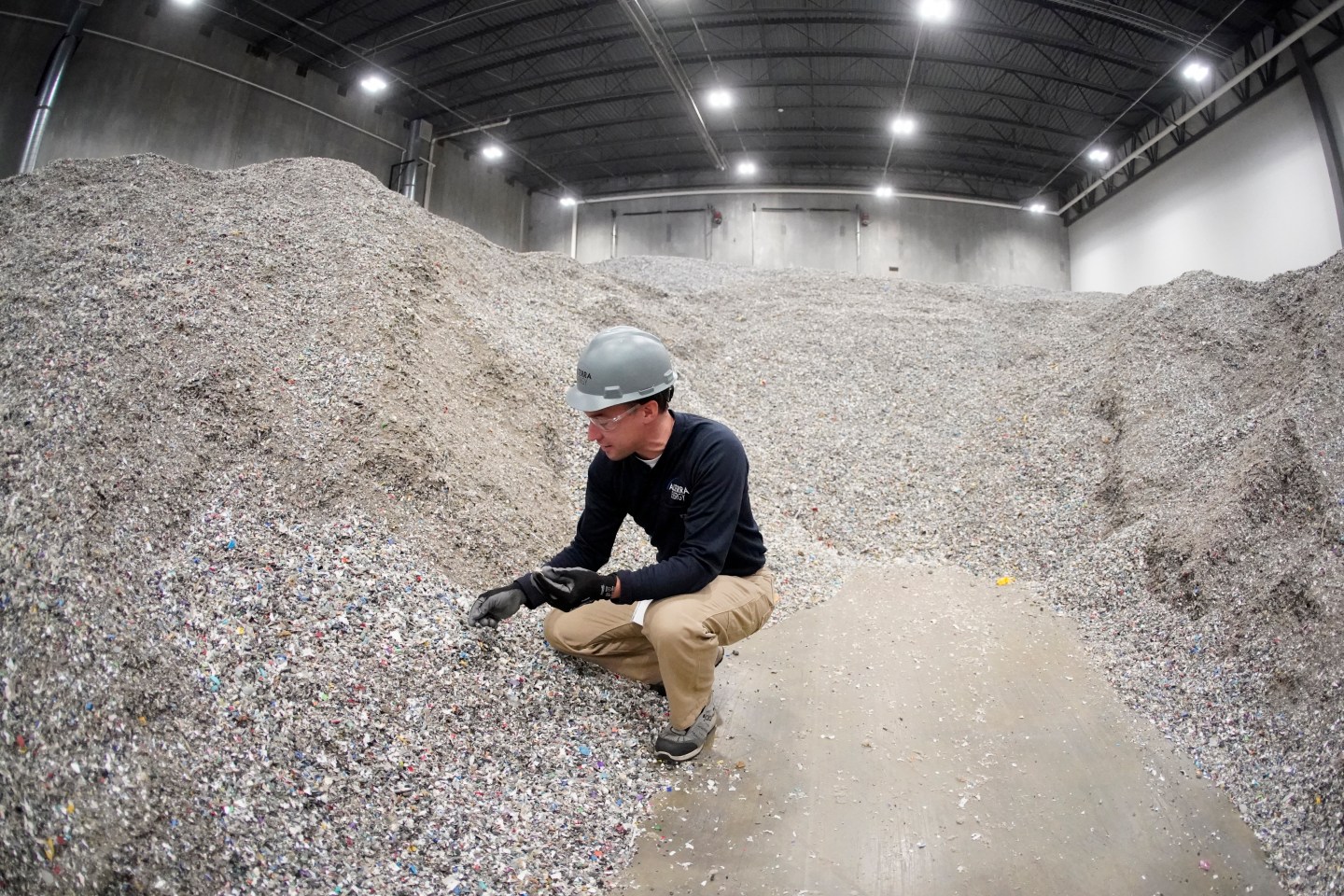
The U.S. facilities currently recycling plastic into new plastic are small — the largest is a 60-ton-per-day plant in Akron, Ohio, Alterra Energy, according to the ACC.
Alterra Energy says it takes in the hard-to-recycle plastics, like flexible pouches, multi-layered films and rigid plastics from automobiles — everything except plastic water bottles since those are recycled mechanically, or plastics marked with a “3” since they contain polyvinyl chloride, or PVC.
“Our mission is to solve plastic pollution,” said Jeremy DeBenedictis, company president. “That is not just a tag line. We all truly want to solve plastic pollution.”
The Ohio facility typically takes in 40 tons to 50 tons per day, heating and liquifying the plastic to turn it back into an oil or hydrocarbon liquid, about 10,000 gallons to 12,000 gallons daily. About 75% of what comes into the facility can be liquified like that. Another 15% is turned into a synthetic natural gas to heat the process, while the remainder — paper, metals, dyes, inks and colorants — exit the reactor as a byproduct, or carbon char, DeBenedictis said. The char is disposed of as nonhazardous waste, though in the future some hope to sell it to the asphalt industry.
The process doesn’t involve oxygen so there’s no combustion or incineration of plastics, DeBenedictis said, and their product is trucked as a synthetic oil to petrochemical companies, essentially the “building blocks on a molecular level for new plastic production.”
The materials they take in, that haven’t been able to be recycled until now, should not be sent to landfills, dumped in the ocean or incinerated, DeBenedictis said.
“That next level has to be a new technology, what you call chemical recycling or advanced recycling. That’s the next frontier,” he said.
“Let’s not kid ourselves here. This is the right time to do it,” added company CEO Fred Schmuck. “There is absolutely no way we can meet our climate goals without addressing plastic waste.”
DeBenedictis said he’s licensing the technology to try to grow the industry because that’s the “best way to make the quickest impact to the world.” A Finnish oil and gas company, Neste, is currently working to commercialize Alterra’s technology in Europe.
The main chemical recycling technologies use pyrolysis, gasification or depolymerization. Neil Tangri, the science and policy director at the Global Alliance for Incinerator Alternatives, is skeptical. He says he has been hearing that pyrolysis is going to change everything since the 1990s, but it hasn’t happened. Instead, plastic production keeps climbing.
GAIA views chemical recycling as a false solution that will facilitate greater production of virgin plastic — a high-energy process with high-carbon emissions that releases hazardous air pollutants, Tangri said. Instead, GAIA wants plastic production to be dramatically scaled back and only recyclable plastics to be produced.
“Nobody needs more plastic,” Tangri said. “We keep trying to solve these production problems with recycling when really we need to change how much we make and what we make. That’s where the solution lies.”
Equity issues in citing plants
In Rhode Island, state lawmakers considered a bill this year to exempt such facilities from solid waste licensing requirements. It was vigorously opposed by environmental activists and residents near the port of Providence who feared it would lead to a new plant in their neighborhood. State environmental officials sided with them.
Monica Huertas, executive director of The People’s Port Authority, helped lead the opposition. The neighborhood is already overburdened by industry, she said, so much so that she sometimes has asthma attacks after walking around.
Dwayne Keys said it’s unfair that he and his neighbors always have to be on guard for proposals like these, unlike residents in some of the state’s wealthy, white neighborhoods. The port area has enough environmental hazards that residents don’t benefit from economically, he added. Keys calls it environmental racism.
“The assessment is, we’re the path of least resistance,” he said. “Not that there’s no resistance, but the least. We’re a coalition of individuals volunteering our time. We don’t have wealth or access to resources or the legal means, as opposed to our white counterparts in higher income, higher net worth communities.”
The chemistry council’s Baca said the facilities operate at the highest standards, the industry believes everyone deserves clear air and water, and he would invite any detractors to one of the facilities so they can see that firsthand.
U.S. plastics producers have said they will recycle or recover all plastic packaging used in the United States by 2040, and have already announced more than $7 billion in investments in both mechanical and chemical recycling.
“I think we are on the cusp of a sustainability revolution where circularity will be the centerpiece of that,” Baca said. “And innovative technologies like advanced recycling will be what makes this possible.”
Kate O’Neill wrote the book on waste, called “Waste.” A professor in the Department of Environmental Science, Policy and Management at the University of California, Berkeley, she has thought a lot about whether chemical recycling should be part of the solution to the plastic crisis. She said she has concluded yes, even though she knows saying so would “piss off the environmentalists.”
“With some of these big problems,” she said, “we can’t rule anything out.”
___
Associated Press climate and environmental coverage receives support from several private foundations. See more about AP’s climate initiative here. The AP is solely responsible for all content.
Sign up for the Fortune Features email list so you don’t miss our biggest features, exclusive interviews, and investigations.