• Home
  • Latest
  • Fortune 500
  • Finance
  • Tech
  • Leadership
  • Lifestyle
  • Rankings
  • Multimedia

Exclusive

An hour in the Oval Office with President Trump Fortune Editor-in-Chief: Alyson Shontell sat down with President Trump in the Oval Office for an hour. Tariffs, Intel, AI, Boeing, Iran—and the question every CEO eventually has to answer: who's next?

An hour in the Oval Office with President Trump Fortune Editor-in-Chief: Alyson Shontell sat down with President Trump in the Oval Office for an hour. Tariffs, Intel, AI, Boeing, Iran—and the question every CEO eventually has to answer: who's next?

An hour in the Oval Office with President Trump Fortune Editor-in-Chief: Alyson Shontell sat down with President Trump in the Oval Office for an hour. Tariffs, Intel, AI, Boeing, Iran—and the question every CEO eventually has to answer: who's next?

An hour in the Oval Office with President Trump Fortune Editor-in-Chief: Alyson Shontell sat down with President Trump in the Oval Office for an hour. Tariffs, Intel, AI, Boeing, Iran—and the question every CEO eventually has to answer: who's next?

An hour in the Oval Office with President Trump Fortune Editor-in-Chief: Alyson Shontell sat down with President Trump in the Oval Office for an hour. Tariffs, Intel, AI, Boeing, Iran—and the question every CEO eventually has to answer: who's next?

An hour in the Oval Office with President Trump Fortune Editor-in-Chief: Alyson Shontell sat down with President Trump in the Oval Office for an hour. Tariffs, Intel, AI, Boeing, Iran—and the question every CEO eventually has to answer: who's next?

An hour in the Oval Office with President Trump Fortune Editor-in-Chief: Alyson Shontell sat down with President Trump in the Oval Office for an hour. Tariffs, Intel, AI, Boeing, Iran—and the question every CEO eventually has to answer: who's next?

An hour in the Oval Office with President Trump Fortune Editor-in-Chief: Alyson Shontell sat down with President Trump in the Oval Office for an hour. Tariffs, Intel, AI, Boeing, Iran—and the question every CEO eventually has to answer: who's next?

An hour in the Oval Office with President Trump Fortune Editor-in-Chief: Alyson Shontell sat down with President Trump in the Oval Office for an hour. Tariffs, Intel, AI, Boeing, Iran—and the question every CEO eventually has to answer: who's next?

An hour in the Oval Office with President Trump Fortune Editor-in-Chief: Alyson Shontell sat down with President Trump in the Oval Office for an hour. Tariffs, Intel, AI, Boeing, Iran—and the question every CEO eventually has to answer: who's next?

Environmentwildlife

The government is spending over $100 million a year to fight off feral hogs—and the pigs are winning

By
Janet McConnaughey
Janet McConnaughey
and
The Associated Press
Down Arrow Button Icon
By
Janet McConnaughey
Janet McConnaughey
and
The Associated Press
Down Arrow Button Icon
December 2, 2022, 12:42 PM ET
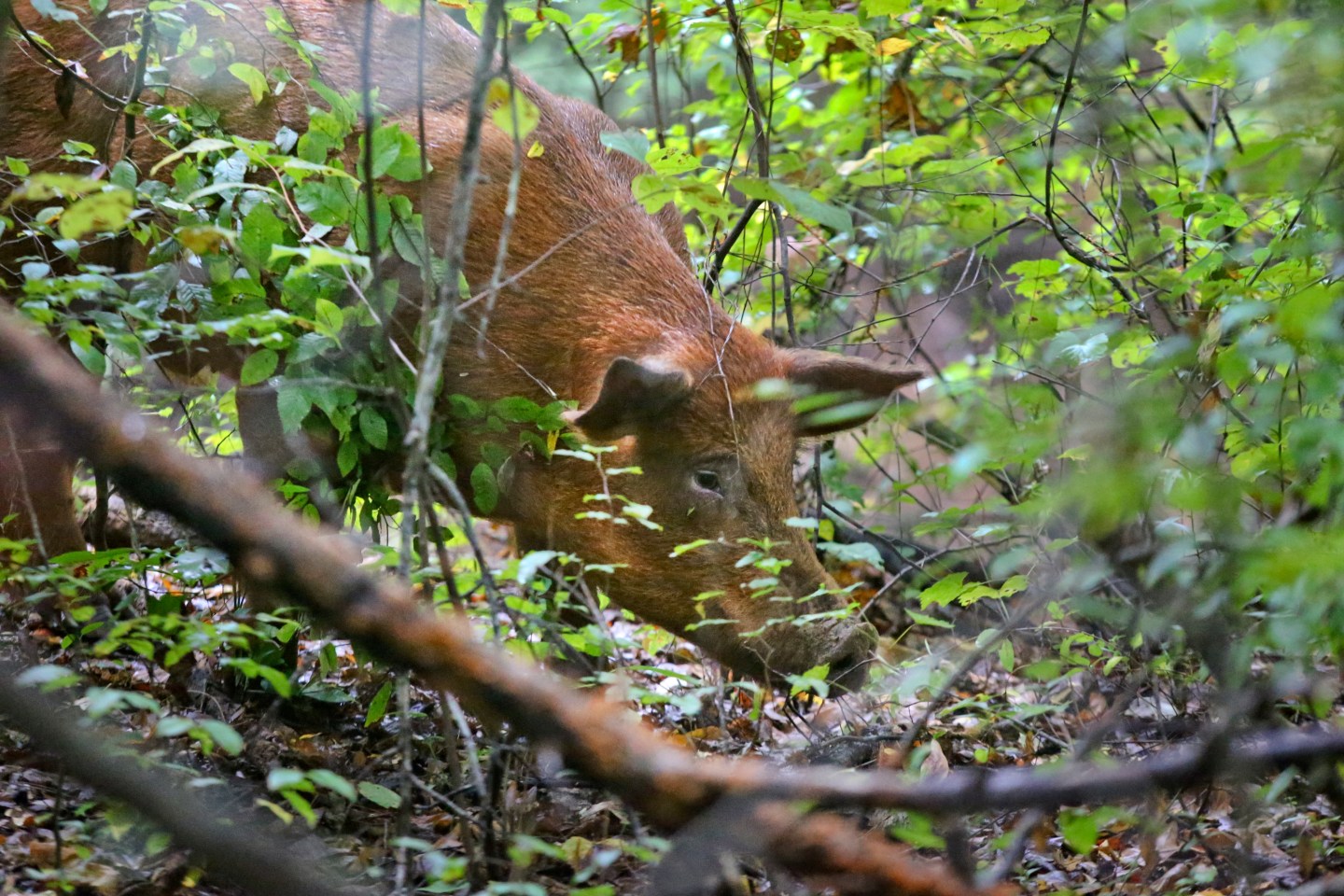
Feral hog
A hog wanders in Lithonia, Ga., in 2013. John Spink—Atlanta Journal-Constitution/AP

Eight years into a U.S. program to control damage from feral pigs, the invasive animals with big appetites and snouts that uproot anything that smells good are still a multibillion-dollar plague on farmers, wildlife and the environment.

These prolific hogs gone wild have been wiped out in 11 of the 41 states where they were reported in 2014 or 2015, and there are fewer in parts of the other 30.

But despite more than $100 million in federal money, an estimated 6 million to 9 million feral swine still ravage the landscape nationwide. They tear up planted fields, wallowing out huge bare depressions. They out-eat deer and turkeys — and also eat turkey eggs and even fawns. They carry parasites and disease and pollute streams and rivers with their feces.

Total U.S. damages are estimated at a minimum $2.5 billion a year.

Adam McLendon, whose family farms about 8,000 acres (3,200 hectares) of peanuts, corn and cotton in several counties in southwestern Georgia, estimates feral pigs have cost them more than $100,000 a year for the past 15 years.

That’s about what one of Mississippi’s two levee boards pays each year to trap and kill feral hogs and to repair damage from their rooting, commissioner Hank Burdine estimated. “That is nominal compared to what we would have if we didn’t take care of it and had a flood,” he added.

Near the Red River in north Texas, hogs are so hard on corn that Layne Chapman and his neighbors no longer even try to grow it.

“I can remember the first day someone called me and said, ‘You’ve got a pig in your wheat field,’ and I said, ‘No we don’t have pigs.’ That was in 2006,” Chapman said. He stopped planting corn in 2016.

The animals root out rows of freshly planted peanuts and corn, leaving huge ruts that must be smoothed before the field can be replanted — weeks after the best planting time. Hogs return to cornfields when the crop is ripening, trampling stalks, taking bites out of ears and wallowing to cool their sweatless bodies.

The U.S. Department of Agriculture’s National Feral Swine Damage Management Program has received $31.5 million since it began in 2014.

McLendon and Chapman, who continues to grow cotton and wheat and to raise cattle on about 8,000 acres (3,200 hectares) in Vernon, Texas, have both benefited from pilot eradication projects under $75 million allocated separately by Congress in the 2018 Farm Bill.

Research also continues on ways to poison feral hogs without killing other animals, said Michael Marlow, assistant manager of the USDA program. The poison, sodium nitrite, is a preservative in bacon but keeps the blood of live pigs from carrying oxygen.

Trials this coming winter and spring will test whether birds can be kept away from dropped bait by using a less crumbly formulation, along with grates to keep crumbs out of reach and air-powered “scarymen” like air dancers used for store advertising, Marlow said.

But for now, two major control methods are aerial shooting and remote-controlled traps that send cellphone pictures when a hog sounder is inside.

Some states have legalized night hunting for feral swine. Derek Chisum, who grows peanuts, cotton and wheat in Hydro, Oklahoma, figures he has killed 120 to 150 a year since Oklahoma did so three years ago.

Since 2014, Idaho, New York, New Jersey, Maryland, Maine, Colorado, Iowa, Minnesota, Washington, Wisconsin and Vermont have killed their small populations of feral pigs, though the program is still keeping a wary eye out in the last six states.

The worst-hit states — California, Oklahoma, Texas and Florida, where a runway collision with a pair of wild pigs totaled an F-16 fighter jet in 1988 — are still at the program’s highest level, with more than 750,000 hogs. Arkansas, Louisiana, Mississippi, Alabama, Georgia, North Carolina and South Carolina put their populations at 100,000 to 750,000, though Hawaii has moved a level down.

The Texas population overall has been “fairly stable” at roughly 3 million since 2011, said Mike Bodenchuk, state director for USDA’s Animal and Plant Health Inspection Service, or APHIS.

But statewide reduction, let alone eradication, is likely to be a long slog with tools and money available now, he said in a telephone interview.

That means killing a lot of swine, though a widely repeated figure — that hogs are so prolific that 70% of those in a given area must be killed each year to keep numbers stable — just isn’t right, said Kim Pepin, a research biologist at USDA’s National Wildlife Research Center in Fort Collins, Colorado.

To reduce populations, you only need to kill more than are born each year — and growth rates vary in different environments, Pepin said. “If you want to know growth rates, you need to do monitoring,” she said.

In Texas, the four-county Upper Red River Watershed Project and other intense efforts paid by the Farm Bill have made a significant dent in target areas, Bodenchuk said. But those cover only 16 of the state’s 254 counties.

The bill is paying for 34 eradication projects in limited areas of a dozen states.

In Texas, APHIS is targeting areas with the worst damage, teaching landowners how to continue the work after Farm Bill projects end in 2023, and leaving resources such as loaner traps — each $7,000 or more — to help “while we move the program across the landscape,” Bodenchuck said.

“Even using this approach, we won’t have the resources to eradicate pigs in Texas in my lifetime,” he wrote in an email.

Researchers are still trying to get good numbers for populations and damages. The current estimate of at least $2.5 billion in annual national damages is up $1 billion from the 2014 estimate, and the number of pigs is now estimated at 6 million to 9 million rather than 5 million.

But those don’t indicate actual increases, said Marlow, the national assistant program manager. “I think we just have a better handle on it,” he said.

The agency has been making surveys to improve damage estimates, but they’re still limited — such as damage to six top crops in 11 states. And the figures are likely low, leaving out costs such as extra time and fuel needed to harvest hog-damaged fields, said Sophie McKee, a research economist at the wildlife research center where Pepin works.

When a small group of farmers and ranchers was asked to consider those costs, their damage estimates nearly tripled, McKee said.

Chapman, the Red River farmer, said such costs can be difficult to assess. For instance, he said, if hogs root on the low side of an irrigated farm “it won’t ever drain again.”

___

Associated Press climate and environmental coverage receives support from several private foundations. See more about AP’s climate initiative here. The AP is solely responsible for all content.

Our new weekly Impact Report newsletter will examine how ESG news and trends are shaping the roles and responsibilities of today's executives—and how they can best navigate those challenges. Subscribe here.


About the Authors
By Janet McConnaughey
See full bioRight Arrow Button Icon
By The Associated Press
See full bioRight Arrow Button Icon

Latest in Environment

Finance
Lorem ipsum dolor sit amet, consectetur adipiscing elit, sed do eiusmod tempor incididunt ut labore et dolore magna aliqua. Ut enim ad minim veniam
By Fortune Editors
October 20, 2025
Finance
Lorem ipsum dolor sit amet, consectetur adipiscing elit, sed do eiusmod tempor incididunt ut labore et dolore magna aliqua. Ut enim ad minim veniam
By Fortune Editors
October 20, 2025
Finance
Lorem ipsum dolor sit amet, consectetur adipiscing elit, sed do eiusmod tempor incididunt ut labore et dolore magna aliqua. Ut enim ad minim veniam
By Fortune Editors
October 20, 2025
Finance
Lorem ipsum dolor sit amet, consectetur adipiscing elit, sed do eiusmod tempor incididunt ut labore et dolore magna aliqua. Ut enim ad minim veniam
By Fortune Editors
October 20, 2025
Finance
Lorem ipsum dolor sit amet, consectetur adipiscing elit, sed do eiusmod tempor incididunt ut labore et dolore magna aliqua. Ut enim ad minim veniam
By Fortune Editors
October 20, 2025
Finance
Lorem ipsum dolor sit amet, consectetur adipiscing elit, sed do eiusmod tempor incididunt ut labore et dolore magna aliqua. Ut enim ad minim veniam
By Fortune Editors
October 20, 2025

Most Popular

Finance
Lorem ipsum dolor sit amet, consectetur adipiscing elit, sed do eiusmod tempor incididunt ut labore et dolore magna aliqua. Ut enim ad minim veniam
By Fortune Editors
October 20, 2025
Finance
Lorem ipsum dolor sit amet, consectetur adipiscing elit, sed do eiusmod tempor incididunt ut labore et dolore magna aliqua. Ut enim ad minim veniam
By Fortune Editors
October 20, 2025
Finance
Lorem ipsum dolor sit amet, consectetur adipiscing elit, sed do eiusmod tempor incididunt ut labore et dolore magna aliqua. Ut enim ad minim veniam
By Fortune Editors
October 20, 2025
Finance
Lorem ipsum dolor sit amet, consectetur adipiscing elit, sed do eiusmod tempor incididunt ut labore et dolore magna aliqua. Ut enim ad minim veniam
By Fortune Editors
October 20, 2025
Finance
Lorem ipsum dolor sit amet, consectetur adipiscing elit, sed do eiusmod tempor incididunt ut labore et dolore magna aliqua. Ut enim ad minim veniam
By Fortune Editors
October 20, 2025
Finance
Lorem ipsum dolor sit amet, consectetur adipiscing elit, sed do eiusmod tempor incididunt ut labore et dolore magna aliqua. Ut enim ad minim veniam
By Fortune Editors
October 20, 2025
Fortune Secondary Logo
Rankings
  • 100 Best Companies
  • Fortune 500
  • Global 500
  • Fortune 500 Europe
  • Most Powerful Women
  • World's Most Admired Companies
  • See All Rankings
  • Lists Calendar
Sections
  • Finance
  • Fortune Crypto
  • Features
  • Leadership
  • Health
  • Commentary
  • Success
  • Retail
  • Mpw
  • Tech
  • Lifestyle
  • CEO Initiative
  • Asia
  • Politics
  • Conferences
  • Europe
  • Newsletters
  • Personal Finance
  • Environment
  • Magazine
  • Education
Customer Support
  • Frequently Asked Questions
  • Customer Service Portal
  • Privacy Policy
  • Terms Of Use
  • Single Issues For Purchase
  • International Print
Commercial Services
  • Advertising
  • Fortune Brand Studio
  • Fortune Analytics
  • Fortune Conferences
  • Business Development
  • Group Subscriptions
About Us
  • About Us
  • Press Center
  • Work At Fortune
  • Terms And Conditions
  • Site Map
  • About Us
  • Press Center
  • Work At Fortune
  • Terms And Conditions
  • Site Map
  • Facebook icon
  • Twitter icon
  • LinkedIn icon
  • Instagram icon
  • Pinterest icon

Latest in Environment

data center
AIData centers
Communities are blocking billions in data centers. Big Tech has wagered $1 trillion otherwise
By Nick LichtenbergMay 18, 2026
11 minutes ago
How EarthRanger uses AI to help protect endangered species—and boost the wildlife tourism industry
AIAfrica
How EarthRanger uses AI to help protect endangered species—and boost the wildlife tourism industry
By Alexandra KirkmanMay 18, 2026
9 hours ago
shyam
CommentaryHealth
World Economic Forum: women’s health gets only 20% of R&D funding. We must seize this $1 trillion opportunity
By Shyam BishenMay 18, 2026
13 hours ago
A man stands looking out over his front porch where a sign reads, "No data centers."
EnvironmentData centers
Startups are installing tiny data centers in people’s homes to reduce strain on the beleaguered electrical grid
By Sasha RogelbergMay 15, 2026
3 days ago
deep-sea mining equipment
EnvironmentChina
China dominates the minerals that power AI. But one company claims there’s enough supply on the ocean floor to last for hundreds of years
By Jake AngeloMay 15, 2026
3 days ago
Americans would rather live near a nuclear power plant than a data center—by a lot
AIData centers
Americans would rather live near a nuclear power plant than a data center—by a lot
By Catherina GioinoMay 15, 2026
3 days ago

Most Popular

Microsoft AI chief gives it 18 months—for all white-collar work to be automated by AI
AI
Microsoft AI chief gives it 18 months—for all white-collar work to be automated by AI
By Jake AngeloMay 16, 2026
2 days ago
The top foreign holders of U.S. debt may soon dump Treasury bonds and bring their money back home, potentially spiking borrowing costs
Economy
The top foreign holders of U.S. debt may soon dump Treasury bonds and bring their money back home, potentially spiking borrowing costs
By Jason MaMay 17, 2026
24 hours ago
The Bezos family just donated $100 million to help achieve one of Mayor Zohran Mamdani’s top campaign promises
Politics
The Bezos family just donated $100 million to help achieve one of Mayor Zohran Mamdani’s top campaign promises
By Jake AngeloMay 12, 2026
6 days ago
'No one was coming to save me': How Reese Witherspoon built a $900 million company from a problem Hollywood wouldn't fix
Success
'No one was coming to save me': How Reese Witherspoon built a $900 million company from a problem Hollywood wouldn't fix
By Sydney LakeMay 17, 2026
1 day ago
SpaceX heads into a record-shattering IPO with the 'deepest moat that exists today' as investors vow to 'never bet against Elon'
Innovation
SpaceX heads into a record-shattering IPO with the 'deepest moat that exists today' as investors vow to 'never bet against Elon'
By Jason MaMay 16, 2026
2 days ago
Gen X is the most indebted generation in America. Their employers can fix that
Commentary
Gen X is the most indebted generation in America. Their employers can fix that
By Mary MorelandMay 17, 2026
1 day ago

© 2026 Fortune Media IP Limited. All Rights Reserved. Use of this site constitutes acceptance of our Terms of Use and Privacy Policy | CA Notice at Collection and Privacy Notice | Do Not Sell/Share My Personal Information
FORTUNE is a trademark of Fortune Media IP Limited, registered in the U.S. and other countries. FORTUNE may receive compensation for some links to products and services on this website. Offers may be subject to change without notice.