• Home
  • Latest
  • Fortune 500
  • Finance
  • Tech
  • Leadership
  • Lifestyle
  • Rankings
  • Multimedia
CommentaryFood and drink

A new agricultural revolution has started. Congress must invest now to secure the future of U.S. food

By
Irving Fain
Irving Fain
Down Arrow Button Icon
By
Irving Fain
Irving Fain
Down Arrow Button Icon
February 10, 2023, 10:55 AM ET
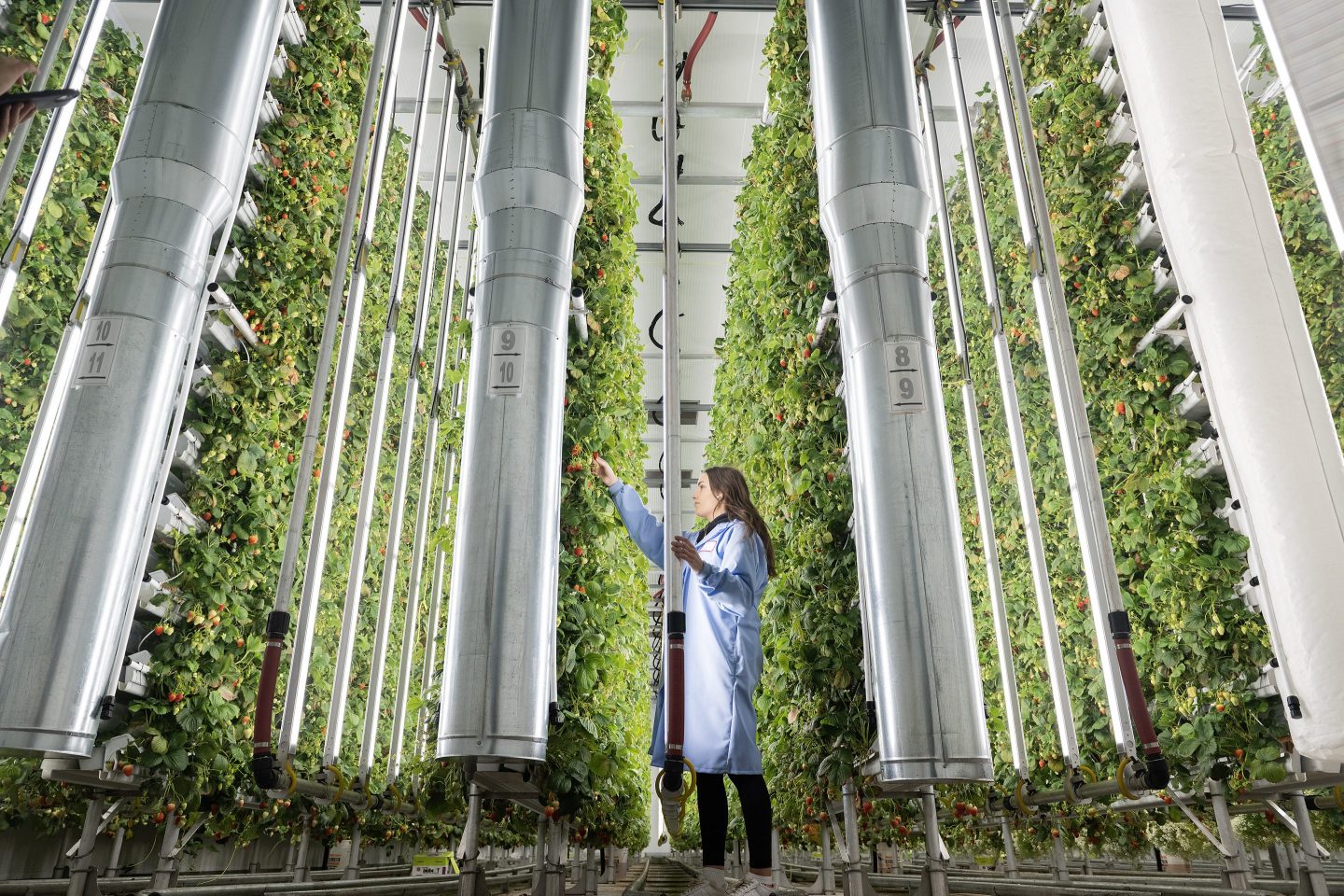
A vertical strawberry farm in Quebec, Canada.
A vertical strawberry farm in Quebec, Canada.Graham Hughes—Bloomberg/Getty Images

At a certain point, we have to wonder how much more the global food system can take.

Historic flooding in Pakistan. Droughts across the American West. Russia’s invasion of Ukraine. The global food system and the supply chains that have long allowed us to move food from where it is grown to where it is needed have rarely been stretched so thin, or so far.

The consequences can be seen in the cost and availability of food in most parts of the world, including in the United States. Americans’ growing demand for fresh produce will only accelerate our reliance on an increasingly fragile food system.

However, the story of this decade doesn’t have to be one of scarcity and strain. A different future is within reach: one of abundance, affordability, and sustainability. The U.S. has a historic opportunity to shorten supply chains, safeguard long-term food security, and decrease the environmental costs of agriculture. Innovation can make this possible–but only if America invests in new farming technologies. Not only to feed ourselves but to reaffirm our role as the world’s greatest exporter of both food and innovation.

Unless you’re in the industry, you might not know that agriculture is undergoing a quiet technological revolution. Drones, sensors, and satellite imaging systems help farms manage crops more effectively with more information and knowledge than ever before. Amid labor shortages, farmers are looking to robotics and automation to fill the gap. Artificial intelligence is now used to monitor soil, control pests, and improve overall yield. These and other advances are enabling the industry to rethink its most basic assumptions: how we grow, what we grow, and how we transport what we grow. 

For example, recent breakthroughs in artificial intelligence, computer vision, and sensor and control systems have allowed our company, Bowery, to grow fresh, local, pesticide-free in large-scale, smart indoor environments with crops stacked from floor to ceiling. This approach, powered by renewable energy, uses significantly less land and water. It’s a sustainable model that works irrespective of changing climate conditions or severe weather events. 

Vertical farms can be built just about anywhere. But by putting them near the markets we serve, we can radically shorten the supply chain–decreasing disruptions and the environmental costs of long-haul shipping, and increasing the resilience of the food system overall. 

Many Americans have probably eaten vertically farmed products without realizing how differently they’re grown. But vertical farming is only part of the broader transformation that the world must undertake. With the global population projected to reach nearly 10 billion by 2050, and with the climate crisis worsening, we need to produce more food, more sustainably. This will require collective effort–and collective investment. 

Much like crops on a farm, a business requires the right inputs to grow. Great ideas, upfront capital, and a commitment at the state and local levels enable businesses to thrive. But for a cutting-edge industry to flourish and have a national and even global impact, the federal government has a key role to play as an accelerator of innovation. 

Think of solar energy in the 1990s or electric vehicles in the early 2000s. The promise was evident. But these innovations could not have become the transformative, ubiquitous technologies they are today absent national investments in research and development, infrastructure, workforce training, and manufacturing–and without appropriate tax incentives. 

Agriculture is poised to become the next great success story of sustainable innovation–as foreign governments increasingly recognize. For example, the Netherlands–the world’s second-largest agricultural exporter–has invested in new growing technology and cell-based meat production. Small, land-poor states like Singapore and the UAE, as well as massive countries such as Russia and China, are working to build food systems that can withstand the changing climate and reduce their reliance on tumultuous trade relationships. 

The U.S. must do the same. The global challenges of climate change and food insecurity will accelerate the development of new farming technologies everywhere humans live and eat. America has an opportunity to lead this revolution and to spread the benefits around the world. As a matter of foreign policy and economic policy, the new Congress must act.

In 2023, Congress will reauthorize the farm bill, as it does every five years. No legislation says more about the importance we assign agriculture. This time, the bill should help accelerate the technological advances underway, increasing domestic food production, and strengthening the supply chain. The farm bill should also prioritize workforce development, preparing the next generation to pursue careers in high-tech farming and positioning our research institutions, land-grant universities, and Historically Black Colleges and Universities as hubs of agricultural innovation.

Last year, to strengthen domestic manufacturing, a bipartisan majority in Congress doubled the research and development tax credit for qualified businesses and created an investment tax credit for the semiconductor industry. Congress must take the same approach to agriculture.

Recently, all 50 members of the National Association of State Departments of Agriculture–both Republicans and Democrats–unanimously endorsed investment tax credits as one way to help scale indoor farming, given its high upfront capital expenditures. Such a policy should also apply to outdoor specialty crop growers, who face similar capital costs as they upgrade their approach with robotics and automation.

From the steel plow to the gas-powered tractor to new breeding technologies, American innovation has led to advances in agriculture that have benefited the entire world. 

Both our potential and the imperative to fulfill it have never been stronger. Congress must do more than improve the current system–it must invest in the future of food.

Irving Fain is the founder and CEO of Bowery.

The opinions expressed in Fortune.com commentary pieces are solely the views of their authors and do not necessarily reflect the opinions and beliefs of Fortune.

More must-read commentary published by Fortune:

  • A soft landing is playing out—but optimism needs to be for the right reasons
  • People are much less likely to trust the medical system if they are from an ethnic minority, have disabilities, or identify as LGBTQ+, according to a first-of-its-kind study by Sanofi
  • The U.S. has thwarted Putin’s energy blackmail. Europe says ‘Tanks a lot!’
  • Once the ‘intellectual blood banks’ of the rich and powerful, can speechwriters be replaced with ChatGPT?

Learn how to navigate and strengthen trust in your business with The Trust Factor, a weekly newsletter examining what leaders need to succeed. Sign up here.
About the Author
By Irving Fain
See full bioRight Arrow Button Icon

Latest in Commentary

Finance
Lorem ipsum dolor sit amet, consectetur adipiscing elit, sed do eiusmod tempor incididunt ut labore et dolore magna aliqua. Ut enim ad minim veniam
By Fortune Editors
October 20, 2025
Finance
Lorem ipsum dolor sit amet, consectetur adipiscing elit, sed do eiusmod tempor incididunt ut labore et dolore magna aliqua. Ut enim ad minim veniam
By Fortune Editors
October 20, 2025
Finance
Lorem ipsum dolor sit amet, consectetur adipiscing elit, sed do eiusmod tempor incididunt ut labore et dolore magna aliqua. Ut enim ad minim veniam
By Fortune Editors
October 20, 2025
Finance
Lorem ipsum dolor sit amet, consectetur adipiscing elit, sed do eiusmod tempor incididunt ut labore et dolore magna aliqua. Ut enim ad minim veniam
By Fortune Editors
October 20, 2025
Finance
Lorem ipsum dolor sit amet, consectetur adipiscing elit, sed do eiusmod tempor incididunt ut labore et dolore magna aliqua. Ut enim ad minim veniam
By Fortune Editors
October 20, 2025
Finance
Lorem ipsum dolor sit amet, consectetur adipiscing elit, sed do eiusmod tempor incididunt ut labore et dolore magna aliqua. Ut enim ad minim veniam
By Fortune Editors
October 20, 2025

Most Popular

Finance
Lorem ipsum dolor sit amet, consectetur adipiscing elit, sed do eiusmod tempor incididunt ut labore et dolore magna aliqua. Ut enim ad minim veniam
By Fortune Editors
October 20, 2025
Finance
Lorem ipsum dolor sit amet, consectetur adipiscing elit, sed do eiusmod tempor incididunt ut labore et dolore magna aliqua. Ut enim ad minim veniam
By Fortune Editors
October 20, 2025
Finance
Lorem ipsum dolor sit amet, consectetur adipiscing elit, sed do eiusmod tempor incididunt ut labore et dolore magna aliqua. Ut enim ad minim veniam
By Fortune Editors
October 20, 2025
Finance
Lorem ipsum dolor sit amet, consectetur adipiscing elit, sed do eiusmod tempor incididunt ut labore et dolore magna aliqua. Ut enim ad minim veniam
By Fortune Editors
October 20, 2025
Finance
Lorem ipsum dolor sit amet, consectetur adipiscing elit, sed do eiusmod tempor incididunt ut labore et dolore magna aliqua. Ut enim ad minim veniam
By Fortune Editors
October 20, 2025
Finance
Lorem ipsum dolor sit amet, consectetur adipiscing elit, sed do eiusmod tempor incididunt ut labore et dolore magna aliqua. Ut enim ad minim veniam
By Fortune Editors
October 20, 2025
Fortune Secondary Logo
Rankings
  • 100 Best Companies
  • Fortune 500
  • Global 500
  • Fortune 500 Europe
  • Most Powerful Women
  • Future 50
  • World’s Most Admired Companies
  • See All Rankings
Sections
  • Finance
  • Fortune Crypto
  • Features
  • Leadership
  • Health
  • Commentary
  • Success
  • Retail
  • Mpw
  • Tech
  • Lifestyle
  • CEO Initiative
  • Asia
  • Politics
  • Conferences
  • Europe
  • Newsletters
  • Personal Finance
  • Environment
  • Magazine
  • Education
Customer Support
  • Frequently Asked Questions
  • Customer Service Portal
  • Privacy Policy
  • Terms Of Use
  • Single Issues For Purchase
  • International Print
Commercial Services
  • Advertising
  • Fortune Brand Studio
  • Fortune Analytics
  • Fortune Conferences
  • Business Development
  • Group Subscriptions
About Us
  • About Us
  • Editorial Calendar
  • Press Center
  • Work At Fortune
  • Diversity And Inclusion
  • Terms And Conditions
  • Site Map
  • About Us
  • Editorial Calendar
  • Press Center
  • Work At Fortune
  • Diversity And Inclusion
  • Terms And Conditions
  • Site Map
  • Facebook icon
  • Twitter icon
  • LinkedIn icon
  • Instagram icon
  • Pinterest icon

Latest in Commentary

LI
CommentaryLinkedIn
AI adoption isn’t the hard part, it’s building employee agency
By Teuila Hanson and Mohak ShroffApril 3, 2026
32 minutes ago
I helped build Uber and Discord and now my tools help fuel billion-dollar unicorns. But Silicon Valley is losing the AI race to itself
CommentarySilicon Valley
I helped build Uber and Discord and now my tools help fuel billion-dollar unicorns. But Silicon Valley is losing the AI race to itself
By Sumeet VaidyaApril 3, 2026
32 minutes ago
messi
CommentaryFlorida
Apollo and FC Barcelona just proved legacy markets are losing their grip on business
By Mike SimasApril 2, 2026
18 hours ago
kroenke
CommentarySoccer
Why American billionaires are abandoning Wall Street for English soccer clubs
By Andrés MartinezApril 2, 2026
20 hours ago
wyle
CommentaryTV
What HBO’s ‘The Pitt’ gets right—and wrong—about treating alcohol use disorder
By Jonathan Hunt-GlassmanApril 2, 2026
1 day ago
nic
CommentaryInsider trading
Prediction markets caught insider traders in real time. Congress wants to shut them down anyway
By Nic PuckrinApril 2, 2026
1 day ago

Most Popular

Gen Z fled San Francisco for Texas and Florida. Now they’re turning ‘welcomer cities’ into the next big tech towns
Real Estate
Gen Z fled San Francisco for Texas and Florida. Now they’re turning ‘welcomer cities’ into the next big tech towns
By Fortune EditorsApril 2, 2026
1 day ago
Major 4-day workweek study suggests that when we work 5 days we spend one doing basically nothing
Success
Major 4-day workweek study suggests that when we work 5 days we spend one doing basically nothing
By Fortune EditorsApril 2, 2026
23 hours ago
Current price of oil as of April 2, 2026
Personal Finance
Current price of oil as of April 2, 2026
By Fortune EditorsApril 2, 2026
24 hours ago
Paul Krugman smacks down Trump speech with argument that $4 gas is ‘less than half’ of the Hormuz hit. Here’s what he’s talking about
Economy
Paul Krugman smacks down Trump speech with argument that $4 gas is ‘less than half’ of the Hormuz hit. Here’s what he’s talking about
By Fortune EditorsApril 2, 2026
18 hours ago
Current price of gold as of April 1, 2026
Personal Finance
Current price of gold as of April 1, 2026
By Fortune EditorsApril 1, 2026
2 days ago
Deutsche Bank asked AI if it’s true that AI will solve the economy’s inflation problems. The robots answered
Economy
Deutsche Bank asked AI if it’s true that AI will solve the economy’s inflation problems. The robots answered
By Fortune EditorsApril 1, 2026
2 days ago

© 2026 Fortune Media IP Limited. All Rights Reserved. Use of this site constitutes acceptance of our Terms of Use and Privacy Policy | CA Notice at Collection and Privacy Notice | Do Not Sell/Share My Personal Information
FORTUNE is a trademark of Fortune Media IP Limited, registered in the U.S. and other countries. FORTUNE may receive compensation for some links to products and services on this website. Offers may be subject to change without notice.