• Home
  • Latest
  • Fortune 500
  • Finance
  • Tech
  • Leadership
  • Lifestyle
  • Rankings
  • Multimedia

Trendingnow

1

MacKenzie Scott alone accounted for one-third of America's $19.2 billion in megagifts last year

2

As Big Tech showers employees with perks to win the talent war, Nvidia built a nearly $5 trillion company by making people pay for their own lunch

3

Philanthropy leader at Warren Buffett and Bill Gates’ Giving Pledge says children of billionaires are pushing them to give their wealth away faster

1

MacKenzie Scott alone accounted for one-third of America's $19.2 billion in megagifts last year

2

As Big Tech showers employees with perks to win the talent war, Nvidia built a nearly $5 trillion company by making people pay for their own lunch

3

Philanthropy leader at Warren Buffett and Bill Gates’ Giving Pledge says children of billionaires are pushing them to give their wealth away faster
TechAI

It’s not just the puffy-jacket pope—different countries are creating deepfakes to spread propaganda

By
Jordan Richard Schoenherr
and
The Conversation
The Conversation
Down Arrow Button Icon
By
Jordan Richard Schoenherr
and
The Conversation
The Conversation
Down Arrow Button Icon
April 14, 2023, 11:59 AM ET
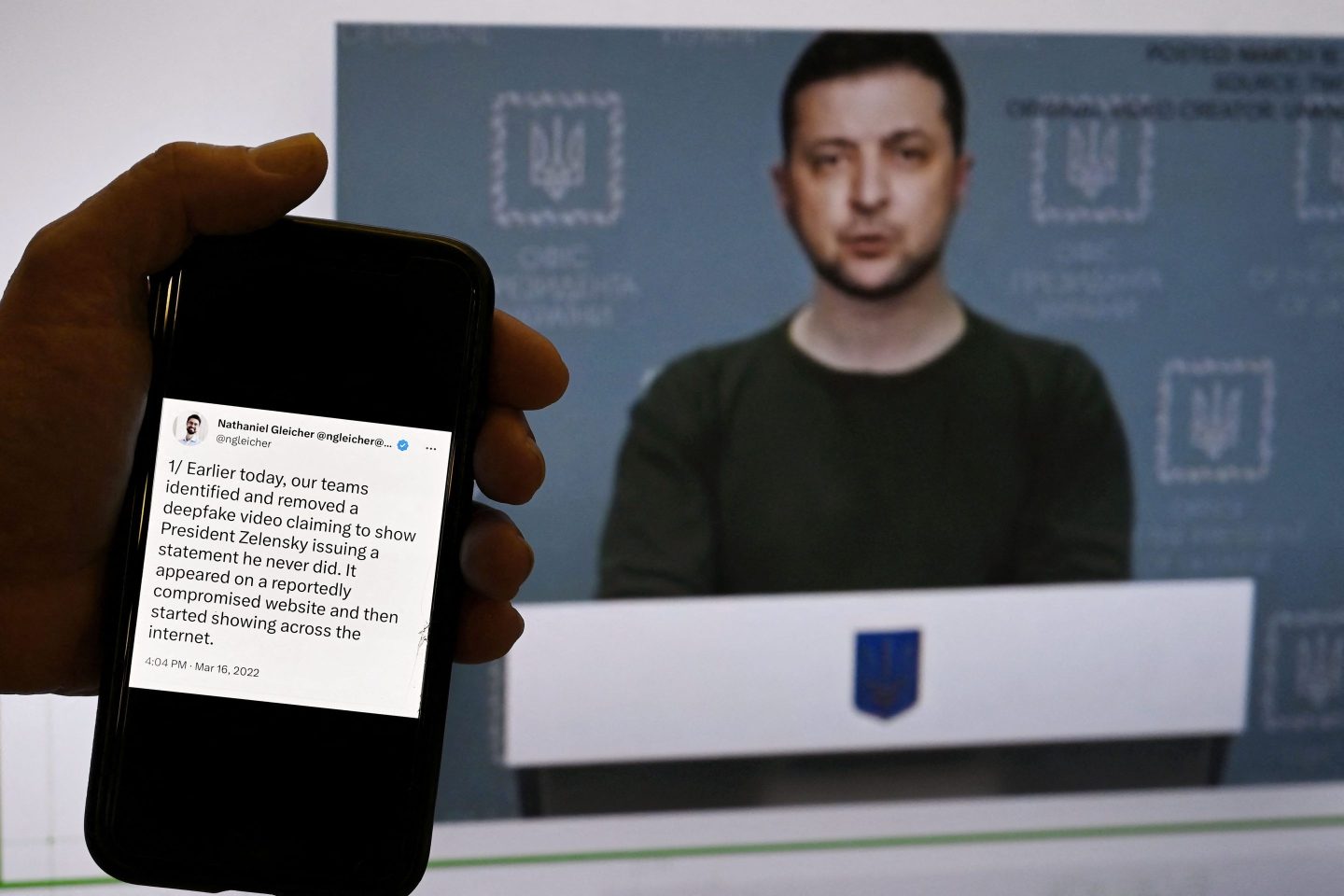
This illustration photo taken on January 30, 2023 shows a phone screen displaying a statement from the head of security policy at META with a fake video of Ukrainian President Volodymyr Zelensky calling on his soldiers to lay down their weapons shown in the background, in Washington, DC.
This illustration photo taken on January 30, 2023 shows a phone screen displaying a statement from the head of security policy at META with a fake video of Ukrainian President Volodymyr Zelensky calling on his soldiers to lay down their weapons shown in the background, in Washington, DC. OLIVIER DOULIERY/AFP — Getty Images)
Add Fortune on Google for similar content.

Social media has been awash with fake images of a stylish Pope Francis, Elon Musk protesting in New York and Donald Trump resisting arrest.

Such AI-generated images and videos, or deepfakes, have become increasingly accessible due to advances in artificial intelligence. As more sophisticated fabricated images spread, it will become increasingly difficult for users to differentiate the real from the fake.

Deepfakes get their name from the technology used to create them: deep-learning neural networks. When unleashed on a dataset, these algorithms learn patterns and can replicate them in novel — and convincing — ways.

While this technology can be used for entertainment, it also has dark potential, raising social and ethical concerns.

Unlike simple stories or memes which differ little from propaganda techniques used by Nazi Germany and photo editing by Communist Russia, deepfakes have a high degree of realism. Their accessibility to the public and states could erode our sense of reality.

Fake news anchor

Beyond the growing concern that AI-generated art threatens human art and artists, deepfakes can be used as the unchecked mouthpieces for organizations and states.

Leading the way, China’s state media has experimented with an AI news anchors, named Ren Xiaorong. Ren, although not the first AI news anchor developed by China, illustrates both the commitment to the technology and the incremental increases in realism.

Other countries such as Kuwait and Russia have also launched AI generated anchors.

When looking at these anchors, we might object that only the most naive viewer would mistake them for real humans, such as Russia’s first robotic news anchor. Yet, these technologies are still in their infancy. We cannot dismiss them.

Fabricated news

China’s transparency in using AI-generated news anchors stands in contrast to Venezuela’s fabricated news coverage. Venezuelan state media presented favourable reports of the country’s progress, purportedly created by international English-language news outlets. However, the stories and anchors were fabricated.

The use of these videos in Venezuela is particularly troubling because they are used as external validation for the government’s activities. By claiming the video comes from outside of one’s country, it provides another source to bolster their claims.

Venezuela is not the only country to adopt these methods. Fabricated videos of Ukraine President Volodymyr Zelenskyy discussing surrender to Russia were also circulated during the ongoing Russia-Ukraine conflict.

Fabricated images and videos are merely the tip of the deepfake iceberg. In 2021, Russia was accused of using deepfake image filters to simulate opponents during interviews with international politicians. The ability to mimic political figures and interact with others in real time is a truly disturbing development.

As these technologies become increasingly accessible to everyone, from harmless meme-makers and would-be social engineers, the boundaries of the real and imagined become progressively indistinguishable.

The proliferation of deepfakes foreshadow a post-truth world, defined by a fractured geopolitical landscape, opinion echo chambers and mutual distrust that can be exploited by governmental and non-governmental organizations.

Disinformation and believable fakes

The spread of disinformation requires that we understand how ideas, innovation or behaviour spread within a social network, referred to as social contagion.

Cognitive science is concerned with “information” — anything that reduces our uncertainty about the actual state of the world. Disinformation has the appearance of information, except uncertainty is reduced at the expense of accuracy.

Observations that disinformation spreads faster that facts likely stems from the fact that when a message is simple, it increases our confidence.

Disinformation spreads for a variety of reasons. It must appear close enough to the “truth” that it is believable. If a new “fact” is incompatible with what we know, we are inclined to reject it even if it is true. People don’t like the feeling of inconsistency and seek to resolve it. People will also ignore the structure and quality of an argument, and focus on the believability of its conclusion.

Deepfakes move us beyond text-based persuasion, because images make a message far more memorable — and persuasive — than abstract concepts alone. Its use in spreading disinformation is therefore far more concerning.

The structure of the environment is also critical. People attend to available information, focusing on information that confirms their prior beliefs. By increasing the frequency of images, ideas and other media, we increase people’s confidence in their own knowledge and the illusion of consensus.

Social networks and contagion

While we look for credible sources of information — experts or peers — our memory stores information separately from its source. Over time, this failure of source monitoring results in our retrieval of information from memory without understanding its origin.

Through product placement and algorithms that control our exposure to media, marketers and governments have exploited these techniques for generations. Most recently, social media influencers have been paid to spread disinformation.

The introduction of AI will only accelerate this process by permitting tighter control of the information environment through dark patterns of design.

Legal, social and moral issues

Producing, managing and disseminating information grants people authority and power. When information ecosystems become flooded with disinformation, truth is debased.

The accusation of “fake news” has become a tactic used to discredit any argument. Deepfakes are variations on this theme. Social media users have already falsely claimed that real videos of U.S. President Joe Biden and former U.S. president Donald Trump are fake.

Social movements such as Black Lives Matter or claims about the treatment of the Uyghurs in China rely on the compelling qualities of videos.

Once we form a belief, it is difficult to counter. The time required for verification — especially if left to the user — allows disinformation to propagate. Private and public fact-checking websites can help. But they need legitimacy to foster trust.

Brazil provides a recent demonstration of such an attempt. After the government launched a verification website, critics accused it of pro-government bias. However, government officials noted that the site was not meant to replace private initiatives.

There is no simple solution to unmasking deepfakes. Rather than passive consumers of media, we must actively challenge our own beliefs.

The only way to combat harmful forms of artificial intelligence is to cultivate human intelligence.

Jordan Richard Schoenherr is an assistant professor of Psychology at Concordia University
About the Authors
By Jordan Richard Schoenherr
See full bioRight Arrow Button Icon
By The Conversation
See full bioRight Arrow Button Icon
Add Fortune on Google for similar content.

Latest in Tech

Finance
Lorem ipsum dolor sit amet, consectetur adipiscing elit, sed do eiusmod tempor incididunt ut labore et dolore magna aliqua. Ut enim ad minim veniam
By Fortune Editors
October 20, 2025
Finance
Lorem ipsum dolor sit amet, consectetur adipiscing elit, sed do eiusmod tempor incididunt ut labore et dolore magna aliqua. Ut enim ad minim veniam
By Fortune Editors
October 20, 2025
Finance
Lorem ipsum dolor sit amet, consectetur adipiscing elit, sed do eiusmod tempor incididunt ut labore et dolore magna aliqua. Ut enim ad minim veniam
By Fortune Editors
October 20, 2025
Finance
Lorem ipsum dolor sit amet, consectetur adipiscing elit, sed do eiusmod tempor incididunt ut labore et dolore magna aliqua. Ut enim ad minim veniam
By Fortune Editors
October 20, 2025
Finance
Lorem ipsum dolor sit amet, consectetur adipiscing elit, sed do eiusmod tempor incididunt ut labore et dolore magna aliqua. Ut enim ad minim veniam
By Fortune Editors
October 20, 2025
Finance
Lorem ipsum dolor sit amet, consectetur adipiscing elit, sed do eiusmod tempor incididunt ut labore et dolore magna aliqua. Ut enim ad minim veniam
By Fortune Editors
October 20, 2025

Most Popular

Finance
Lorem ipsum dolor sit amet, consectetur adipiscing elit, sed do eiusmod tempor incididunt ut labore et dolore magna aliqua. Ut enim ad minim veniam
By Fortune Editors
October 20, 2025
Finance
Lorem ipsum dolor sit amet, consectetur adipiscing elit, sed do eiusmod tempor incididunt ut labore et dolore magna aliqua. Ut enim ad minim veniam
By Fortune Editors
October 20, 2025
Finance
Lorem ipsum dolor sit amet, consectetur adipiscing elit, sed do eiusmod tempor incididunt ut labore et dolore magna aliqua. Ut enim ad minim veniam
By Fortune Editors
October 20, 2025
Finance
Lorem ipsum dolor sit amet, consectetur adipiscing elit, sed do eiusmod tempor incididunt ut labore et dolore magna aliqua. Ut enim ad minim veniam
By Fortune Editors
October 20, 2025
Finance
Lorem ipsum dolor sit amet, consectetur adipiscing elit, sed do eiusmod tempor incididunt ut labore et dolore magna aliqua. Ut enim ad minim veniam
By Fortune Editors
October 20, 2025
Finance
Lorem ipsum dolor sit amet, consectetur adipiscing elit, sed do eiusmod tempor incididunt ut labore et dolore magna aliqua. Ut enim ad minim veniam
By Fortune Editors
October 20, 2025
Fortune Secondary Logo
Rankings
  • 100 Best Companies
  • Fortune 500
  • Global 500
  • Fortune 500 Europe
  • Most Powerful Women
  • World's Most Admired Companies
  • See All Rankings
  • Lists Calendar
Sections
  • Finance
  • Fortune Crypto
  • Features
  • Leadership
  • Health
  • Commentary
  • Success
  • Retail
  • Mpw
  • Tech
  • Lifestyle
  • CEO Initiative
  • Asia
  • Politics
  • Conferences
  • Europe
  • Newsletters
  • Personal Finance
  • Environment
  • Magazine
  • Education
Customer Support
  • Frequently Asked Questions
  • Customer Service Portal
  • Privacy Policy
  • Terms Of Use
  • Single Issues For Purchase
  • International Print
Commercial Services
  • Advertising
  • Fortune Brand Studio
  • Fortune Analytics
  • Fortune Conferences
  • Business Development
  • Group Subscriptions
About Us
  • About Us
  • Press Center
  • Work At Fortune
  • Terms And Conditions
  • Site Map
  • About Us
  • Press Center
  • Work At Fortune
  • Terms And Conditions
  • Site Map
  • Facebook icon
  • Twitter icon
  • LinkedIn icon
  • Instagram icon
  • Pinterest icon

Latest in Tech

How foodservice giant Sodexo is embracing AI and robotics to reshape the kitchen
NewslettersCIO Intelligence
How foodservice giant Sodexo is embracing AI and robotics to reshape the kitchen
By John KellJuly 1, 2026
5 hours ago
Anthropic CEO Dario Amodei
AIAnthropic
Anthropic’s AI models are back online after a two-week government standoff—settling the company and administration into a fragile truce
By Tristan BoveJuly 1, 2026
5 hours ago
Nikesh Arora, chief executive officer at Palo Alto Networks
SuccessJobs
CEO of $248 billion cybersecurity company says workers are about to face a ‘Darwinian moment’ thanks to AI: Evolve or get cut
By Emma BurleighJuly 1, 2026
7 hours ago
Current price of Ethereum for July 1, 2026
Personal FinanceEthereum
Current price of Ethereum for July 1, 2026
By Joseph HostetlerJuly 1, 2026
9 hours ago
In this photo illustration, a Cisco logo is displayed on a smartphone with Artificial Intellingence (AI) symbols in the background.
AICFO Daily
Cisco is rolling out AI agents to every single one of its 90,000 employees
By Sheryl EstradaJuly 1, 2026
9 hours ago
senate
CommentaryCongress
One rare bipartisan AI bill is moving through Congress. Here’s why it deserves to pass
By Neil Björkman and Betsy BrewerJuly 1, 2026
11 hours ago

Most Popular

MacKenzie Scott alone accounted for one-third of America's $19.2 billion in megagifts last year
Success
MacKenzie Scott alone accounted for one-third of America's $19.2 billion in megagifts last year
By Sydney LakeJune 25, 2026
7 days ago
As Big Tech showers employees with perks to win the talent war, Nvidia built a nearly $5 trillion company by making people pay for their own lunch
Big Tech
As Big Tech showers employees with perks to win the talent war, Nvidia built a nearly $5 trillion company by making people pay for their own lunch
By Marco Quiroz-GutierrezJuly 1, 2026
15 hours ago
Philanthropy leader at Warren Buffett and Bill Gates’ Giving Pledge says children of billionaires are pushing them to give their wealth away faster
Success
Philanthropy leader at Warren Buffett and Bill Gates’ Giving Pledge says children of billionaires are pushing them to give their wealth away faster
By Preston ForeJune 27, 2026
4 days ago
The Supreme Court's birthright citizenship ruling hands the U.S. economy a $7.7 trillion win
Newsletters
The Supreme Court's birthright citizenship ruling hands the U.S. economy a $7.7 trillion win
By Diane BradyJuly 1, 2026
13 hours ago
Elon Musk on MacKenzie Scott giving away $26 billion of her fortune: 'Sadly,' it makes the world a worse place
Success
Elon Musk on MacKenzie Scott giving away $26 billion of her fortune: 'Sadly,' it makes the world a worse place
By Sydney LakeJune 29, 2026
2 days ago
The U.S. Army is opening military bases to private billions — here's why that changes everything for the next 250 years
Commentary
The U.S. Army is opening military bases to private billions — here's why that changes everything for the next 250 years
By Marc AndersenJune 30, 2026
1 day ago

© 2026 Fortune Media IP Limited. All Rights Reserved. Use of this site constitutes acceptance of our Terms of Use and Privacy Policy | CA Notice at Collection and Privacy Notice | Do Not Sell/Share My Personal Information
FORTUNE is a trademark of Fortune Media IP Limited, registered in the U.S. and other countries. FORTUNE may receive compensation for some links to products and services on this website. Offers may be subject to change without notice.