On the first day of May this year, George Hardy appeared at the Emergency Department of Massachusetts General Hospital in Boston. The diagnosis was clear: Hardy was suffering from congestive heart failure–and the 84-year-old spent most of the next 24 hours at the emergency department. Then he went home. But he didn’t leave the hospital.
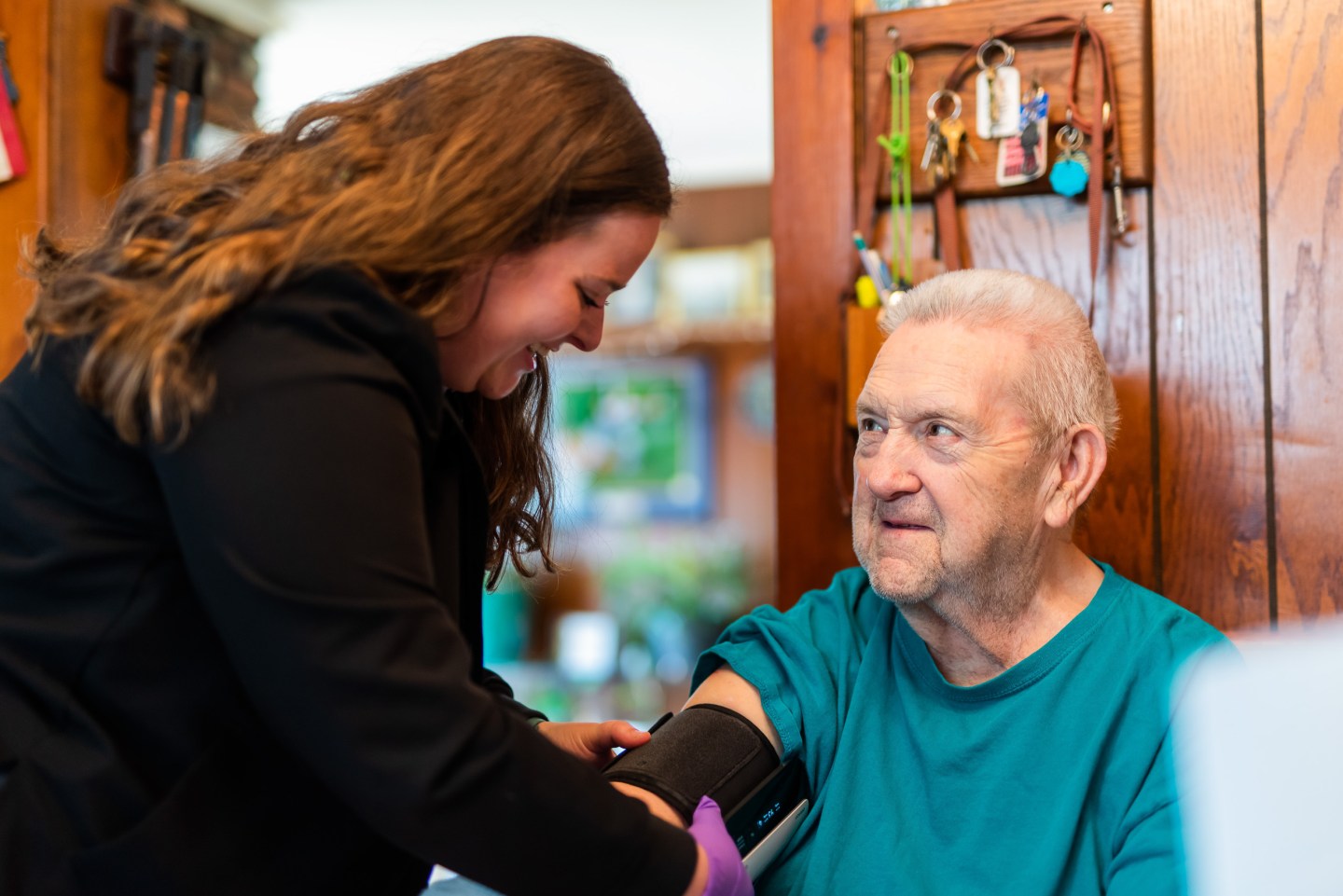
Instead, Hardy was admitted to Mass General Brigham via its Healthcare at Home program at his own residence in nearby Somerville. Over the next three weeks, he received the same care he’d have gotten inside a typical hospital: twice-daily nursing checks, provider visits, labs, physical assessments, and medications such as Lasix to treat his condition. But he slept in his own bed, moved around in his own house, and had his cat, Emma, and his parakeet, Fritz, by his side. He was a patient, just not one whose family had to drive to a hospital building to visit him.
“I really loved to have treatments at home,” Hardy, who has since transitioned to post-acute home nursing care, told me. “When I was in the hospital, my doctor told my family, ‘He’s going to get just as good or better service at home.’ She was right. I’ve had a better time at home.”
A looming deadline
The hospital-at-home model is hardly a futuristic notion. The practice of treating some acute-care patients in their own residences has been in place for decades in Spain and Australia. England, Canada, and Israel are also among the countries with established home-hospital models.
As with so many things connected with health care, the idea of a hospital-at-home system in the United States remains on an agonizingly slow track due to a lack of funding. A waiver extension currently in place, which provides for reimbursement of home hospital care through the Centers for Medicare and Medicaid Services, expires on Dec. 31, 2024. Unless the federal government approves hospital-at-home care for another waiver extension or as a permanent benefit, the path to this emerging form of care will remain an uphill battle.
“We know that a lot of health systems and hospitals are still holding back because they don’t see permanence yet,” says David Levine, a practicing internist at Harvard Medical School and clinical director of research and development at Mass General Brigham. “You could imagine a CEO saying, ‘Why should I build a home hospital service line if, in December 2024, they’re not going to pay for it anymore?’”
That point on the calendar is crucial. Levine says many clinicians and researchers “are working their tails off” to gather the evidence that will persuade the government that the waiver extension or full CMS coverage is the way to go.
What lies in the balance is a mode of care that, in several studies completed so far, delivers equal or superior results compared to traditional inpatient care in a whole raft of areas: hospital readmissions, mortality, total cost, average length of stay, and patient satisfaction. That last item is no surprise, researchers say. Most patients strongly prefer to be treated in the comfort of their homes if they can be.
‘Once they’ve experienced it, they never want to have facility-based care again’
In the larger view, some experts believe that we are also talking about an inflection point in the conversation about the future of the American health system.
“Healthcare delivery in this country has to change,” says Michael Maniaci, director of virtual care at the Mayo Clinic Center for Digital Health. “We don’t have enough (hospital and care) buildings for all the baby boomers–and even if we did, we don’t have enough staff, physicians, nurses, laypeople to deliver care in those buildings.”
The hospital-at-home model addresses some of that, within certain parameters. Candidates must meet specific criteria, for example: sick enough to be hospitalized, but stable enough to receive care at home. Speaking very generally, that list might currently include patients with a flare of chronic obstructive pulmonary disease, pneumonia, asthma, or heart failure like Hardy. Under the CMS waiver rules, the patients must have first visited a brick-and-mortar hospital, either in an emergency department or inpatient unit.
The home hospital process is nothing like traditional home health care. It involves the installation of medical supplies, including patient monitoring equipment, programmable IV pumps, and often a telehealth tablet and whatever is needed to facilitate a virtual connection. Services might include intravenous fluids, medications, lab draws, oxygen therapy, x-rays, electrocardiograms or ultrasound, and visits from therapists and social workers. Patients receive twice daily visits from healthcare providers, but they may see their doctors and nurses virtually as part of a decentralized approach that allows medical staff to spend more time on the care itself.
Mayo’s burgeoning program currently includes a medical “command center” in Jacksonville, along with Mayo facilities and healthcare partners elsewhere in Florida, Eau Claire, Wisconsin, and Phoenix, Arizona, Maniaci says. Doctors and nurses at the Jacksonville location are caring for patients in three different time zones–but each of those patients still has two in-person visits daily by a traveling nurse or paramedic. They may also be seen in person by an advanced practice provider.
“I think a traditional nursing ratio on our floors is one to three or four patients depending on acuity,” Maniaci says. “With this program, we’re already at one to five, sometimes even one to seven or eight at night–because, again, the nurses aren’t running around. It’s virtual.”
There’s variability across the country as to how these programs are run. For example, at Mass General Brigham, in addition to twice daily visits that may include nurses or paramedics, physicians often visit patients in person one day and by video the next, alternating based on the patient’s need.
A meta-analysis of 61 studies published in 2017 found that the hospital-at-home model “is associated with reductions in mortality, readmission rates, and cost, and increases in patient and carer satisfaction, but no change in carer burden.” Levine says that a small randomized control trial he and others conducted showed that the adjusted mean cost of an acute care episode was 38% lower for home patients compared to controls, 30-day readmissions were lower (7% vs 23%), and home patients spent much less of their day lying down (18% vs 55%).
“And once they’ve experienced it, we hear that for most patients, they never want to have facility-based care again,” says Stephen Dorner, chief clinical and innovation officer for MGB’s Healthcare at Home. “That’s not to say that all care can be delivered at home, because it certainly can’t…We’re only just seeing the tip of the iceberg and identifying all the benefits that can be afforded through home-based care delivery.”
‘The kind of numbers that health systems crave’
Despite the model’s strong acceptance in Europe and beyond, participation numbers in the U.S. remain low. According to the CMS, the current approved participation list involves 295 hospitals and 125 health systems across 37 states. (There are 6,129 hospitals in the country.)
One reason? In many countries with strong home-hospital networks, the government either actively encourages the program or does nothing to stand in its way. In the U.S., the federal government’s short-term waiver extension, set to expire next year, fairly well describes the uncertainty surrounding the movement. Many private insurers have been wary of the program, and even with the CMS waiver, not all states have authorized Medicaid payments for the service.
The waiver itself was the product of the pandemic, as U.S. hospitals overflowed and health systems looked for creative ways to treat patients, both COVID sufferers and others. It was set to expire in 2022, but a two-year extension was part of Congress’s omnibus spending bill that continued it through 2024.
“So now you have Medicare involvement,” says Robert Moskowitz, chief medical officer at Contessa Health, which partners with health systems to administer home hospital care. “You’ve got proven outcomes and proven points that this can work…It has become a question not of if we should be doing this, but how we should be doing this and how it should grow.”
Depending upon whom you consult, that growth could be explosive. “The next five to 10 years, it’s going to be everybody getting into the field,” according to Mayo’s Maniaci. “I think the future will be when you are sick in your home, you’ll be able to activate a system where they’ll be able to do an assessment and treat you immediately–and then admit you to your own home hospital. If you have a dire condition, like a stroke or heart attack, they’ll move you via emergency services appropriately to a physical hospital.”
Some systems are betting on such development. Heather O’Sullivan, president of MGB’s Healthcare at Home, says Mass General Brigham has made the program “one of its most strategic priorities,” and several hospital systems–Presbyterian, Johns Hopkins, Mount Sinai–have been working for years to build out their home hospital systems.
For 84-year-old George Hardy, the conversation is much less complex. For him, a hospital at home worked. Among other things, he resumed his love of cooking in his own kitchen. “You’re able to move around and do some of your normal things,” he told me. The people who come to your house are extraordinary. They know their job. They make you feel like family, you know what I mean?”
Hardy’s endorsement is part of an approval rating that executives say has proved to be higher for those cared for at home than those in the hospital–in some cases, much higher. “We have patient satisfaction scores that are well above 90%,” says Contessa’s Moskowitz. Those are the kind of numbers that health systems crave. The question now is whether the federal government sees enough value in such numbers to throw its permanent support behind the program. The clock is ticking.
Carolyn Barber, M.D., is an internationally published science and medical writer and a 25-year emergency physician. She is the author of the book Runaway Medicine: What You Don’t Know May Kill You, and the co-founder of the California-based homeless work program Wheels of Change.
The opinions expressed in Fortune.com commentary pieces are solely the views of their authors and do not necessarily reflect the opinions and beliefs of Fortune.
More must-read commentary published by Fortune:
- Ripple v. SEC: Why the crypto industry may have celebrated too early
- Demand for urban real estate will be challenged for the rest of the decade. Here’s how the world’s superstar cities are projected to fare by 2030
- ‘The Feckless 400’: These companies are still doing business in Russia–and funding Putin’s war
- Daniel Lubetzky: ‘You can’t make big ESG commitments while failing at the basics of kindness’