• Home
  • Latest
  • Fortune 500
  • Finance
  • Tech
  • Leadership
  • Lifestyle
  • Rankings
  • Multimedia

Trendingnow

1

MacKenzie Scott alone accounted for one-third of America's $19.2 billion in megagifts last year

2

Philanthropy leader at Warren Buffett and Bill Gates’ Giving Pledge says children of billionaires are pushing them to give their wealth away faster

3

Elon Musk on MacKenzie Scott giving away $26 billion of her fortune: 'Sadly,' it makes the world a worse place

1

MacKenzie Scott alone accounted for one-third of America's $19.2 billion in megagifts last year

2

Philanthropy leader at Warren Buffett and Bill Gates’ Giving Pledge says children of billionaires are pushing them to give their wealth away faster

3

Elon Musk on MacKenzie Scott giving away $26 billion of her fortune: 'Sadly,' it makes the world a worse place
LeadershipLabor

Workers are unionizing. How should management respond?

By
Paige McGlauflin
Paige McGlauflin
Down Arrow Button Icon
By
Paige McGlauflin
Paige McGlauflin
Down Arrow Button Icon
January 23, 2024, 7:00 AM ET
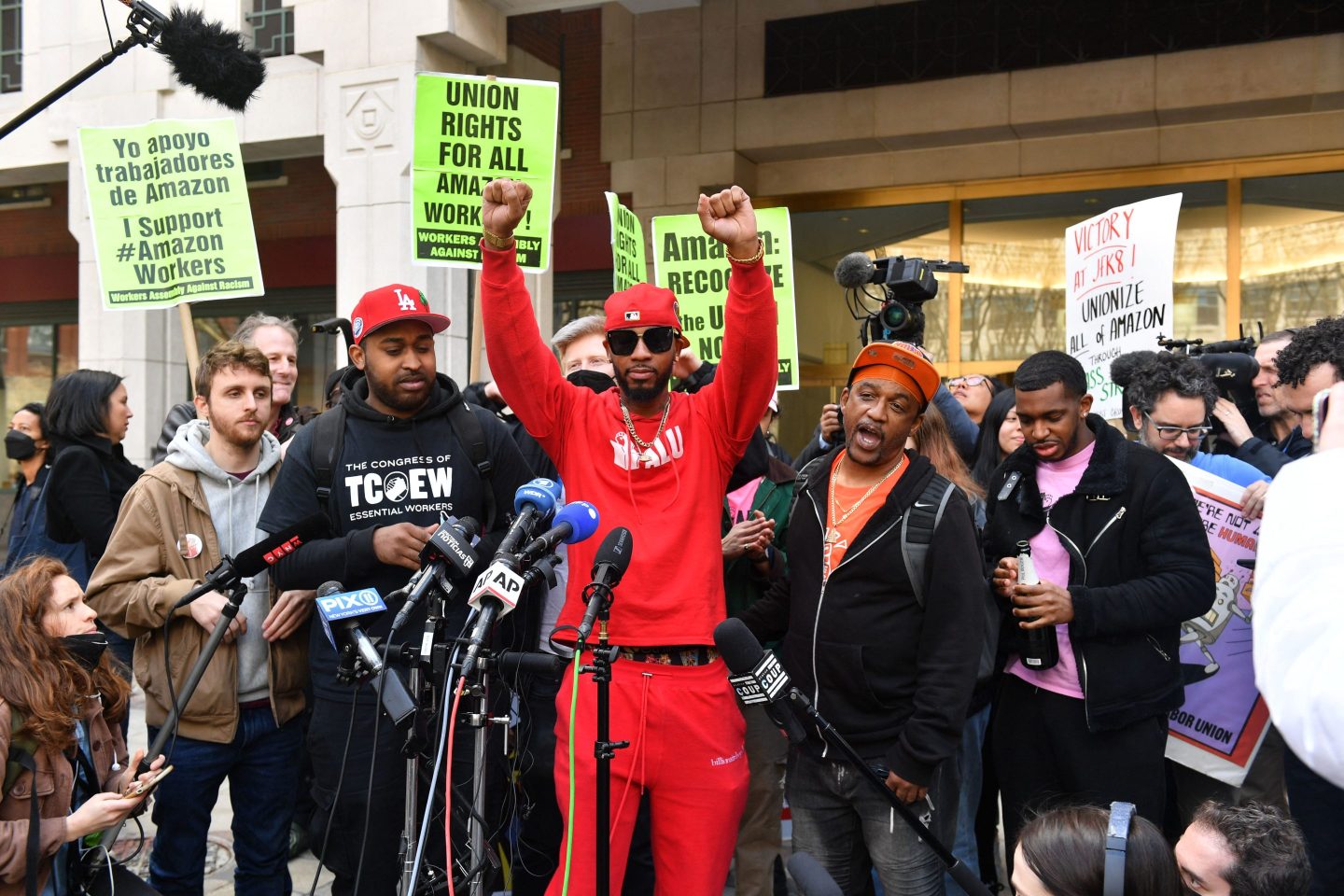
Union organizer Christian Smalls (C) celebrates as he speaks following the April 1, 2022, vote for the unionization of the Amazon Staten Island warehouse in New York.
Union organizer Christian Smalls (C) celebrates as he speaks following the April 1, 2022, vote for the unionization of the Amazon Staten Island warehouse in New York.Andrea Renault—AFP/Getty Images
Add Fortune on Google for similar content.

Last year’s “hot labor summer” may never end—at least not in 2024. There will likely be a lot more unionization efforts this year thanks to a National Labor Relations Board ruling earlier this month that makes it easier for unions to mobilize without following a more formal process. 

That means that a main challenge for employers going into this year is knowing how to reply to such efforts appropriately.

Company leaders can sometimes take union organizing as a personal rebuke, particularly if the company is family-owned or if management considers its culture tight-knit. But how company leaders and managers respond to such organizing efforts is critical. At best, communication can help resolve conflict between management and workers; at worst, it can further damage the employee-employer relationship. 

Fortune spoke with several experts in human resources and internal communications on best practices for companies reacting to employee interest in unionization. Here’s what they shared about the actions management should avoid—as well as the ones they should embrace—when crafting a response.

What employers should do 

Take a moment to self-reflect

Management needs to remember first and foremost that employees don’t consider unionization as a first effort to get what they need. Employees often turn to organizing because they think it’s the only way for management to hear them. Ignoring or attempting to squash such actions will only exacerbate employees’ frustrations. 

“I think one of the mistakes that we tend to make is we see this as an external threat that we have to react to and mitigate and try to thwart, rather than looking at this an opportunity to say: ‘What have we done, what have we not done that has led us to a point where our own employees feel like their only recourse to get us to listen is to organize?’” says  David Kryscynski, an associate professor of human resources at Rutgers University.

Gather stakeholders

Before responding, management should turn to a key group of confidants who can offer guidance on best practices.

“Assemble a group first and foremost, with key stakeholders in the organization so that you can create a plan together to remain informed, maintain open lines of communication, and make sure that you’re constantly acting in good faith,” says Chris Lee, vice president of employee experience and communication at management consulting firm Gallagher.

At minimum, the company’s legal counsel, HR leadership, and head of communications should be part of this coalition, he says. Management can also consider hiring a consultant to assess the situation and offer recommendations.

Commit to a transparent dialogue

Management should focus on having an open and transparent dialogue with employees about their concerns before deciding which actions to take.

”[Employees] have a collective reason for their actions, there must be a root cause for this,” says Rita Men, a professor of public relations and director of internal communication research at the University of Florida’s college of journalism and communications. She recommends “listening and sitting down with them, making them feel that they are heard, their perspectives are acknowledged and respected, and truly standing in the shoes of employees to get to the root of the problem so that you know your next step on what to do to address the issue.”

IRL is best 

Management should ensure any conversations about unionizing and collective bargaining are held face-to-face, and avoid engaging in dialogues over digital channels. Leaders should be particularly cognizant of only speaking with union leaders or representatives in face-to-face settings.

“Email, or social media, or other media channels, are not the best way of listening, especially regarding complex, complicated issues,” Men says. 

Honesty is the best policy

When responding to employees’ concerns, leaders should offer candid responses to their workers. Doing so may also help resolve employees’ specific issues or requests before entering the collective bargaining process. 

For example, while employees usually unionize to secure better wages or benefits, they will likely understand if management is honest about the company’s finances and explains why the company cannot accommodate every request.

“Employees do want to be respected in the process, and so it’s not always true that the solution is to just raise wages, provide more benefits and give more paid time off,” says Kryscynski. “Sometimes the solution is opening the books and just being transparent with the workforce about saying, ‘Here’s where we are, and here’s what’s going on.’”

What employers shouldn’t do

Don’t take it personally 

Management should avoid taking employees’ interests personally when unionizing or making rash decisions when responding to organizing efforts. 

“This can feel like an emotional gut punch, and it can be tempting to take this development personally,” says Lee. “This can backfire in a number of ways.”

That includes a short-sighted, knee-jerk response which can negatively impact the reputation of the employer, their relationship with employees, and the company in legal ways, he says. The smart move is to consult with other stakeholders, and with firms that can help them come up with a coherent strategy.  

Don’t be dismissive or patronizing 

Many employers will initially respond to employees organizing by saying something along the lines of “we respect your right to organize.” While that may sound respectful, employees can consider such phrasing to be insulting, as workers have a legal right to organize. 

“Management giving the workforce permission for something they already are entitled to is incredibly paternalistic and insulting,” says Kryscynski.

Instead, management should clearly signal and communicate something along the lines of: “Whether you choose to organize or not, we are committed to building a positive working relationship with you.” This signals to employees that management understands it hasn’t done a great job listening and needs to fix that going forward, regardless of whether employees ultimately unionize.

Management should also express that “a positive working relationship with the workforce helps everybody win,” says Kryscynski. “Those messages take the pressure off and allow management to step back and honestly respect whatever process happens.”

Ditch the token gestures

Management should avoid trying to appease employees through superficial gestures with no intention of making substantive changes. That could involve a CEO going on an employee listening tour, or leadership taking on frontline shifts with no plans to follow that up with changes for the company on a larger scale. 

For example, Starbucks’ CEO Laxman Narasimhan worked monthly barista shifts when he took over the company. While that may be an attempt to connect the company’s upper echelon with frontline workers, some experts have criticized this strategy as performative placating amid the coffee chain’s internal turmoil over unionization.


About the Author
By Paige McGlauflin
LinkedIn icon
See full bioRight Arrow Button Icon
Add Fortune on Google for similar content.

Latest in Leadership

Finance
Lorem ipsum dolor sit amet, consectetur adipiscing elit, sed do eiusmod tempor incididunt ut labore et dolore magna aliqua. Ut enim ad minim veniam
By Fortune Editors
October 20, 2025
Finance
Lorem ipsum dolor sit amet, consectetur adipiscing elit, sed do eiusmod tempor incididunt ut labore et dolore magna aliqua. Ut enim ad minim veniam
By Fortune Editors
October 20, 2025
Finance
Lorem ipsum dolor sit amet, consectetur adipiscing elit, sed do eiusmod tempor incididunt ut labore et dolore magna aliqua. Ut enim ad minim veniam
By Fortune Editors
October 20, 2025
Finance
Lorem ipsum dolor sit amet, consectetur adipiscing elit, sed do eiusmod tempor incididunt ut labore et dolore magna aliqua. Ut enim ad minim veniam
By Fortune Editors
October 20, 2025
Finance
Lorem ipsum dolor sit amet, consectetur adipiscing elit, sed do eiusmod tempor incididunt ut labore et dolore magna aliqua. Ut enim ad minim veniam
By Fortune Editors
October 20, 2025
Finance
Lorem ipsum dolor sit amet, consectetur adipiscing elit, sed do eiusmod tempor incididunt ut labore et dolore magna aliqua. Ut enim ad minim veniam
By Fortune Editors
October 20, 2025

Most Popular

Finance
Lorem ipsum dolor sit amet, consectetur adipiscing elit, sed do eiusmod tempor incididunt ut labore et dolore magna aliqua. Ut enim ad minim veniam
By Fortune Editors
October 20, 2025
Finance
Lorem ipsum dolor sit amet, consectetur adipiscing elit, sed do eiusmod tempor incididunt ut labore et dolore magna aliqua. Ut enim ad minim veniam
By Fortune Editors
October 20, 2025
Finance
Lorem ipsum dolor sit amet, consectetur adipiscing elit, sed do eiusmod tempor incididunt ut labore et dolore magna aliqua. Ut enim ad minim veniam
By Fortune Editors
October 20, 2025
Finance
Lorem ipsum dolor sit amet, consectetur adipiscing elit, sed do eiusmod tempor incididunt ut labore et dolore magna aliqua. Ut enim ad minim veniam
By Fortune Editors
October 20, 2025
Finance
Lorem ipsum dolor sit amet, consectetur adipiscing elit, sed do eiusmod tempor incididunt ut labore et dolore magna aliqua. Ut enim ad minim veniam
By Fortune Editors
October 20, 2025
Finance
Lorem ipsum dolor sit amet, consectetur adipiscing elit, sed do eiusmod tempor incididunt ut labore et dolore magna aliqua. Ut enim ad minim veniam
By Fortune Editors
October 20, 2025
Fortune Secondary Logo
Rankings
  • 100 Best Companies
  • Fortune 500
  • Global 500
  • Fortune 500 Europe
  • Most Powerful Women
  • World's Most Admired Companies
  • See All Rankings
  • Lists Calendar
Sections
  • Finance
  • Fortune Crypto
  • Features
  • Leadership
  • Health
  • Commentary
  • Success
  • Retail
  • Mpw
  • Tech
  • Lifestyle
  • CEO Initiative
  • Asia
  • Politics
  • Conferences
  • Europe
  • Newsletters
  • Personal Finance
  • Environment
  • Magazine
  • Education
Customer Support
  • Frequently Asked Questions
  • Customer Service Portal
  • Privacy Policy
  • Terms Of Use
  • Single Issues For Purchase
  • International Print
Commercial Services
  • Advertising
  • Fortune Brand Studio
  • Fortune Analytics
  • Fortune Conferences
  • Business Development
  • Group Subscriptions
About Us
  • About Us
  • Press Center
  • Work At Fortune
  • Terms And Conditions
  • Site Map
  • About Us
  • Press Center
  • Work At Fortune
  • Terms And Conditions
  • Site Map
  • Facebook icon
  • Twitter icon
  • LinkedIn icon
  • Instagram icon
  • Pinterest icon

Latest in Leadership

U.S. Polo Assn. CEO J. Michael Prince
SuccessThe Promotion Playbook
U.S. Polo Assn. CEO was told he wasn’t right for a promotion—so he ‘outworked’ anyone else who wanted the job for 6 months straight
By Orianna Rosa RoyleJuly 1, 2026
2 hours ago
Nikesh Arora, chief executive officer at Palo Alto Networks
SuccessJobs
CEO of $248 billion cybersecurity company says workers are about to face a ‘Darwinian moment’ thanks to AI: Evolve or get cut
By Emma BurleighJuly 1, 2026
3 hours ago
DHL plane being refuelled at airport by man in high-vis jacket
EuropeAviation
The Iran conflict saw jet fuel prices soar—when you use 1.88 million tonnes a year, how you respond really matters (just ask DHL)
By Sam ForsdickJuly 1, 2026
5 hours ago
I know how Gen Z can survive the ‘jobpocalypse’ because I built an AI company — in 2015
CommentaryCareers
I know how Gen Z can survive the ‘jobpocalypse’ because I built an AI company — in 2015
By Jeremy FainJuly 1, 2026
7 hours ago
mr
Commentary250 Years of Innovation
America needs 3.8 million manufacturing workers. This CEO has a blueprint to find them
By Mark RayfieldJuly 1, 2026
7 hours ago
Photo: Rocks balancing on driftwood, sea in background.
AIMarkets
Leveraged stock bets are ‘very concentrated in the AI ecosystem,’ Goldman Sachs warns
By Jim EdwardsJuly 1, 2026
8 hours ago

Most Popular

MacKenzie Scott alone accounted for one-third of America's $19.2 billion in megagifts last year
Success
MacKenzie Scott alone accounted for one-third of America's $19.2 billion in megagifts last year
By Sydney LakeJune 25, 2026
6 days ago
Philanthropy leader at Warren Buffett and Bill Gates’ Giving Pledge says children of billionaires are pushing them to give their wealth away faster
Success
Philanthropy leader at Warren Buffett and Bill Gates’ Giving Pledge says children of billionaires are pushing them to give their wealth away faster
By Preston ForeJune 27, 2026
4 days ago
Elon Musk on MacKenzie Scott giving away $26 billion of her fortune: 'Sadly,' it makes the world a worse place
Success
Elon Musk on MacKenzie Scott giving away $26 billion of her fortune: 'Sadly,' it makes the world a worse place
By Sydney LakeJune 29, 2026
2 days ago
As Big Tech showers employees with perks to win the talent war, Nvidia built a nearly $5 trillion company by making people pay for their own lunch
Big Tech
As Big Tech showers employees with perks to win the talent war, Nvidia built a nearly $5 trillion company by making people pay for their own lunch
By Marco Quiroz-GutierrezJuly 1, 2026
11 hours ago
The U.S. Army is opening military bases to private billions — here's why that changes everything for the next 250 years
Commentary
The U.S. Army is opening military bases to private billions — here's why that changes everything for the next 250 years
By Marc AndersenJune 30, 2026
1 day ago
The Supreme Court's birthright citizenship ruling hands the U.S. economy a $7.7 trillion win
Newsletters
The Supreme Court's birthright citizenship ruling hands the U.S. economy a $7.7 trillion win
By Diane BradyJuly 1, 2026
9 hours ago

© 2026 Fortune Media IP Limited. All Rights Reserved. Use of this site constitutes acceptance of our Terms of Use and Privacy Policy | CA Notice at Collection and Privacy Notice | Do Not Sell/Share My Personal Information
FORTUNE is a trademark of Fortune Media IP Limited, registered in the U.S. and other countries. FORTUNE may receive compensation for some links to products and services on this website. Offers may be subject to change without notice.