Times change. A century ago 15 million Model-T Ford cars released consumers and workers alike to a freedom which in turn released the American Dream: to be mobile in a changing world and to move with the times. Writing about it in the New Yorker in 1936 as it was about to cease production, E.B. White (who later wrote Charlotte’s Webb) commented that, “As a vehicle, it was hardworking, commonplace, heroic; to get under way you simply hooked the third finger of the right hand around a lever on the steering column, pulled down hard and shoved your left food down forcibly against the low speed pedal. These were simple, positive motions; the car responded by lunging forward with a roar.”
Never mind that it was clunky: It moved. The singer-songwriter Tracy Chapman became an overnight sensation in the late 1980s with her song “Fast Car.” The lyrics are a pure distillation of the desire and hope to get a better life through work.
Henry Ford’s affordable motor car spawned a million pop songs. To work in a city and belong. To be at the wheel of your own destiny. Mickey Haller, the bestselling creation of writer Michael Connelly, is “the Lincoln Lawyer”—the Lincoln being his car. His workplace? The freeways. The office has been everywhere and nowhere for some time—but people go and move to where work and fulfillment lie.
In my own way, the car has always been my commute. In Camden, North London, in the 1970s I used to gaze longingly out of the plate glass window during assembly at the cars and lorries trundling up the trunk road. Most of my peers went to university but I went to work—in my car. For my twenty-first the birthday my elderly cousin Gretl gave me a silver Toyota Corolla which I used to drive around London in—to my first big office job at Penguin Books in the King’s Road, then to the BBC not so far away. I belonged less in my workplace, which changed, than in the car itself. I worked from a desk in both places, but the connecting tissue was what got me there and what happened in between. The office was a static place, with its filing cabinets, corded telephones and piles of paper. But the car? That was the exciting way I knew I was entering the grown-up world of work.
Times change. All of the offices I have ever worked in have. The BBC White City HQ, which used to be called “Television Centre”, has become a vast Soho House. Penguin Books became, I think, a block of apartments, what the British call “flats.” The idea of driving a car to an office in a city has changed too, and is as politically off limits as smoking now, partly because of climate change and pro-cycling city politics, partly because public transportation systems have grown, and partly because of Covid’s impact on the commute.
The car is a symbol of what gets outdated—and updated. Cars are changing massively, from petrol to electric to driverless. The car, the commute, the city—it’s all connected, and it’s all changing. The traditional forces upon which a commute was based—a daily journey to a nine to five job in a single central building in a city or town center, which millions upon millions of people did, no questions asked, for nearly a century—are being upended by a different kind of motion: the desire for personal mobility.
The game was up as soon as mobile phones and the internet arrived. When outsourcing and globalization arrived, migration for work became internal: A million Americans have moved from north to south already, and an Upwork study predicted up to 10 percent of the entire workforce will ultimately move physically as the remote work revolution gains traction. Flexibility is here. Mobility goes hand in hand with it. The Uber driver has come to represent this too: Cities work well now with Ubers, and they simply work less well without. Uber is, however, a good example of how it takes time to settle in to new systems, especially where technology collides with work practices. It’s not only that it took Uber a while to wake up and smell the coffee that they needed to treat workers properly, with certain rights and protections. In London it mightily disrupted the famous black cab taxi drivers, who now have to handle card and cashless transactions as a matter of law. This was expensive, and my goodness, they grumbled. But it works better now.
The dreaded commute
Perhaps we know what we don’t want rather than what we do at the moment. One thing we do know is that the commute has come to represent everything people hate, namely a time-suck on someone else’s rules. And we know that there is a direct correlation between the drop in office occupancy of the cities, where getting in and out takes over an hour.
We also know that the commute isn’t just unpopular but unhealthy. And although in the UK car trips account more for shopping and leisure than commuting, not so elsewhere in the world: three quarters of Americans still prefer to use their cars to travel between home and work. A recent study shows that switching to remote work can minimize carbon emissions by 58 percent. Climate change of course is affecting where people live and work from anyway: Shrinking property insurance associated with climate risks accounts for a staggering 17 percent of GDP in the US.
The central story around the commute hinges on how people move into and across the city, from where they live to where they work. Ever since global “stay at home” notices were issued around the world in March 2020, the working assumption that the majority of people must commute to work daily ended. The city, the office, the home: This is the new trio of locations battling to be the workplace for anywhere the technology allows.
People are ultimately place-agnostic and person-centered about the workplace, but not about how they live and work. They want three things now: 1) better work–life balance; 2) for work to comfortably cover the cost of living; and 3) good tech which works wherever and whenever they work. Commuter towns will grow in locations in which housing and childcare is affordable and plentiful, which are safe from climate change, and increasingly, within a reachable radius of HQ.
This moment has many more questions than answers. My working assumptions are influenced by what I see happening in London, where I live, and New York, which is something of a home from home, from where I work several times a year. Someone who helps me make sense of the overall trends is a New Yorker, Peter Miscovich, who is the Global Future of Work Lead for Consulting at JLL, one of the world’s leading commercial real estate advisory firms.
Peter, who has been in the real estate and work transformation space one way or another for well over a quarter of a century, has the rare gift of being deeply commercially savvy, corporate to his fingertips (some of the biggest brand names in the world are current or former clients of his), and yet wonderfully candid. Peter is a realist who sees things in the round. He was one of the first people to confirm my suspicion that the world of corporate real estate was being changed forever by the pandemic at a time when plenty were flatly denying it.
He told me:
“I tend to look at corporate real estate and the real estate industry sector with a thirty- to fifty-year-lens, and there was really almost thirty to forty years of transformation that is now accelerating even faster with more disruption and with more complexity. And with this comes an interesting emergent paradox around supply and demand, with a new focus upon cost management in parallel with enhanced human experience, integration of new disruptive technologies enabling new ways of working in parallel to massive workforce demographic shifts—all these influencing factors are impacting the corporate real estate simultaneously at scale today.
“So, the paradoxical complexity of the corporate real estate landscape has really increased dramatically over the last five years. We’re now working with several global clients and looking at 2030 strategies, and we’re looking at those strategies in four-year tranches—from 2024 to 2027, and then from 2027 to 2030.”
The remote work ‘swoosh’
It isn’t just the time frame which is changing—shortening and also lengthening—but the language is shifting. Heard of the “urban doom loop”? This and “urban apocalypse” were predicted by the economist Arpit Gupta, who reminded me not only that cities have evolved continuously around the available technology (or lack of it)—e.g. New York’s theater district evolved around the nearby garment district—but that there is a simple cost equation now which just isn’t adding up for many office tenants.
According to Professor Gupta, real estate rental costs the average white collar firm around $15,000 per employee. Fine if you’re a huge business, underwritten by millions or billions of dollars, but nearly half of private sector jobs in business in America are generated by the 3 million or so small businesses. For them that amount is the deciding factor in how much property to rent—if any—in order to get the work done.
What does this all add up to? Movement. Movement of people out of cities and into suburbs or smaller cities, and movement of patterns of office and workspace usage. We need to not fear change but go with it. The death knell for the commute and the doom loop gives rise to something else: the Nike swoosh. Professor Nicholas Bloom of Stanford University, a high-profile academic predicting remote and hybrid working, wrote a guest piece in The Economist in August 2023 predicting that “Remote work is set to undergo a Nike swoosh, with an initial postpandemic drop, followed by its current stabilization and a future long-run surge.”
Perhaps the enduring symbol of the turbulence in city real estate is WeWork. When WeWork went bankrupt at the end of 2023 it marked the end of an era in which the working assumption office life would last forever proved to be an expensive mistake. WeWork’s rise and fall serves as a metaphor for the end of the office, even though it was only actually the end of WeWork (Adam Neumann, its charismatic and controversial founder, who I personally always confuse with his dramatic alter ego actor Jared Leto, is in the process of trying to buy WeWork back but really: You can’t go back, only forwards. I think we can say WeWork stopped working).
The global market in office space dropped by a good twenty percent after 2020, and it’s not coming back, not as before anyway. The influential Conference Board report of January 2024 showed that global CEOs have come to regard attracting talent as “high focus” but getting them back to the office as “low focus.” All proof that the smart money is on making offices attractive for a return on a social basis, a part-time basis, and different basis—but not the same basis as before.
Although the WeWork model and its imitators was marketed as a drop-in-freelance-worker model, it made its bread and butter from sub-letting to larger companies who either ran out of space or wanted to look hip. Until they didn’t. By the time it closed, WeWork’s million or so workstations were empty in nearly 800 locations in forty-odd countries around the world.
Commercial real estate may have become a Bermuda Triangle for investors and developers, with the smart ones pivoting to live-to-work space and hiring people like Peter Miscovich to help them through. But a new “commuter triangle”—a space for people, their home and their work life which isn’t a sinkhole but symbiotic—has emerged. It isn’t a place you get lost in, but a real set of dynamics to grapple with: A working person now sits at the center of their home life and their work life. The company which gets that and dedicates the design of jobs, work and workspace to it will move them, motivate them, and get them to go the distance.
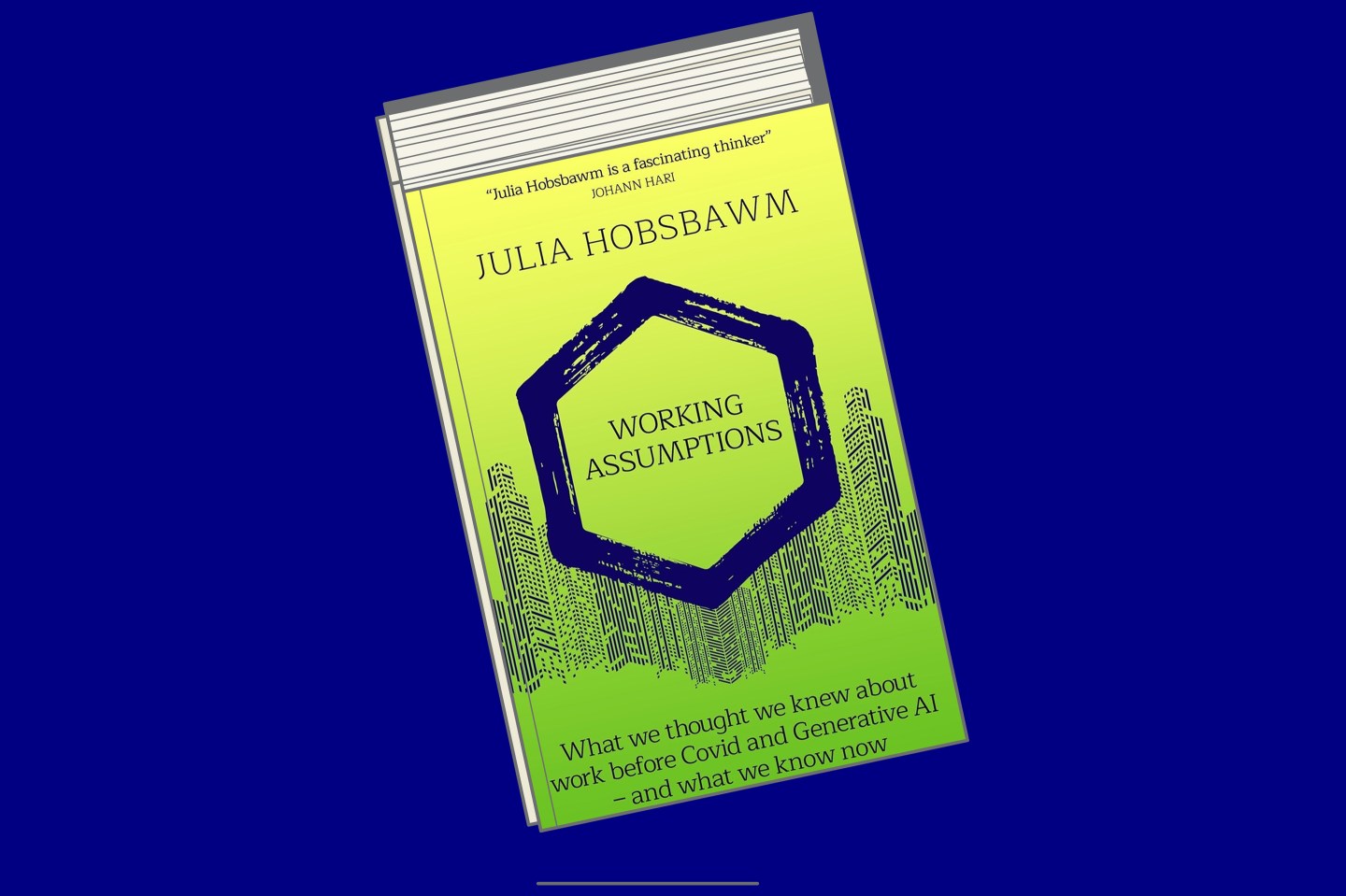
Excerpted and adapted from the book Working Assumptions: What We Thought We Knew About Work Before Covid and Generative AI—And What We Know Now. Copyright © 2024 by Julia Hobsbawm.