• Home
  • Latest
  • Fortune 500
  • Finance
  • Tech
  • Leadership
  • Lifestyle
  • Rankings
  • Multimedia

Trendingnow

1

Microsoft AI chief gives it 18 months—for all white-collar work to be automated by AI

2

Despite having a $165 million net worth, Scarlett Johansson says work-life balance doesn’t exist—and the first step to success is admitting that

3

The Bezos family just donated $100 million to help achieve one of Mayor Zohran Mamdani’s top campaign promises

1

Microsoft AI chief gives it 18 months—for all white-collar work to be automated by AI

2

Despite having a $165 million net worth, Scarlett Johansson says work-life balance doesn’t exist—and the first step to success is admitting that

3

The Bezos family just donated $100 million to help achieve one of Mayor Zohran Mamdani’s top campaign promises
Leadership

Microsoft and Nvidia are now the world’s most valuable companies. How Intel—once the top chipmaker—blew its shot to be one of them

Geoff Colvin
By
Geoff Colvin
Geoff Colvin
Senior Editor-at-Large
Down Arrow Button Icon
Geoff Colvin
By
Geoff Colvin
Geoff Colvin
Senior Editor-at-Large
Down Arrow Button Icon
June 20, 2024, 11:44 AM ET
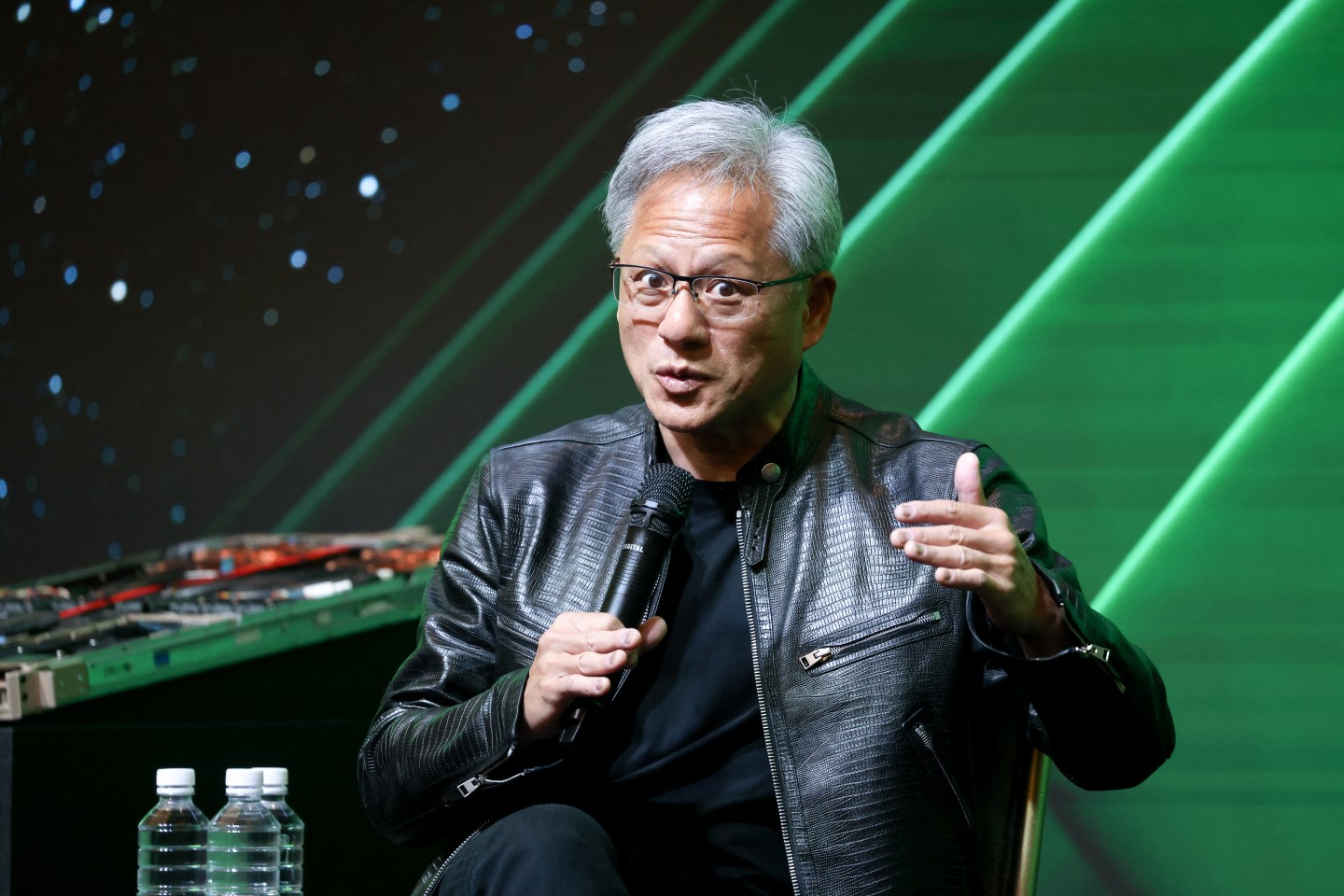
Jensen Huang’s Nvidia rocketed past rivals like Intel.
Jensen Huang’s Nvidia rocketed past rivals like Intel. I-HWA CHENG—AFP/Getty Images

In the annals of business success stories few saw coming, Nvidia’s incredible rise to surpass Microsoft and become the world’s most valuable company is one for the books. This past week Nvidia, cofounded by Jensen Huang, edged out Microsoft as its market cap soared to $3.42 trillion. Yet it could have been otherwise. As business leaders marvel at Nvidia’s rise, it’s worth remembering that another company—Intel—came tantalizingly close to being where Nvidia is now.

Recommended Video

Instead, Intel is waging a heroic effort to regain its place as the world’s preeminent maker of leading edge chips. The story of how it lost that position is part of a recent Fortune case study.


As detailed in the piece, a key moment occurred in the mid-2000s, when Paul Otellini, then CEO of Intel, said a word to Steve Jobs he almost never heard: No.

It was 2006, and Intel, the global king of computer chips, was bringing in record revenue and profits by dominating the kinds of chips in hottest demand—for personal computers and data centers. Now Jobs wanted Intel to make a different type of chip for a product that didn’t even exist, which would be called the iPhone.

Otellini knew chips for phones and tablets were the next big thing, but Intel had to devote substantial capital and its best minds to the fabulously profitable business it already possessed. Besides, “no one knew what the iPhone would do,” he told The Atlantic seven years later, just before he stepped down as CEO. “There was a chip that they were interested in, that they wanted to pay a certain price for and not a nickel more, and that price was below our forecasted cost. I couldn’t see it.”

Otellini, who died in 2017, was a highly successful CEO by many measures. But if that decision had gone the other way, Intel might have become a chip titan of the post-PC era. Instead, it gave up on phone chips in 2016 after losing billions trying to become a significant player. As he left the company, Otellini seemed to grasp the magnitude of his decision: “The world would have been a lot different if we’d done it.”

Meantime, some 800 miles north, in Seattle, Microsoft was struggling to find its role in a tech world dominated by the internet, mobile devices, social media, and search. Investors were not impressed by its efforts. No one could have foreseen that years later, a few key decisions would set the company up as an AI powerhouse and send its stock soaring.

There was a time not so long ago that Microsoft and Intel were both atop the tech world. They were neither competitors nor significant customers of each other, but what New York University’s Adam Brandenburger and Yale’s Barry Nalebuff deemed “complementors.” Microsoft built its hugely profitable Windows operating system over the years to work on computers that used Intel’s chips, and Intel designed new chips to run Windows (hence “Wintel”). The system fueled the leading tech product of the 1990s, the personal computer. Microsoft’s Bill Gates became a celebrity wonk billionaire, and Intel CEO Andy Grove was Time’s 1997 Man of the Year.

Snubbing Steve Jobs wasn’t the only cause of Intel’s decline, but it was a significant one. Intel also tried and failed to develop a GPU (graphics processing unit), which turned out to be the type of chip used in AI development and that Nvidia designs. What if Intel had succeeded? It was the world’s sixth most valuable company in 2000 and the largest maker of semiconductors; today it’s No. 69 by value and No. 2 in semiconductors by revenue, far behind No. 1 TSMC (and in some years also behind Samsung).

A Fortune 500 CEO makes thousands of decisions in a career, a few of which will turn out to be momentous. What’s easy to explain in hindsight—that Microsoft would be at the forefront of AI, that Google would become a behemoth, that Blockbuster would fade into obscurity—is never preordained. Often the fateful decisions are identifiable only in retrospect. Nothing more vividly illustrates this than the parallel stories of Microsoft and Intel, and the failures at the latter that cleared the way for the moonshot rise of Nvidia. The case study of what went right and wrong at these giant corporations offers a master class in business strategy not just for today’s front-runners at the likes of Nvidia, Google, Open AI, Amazon, and elsewhere—but also for any Fortune 500 leader hoping to survive and thrive in the coming decade.

You can read the full case study here.
Join us at the Fortune Workplace Innovation Summit May 19–20, 2026, in Atlanta. The next era of workplace innovation is here—and the old playbook is being rewritten. At this exclusive, high-energy event, the world’s most innovative leaders will convene to explore how AI, humanity, and strategy converge to redefine, again, the future of work. Register now.
About the Author
Geoff Colvin
By Geoff ColvinSenior Editor-at-Large
LinkedIn iconTwitter icon

Geoff Colvin is a senior editor-at-large at Fortune, covering leadership, globalization, wealth creation, the infotech revolution, and related issues.

See full bioRight Arrow Button Icon

Latest in Leadership

Finance
Lorem ipsum dolor sit amet, consectetur adipiscing elit, sed do eiusmod tempor incididunt ut labore et dolore magna aliqua. Ut enim ad minim veniam
By Fortune Editors
October 20, 2025
Finance
Lorem ipsum dolor sit amet, consectetur adipiscing elit, sed do eiusmod tempor incididunt ut labore et dolore magna aliqua. Ut enim ad minim veniam
By Fortune Editors
October 20, 2025
Finance
Lorem ipsum dolor sit amet, consectetur adipiscing elit, sed do eiusmod tempor incididunt ut labore et dolore magna aliqua. Ut enim ad minim veniam
By Fortune Editors
October 20, 2025
Finance
Lorem ipsum dolor sit amet, consectetur adipiscing elit, sed do eiusmod tempor incididunt ut labore et dolore magna aliqua. Ut enim ad minim veniam
By Fortune Editors
October 20, 2025
Finance
Lorem ipsum dolor sit amet, consectetur adipiscing elit, sed do eiusmod tempor incididunt ut labore et dolore magna aliqua. Ut enim ad minim veniam
By Fortune Editors
October 20, 2025
Finance
Lorem ipsum dolor sit amet, consectetur adipiscing elit, sed do eiusmod tempor incididunt ut labore et dolore magna aliqua. Ut enim ad minim veniam
By Fortune Editors
October 20, 2025

Most Popular

Finance
Lorem ipsum dolor sit amet, consectetur adipiscing elit, sed do eiusmod tempor incididunt ut labore et dolore magna aliqua. Ut enim ad minim veniam
By Fortune Editors
October 20, 2025
Finance
Lorem ipsum dolor sit amet, consectetur adipiscing elit, sed do eiusmod tempor incididunt ut labore et dolore magna aliqua. Ut enim ad minim veniam
By Fortune Editors
October 20, 2025
Finance
Lorem ipsum dolor sit amet, consectetur adipiscing elit, sed do eiusmod tempor incididunt ut labore et dolore magna aliqua. Ut enim ad minim veniam
By Fortune Editors
October 20, 2025
Finance
Lorem ipsum dolor sit amet, consectetur adipiscing elit, sed do eiusmod tempor incididunt ut labore et dolore magna aliqua. Ut enim ad minim veniam
By Fortune Editors
October 20, 2025
Finance
Lorem ipsum dolor sit amet, consectetur adipiscing elit, sed do eiusmod tempor incididunt ut labore et dolore magna aliqua. Ut enim ad minim veniam
By Fortune Editors
October 20, 2025
Finance
Lorem ipsum dolor sit amet, consectetur adipiscing elit, sed do eiusmod tempor incididunt ut labore et dolore magna aliqua. Ut enim ad minim veniam
By Fortune Editors
October 20, 2025
Fortune Secondary Logo
Rankings
  • 100 Best Companies
  • Fortune 500
  • Global 500
  • Fortune 500 Europe
  • Most Powerful Women
  • World's Most Admired Companies
  • See All Rankings
  • Lists Calendar
Sections
  • Finance
  • Fortune Crypto
  • Features
  • Leadership
  • Health
  • Commentary
  • Success
  • Retail
  • Mpw
  • Tech
  • Lifestyle
  • CEO Initiative
  • Asia
  • Politics
  • Conferences
  • Europe
  • Newsletters
  • Personal Finance
  • Environment
  • Magazine
  • Education
Customer Support
  • Frequently Asked Questions
  • Customer Service Portal
  • Privacy Policy
  • Terms Of Use
  • Single Issues For Purchase
  • International Print
Commercial Services
  • Advertising
  • Fortune Brand Studio
  • Fortune Analytics
  • Fortune Conferences
  • Business Development
  • Group Subscriptions
About Us
  • About Us
  • Press Center
  • Work At Fortune
  • Terms And Conditions
  • Site Map
  • About Us
  • Press Center
  • Work At Fortune
  • Terms And Conditions
  • Site Map
  • Facebook icon
  • Twitter icon
  • LinkedIn icon
  • Instagram icon
  • Pinterest icon

Latest in Leadership

tarot
AICulture
We talked to 12 tarot card readers who are using AI. They split in 2 camps, with big implications for the technology
By Ziv Epstein, Farnaz Jahanbakhsh, Vana Goblot and The ConversationMay 16, 2026
7 hours ago
mustafa suleyman
AIMicrosoft
Microsoft AI chief gives it 18 months—for all white-collar work to be automated by AI
By Jake AngeloMay 16, 2026
9 hours ago
Kevin O'Leary wears a suit and gestures
Future of Workwork-life balance
‘You’re not a hero, you’re a liability’: Shark Tank’s Kevin O’Leary warns Gen Z founders to stop glorifying hustle culture
By Jacqueline MunisMay 16, 2026
9 hours ago
tom
SuccessEntrepreneurs
Top Chef’s Tom Colicchio got a 15x return on a tech company most Americans have never heard of. He thinks his own industry is broken
By Nick LichtenbergMay 16, 2026
10 hours ago
bhaskar
Economydisruption
The prophet of the ‘Wired Belt’ says capitalism is finally eating itself
By Bhaskar ChakravortiMay 16, 2026
11 hours ago
Kurt Alexander, president of Omni Hotels & Resorts
SuccessCareers
Gen Z wants AI-proof jobs. The president of a 50-property hotel chain says hospitality is hiding in plain sight
By Preston ForeMay 16, 2026
11 hours ago

Most Popular

Microsoft AI chief gives it 18 months—for all white-collar work to be automated by AI
AI
Microsoft AI chief gives it 18 months—for all white-collar work to be automated by AI
By Jake AngeloMay 16, 2026
9 hours ago
Despite having a $165 million net worth, Scarlett Johansson says work-life balance doesn’t exist—and the first step to success is admitting that
Success
Despite having a $165 million net worth, Scarlett Johansson says work-life balance doesn’t exist—and the first step to success is admitting that
By Preston ForeMay 13, 2026
3 days ago
The Bezos family just donated $100 million to help achieve one of Mayor Zohran Mamdani’s top campaign promises
Politics
The Bezos family just donated $100 million to help achieve one of Mayor Zohran Mamdani’s top campaign promises
By Jake AngeloMay 12, 2026
4 days ago
Current price of oil as of May 15, 2026
Personal Finance
Current price of oil as of May 15, 2026
By Joseph HostetlerMay 15, 2026
1 day ago
Meet the 20-year-old CEO who launched a company in high school to solve Gen Z's entry-level job crisis
Future of Work
Meet the 20-year-old CEO who launched a company in high school to solve Gen Z's entry-level job crisis
By Jake AngeloMay 16, 2026
13 hours ago
‘You’re not a hero, you’re a liability’: Shark Tank’s Kevin O’Leary warns Gen Z founders to stop glorifying hustle culture
Future of Work
‘You’re not a hero, you’re a liability’: Shark Tank’s Kevin O’Leary warns Gen Z founders to stop glorifying hustle culture
By Jacqueline MunisMay 16, 2026
9 hours ago

© 2026 Fortune Media IP Limited. All Rights Reserved. Use of this site constitutes acceptance of our Terms of Use and Privacy Policy | CA Notice at Collection and Privacy Notice | Do Not Sell/Share My Personal Information
FORTUNE is a trademark of Fortune Media IP Limited, registered in the U.S. and other countries. FORTUNE may receive compensation for some links to products and services on this website. Offers may be subject to change without notice.