• Home
  • Latest
  • Fortune 500
  • Finance
  • Tech
  • Leadership
  • Lifestyle
  • Rankings
  • Multimedia

Trendingnow

1

As Big Tech showers employees with perks to win the talent war, Nvidia built a nearly $5 trillion company by making people pay for their own lunch

2

MacKenzie Scott alone accounted for one-third of America's $19.2 billion in megagifts last year

3

The Supreme Court's birthright citizenship ruling hands the U.S. economy a $7.7 trillion win

1

As Big Tech showers employees with perks to win the talent war, Nvidia built a nearly $5 trillion company by making people pay for their own lunch

2

MacKenzie Scott alone accounted for one-third of America's $19.2 billion in megagifts last year

3

The Supreme Court's birthright citizenship ruling hands the U.S. economy a $7.7 trillion win
SuccessLeadership

Satya Nadella returned Microsoft to the top by showing humility as CEO. Here’s how it’s done

By
Michael Morris
Michael Morris
Down Arrow Button Icon
By
Michael Morris
Michael Morris
Down Arrow Button Icon
September 30, 2024, 5:48 PM ET
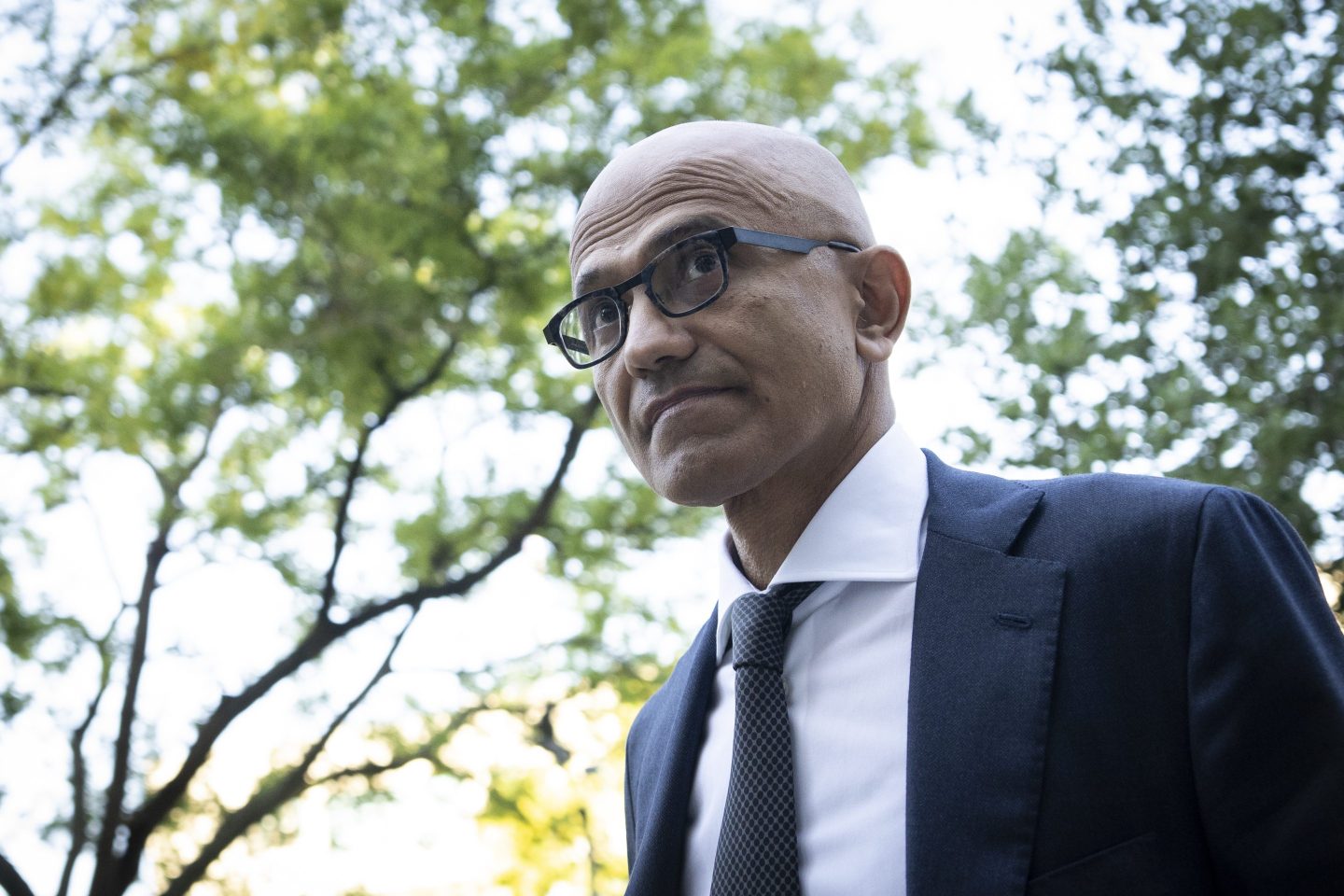
Microsoft CEO Satya Nadella.
Microsoft CEO Satya Nadella.Drew Angerer/Getty Images
Add Fortune on Google for similar content.

When Satya Nadella took the helm of Microsoft in 2014, he needed to “hit refresh” on its culture. A culture of deferring to technical experts, from the CEO on down, had resulted in ever-heavier apps (overloaded with features that few customers used) that were rapidly losing market share. In the “cloud computing” era, it had become imperative to know your customers’ needs well and tailor offerings to them. However, Nadella didn’t use his bully pulpit to demand managers learn customer focus. Shouting at people to become better listeners doesn’t work very well. Instead, he went on a “listening tour,” meeting with managers throughout the firm and quickly implementing some of the bottom-up requests (e.g., dropping the company’s force-ranked performance evaluations). He also toured the firm’s ecosystem, such as customers, partner firms, and universities it recruits from. After a gaffe in responding to a question at a tech conference about gender discrimination, Nadella went out of his way to apologize, drawing attention to his mistake and publicly meeting with women in tech groups to learn more. These actions modeled the managerial style that the times required—curiosity, listening, and humility. Through leading by example, Nadella updated the firm’s “know-it-all” culture into a “learn-it-all” culture that helped it regain its growth and innovation.

Encouraging big bets

The challenge of signaling creative ideals arises in other industries as well. Netflix wants its executives to take big risks so that its content stays innovative. However, dictums from the C-suite won’t work to sustain this ideal; shows of authority make employees feel more cautious. Netflix tries to sustain the ideal by celebrating tales of “big bets,” such as when Chief Content Officer (now co-CEO) Ted Sarandos committed $100 million to House of Cards without even informing the CEO at the time, Reed Hastings. Not only are these stories passed through the grapevine, but they are foregrounded in the firm’s presentations and communications.

Empowering employees

It’s hard for an executive to call for revolutionary innovation. You can’t role model challenging authority if you are the authority. This problem came up for Indian IT firms who sought to move up the value chain after the “offshoring era” by competing on innovation. Innovating requires that frontline employees criticize current procedures and brainstorm better ways. At HCL Technologies, CEO Vineet Nayar tried holding sessions at different worksites to hear employees’ ideas, but the auditorium would fall silent the moment he stepped on stage. To a demigod of Indian industry, employees would only express praise for the firm. One time, as the curtains opened with a blast of music, Nayar tried breaking into a Bollywood dance routine. Seeing employees’ astonished expressions, he kept bouncing and wiggling to the bhangra beat, moving his way up the aisles of the room and pulling young engineers to their feet to show him how. By the time the music stopped, everyone in the room was laughing. Nayar had found a way to telegraph that the executives don’t know everything. He followed it up by posting executives’ critical performance reviews on the intranet for employees to see. This helped to convey that the leaders really needed ideas from junior employees. This “employees first” push shifted the culture toward one in which employees shared critiques of current products and suggestions about better ways.

Their competitor Infosys faced the same challenge, and CEO Narayana Murthy decided to take himself off the stage entirely. Instead, he “spotlighted” employees who had made marketable innovations by training them to give public talks (which became videos) about their contributions. Murthy imbued them with prestige, and they became relatable heroes that employees could emulate. Their talks crystallized for other employees what it meant to contribute as an innovator at Infosys. This approach grew into Infosys Stories, a web-based collection of videos that illustrates different kinds of desired contributions.

A company of giants

In the 1970s, Ogilvy almost lost its edge. The advertising firm had expanded through mergers and opening new offices, and the founder could no longer personally oversee all the key hires. It’s the usual trend that as firms grow larger, they become increasingly populated by people who focus on bureaucracy rather than people who focus on creativity. The firm was no longer hiring Don Draper types who ruffle feathers and take creative risks.

David Ogilvy didn’t do what most CEOs do in this predicament—post a prominent mission statement or list of “core values.” (Enron chiseled “integrity, communication, and respect” into its marble walls, but this failed to inscribe these values into their managers’ minds.) Nor did Ogilvy fire off a bullet-pointed memo with detailed rules about hiring and creative decisions. You can’t legislate creative risk-taking. More bureaucracy couldn’t be the answer. One day, a group of senior executives arrived at a boardroom and found that the CEO was uncharacteristically missing. To add to the mystery, there was a strange object at each of their places—a wooden matryoshka doll. To pass the time, they began twisting open the dolls, finding smaller and smaller replicas nested within, until inside the tenth and tiniest doll they discovered a note, rolled up as if in a fortune cookie: If you hire people who are bigger than you are, we shall become a company of giants.

At first the dolls appeared to be leftovers from a prior pitch meeting, but the executives soon recognized their boss’s bent for oblique messages. But what exactly could he mean? The room exploded with conjectures about the need for big ideas. They reminisced about the bold ideas and colorful characters of the early years. It reminded them of what made their firm special, and they vowed to keep the spirit alive. They left with arms full of wooden dolls and aspirations to big ideas.

An effective prestige signal depends not just on the message but on the messenger and the medium. It was wise for Ogilvy to absent himself physically and communicate symbolically rather than literally. It demonstrated the kind of risk-taking and flair that the firm needed, and it forced his key people to articulate the message themselves. Afterward, those who had been in the meeting (and even some who had not) put matryoshka dolls on their desks, eliciting informal retellings of the story (until it became an official part of new employee trainings). Ogilvy began a practice of sending dolls to every new director in the firm. The doll became a corporate icon—featured on posters, mugs, and screensavers—that reminded employees of the ideal of taking creative risks.

Adapted from Tribal: How the Cultural Instincts That Divide Us Can Help Bring Us Together by Michael Morris, published by Thesis, an imprint of Penguin Publishing Group, a division of Penguin Random House, LLC. Copyright (c) 2024 by Michael Morris.

Read more:

  • Microsoft turns 50: How it’s remained essential, based on my 27 years there 
  • Microsoft CEO Satya Nadella does not see empathy as a soft skill: ‘It’s the hardest skill we learn’
  • Satya Nadella transformed Microsoft’s culture during his decade as CEO by turning everyone into ‘learn-it-alls’ instead of ‘know-it-alls’
  • Satya Nadella has made Microsoft 10 times more valuable in his decade as CEO. Can he stay ahead in the AI age?

The Fortune 500 Innovation Forum will convene Fortune 500 executives, U.S. policy officials, top founders, and thought leaders to help define what’s next for the American economy, Nov. 16-17 in Detroit. Apply here.
About the Author
By Michael Morris
See full bioRight Arrow Button Icon
Add Fortune on Google for similar content.

Latest in Success

Finance
Lorem ipsum dolor sit amet, consectetur adipiscing elit, sed do eiusmod tempor incididunt ut labore et dolore magna aliqua. Ut enim ad minim veniam
By Fortune Editors
October 20, 2025
Finance
Lorem ipsum dolor sit amet, consectetur adipiscing elit, sed do eiusmod tempor incididunt ut labore et dolore magna aliqua. Ut enim ad minim veniam
By Fortune Editors
October 20, 2025
Finance
Lorem ipsum dolor sit amet, consectetur adipiscing elit, sed do eiusmod tempor incididunt ut labore et dolore magna aliqua. Ut enim ad minim veniam
By Fortune Editors
October 20, 2025
Finance
Lorem ipsum dolor sit amet, consectetur adipiscing elit, sed do eiusmod tempor incididunt ut labore et dolore magna aliqua. Ut enim ad minim veniam
By Fortune Editors
October 20, 2025
Finance
Lorem ipsum dolor sit amet, consectetur adipiscing elit, sed do eiusmod tempor incididunt ut labore et dolore magna aliqua. Ut enim ad minim veniam
By Fortune Editors
October 20, 2025
Finance
Lorem ipsum dolor sit amet, consectetur adipiscing elit, sed do eiusmod tempor incididunt ut labore et dolore magna aliqua. Ut enim ad minim veniam
By Fortune Editors
October 20, 2025

Most Popular

Finance
Lorem ipsum dolor sit amet, consectetur adipiscing elit, sed do eiusmod tempor incididunt ut labore et dolore magna aliqua. Ut enim ad minim veniam
By Fortune Editors
October 20, 2025
Finance
Lorem ipsum dolor sit amet, consectetur adipiscing elit, sed do eiusmod tempor incididunt ut labore et dolore magna aliqua. Ut enim ad minim veniam
By Fortune Editors
October 20, 2025
Finance
Lorem ipsum dolor sit amet, consectetur adipiscing elit, sed do eiusmod tempor incididunt ut labore et dolore magna aliqua. Ut enim ad minim veniam
By Fortune Editors
October 20, 2025
Finance
Lorem ipsum dolor sit amet, consectetur adipiscing elit, sed do eiusmod tempor incididunt ut labore et dolore magna aliqua. Ut enim ad minim veniam
By Fortune Editors
October 20, 2025
Finance
Lorem ipsum dolor sit amet, consectetur adipiscing elit, sed do eiusmod tempor incididunt ut labore et dolore magna aliqua. Ut enim ad minim veniam
By Fortune Editors
October 20, 2025
Finance
Lorem ipsum dolor sit amet, consectetur adipiscing elit, sed do eiusmod tempor incididunt ut labore et dolore magna aliqua. Ut enim ad minim veniam
By Fortune Editors
October 20, 2025
Fortune Secondary Logo
Rankings
  • 100 Best Companies
  • Fortune 500
  • Global 500
  • Fortune 500 Europe
  • Most Powerful Women
  • World's Most Admired Companies
  • See All Rankings
  • Lists Calendar
Sections
  • Finance
  • Fortune Crypto
  • Features
  • Leadership
  • Health
  • Commentary
  • Success
  • Retail
  • Mpw
  • Tech
  • Lifestyle
  • CEO Initiative
  • Asia
  • Politics
  • Conferences
  • Europe
  • Newsletters
  • Personal Finance
  • Environment
  • Magazine
  • Education
Customer Support
  • Frequently Asked Questions
  • Customer Service Portal
  • Privacy Policy
  • Terms Of Use
  • Single Issues For Purchase
  • International Print
Commercial Services
  • Advertising
  • Fortune Brand Studio
  • Fortune Analytics
  • Fortune Conferences
  • Business Development
  • Group Subscriptions
About Us
  • About Us
  • Press Center
  • Work At Fortune
  • Terms And Conditions
  • Site Map
  • About Us
  • Press Center
  • Work At Fortune
  • Terms And Conditions
  • Site Map
  • Facebook icon
  • Twitter icon
  • LinkedIn icon
  • Instagram icon
  • Pinterest icon

Latest in Success

Trump’s 927-page disclosure is just a normal Tuesday for direct indexing and crypto wealth managers
InvestingDonald Trump
Trump’s 927-page disclosure is just a normal Tuesday for direct indexing and crypto wealth managers
By Catherina GioinoJuly 1, 2026
8 hours ago
U.S. Polo Assn. CEO J. Michael Prince
SuccessThe Promotion Playbook
U.S. Polo Assn. CEO was told he wasn’t right for a promotion—so he ‘outworked’ anyone else who wanted the job for 6 months straight
By Orianna Rosa RoyleJuly 1, 2026
15 hours ago
Nikesh Arora, chief executive officer at Palo Alto Networks
SuccessJobs
CEO of $248 billion cybersecurity company says workers are about to face a ‘Darwinian moment’ thanks to AI: Evolve or get cut
By Emma BurleighJuly 1, 2026
16 hours ago
I know how Gen Z can survive the ‘jobpocalypse’ because I built an AI company — in 2015
CommentaryCareers
I know how Gen Z can survive the ‘jobpocalypse’ because I built an AI company — in 2015
By Jeremy FainJuly 1, 2026
20 hours ago
mr
Commentary250 Years of Innovation
America needs 3.8 million manufacturing workers. This CEO has a blueprint to find them
By Mark RayfieldJuly 1, 2026
20 hours ago
Photo: Rocks balancing on driftwood, sea in background.
AIMarkets
Leveraged stock bets are ‘very concentrated in the AI ecosystem,’ Goldman Sachs warns
By Jim EdwardsJuly 1, 2026
21 hours ago

Most Popular

As Big Tech showers employees with perks to win the talent war, Nvidia built a nearly $5 trillion company by making people pay for their own lunch
Big Tech
As Big Tech showers employees with perks to win the talent war, Nvidia built a nearly $5 trillion company by making people pay for their own lunch
By Marco Quiroz-GutierrezJuly 1, 2026
24 hours ago
MacKenzie Scott alone accounted for one-third of America's $19.2 billion in megagifts last year
Success
MacKenzie Scott alone accounted for one-third of America's $19.2 billion in megagifts last year
By Sydney LakeJune 25, 2026
7 days ago
The Supreme Court's birthright citizenship ruling hands the U.S. economy a $7.7 trillion win
Newsletters
The Supreme Court's birthright citizenship ruling hands the U.S. economy a $7.7 trillion win
By Diane BradyJuly 1, 2026
22 hours ago
Current price of oil as of July 1, 2026
Personal Finance
Current price of oil as of July 1, 2026
By Joseph HostetlerJuly 1, 2026
18 hours ago
Philanthropy leader at Warren Buffett and Bill Gates’ Giving Pledge says children of billionaires are pushing them to give their wealth away faster
Success
Philanthropy leader at Warren Buffett and Bill Gates’ Giving Pledge says children of billionaires are pushing them to give their wealth away faster
By Preston ForeJune 27, 2026
5 days ago
Elon Musk on MacKenzie Scott giving away $26 billion of her fortune: 'Sadly,' it makes the world a worse place
Success
Elon Musk on MacKenzie Scott giving away $26 billion of her fortune: 'Sadly,' it makes the world a worse place
By Sydney LakeJune 29, 2026
3 days ago

© 2026 Fortune Media IP Limited. All Rights Reserved. Use of this site constitutes acceptance of our Terms of Use and Privacy Policy | CA Notice at Collection and Privacy Notice | Do Not Sell/Share My Personal Information
FORTUNE is a trademark of Fortune Media IP Limited, registered in the U.S. and other countries. FORTUNE may receive compensation for some links to products and services on this website. Offers may be subject to change without notice.