The story of the Edelman Trust Barometer began in 1999 with the “Battle of Seattle,” when anti-globalization protests organized by nongovernmental organizations erupted in violence at the World Trade Organization Ministerial Conference.
We wondered how NGOs would be perceived relative to the institutions of business, government and media. The Trust Barometer posed a simple question: “How much do you trust each institution to do what is right?” We were stunned to find that NGOs were the most trusted institution in most countries. This was the first indication that the global consensus on the triumph of capitalism and democracy was built on a foundation of sand.
We will publish the 25th anniversary Trust Barometer this month. It shows that the multi-decade erosion of trust in institutions has turned into an avalanche. We have entered an age of grievance, with some even approving of violence as a lever for change.
What led to this moment? And what can we do?
Five world-shaping events over the past quarter century weakened trust in our institutions. As the historian Niall Ferguson has observed, “the only real law of history is the law of unintended consequences.”
The first was the flawed notion that History (with a capital “H”) had come to an end with the new millennium and the world was conjointly moving toward greater peace and prosperity. But the Iraq War—and the false premises of nuclear threat and promise of democracy—began a long downward slide of public trust in government.
The second was the global financial crisis in 2008, enabled by hands-off regulation. It came on the heels of the Enron and Arthur Andersen scandals that had already tarnished the status of CEOs. Public confidence in capitalism and trust in banks collapsed. At least 10 million Americans lost their homes, a quarter of American families lost 75% of their net worth, 30 million individuals globally lost jobs, and millions were pushed into extreme poverty.
The third was the rise of populism both on the left and right in developed nations beginning in 2012, spurred by deindustrialization and a sense of unfairness and enabled by communications technology. A parade of leaders offered simple solutions to complex problems, prioritized the national interest, and rebelled against elites. The elections of Donald Trump, Jair Bolsonaro in Brazil, Viktor Orban in Hungary, and Andrés Manuel López Obrador in Mexico—plus movements like Brexit, Gilets Jaunes, and the Canada Freedom Convoy blockade—supercharged the belief that mainstream politics was broken.
The fourth shock was a once-in-a-century global pandemic, COVID-19. Lockdowns, masking, social distancing, mandatory vaccination, and nearly 7 million deaths undermined belief in medical experts and the competence of national governments. Information was weaponized; fear, cynicism, and distrust followed.
The fifth event is the return of great power competition. The rivalry between the U.S. and China has prompted new security alignments and interrupted international trade. Russia’s invasion of Ukraine and conflict in the Middle East following the Oct. 7 attack have further divided the world and accentuated a multipolar reality.
What are the major trends from our Trust studies over the last quarter of a century?
First, starting in 2005, we noticed the decline of belief in establishment leaders. Prime ministers, presidents, CEOs, and mainstream media lost their dominant status as opinion formers. Peer trust emerged, as friends and family depended on one another for advice and used social media as the connection point.
Second, the mass-class divide became evident in 2012, with the top quartile of earners trusting institutions much more than the lowest quartile. Now this divide has spread around the world. In 2012, just 4 of 20 countries, mostly in the developed world, had double-digit divides in average trust across business, government, NGOs, and media. Today, 22 of 28 countries exhibit double-digit income-based trust inequality, with developing markets such as Thailand, Saudi Arabia, and the UAE the most extreme cases.
Third: the battle for truth. Media became the least-trusted institution in 2020, and social media has been the least-trusted channel since 2016. Information became a bitter and contested battleground used to manipulate, drive societal wedges, and fuel political polarization. Media is now an elastic term, covering everything from newspapers and television to social media and special interest podcasts. The local newspaper industry has dwindled, and traditional television news is under immense pressure from digital advertising. Generational differences put further pressure on information systems, as Gen Z Americans take TikTok as their primary news source. This puts huge pressure on readers to decide what and who to trust for quality information.
Fourth, business succeeded NGOs as the most trusted institution in 2021. It’s the only institution rated as both ethical and competent and is 48 points higher than government on competence. With this gap, the private sector is expected to take the lead on societal as well as economic issues. Recent efforts by the conservative movement pushed business to focus on opportunities where an enterprise has both unique skills to fix a problem and clear financial benefit from doing so.
Fifth, we have found a correlation between trust and economic growth. That is partly why Saudi Arabia, the UAE, and India consistently show high levels of institutional trust. Similarly, single-party states fare better in the Trust Barometer, since media and government enjoy higher trust in those markets. At the other end of the scale are democracies with governments suffering economic and political travails, including Germany, Japan, and South Korea. Trust in Japan struggled for years to recover following the Fukushima nuclear accident in 2011.
What might we see over the next 25 years?
The 2025 Edelman Trust Barometer finds the world slipping into grievance, a new feeling of discrimination and unfairness of the system. Our core trust question—“How much do you trust each institution to do what is right?”—also asks whether an institution is honest or not. Being honest means owning up to mistakes. It is not about deploying bluff and bluster or changing the conversation. It took a long time for the U.S. and U.K. to admit errors in judgment in Iraq. Neither the government nor the financial sector were quick to acknowledge the problems that brought about the financial crisis. As we approach the fifth anniversary of the start of the pandemic, the public still needs a reckoning on COVID.
We must fix our information systems. Quality information is the lifeblood of trust. Well-informed societies are healthier, more competitive, and resilient. While there is lively debate about freedom of speech, too often the argument is deployed to deflect from making commonsense decisions. Improved media literacy and investment in high-quality journalism would go some of the way. How we reshape our information systems as we adapt to living and working with generative AI—and eventually artificial general intelligence—is one of the grand challenges facing humanity. But media simply cannot do this alone. Leaders of government, business, and NGOs all have a responsibility to put out quality information to supplement media coverage. Politicians and public opinion formers have a duty of care to be part of the solution.
We should utilize local sources of trust. This extends well beyond those in official positions of power to leaders who people have regular interactions with and practical influence over. Our research shows that teachers and personal religious leaders are among the most trusted voices in people’s lives. One’s employer is consistently the most trusted institution, even more than business in general, and employer media is more trusted than traditional news. Multinational companies need to invest more authority in local subsidiaries and local leaders. Any actions they take must map to local cultural context.
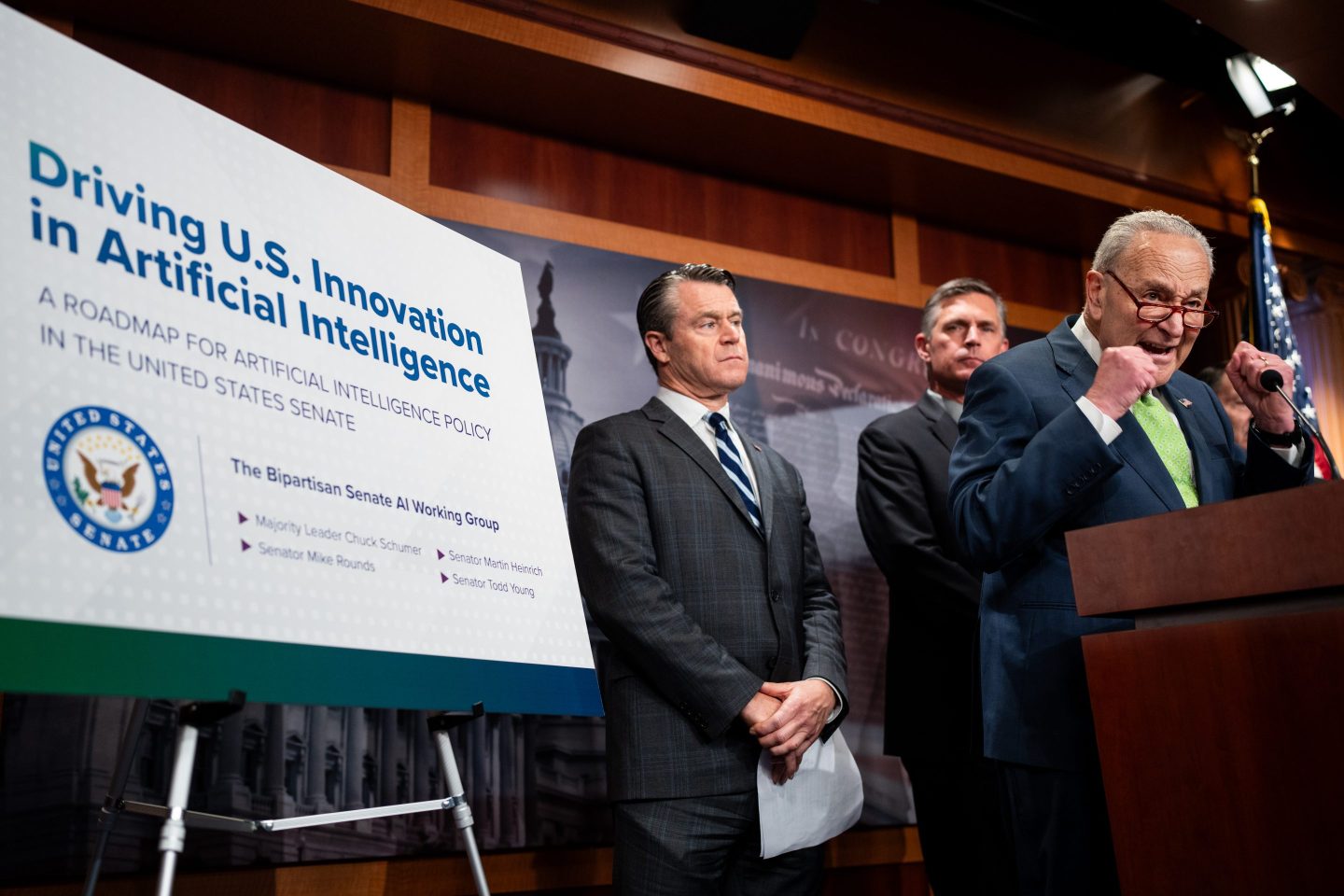
The most pressing need is to restore economic optimism. Our research tells us that when people see solutions, they’re more hopeful and willing to sacrifice for the greater good. When trust is earned, optimism grows. Artificial intelligence will build new industries just as it makes others obsolete. Brad Smith, president of Microsoft, talks about AI as “the electricity of our age” that will invigorate economies and competitiveness. He goes on to say that this will require “a partnership that unites leaders from government, the private sector, and the country’s educational and non-profit institutions.” We can’t afford for this epoch-defining technological development to be the sixth trust shock.
We have confidence that the trend toward grievance can be reversed over the next quarter century. Society needs balance. While business has proven to be exceptional in earning trust, the other institutions of government, NGOs, and media need to perform better. It’s a fundamentally simple exchange: If institutions can perform for people, they will trust them in return.
The opinions expressed in Fortune.com commentary pieces are solely the views of their authors and do not necessarily reflect the opinions and beliefs of Fortune.