• Home
  • Latest
  • Fortune 500
  • Finance
  • Tech
  • Leadership
  • Lifestyle
  • Rankings
  • Multimedia

Trendingnow

1

As Big Tech showers employees with perks to win the talent war, Nvidia built a nearly $5 trillion company by making people pay for their own lunch

2

MacKenzie Scott alone accounted for one-third of America's $19.2 billion in megagifts last year

3

Current price of oil as of July 1, 2026

1

As Big Tech showers employees with perks to win the talent war, Nvidia built a nearly $5 trillion company by making people pay for their own lunch

2

MacKenzie Scott alone accounted for one-third of America's $19.2 billion in megagifts last year

3

Current price of oil as of July 1, 2026
FinanceBanks

A former JPMorgan employee has accused the bank of obscuring the true size of its trading business to evade capital requirements

By
Greg McKenna
Greg McKenna
News Fellow
Down Arrow Button Icon
By
Greg McKenna
Greg McKenna
News Fellow
Down Arrow Button Icon
February 28, 2025, 5:21 AM ET
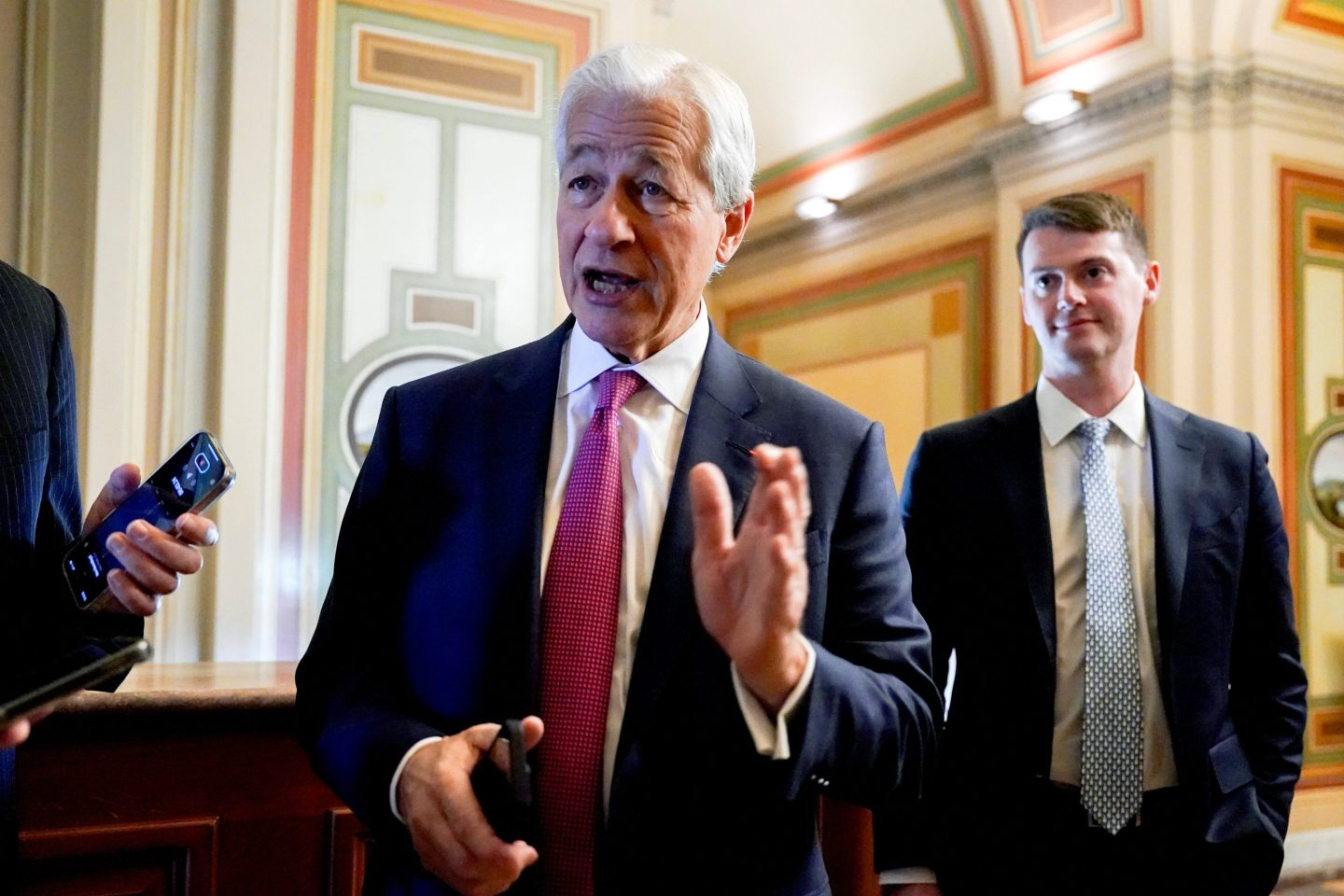
Jamie Dimon lifts his left hand up as he talks to reporters in the U.S. Capitol.
JPMorgan Chase CEO Jamie Dimon Al Drago—Bloomberg via Getty Images
Add Fortune on Google for similar content.
  • The world’s most important central banks helped develop common standards to regulate JPMorgan Chase and other financial institutions critical to the health of the global economy. However, if the Fed is allowing U.S. banks to flout some of those norms, experts told Fortune, other countries have little incentive not to let their big lenders do the same. 

It turns out JPMorgan might not want to boast about the size of its book. In fact, a whistleblower has alleged the world’s largest bank, along with several of its peers, has deliberately underreported the scale of its trading activity to minimize capital requirements the industry has long argued are onerous. JPMorgan, for its part, has called allegations it is evading capital requirements completely “false.”

Recommended Video

The requirements at issue are aimed at ensuring banks can survive if they sustain heavy losses, and they were tightened in the aftermath of the 2008 financial crisis. Regulators from around the world developed what is known as Basel III, or common standards to safeguard the health of so-called “globally systemic banks”—many of which required controversial government bailouts to avoid economic catastrophe. But if the Federal Reserve is allowing JPMorgan and other competitors to defy some of those norms, experts in corporate finance and administrative law told Fortune, other countries have little incentive not to let their banks follow suit.

“It kind of diminishes the meaning of the rules and the extent to which people are going to take them seriously going forward,” said Itay Goldstein, who chairs the finance department at the University of Pennsylvania’s Wharton School.

The Bureau of Investigative Journalism broke the allegations in January, citing a former JPMorgan employee who said the bank was improperly reporting its long and short positions in certain securities, obscuring the true size of its trading business. The publication also quoted another banker familiar with the matter, who said the Federal Reserve has given tacit approval for other U.S. banks to do the same.

JPMorgan, meanwhile, has been adamant that it is following the law and referred Fortune to its previous statements on the matter.

“We are confident in our methodology, which is fully transparent to our regulators,” the bank said. “We comply with all capital regulations, and claims suggesting otherwise are false.”

The Federal Reserve, meanwhile, declined to comment. The central bank previously told the Bureau that American lenders are subject to higher capital requirements than their international counterparts but did not directly address the allegations.

The Fed treats its supervisory relationship with banks as confidential, said David Zaring, a professor of legal studies and business ethics at Wharton, to avoid exposing lenders’ sensitive information to competitors and trading counterparties.

“Totally makes sense to me,” he added, “but it means that you often aren’t really sure what they’re looking at when they tell you, ‘We’re comfortable with this bank’s derivative book of business and how [the bank is] accounting for it.’”

What is netting, and why does it affect capital requirements?

Netting refers to the process of consolidating and offsetting multiple financial obligations to reduce overall risk. Rules around netting are relevant because the size of a bank’s balance sheet and the risk profile of the investments it contains helps regulators determine how much of a lender’s assets should be financed by equity that can sustain losses.

“Once the equity is wiped out, there’s nothing to absorb the loss,” Goldstein said. What’s left, he added, “is going to fall on the debt holders or the government.”

That’s why several banks are deemed “too big to fail,” a term that gained in popularity after the U.S. government spent $700 billion to save Wall Street banks and other financial institutions critical to the nation’s economy. All of America’s largest banks are subject to a minimum 4.5% capital requirement, with additional buffers mandated based on the Fed’s stress tests of bank balance sheets. Then, finally, there’s a capital surcharge for banks deemed to be “globally systemic,” termed G-SIBs.

JPMorgan sits alone atop the list, subject to an additional 50 basis point requirement compared to its closest peers, Citigroup and HSBC. The Bureau’s reporting suggested the G-SIB surcharge would be higher, however, if the Fed enforced international standards to which the central bank previously agreed.

As Goldstein explained, there is often a strong economic rationale to netting, or allowing long and short positions in the same security to offset each other. In a simplified example, if a long is equivalent to a short, they cancel each other out on the balance sheet.

“It is as if you don’t hold anything,” Goldstein said.

But there are several reasons why regulators might want to see the whole gross position, or the longs added to the shorts, Goldstein said. On one side of the trade, for instance, there might be a higher possibility that the other party could default on its obligations.

That’s why the Basel Committee on Banking Supervision instructs G-SIB’s not to net longs and shorts for securities that, “if sold quickly during periods of severe market stress, are more likely to incur larger fire-sale discounts or haircuts to compensate for high market risk.” Each country’s central bank, however, is ultimately responsible for enacting this standard.

Banks have been very successful at pushing back on the Fed’s efforts to fully implement Basel III. The Fed scrapped its initial proposal last year, which would have raised capital requirements by 19%, and vice chair of supervision Michael Barr later stepped down to let President Donald Trump make his own pick for the role.

“The idea of entering into an international agreement in the current administration, even an informal one, is pretty unpopular,” Zaring said.

In other words, cooperation among the Fed and foreign regulators may be undermined by several factors. Just add this issue about netting to the list.


About the Author
By Greg McKennaNews Fellow
LinkedIn icon

Greg McKenna is a news fellow at Fortune.

See full bioRight Arrow Button Icon
Add Fortune on Google for similar content.

Latest in Finance

Finance
Lorem ipsum dolor sit amet, consectetur adipiscing elit, sed do eiusmod tempor incididunt ut labore et dolore magna aliqua. Ut enim ad minim veniam
By Fortune Editors
October 20, 2025
Finance
Lorem ipsum dolor sit amet, consectetur adipiscing elit, sed do eiusmod tempor incididunt ut labore et dolore magna aliqua. Ut enim ad minim veniam
By Fortune Editors
October 20, 2025
Finance
Lorem ipsum dolor sit amet, consectetur adipiscing elit, sed do eiusmod tempor incididunt ut labore et dolore magna aliqua. Ut enim ad minim veniam
By Fortune Editors
October 20, 2025
Finance
Lorem ipsum dolor sit amet, consectetur adipiscing elit, sed do eiusmod tempor incididunt ut labore et dolore magna aliqua. Ut enim ad minim veniam
By Fortune Editors
October 20, 2025
Finance
Lorem ipsum dolor sit amet, consectetur adipiscing elit, sed do eiusmod tempor incididunt ut labore et dolore magna aliqua. Ut enim ad minim veniam
By Fortune Editors
October 20, 2025
Finance
Lorem ipsum dolor sit amet, consectetur adipiscing elit, sed do eiusmod tempor incididunt ut labore et dolore magna aliqua. Ut enim ad minim veniam
By Fortune Editors
October 20, 2025

Most Popular

Finance
Lorem ipsum dolor sit amet, consectetur adipiscing elit, sed do eiusmod tempor incididunt ut labore et dolore magna aliqua. Ut enim ad minim veniam
By Fortune Editors
October 20, 2025
Finance
Lorem ipsum dolor sit amet, consectetur adipiscing elit, sed do eiusmod tempor incididunt ut labore et dolore magna aliqua. Ut enim ad minim veniam
By Fortune Editors
October 20, 2025
Finance
Lorem ipsum dolor sit amet, consectetur adipiscing elit, sed do eiusmod tempor incididunt ut labore et dolore magna aliqua. Ut enim ad minim veniam
By Fortune Editors
October 20, 2025
Finance
Lorem ipsum dolor sit amet, consectetur adipiscing elit, sed do eiusmod tempor incididunt ut labore et dolore magna aliqua. Ut enim ad minim veniam
By Fortune Editors
October 20, 2025
Finance
Lorem ipsum dolor sit amet, consectetur adipiscing elit, sed do eiusmod tempor incididunt ut labore et dolore magna aliqua. Ut enim ad minim veniam
By Fortune Editors
October 20, 2025
Finance
Lorem ipsum dolor sit amet, consectetur adipiscing elit, sed do eiusmod tempor incididunt ut labore et dolore magna aliqua. Ut enim ad minim veniam
By Fortune Editors
October 20, 2025
Fortune Secondary Logo
Rankings
  • 100 Best Companies
  • Fortune 500
  • Global 500
  • Fortune 500 Europe
  • Most Powerful Women
  • World's Most Admired Companies
  • See All Rankings
  • Lists Calendar
Sections
  • Finance
  • Fortune Crypto
  • Features
  • Leadership
  • Health
  • Commentary
  • Success
  • Retail
  • Mpw
  • Tech
  • Lifestyle
  • CEO Initiative
  • Asia
  • Politics
  • Conferences
  • Europe
  • Newsletters
  • Personal Finance
  • Environment
  • Magazine
  • Education
Customer Support
  • Frequently Asked Questions
  • Customer Service Portal
  • Privacy Policy
  • Terms Of Use
  • Single Issues For Purchase
  • International Print
Commercial Services
  • Advertising
  • Fortune Brand Studio
  • Fortune Analytics
  • Fortune Conferences
  • Business Development
  • Group Subscriptions
About Us
  • About Us
  • Press Center
  • Work At Fortune
  • Terms And Conditions
  • Site Map
  • About Us
  • Press Center
  • Work At Fortune
  • Terms And Conditions
  • Site Map
  • Facebook icon
  • Twitter icon
  • LinkedIn icon
  • Instagram icon
  • Pinterest icon

Latest in Finance

rn
CommentaryCryptocurrency
Former Iran director at NSC: Crypto legislation is a ticket to sanctions evasion
By Richard NephewJuly 2, 2026
2 hours ago
Trump stopped talking about these media stocks, but his portfolio didn’t stop trading them
InvestingDonald Trump
Trump stopped talking about these media stocks, but his portfolio didn’t stop trading them
By Mia OsmonbekovJuly 2, 2026
2 hours ago
m
CommentaryManufacturing
McKinsey chairs: Building a more resilient industrial base may require $2 trillion in investment
By Eric Kutcher and Shubham SinghalJuly 2, 2026
2 hours ago
Current price of Bitcoin for July 2, 2026
Personal FinanceCryptocurrency
Current price of Bitcoin for July 2, 2026
By Joseph HostetlerJuly 2, 2026
2 hours ago
Current price of Ethereum for July 2, 2026
Personal FinanceEthereum
Current price of Ethereum for July 2, 2026
By Joseph HostetlerJuly 2, 2026
2 hours ago
Top CD rates from major banks July 2, 2026: Chase CDs, Bank of America CDs, Citibank CDs, and more
Personal FinanceCertificates of Deposit (CDs)
Top CD rates from major banks on July 2, 2026: Chase CDs, Bank of America CDs, Citibank CDs, and more
By Joseph HostetlerJuly 2, 2026
3 hours ago

Most Popular

As Big Tech showers employees with perks to win the talent war, Nvidia built a nearly $5 trillion company by making people pay for their own lunch
Big Tech
As Big Tech showers employees with perks to win the talent war, Nvidia built a nearly $5 trillion company by making people pay for their own lunch
By Marco Quiroz-GutierrezJuly 1, 2026
1 day ago
MacKenzie Scott alone accounted for one-third of America's $19.2 billion in megagifts last year
Success
MacKenzie Scott alone accounted for one-third of America's $19.2 billion in megagifts last year
By Sydney LakeJune 25, 2026
7 days ago
Current price of oil as of July 1, 2026
Personal Finance
Current price of oil as of July 1, 2026
By Joseph HostetlerJuly 1, 2026
1 day ago
Trump got a $78K pension from the Screen Actors Guild in 2025 because he appeared in Home Alone 2 in 1992
Politics
Trump got a $78K pension from the Screen Actors Guild in 2025 because he appeared in Home Alone 2 in 1992
By Sasha RogelbergJuly 1, 2026
24 hours ago
Philanthropy leader at Warren Buffett and Bill Gates’ Giving Pledge says children of billionaires are pushing them to give their wealth away faster
Success
Philanthropy leader at Warren Buffett and Bill Gates’ Giving Pledge says children of billionaires are pushing them to give their wealth away faster
By Preston ForeJune 27, 2026
5 days ago
CEO of $248 billion cybersecurity company says workers are about to face a ‘Darwinian moment’ thanks to AI: Evolve or get cut
Success
CEO of $248 billion cybersecurity company says workers are about to face a ‘Darwinian moment’ thanks to AI: Evolve or get cut
By Emma BurleighJuly 1, 2026
1 day ago

© 2026 Fortune Media IP Limited. All Rights Reserved. Use of this site constitutes acceptance of our Terms of Use and Privacy Policy | CA Notice at Collection and Privacy Notice | Do Not Sell/Share My Personal Information
FORTUNE is a trademark of Fortune Media IP Limited, registered in the U.S. and other countries. FORTUNE may receive compensation for some links to products and services on this website. Offers may be subject to change without notice.