• Home
  • Latest
  • Fortune 500
  • Finance
  • Tech
  • Leadership
  • Lifestyle
  • Rankings
  • Multimedia
FinanceTariffs

Tariffs 101: Here’s what they are, how they work—and who pays them

By
Paul Wiseman
Paul Wiseman
and
The Associated Press
Down Arrow Button Icon
By
Paul Wiseman
Paul Wiseman
and
The Associated Press
Down Arrow Button Icon
March 4, 2025, 6:21 AM ET
Trucks line up to enter a Port of Oakland shipping terminal on Nov. 10, 2021, in Oakland.
Trucks line up to enter a Port of Oakland shipping terminal on Nov. 10, 2021, in Oakland.Noah Berger—AP

Tariffs are in the news at the moment. Here’s what they are and what you need to know about them:

Recommended Video

Tariffs are a tax on imports

Tariffs are typically charged as a percentage of the price a buyer pays a foreign seller. In the United States, tariffs are collected by Customs and Border Protection agents at 328 ports of entry across the country.

U.S. tariff rates vary: They are generally 2.5% on passenger cars, for instance, and 6% on golf shoes. Tariffs can be lower for countries with which the United States has trade agreements. Before the U.S. began imposing 25% tariffs on good from Canada and Mexico as of Tuesday, most goods moved between the United States and those countries tariff-free because of President Donald Trump’s U.S.-Mexico-Canada trade agreement.

Mainstream economists are generally skeptical about tariffs, considering them an inefficient way for governments to raise revenue.

There’s much misinformation about who actually pays tariffs

Trump is a proponent of tariffs, insisting that they are paid for by foreign countries. In fact, it is importers — American companies — that pay tariffs, and the money goes to the U.S. Treasury. Those companies typically pass their higher costs on to their customers in the form of higher prices. That’s why economists say consumers usually end up footing the bill for tariffs.

Still, tariffs can hurt foreign countries by making their products pricier and harder to sell abroad. Foreign companies might have to cut prices — and sacrifice profits — to offset the tariffs and try to maintain their market share in the United States. Yang Zhou, an economist at Shanghai’s Fudan University, concluded in a study that Trump’s tariffs on Chinese goods inflicted more than three times as much damage to the Chinese economy as they did to the U.S. economy.

What has Trump said about tariffs?

Trump has said tariffs will create more factory jobs, shrink the federal deficit, lower food prices and allow the government to subsidize childcare.

“Tariffs are the greatest thing ever invented,’’ Trump said at a rally in Flint, Michigan, during his presidential campaign.

During his first term, Trump imposed tariffs with a flourish — targeting imported solar panels, steel, aluminum and pretty much everything from China.

“Tariff Man,” he called himself.

Trump is moving ahead with higher tariffs in his second term.

The United States in recent years has gradually retreated from its post-World War II role of promoting global free trade and lower tariffs. That’s generally a response to the loss of U.S. manufacturing jobs, widely attributed to unfettered tree trade and and China’s ascent as a manufacturing power.

Tariffs are intended mainly to protect domestic industries

By raising the price of imports, tariffs can protect home-grown manufacturers. They may also serve to punish foreign countries for unfair trade practices such as subsidizing their exporters or dumping products at unfairly low prices.

Before the federal income tax was established in 1913, tariffs were a major revenue source for the government. From 1790 to 1860, tariffs accounted for 90% of federal revenue, according to Douglas Irwin, a Dartmouth College economist who has studied the history of trade policy.

Tariffs fell out of favor as global trade grew after World War II. The government needed vastly bigger revenue streams to finance its operations.

In the fiscal year that ended Sept. 30, the government collected around $80 billion in tariffs and fees, a trifle next to the $2.5 trillion that comes from individual income taxes and the $1.7 trillion from Social Security and Medicare taxes.

Still, Trump favors a budget policy that resembles what was in place in the 19th century.

Tariffs can also be used to pressure other countries on issues that may or may not be related to trade. In 2019, for example, Trump used the threat of tariffs as leverage to persuade Mexico to crack down on waves of Central American migrants crossing Mexican territory on their way to the United States.

Trump even sees tariffs as a way to prevent wars.

“I can do it with a phone call,’’ he said at an August rally in North Carolina.

If another country tries to start a war, he said he’d issue a threat:

“We’re going to charge you 100% tariffs. And all of a sudden, the president or prime minister or dictator or whoever the hell is running the country says to me, ‘Sir, we won’t go to war.’ ”

Economists generally consider tariffs self-defeating

Tariffs raise costs for companies and consumers that rely on imports. They’re also likely to provoke retaliation.

The European Union, for example, punched back against Trump’s tariffs on steel and aluminum by taxing U.S. products, from bourbon to Harley-Davidson motorcycles. Likewise, China has responded to Trump’s trade war by slapping tariffs on American goods, including soybeans and pork in a calculated drive to hurt his supporters in farm country.

A study by economists at the Massachusetts Institute of Technology, the University of Zurich, Harvard and the World Bank concluded that Trump’s tariffs failed to restore jobs to the American heartland. The tariffs “neither raised nor lowered U.S. employment’’ where they were supposed to protect jobs, the study found.

Despite Trump’s 2018 taxes on imported steel, for example, the number of jobs at U.S. steel plants barely budged: They remained right around 140,000. By comparison, Walmart alone employs 1.6 million people in the United States.

Worse, the retaliatory taxes imposed by China and other nations on U.S. goods had “negative employment impacts,’’ especially for farmers, the study found. These retaliatory tariffs were only partly offset by billions in government aid that Trump doled out to farmers. The Trump tariffs also damaged companies that relied on targeted imports.

If Trump’s trade war fizzled as policy, though, it succeeded as politics. The study found that support for Trump and Republican congressional candidates rose in areas most exposed to the import tariffs — the industrial Midwest and manufacturing-heavy Southern states like North Carolina and Tennessee.


Join us at the Fortune Workplace Innovation Summit May 19–20, 2026, in Atlanta. The next era of workplace innovation is here—and the old playbook is being rewritten. At this exclusive, high-energy event, the world’s most innovative leaders will convene to explore how AI, humanity, and strategy converge to redefine, again, the future of work. Register now.
About the Authors
By Paul Wiseman
See full bioRight Arrow Button Icon
By The Associated Press
See full bioRight Arrow Button Icon

Latest in Finance

Finance
Lorem ipsum dolor sit amet, consectetur adipiscing elit, sed do eiusmod tempor incididunt ut labore et dolore magna aliqua. Ut enim ad minim veniam
By Fortune Editors
October 20, 2025
Finance
Lorem ipsum dolor sit amet, consectetur adipiscing elit, sed do eiusmod tempor incididunt ut labore et dolore magna aliqua. Ut enim ad minim veniam
By Fortune Editors
October 20, 2025
Finance
Lorem ipsum dolor sit amet, consectetur adipiscing elit, sed do eiusmod tempor incididunt ut labore et dolore magna aliqua. Ut enim ad minim veniam
By Fortune Editors
October 20, 2025
Finance
Lorem ipsum dolor sit amet, consectetur adipiscing elit, sed do eiusmod tempor incididunt ut labore et dolore magna aliqua. Ut enim ad minim veniam
By Fortune Editors
October 20, 2025
Finance
Lorem ipsum dolor sit amet, consectetur adipiscing elit, sed do eiusmod tempor incididunt ut labore et dolore magna aliqua. Ut enim ad minim veniam
By Fortune Editors
October 20, 2025
Finance
Lorem ipsum dolor sit amet, consectetur adipiscing elit, sed do eiusmod tempor incididunt ut labore et dolore magna aliqua. Ut enim ad minim veniam
By Fortune Editors
October 20, 2025

Most Popular

Finance
Lorem ipsum dolor sit amet, consectetur adipiscing elit, sed do eiusmod tempor incididunt ut labore et dolore magna aliqua. Ut enim ad minim veniam
By Fortune Editors
October 20, 2025
Finance
Lorem ipsum dolor sit amet, consectetur adipiscing elit, sed do eiusmod tempor incididunt ut labore et dolore magna aliqua. Ut enim ad minim veniam
By Fortune Editors
October 20, 2025
Finance
Lorem ipsum dolor sit amet, consectetur adipiscing elit, sed do eiusmod tempor incididunt ut labore et dolore magna aliqua. Ut enim ad minim veniam
By Fortune Editors
October 20, 2025
Finance
Lorem ipsum dolor sit amet, consectetur adipiscing elit, sed do eiusmod tempor incididunt ut labore et dolore magna aliqua. Ut enim ad minim veniam
By Fortune Editors
October 20, 2025
Finance
Lorem ipsum dolor sit amet, consectetur adipiscing elit, sed do eiusmod tempor incididunt ut labore et dolore magna aliqua. Ut enim ad minim veniam
By Fortune Editors
October 20, 2025
Finance
Lorem ipsum dolor sit amet, consectetur adipiscing elit, sed do eiusmod tempor incididunt ut labore et dolore magna aliqua. Ut enim ad minim veniam
By Fortune Editors
October 20, 2025
Fortune Secondary Logo
Rankings
  • 100 Best Companies
  • Fortune 500
  • Global 500
  • Fortune 500 Europe
  • Most Powerful Women
  • Future 50
  • World’s Most Admired Companies
  • See All Rankings
Sections
  • Finance
  • Fortune Crypto
  • Features
  • Leadership
  • Health
  • Commentary
  • Success
  • Retail
  • Mpw
  • Tech
  • Lifestyle
  • CEO Initiative
  • Asia
  • Politics
  • Conferences
  • Europe
  • Newsletters
  • Personal Finance
  • Environment
  • Magazine
  • Education
Customer Support
  • Frequently Asked Questions
  • Customer Service Portal
  • Privacy Policy
  • Terms Of Use
  • Single Issues For Purchase
  • International Print
Commercial Services
  • Advertising
  • Fortune Brand Studio
  • Fortune Analytics
  • Fortune Conferences
  • Business Development
  • Group Subscriptions
About Us
  • About Us
  • Editorial Calendar
  • Press Center
  • Work At Fortune
  • Diversity And Inclusion
  • Terms And Conditions
  • Site Map
  • About Us
  • Editorial Calendar
  • Press Center
  • Work At Fortune
  • Diversity And Inclusion
  • Terms And Conditions
  • Site Map
  • Facebook icon
  • Twitter icon
  • LinkedIn icon
  • Instagram icon
  • Pinterest icon

Latest in Finance

kroenke
CommentarySoccer
Why American billionaires are abandoning Wall Street for English soccer clubs
By Andrés MartinezApril 2, 2026
14 minutes ago
Workers on the production line of solar panels in China
EnergyRenewables
After renewable power’s record-smashing 2025, the Iran war could accelerate the shift as countries seek ‘structurally more resilient’ energy, UN says
By Tristan BoveApril 2, 2026
15 minutes ago
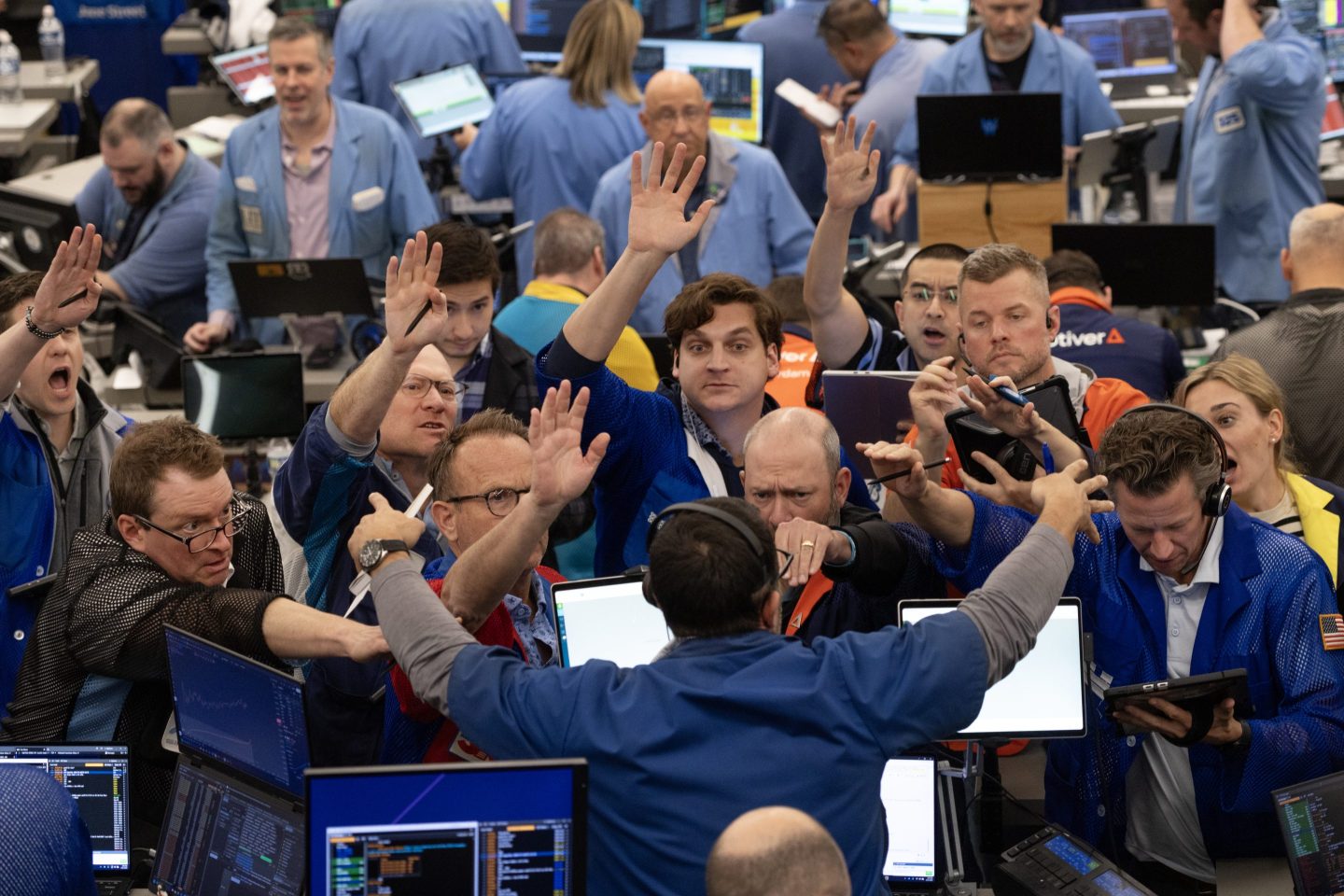
Traders signal offers in the S&P options trading pit at the Cboe Global Markets exchange on March 31, 2026 in Chicago, Illinois.
EnergyIran
Markets rally hard on Iran’s promise to play nice at Hormuz as its leaders pocket billions from the disruption
By Eva RoytburgApril 2, 2026
1 hour ago
Jack Dorsey and Roelof Botha think AI can make middle management obsolete 
AIBlock
Jack Dorsey and Roelof Botha think AI can make middle management obsolete 
By Jacqueline MunisApril 2, 2026
1 hour ago
A woman looks concerned as she fills up at a gas station
Economygas prices
The Iran war is effectively a ‘tax’ on US households that could accelerate the economy’s widening K shape, Moody’s says
By Tristan BoveApril 2, 2026
1 hour ago
jobless
Economyunemployment
Jobless claims fall 9,000 as overall layoffs remain low across the economy
By Matt Ott and The Associated PressApril 2, 2026
2 hours ago

Most Popular

Gen Z fled San Francisco for Texas and Florida. Now they’re turning ‘welcomer cities’ into the next big tech towns
Real Estate
Gen Z fled San Francisco for Texas and Florida. Now they’re turning ‘welcomer cities’ into the next big tech towns
By Fortune EditorsApril 2, 2026
11 hours ago
Current price of gold as of April 1, 2026
Personal Finance
Current price of gold as of April 1, 2026
By Fortune EditorsApril 1, 2026
1 day ago
Two-thirds of parents say their adult Gen Z kids still rely on them financially  for support—even though it's putting them under strain
Success
Two-thirds of parents say their adult Gen Z kids still rely on them financially  for support—even though it's putting them under strain
By Fortune EditorsMarch 31, 2026
2 days ago
Current price of oil as of April 1, 2026
Personal Finance
Current price of oil as of April 1, 2026
By Fortune EditorsApril 1, 2026
1 day ago
Jerome Powell says the $39 trillion national debt is ‘not unsustainable,’ but warns the trajectory ‘will not end well’
Economy
Jerome Powell says the $39 trillion national debt is ‘not unsustainable,’ but warns the trajectory ‘will not end well’
By Fortune EditorsMarch 30, 2026
3 days ago
Deutsche Bank asked AI if it’s true that AI will solve the economy’s inflation problems. The robots answered
Economy
Deutsche Bank asked AI if it’s true that AI will solve the economy’s inflation problems. The robots answered
By Fortune EditorsApril 1, 2026
23 hours ago

© 2026 Fortune Media IP Limited. All Rights Reserved. Use of this site constitutes acceptance of our Terms of Use and Privacy Policy | CA Notice at Collection and Privacy Notice | Do Not Sell/Share My Personal Information
FORTUNE is a trademark of Fortune Media IP Limited, registered in the U.S. and other countries. FORTUNE may receive compensation for some links to products and services on this website. Offers may be subject to change without notice.