• Home
  • Latest
  • Fortune 500
  • Finance
  • Tech
  • Leadership
  • Lifestyle
  • Rankings
  • Multimedia
Commentary

Trump’s tariffs program is based on flawed assumptions about the trade deficit

By
Steve H. Hanke
Steve H. Hanke
and
Matt Sekerke
Matt Sekerke
Down Arrow Button Icon
By
Steve H. Hanke
Steve H. Hanke
and
Matt Sekerke
Matt Sekerke
Down Arrow Button Icon
March 19, 2025, 11:32 AM ET

Steve H. Hanke is a Professor of Applied Economics at The Johns Hopkins University. Matt Sekerke is a Managing Director at SEDA Experts and Senior Macro Advisor at Hiddenite Capital Partners. They are the co-authors of Making Money Work (forthcoming, Wiley, 2025).

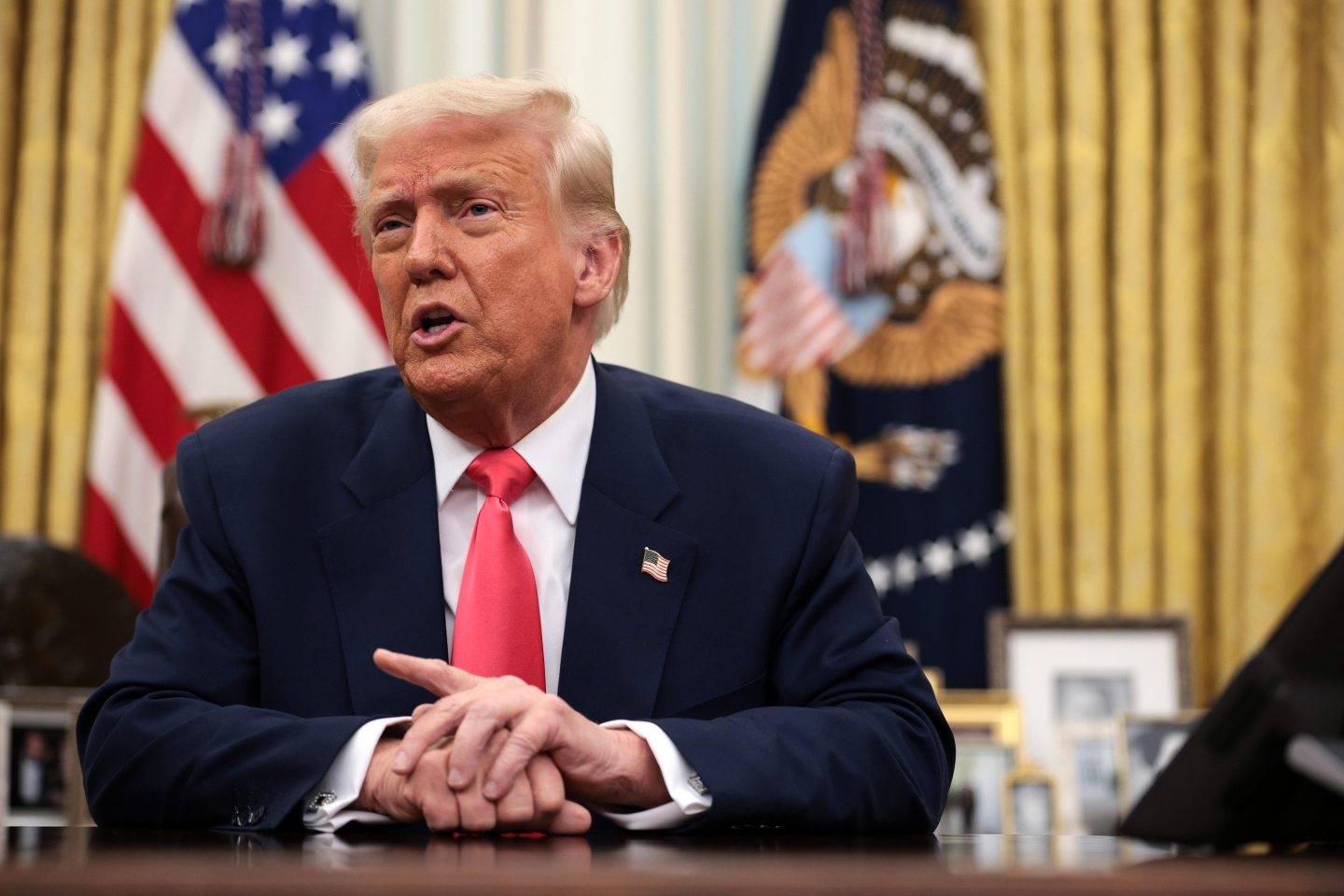
U.S. President Donald Trump.
U.S. President Donald Trump.Alex Wong/Getty Images

President Trump is tariff-happy. The impetus for his trade war is the U.S. trade deficit, a deficit that he believes is the result of foreigners taking advantage of the United States through “unfair” trade practices.

Trump, like most businessmen, thinks deficits are bad. When a business runs consistent budget deficits, it must either raise more capital to finance those deficits or enter into bankruptcy. But what is true for running a business is not necessarily true for running a country. Indeed, Trump’s line of thinking represents a classic fallacy of composition—the belief that what is true of a part (a business) is true for the whole (the economy). 

Trump is wrong on two counts. The U.S. trade deficit is not caused by foreigners—it is homegrown, made in the good old U.S.A. It also is not inherently bad; in fact, for Americans, it is a privilege. Both of these errors stem from Trump’s unawareness of the close connections between saving, investment, and a country’s trade balance.

A country’s trade balance is always accompanied by a corresponding gap between its domestic saving and domestic investment. If a country’s domestic saving is greater than its domestic investment, like China, Switzerland, and Germany, it will register a trade surplus. Likewise, if a country saves less than it invests, like the United States, it will register a trade deficit. The United States’ negative trade balance, which the country has registered every year since 1975, is “made in the U.S.A.,” a result of investment running ahead of its domestic savings. To view the trade balance correctly, the focus should be on investment conditions in the domestic economy, not nefarious foreign actors.

What follows from the savings-investment identity is that a country can only run a trade deficit to the extent that it is able to finance surplus investment with the rest of the world’s savings. For many countries, persistent trade deficits are worrisome because inflows of external savings are fickle. Higher interest rates are needed to retain external finance, which can slow growth and lead to currency depreciation. If the ability of a country to finance its deficits is called into question, a sudden stop of capital inflows may even precipitate a currency crisis. The opposite has been the case for the United States over nearly five decades. Foreigners are not just happy to finance our trade deficits. They are so eager to accumulate claims on the United States that external financial inflows lower U.S. interest rates and strengthen the U.S. dollar. Thanks to the ability of the American government and the U.S. financial system to attract and retain external finance, Americans are able to consume more than they produce. What’s more, the U.S. enjoys robust investment and economic growth despite its low domestic saving rates.

Why do foreign investors afford Americans this privilege? The simple answer is that, for many reasons, the United States is the best place in the world to invest. The U.S. dollar is the world’s reserve currency—investors have confidence in it. The U.S. also has strong property rights, robust legal and banking institutions, a lot of talented human capital, and the largest and most liquid capital markets in the world.

The premise underlying Trump’s tariff program is simply untrue. In fact, reality turns Trump’s premise on its head. For Americans, deficits are good, not bad. Furthermore, deficits are not caused by foreigners eating our lunch. The United States itself has created its trade deficits by making itself the leading destination for the world’s savings. That’s why Nobelist Milton Friedman concluded that: “One of the things that baffles me is the extent to which people regard the trade deficit as a bad thing.” It baffles us, too.

The opinions expressed in Fortune.com commentary pieces are solely the views of their authors and do not necessarily reflect the opinions and beliefs of Fortune.

Read more:

  • Trump’s tariffs and policies are putting America’s economy at risk: Consumer Technology Association CEO
  • Tariffs won’t make America great again: Export-Import Bank’s former chairman and president
  • Are Trump’s trade and tariffs tantrums repairing market failures or eroding global trust?
  • The best psych-out artists know how to mess with your mind, but Trump’s push for tariffs shows how this strategy can backfire

Join us at the Fortune Workplace Innovation Summit May 19–20, 2026, in Atlanta. The next era of workplace innovation is here—and the old playbook is being rewritten. At this exclusive, high-energy event, the world’s most innovative leaders will convene to explore how AI, humanity, and strategy converge to redefine, again, the future of work. Register now.
About the Authors
Steve H. Hanke
By Steve H. Hanke
Twitter icon
See full bioRight Arrow Button Icon
By Matt Sekerke
See full bioRight Arrow Button Icon

Latest in Commentary

Finance
Lorem ipsum dolor sit amet, consectetur adipiscing elit, sed do eiusmod tempor incididunt ut labore et dolore magna aliqua. Ut enim ad minim veniam
By Fortune Editors
October 20, 2025
Finance
Lorem ipsum dolor sit amet, consectetur adipiscing elit, sed do eiusmod tempor incididunt ut labore et dolore magna aliqua. Ut enim ad minim veniam
By Fortune Editors
October 20, 2025
Finance
Lorem ipsum dolor sit amet, consectetur adipiscing elit, sed do eiusmod tempor incididunt ut labore et dolore magna aliqua. Ut enim ad minim veniam
By Fortune Editors
October 20, 2025
Finance
Lorem ipsum dolor sit amet, consectetur adipiscing elit, sed do eiusmod tempor incididunt ut labore et dolore magna aliqua. Ut enim ad minim veniam
By Fortune Editors
October 20, 2025
Finance
Lorem ipsum dolor sit amet, consectetur adipiscing elit, sed do eiusmod tempor incididunt ut labore et dolore magna aliqua. Ut enim ad minim veniam
By Fortune Editors
October 20, 2025
Finance
Lorem ipsum dolor sit amet, consectetur adipiscing elit, sed do eiusmod tempor incididunt ut labore et dolore magna aliqua. Ut enim ad minim veniam
By Fortune Editors
October 20, 2025

Most Popular

Finance
Lorem ipsum dolor sit amet, consectetur adipiscing elit, sed do eiusmod tempor incididunt ut labore et dolore magna aliqua. Ut enim ad minim veniam
By Fortune Editors
October 20, 2025
Finance
Lorem ipsum dolor sit amet, consectetur adipiscing elit, sed do eiusmod tempor incididunt ut labore et dolore magna aliqua. Ut enim ad minim veniam
By Fortune Editors
October 20, 2025
Finance
Lorem ipsum dolor sit amet, consectetur adipiscing elit, sed do eiusmod tempor incididunt ut labore et dolore magna aliqua. Ut enim ad minim veniam
By Fortune Editors
October 20, 2025
Finance
Lorem ipsum dolor sit amet, consectetur adipiscing elit, sed do eiusmod tempor incididunt ut labore et dolore magna aliqua. Ut enim ad minim veniam
By Fortune Editors
October 20, 2025
Finance
Lorem ipsum dolor sit amet, consectetur adipiscing elit, sed do eiusmod tempor incididunt ut labore et dolore magna aliqua. Ut enim ad minim veniam
By Fortune Editors
October 20, 2025
Finance
Lorem ipsum dolor sit amet, consectetur adipiscing elit, sed do eiusmod tempor incididunt ut labore et dolore magna aliqua. Ut enim ad minim veniam
By Fortune Editors
October 20, 2025
Fortune Secondary Logo
Rankings
  • 100 Best Companies
  • Fortune 500
  • Global 500
  • Fortune 500 Europe
  • Most Powerful Women
  • Future 50
  • World’s Most Admired Companies
  • See All Rankings
Sections
  • Finance
  • Fortune Crypto
  • Features
  • Leadership
  • Health
  • Commentary
  • Success
  • Retail
  • Mpw
  • Tech
  • Lifestyle
  • CEO Initiative
  • Asia
  • Politics
  • Conferences
  • Europe
  • Newsletters
  • Personal Finance
  • Environment
  • Magazine
  • Education
Customer Support
  • Frequently Asked Questions
  • Customer Service Portal
  • Privacy Policy
  • Terms Of Use
  • Single Issues For Purchase
  • International Print
Commercial Services
  • Advertising
  • Fortune Brand Studio
  • Fortune Analytics
  • Fortune Conferences
  • Business Development
  • Group Subscriptions
About Us
  • About Us
  • Editorial Calendar
  • Press Center
  • Work At Fortune
  • Diversity And Inclusion
  • Terms And Conditions
  • Site Map
  • About Us
  • Editorial Calendar
  • Press Center
  • Work At Fortune
  • Diversity And Inclusion
  • Terms And Conditions
  • Site Map
  • Facebook icon
  • Twitter icon
  • LinkedIn icon
  • Instagram icon
  • Pinterest icon

Latest in Commentary

kroenke
CommentarySoccer
Why American billionaires are abandoning Wall Street for English soccer clubs
By Andrés MartinezApril 2, 2026
7 minutes ago
wyle
CommentaryTV
What HBO’s ‘The Pitt’ gets right—and wrong—about treating alcohol use disorder
By Jonathan Hunt-GlassmanApril 2, 2026
5 hours ago
nic
CommentaryInsider trading
Prediction markets caught insider traders in real time. Congress wants to shut them down anyway
By Nic PuckrinApril 2, 2026
6 hours ago
elon
CommentarySpaceX
The SpaceX IPO is great — but it won’t deliver 100x returns 
By Jeffrey StewartApril 1, 2026
19 hours ago
gary
Commentaryregulation
The biggest mistake CEOs make with AI has nothing to do with the technology
By Gary ShapiroApril 1, 2026
1 day ago
trump
CommentaryEPA
The EPA just valued a human life at $0. That’s not just a moral crisis — it’s a market crisis
By Andrew BeharApril 1, 2026
1 day ago

Most Popular

Gen Z fled San Francisco for Texas and Florida. Now they’re turning ‘welcomer cities’ into the next big tech towns
Real Estate
Gen Z fled San Francisco for Texas and Florida. Now they’re turning ‘welcomer cities’ into the next big tech towns
By Fortune EditorsApril 2, 2026
11 hours ago
Current price of gold as of April 1, 2026
Personal Finance
Current price of gold as of April 1, 2026
By Fortune EditorsApril 1, 2026
1 day ago
Two-thirds of parents say their adult Gen Z kids still rely on them financially  for support—even though it's putting them under strain
Success
Two-thirds of parents say their adult Gen Z kids still rely on them financially  for support—even though it's putting them under strain
By Fortune EditorsMarch 31, 2026
2 days ago
Current price of oil as of April 1, 2026
Personal Finance
Current price of oil as of April 1, 2026
By Fortune EditorsApril 1, 2026
1 day ago
Jerome Powell says the $39 trillion national debt is ‘not unsustainable,’ but warns the trajectory ‘will not end well’
Economy
Jerome Powell says the $39 trillion national debt is ‘not unsustainable,’ but warns the trajectory ‘will not end well’
By Fortune EditorsMarch 30, 2026
3 days ago
Deutsche Bank asked AI if it’s true that AI will solve the economy’s inflation problems. The robots answered
Economy
Deutsche Bank asked AI if it’s true that AI will solve the economy’s inflation problems. The robots answered
By Fortune EditorsApril 1, 2026
22 hours ago

© 2026 Fortune Media IP Limited. All Rights Reserved. Use of this site constitutes acceptance of our Terms of Use and Privacy Policy | CA Notice at Collection and Privacy Notice | Do Not Sell/Share My Personal Information
FORTUNE is a trademark of Fortune Media IP Limited, registered in the U.S. and other countries. FORTUNE may receive compensation for some links to products and services on this website. Offers may be subject to change without notice.