
• Home
  • Latest
  • Fortune 500
  • Finance
  • Tech
  • Leadership
  • Lifestyle
  • Rankings
  • Multimedia

Trendingnow

1

MacKenzie Scott alone accounted for one-third of America's $19.2 billion in megagifts last year

2

As Big Tech showers employees with perks to win the talent war, Nvidia built a nearly $5 trillion company by making people pay for their own lunch

3

Philanthropy leader at Warren Buffett and Bill Gates’ Giving Pledge says children of billionaires are pushing them to give their wealth away faster

1

MacKenzie Scott alone accounted for one-third of America's $19.2 billion in megagifts last year

2

As Big Tech showers employees with perks to win the talent war, Nvidia built a nearly $5 trillion company by making people pay for their own lunch

3

Philanthropy leader at Warren Buffett and Bill Gates’ Giving Pledge says children of billionaires are pushing them to give their wealth away faster
SuccessWealth

‘Something weird’s going on’ in the economy as 6 new economic classes take shape, says New York Times bestselling author

Nick Lichtenberg
By
Nick Lichtenberg
Nick Lichtenberg
Business Editor
Down Arrow Button Icon
Nick Lichtenberg
By
Nick Lichtenberg
Nick Lichtenberg
Business Editor
Down Arrow Button Icon
August 9, 2025, 8:00 AM ET
A young man in a suit sits on a bench next to a man who appears less affluent
Where are you on the ladder?Getty Images
Add Fortune on Google for similar content.

Nick Maggiulli is juggling more than spreadsheets these days. He’s chief operating officer at Ritholtz Wealth Management, but he’s also a blogger, and now a two-time author thanks to his latest book, The Wealth Ladder, which quickly shot to New York Times bestseller status. Through his many efforts, Maggiulli has found himself at the forefront of a conversation increasingly relevant to Americans: what it means to have wealth, and how that meaning is rapidly evolving. “Something weird’s going on,” he told Fortune in an interview.

Recommended Video

Maggiulli’s insights are rooted in data and everyday observation, but he believes the upper middle class is going through an “existential crisis,” as he noted on his blog Of Dollars and Data. He talked to Fortune about what he thinks is going on: “The economy wasn’t built to handle this many people with this much money,” he said, hinting at his research on what he calls the new economic classes of the United States.

In The Wealth Ladder, Maggiulli proposes a new, data-backed framework for thinking about affluence. It’s a much bigger topic than just level 4. He divides American households into six wealth levels, ranging from under $10,000 (level 1) to $10-million-plus (level 5 and beyond). The most populous segment is level 3—those with $100,000 to $1 million in wealth—but he says that level 4, the “upper middle class,” is notable for its rapid growth and unique challenges.

Nick Maggiulli's six economic classes in the U.S., based on household net worth.

Maggiulli’s analysis shows the angsty, existential level 4 was just 7% of the country in 1989, but as of 2022–23, that had shot all the way up to 18%. Admittedly, inflation means that a millionaire in the late ’90s would have a net worth of around $2 million, also as of 2022–23. But still, he says, this economic class is much bigger than it used to be, especially since the pandemic, and he thinks it’s “starting to have all these impacts throughout the rest of the economy.”

The existential crisis of the upper middle class in the 21st century

This demographic expansion, Maggiulli says, has sparked unexpected economic side effects, from crowded airport lounges to bidding wars for housing and luxury amenities. “The economy wasn’t built to handle this many people with this much money,” he observes, linking “scarce resource” frustrations to the surging population of affluent Americans. “They’re all competing for a small pool of resources,” he says.

The weirdest thing, Maggiulli says, is that these people are objectively very successful. “They’ve done well in life…but on a relative basis in the United States, the competition for these higher-end goods is very high, so now it feels like we’re all canceling each other out with all this extra wealth.” Wealthy level 4 Americans could always move somewhere else, where their money would go much further, but they are mostly staying in the U.S., where they don’t feel like the millionaires that they’ve become.

It really is different from the late ’90s to now, Maggiulli says, adding that in terms of purchasing power, an American with a net worth of $1 million back then would rank in the top 5% of wealth, whereas that status in the 2020s belongs to someone worth $4 million. “There’s so much wealth being created that the upper end is seeing this competition like never before,” he adds.

UBS Global Wealth Management noticed a similar trend in its 2025 edition of the Global Wealth report, seeing a dramatic rise in the “everyday millionaire,” or EMILLI. At the dawn of the millennium, there were just over 13 million EMILLIs worldwide, UBS found, but that number had shot up to nearly 52 million—a more than fourfold increase in less than 25 years. Even after adjusting for inflation, the number of EMILLIs has more than doubled in real terms since 2000. “There’s a good portion of [these level 4, everyday millionaires] that feel like they don’t have enough,” Maggiulli told Fortune, “and they feel like they’re just getting by, even though statistically they’re in the top 20% of U.S. households.”

Maggiulli’s remarks recall those of Charlie Munger, Warren Buffett’s longtime right-hand man at Berkshire Hathaway, who died in 2024. The previous year, in his last appearance at the annual meeting for his newspaper holding company, Daily Journal, Munger sounded a similar tune about things being ever better but people feeling ever worse. “People are less happy about the state of affairs than they were when things were way tougher,” Munger said, then made a striking comparison. “It’s weird for somebody my age, because I was in the middle of the Great Depression when the hardship was unbelievable.” Munger said he was powerless to change how unhappy people felt “after everything’s improved by about 600% because there’s still somebody else who has more.”

The importance of assets

Maggiulli’s analysis extends to the composition of wealth across classes: “The poor own cars, the middle class own homes, and the rich own businesses.” He stresses the “rich” in America tend to hold assets like businesses and stocks, not just real estate or commodities. To truly shift up levels, the kind of assets you own really matters.
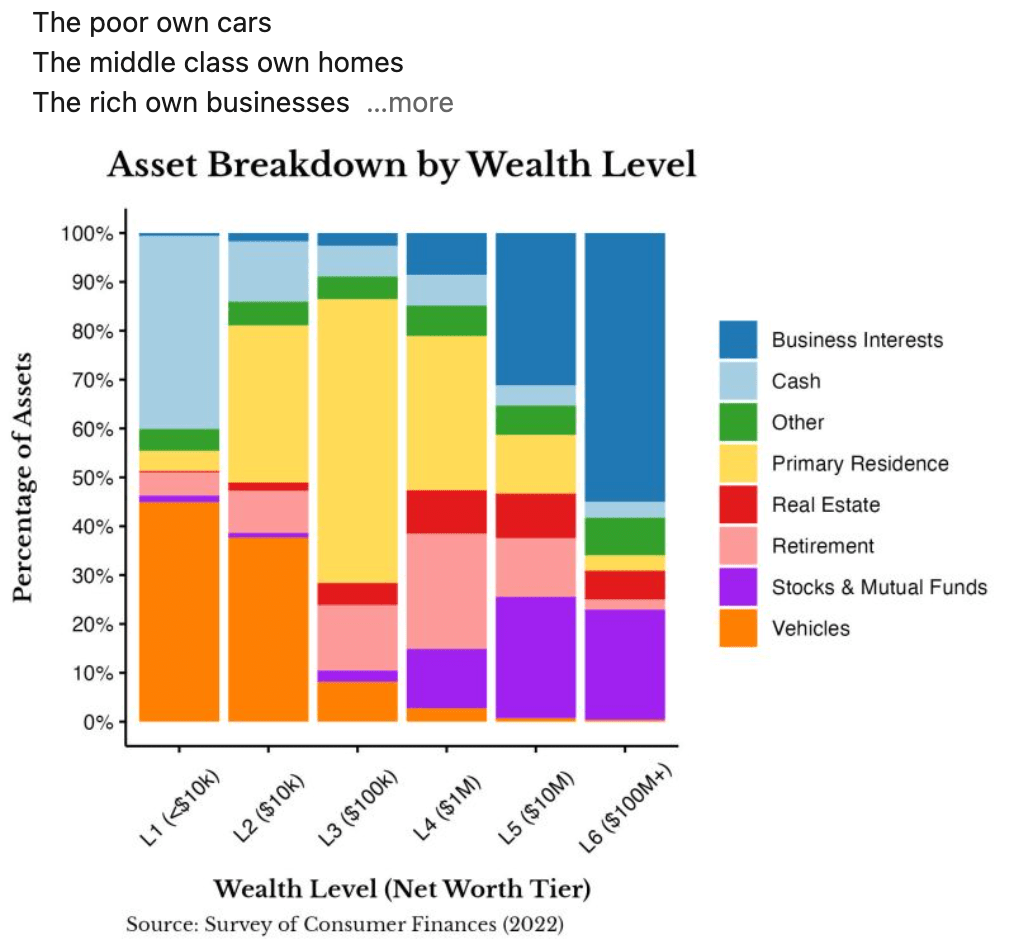
Nick Maggiulli's asset breakdown by wealth level.
What the different classes in America own.
Nick Maggiulli

Maggiulli told Fortune about the long-anticipated Great Wealth Transfer, when baby boomers pass on their $124 trillion fortunes to the Gen Xers and millennials now in or entering midlife. As baby boomers age, their assets are expected to flow into Gen X and eventually millennials, a process he frames as “very normal.” But he cautions that much of this wealth is tied up in illiquid assets like real estate, potentially distorting Americans’ perception of their own affluence.

He’s also candid about what he calls the “broken housing market.” Even affluent adults are forced into renting more often than not: In fact, Maggiulli’s research shows there have never been so many millionaire renters before. Maggiulli says if it seems like economic conditions have driven many Americans to postpone homeownership, he would know, because he’s one of them. “What that means for me personally is that I’m just gonna be renting for a lot longer,” Maggiulli tells Fortune, “because it doesn’t make sense to buy, especially where rates are, prices, everything.” The housing market as currently constructed just “doesn’t add up” for his situation.

For Maggiulli, the key takeaway is adaptability. He analogizes personal finance to fitness: “You can imagine a fitness instructor giving different advice to someone who’s morbidly obese versus someone who’s a well-trained athlete.” Likewise, financial strategies must shift as individuals progress up the “wealth ladder.” This particular ladder isn’t one that you’re meant to keep climbing forever, but a very large ladder with a lot of plateaus on it, some where you stay forever. He says you need to step back and reassess: “Do I need to keep climbing? Is this right for me?”

Alex Bryson, professor of quantitative social science at University College London, told Fortune something similar in an interview about his research into 21st-century labor markets, social mobility, and young workers. “People at that time in their lives, when they’re looking to build careers and move on and acquire property and, you know, all the ladder-type things…it feels as if, perhaps, for some of them, somebody’s removed some of the rungs on that ladder.” Bryson added that “we haven’t necessarily got the same career structures and patterns” in the current economy as in the past.

Maggiulli says he’s not advocating through his book for people to choose one particular path or another, but to be aware of their wealth and their trajectory. “I think a lot of people get there, and they say, ‘Wait, do I want to keep going down this path? Or maybe I can take my foot off the gas and choose a different path where money is not the only thing I’m focusing on.’”

Does this align with your experience? Fortune would love to hear from you: Get in touch at nick.lichtenberg@consultant.fortune.com. 

For this story, Fortune used generative AI to help with an initial draft. An editor verified the accuracy of the information before publishing. 

The Fortune 500 Innovation Forum will convene Fortune 500 executives, U.S. policy officials, top founders, and thought leaders to help define what’s next for the American economy, Nov. 16-17 in Detroit. Apply here.
About the Author
Nick Lichtenberg
By Nick LichtenbergBusiness Editor
LinkedIn icon

Nick Lichtenberg is business editor and was formerly Fortune's executive editor of global news.

See full bioRight Arrow Button Icon
Add Fortune on Google for similar content.

Latest in Success

Finance
Lorem ipsum dolor sit amet, consectetur adipiscing elit, sed do eiusmod tempor incididunt ut labore et dolore magna aliqua. Ut enim ad minim veniam
By Fortune Editors
October 20, 2025
Finance
Lorem ipsum dolor sit amet, consectetur adipiscing elit, sed do eiusmod tempor incididunt ut labore et dolore magna aliqua. Ut enim ad minim veniam
By Fortune Editors
October 20, 2025
Finance
Lorem ipsum dolor sit amet, consectetur adipiscing elit, sed do eiusmod tempor incididunt ut labore et dolore magna aliqua. Ut enim ad minim veniam
By Fortune Editors
October 20, 2025
Finance
Lorem ipsum dolor sit amet, consectetur adipiscing elit, sed do eiusmod tempor incididunt ut labore et dolore magna aliqua. Ut enim ad minim veniam
By Fortune Editors
October 20, 2025
Finance
Lorem ipsum dolor sit amet, consectetur adipiscing elit, sed do eiusmod tempor incididunt ut labore et dolore magna aliqua. Ut enim ad minim veniam
By Fortune Editors
October 20, 2025
Finance
Lorem ipsum dolor sit amet, consectetur adipiscing elit, sed do eiusmod tempor incididunt ut labore et dolore magna aliqua. Ut enim ad minim veniam
By Fortune Editors
October 20, 2025

Most Popular

Finance
Lorem ipsum dolor sit amet, consectetur adipiscing elit, sed do eiusmod tempor incididunt ut labore et dolore magna aliqua. Ut enim ad minim veniam
By Fortune Editors
October 20, 2025
Finance
Lorem ipsum dolor sit amet, consectetur adipiscing elit, sed do eiusmod tempor incididunt ut labore et dolore magna aliqua. Ut enim ad minim veniam
By Fortune Editors
October 20, 2025
Finance
Lorem ipsum dolor sit amet, consectetur adipiscing elit, sed do eiusmod tempor incididunt ut labore et dolore magna aliqua. Ut enim ad minim veniam
By Fortune Editors
October 20, 2025
Finance
Lorem ipsum dolor sit amet, consectetur adipiscing elit, sed do eiusmod tempor incididunt ut labore et dolore magna aliqua. Ut enim ad minim veniam
By Fortune Editors
October 20, 2025
Finance
Lorem ipsum dolor sit amet, consectetur adipiscing elit, sed do eiusmod tempor incididunt ut labore et dolore magna aliqua. Ut enim ad minim veniam
By Fortune Editors
October 20, 2025
Finance
Lorem ipsum dolor sit amet, consectetur adipiscing elit, sed do eiusmod tempor incididunt ut labore et dolore magna aliqua. Ut enim ad minim veniam
By Fortune Editors
October 20, 2025
Fortune Secondary Logo
Rankings
  • 100 Best Companies
  • Fortune 500
  • Global 500
  • Fortune 500 Europe
  • Most Powerful Women
  • World's Most Admired Companies
  • See All Rankings
  • Lists Calendar
Sections
  • Finance
  • Fortune Crypto
  • Features
  • Leadership
  • Health
  • Commentary
  • Success
  • Retail
  • Mpw
  • Tech
  • Lifestyle
  • CEO Initiative
  • Asia
  • Politics
  • Conferences
  • Europe
  • Newsletters
  • Personal Finance
  • Environment
  • Magazine
  • Education
Customer Support
  • Frequently Asked Questions
  • Customer Service Portal
  • Privacy Policy
  • Terms Of Use
  • Single Issues For Purchase
  • International Print
Commercial Services
  • Advertising
  • Fortune Brand Studio
  • Fortune Analytics
  • Fortune Conferences
  • Business Development
  • Group Subscriptions
About Us
  • About Us
  • Press Center
  • Work At Fortune
  • Terms And Conditions
  • Site Map
  • About Us
  • Press Center
  • Work At Fortune
  • Terms And Conditions
  • Site Map
  • Facebook icon
  • Twitter icon
  • LinkedIn icon
  • Instagram icon
  • Pinterest icon

Latest in Success

U.S. Polo Assn. CEO J. Michael Prince
SuccessThe Promotion Playbook
U.S. Polo Assn. CEO was told he wasn’t right for a promotion—so he ‘outworked’ anyone else who wanted the job for 6 months straight
By Orianna Rosa RoyleJuly 1, 2026
5 hours ago
Nikesh Arora, chief executive officer at Palo Alto Networks
SuccessJobs
CEO of $248 billion cybersecurity company says workers are about to face a ‘Darwinian moment’ thanks to AI: Evolve or get cut
By Emma BurleighJuly 1, 2026
6 hours ago
I know how Gen Z can survive the ‘jobpocalypse’ because I built an AI company — in 2015
CommentaryCareers
I know how Gen Z can survive the ‘jobpocalypse’ because I built an AI company — in 2015
By Jeremy FainJuly 1, 2026
10 hours ago
mr
Commentary250 Years of Innovation
America needs 3.8 million manufacturing workers. This CEO has a blueprint to find them
By Mark RayfieldJuly 1, 2026
10 hours ago
Photo: Rocks balancing on driftwood, sea in background.
AIMarkets
Leveraged stock bets are ‘very concentrated in the AI ecosystem,’ Goldman Sachs warns
By Jim EdwardsJuly 1, 2026
11 hours ago
Nike’s earning numbers exceeded Wall Street’s expectations. But CEO Elliott Hill’s next test is the World Cup
RetailNike
Nike’s earning numbers exceeded Wall Street’s expectations. But CEO Elliott Hill’s next test is the World Cup
By Mia OsmonbekovJune 30, 2026
24 hours ago

Most Popular

MacKenzie Scott alone accounted for one-third of America's $19.2 billion in megagifts last year
Success
MacKenzie Scott alone accounted for one-third of America's $19.2 billion in megagifts last year
By Sydney LakeJune 25, 2026
7 days ago
As Big Tech showers employees with perks to win the talent war, Nvidia built a nearly $5 trillion company by making people pay for their own lunch
Big Tech
As Big Tech showers employees with perks to win the talent war, Nvidia built a nearly $5 trillion company by making people pay for their own lunch
By Marco Quiroz-GutierrezJuly 1, 2026
14 hours ago
Philanthropy leader at Warren Buffett and Bill Gates’ Giving Pledge says children of billionaires are pushing them to give their wealth away faster
Success
Philanthropy leader at Warren Buffett and Bill Gates’ Giving Pledge says children of billionaires are pushing them to give their wealth away faster
By Preston ForeJune 27, 2026
4 days ago
Elon Musk on MacKenzie Scott giving away $26 billion of her fortune: 'Sadly,' it makes the world a worse place
Success
Elon Musk on MacKenzie Scott giving away $26 billion of her fortune: 'Sadly,' it makes the world a worse place
By Sydney LakeJune 29, 2026
2 days ago
The Supreme Court's birthright citizenship ruling hands the U.S. economy a $7.7 trillion win
Newsletters
The Supreme Court's birthright citizenship ruling hands the U.S. economy a $7.7 trillion win
By Diane BradyJuly 1, 2026
12 hours ago
The U.S. Army is opening military bases to private billions — here's why that changes everything for the next 250 years
Commentary
The U.S. Army is opening military bases to private billions — here's why that changes everything for the next 250 years
By Marc AndersenJune 30, 2026
1 day ago

© 2026 Fortune Media IP Limited. All Rights Reserved. Use of this site constitutes acceptance of our Terms of Use and Privacy Policy | CA Notice at Collection and Privacy Notice | Do Not Sell/Share My Personal Information
FORTUNE is a trademark of Fortune Media IP Limited, registered in the U.S. and other countries. FORTUNE may receive compensation for some links to products and services on this website. Offers may be subject to change without notice.