Deep in Earth’s past, an icy landscape became a seascape as the ice melted and the oceans rose off what is now the northeastern United States. Nearly 50 years ago, a U.S. government ship searching for minerals and hydrocarbons in the area drilled into the seafloor to see what it could find.
It found, of all things, drops to drink under the briny deeps — fresh water.
This summer, a first-of-its-kind global research expedition followed up on that surprise. Drilling for fresh water under the salt water off Cape Cod, Expedition 501 extracted thousands of samples from what is now thought to be a massive, hidden aquifer stretching from New Jersey as far north as Maine.
It’s just one of many depositories of “secret fresh water” known to exist in shallow salt waters around the world that might some day be tapped to slake the planet’s intensifying thirst, said Brandon Dugan, the expedition’s co-chief scientist.
“We need to look for every possibility we have to find more water for society,” Dugan, a geophysicist and hydrologist at the Colorado School of Mines, told Associated Press journalists who recently spent 12 hours on the drilling platform. The research teams looked in “one of the last places you would probably look for fresh water on Earth.”
They found it, and will be analyzing nearly 50,000 liters (13,209 gallons) of it back in their labs around the world in the coming months. They’re out to solve the mystery of its origins — whether the water is from glaciers, connected groundwater systems on land or some combination.
The potential is enormous. So are the hurdles of getting the water out and puzzling over who owns it, who uses it and how to extract it without undue harm to nature. It’s bound to take years to bring that water ashore for public use in a big way, if it’s even feasible.
The Ancient Mariner told us so
Why try? In just five years, the U.N. says, the global demand for fresh water will exceed supplies by 40%. Rising sea levels from the warming climate are souring coastal freshwater sources while data centers that power AI and cloud computing are consuming water at an insatiable rate.
The fabled Ancient Mariner’s lament, “Water, water, every where, nor any drop to drink,” looms as a warning to landlubbers as well as to sailors on salty seas.
In Virginia alone, a quarter of all power produced in the state goes to data centers, a share expected to nearly double in five years. By some estimates, each midsize data center consumes as much water as 1,000 households. Each of the Great Lakes states has experienced groundwater shortages.
Cape Town, South Africa, came perilously close to running out of fresh water for its nearly 5 million people in 2018 during an epic, three-year drought. South Africa is thought to have a coastal undersea freshwater bonanza, too, and there is at least anecdotal evidence that every continent may have the same.
Canada’s Prince Edward Island, Hawaii and Jakarta, Indonesia, are among places where stressed freshwater supplies coexist with prospective aquifers under the ocean.
Enter Expedition 501, a $25 million scientific collaboration of more than a dozen countries backed by the U.S. government’s National Science Foundation and the European Consortium for Ocean Research Drilling (U.S. money for it was secured before budget cuts sought by the Trump administration).
Scientists went into the project believing the undersea aquifer they were sampling might be sufficient to meet the needs of a metropolis the size of New York City for 800 years. They found fresh or nearly fresh water at both higher and lower depths below the seafloor than they anticipated, suggesting a larger supply even than that.
Drill, baby, drill. For water
Their work at sea unfolded over three months from Liftboat Robert, an oceangoing vessel that, once on site, lowers three enormous pillars to the seafloor and squats above the waves. Normally it services offshore petroleum sites and wind farms. This drill-baby-drill mission was different.
“It’s known that this phenomena exists both here and elsewhere around the world,” Expedition 501 project manager Jez Everest, a scientist who came from the British Geological Survey in Edinburgh, Scotland, said of undersea water. “But it’s a subject that’s never been directly investigated by any research project in the past.”
By that, he means no one globally had drilled systematically into the seabed on a mission to find freshwater. Expedition 501 was quite literally groundbreaking — it penetrated Earth below the sea by as many as 1,289 feet or nearly 400 meters.
But it followed a 2015 research project that mapped contours of an aquifer remotely, using electromagnetic technology, and roughly estimated salinity of the water underneath.
That mission, by the Woods Hole Oceanographic Institution and Lamont-Doherty Earth Observatory at Columbia University, reported evidence of a “massive offshore aquifer system” in this area, possibly rivalling the size of America’s largest — the Ogallala aquifer, which supplies water to parts of eight Great Plains states.
Two developments in 1976 had stirred interest in searching for undersea freshwater.
In the middle of Nantucket island, the U.S. Geological Survey drilled a test well to see how far down the groundwater went. It extracted fresh water from such great depths that it made scientists wonder if the water came from the sea, not the sky.
The same year, that federal agency mounted a 60-day expedition aboard the drilling vessel Glomar Conception along a vast stretch of the Continental Shelf from Georgia to Georges Bank off New England. It drilled cores in search of the sub-seabed’s resources, like methane.
It found an eye-opening amount of fresh or freshened water in borehole after borehole.
That set the stage for the water-seekers to do their work a half-century later.
A eureka moment comes early
Soon after Robert arrived at the first of three drilling sites May 19, samples drawn from below the seabed registered salinity of just 4 parts per thousand. That’s far below the oceans’ average salt content of 35 parts per thousand but still too briny to meet the U.S. freshwater standard of under 1 part per thousand.
“Four parts per thousand was a eureka moment,” Dugan said, because the finding suggested that the water must have been connected to a terrestrial system in the past, or still is.
As the weeks wore on and Robert moved from site to site 20 to 30 miles (30 to 50 kilometers) off the coast, the process of drilling into the waterlogged subsea sediment yielded a collection of samples down to 1 part per thousand salt content. Some were even lower.
Bingo. That’s what you find in many bodies of fresh water on land. That’s water you can drink, in theory. No one did.
Don’t drink the water yet
In months of analysis ahead, the scientists will investigate a range of properties of the water, including what microbes were living in the depths, what they used for nutrients and energy sources and what byproducts they might generate; in other words, whether the water is safe to consume or otherwise use.
“This is a new environment that has never been studied before,” said Jocelyne DiRuggiero, a Johns Hopkins University biologist in Baltimore who studies the microbial ecology of extreme environments and is not involved in the expedition.
“The water may contain minerals detrimental to human health since it percolated through layers of sediments,” she said. “However, a similar process forms the terrestrial aquifers that we use for freshwater, and those typically have very high quality.”
By sequencing DNA extracted from their samples, she said, the researchers can determine which microorganisms are there and “learn how they potentially make a living.”
Determining the water’s age is
key
Techniques will also be used to determine whether it came from glacial ice melt thousands of years ago or is still coming via labyrinthian geologic formations from land.
Researchers will date the water back in the lab, and that will be key in determining whether it is a renewable resource that could be used responsibly. Primordial water is trapped and finite; newer water suggests the aquifer is still connected to a terrestrial source and being refreshed, however slowly.
“Younger means it was a raindrop 100 years ago, 200 years ago,” Dugan said. “If young, it’s recharging.”
Those questions are for basic science. For society, all sorts of complex questions arise if the basic science affirms the conditions necessary for exploiting the water. Who will manage it? Can it be taken without an unacceptable risk of contaminating the supply from the ocean above? Will it be cheaper or environmentally friendlier than today’s energy-hungry desalination plants?
Dugan said if governments decide to get the water, local communities could turn to the aquifers in time of need, such as drought, or when extreme storms flood coastal freshwater reserves and ruin them. The notion of actually using this old buried water is so new that it has not been on the radar of many policymakers or conservationists.
“It’s a lesson in how long it can take sometimes to make these things happen and the perseverance that’s needed to get there,” said Woods Hole geophysicist Rob Evans, whose 2015 expedition helped point the way for 501. “There’s a ton of excitement that finally they’ve got samples.”
Still, he sees some red flags. One is that tapping undersea aquifers could draw water away from onshore reserves. Another is that undersea groundwater that seeps out to the seafloor may supply nutrients vital to the ecosystem, and that could be upset.
“If we were to go out and start pumping these waters, there would almost certainly be unforeseen consequences,” he said. “There’s a lot of balance we would need to consider before we started diving in and drilling and exploiting these kinds of things.”
They’re a long way from home
For most in the project, getting to and from Liftboat Robert meant a voyage of seven hours or more from Fall River, Massachusetts, on a supply boat that made round trips every 10 days or so to replenish stocks and rotate people.
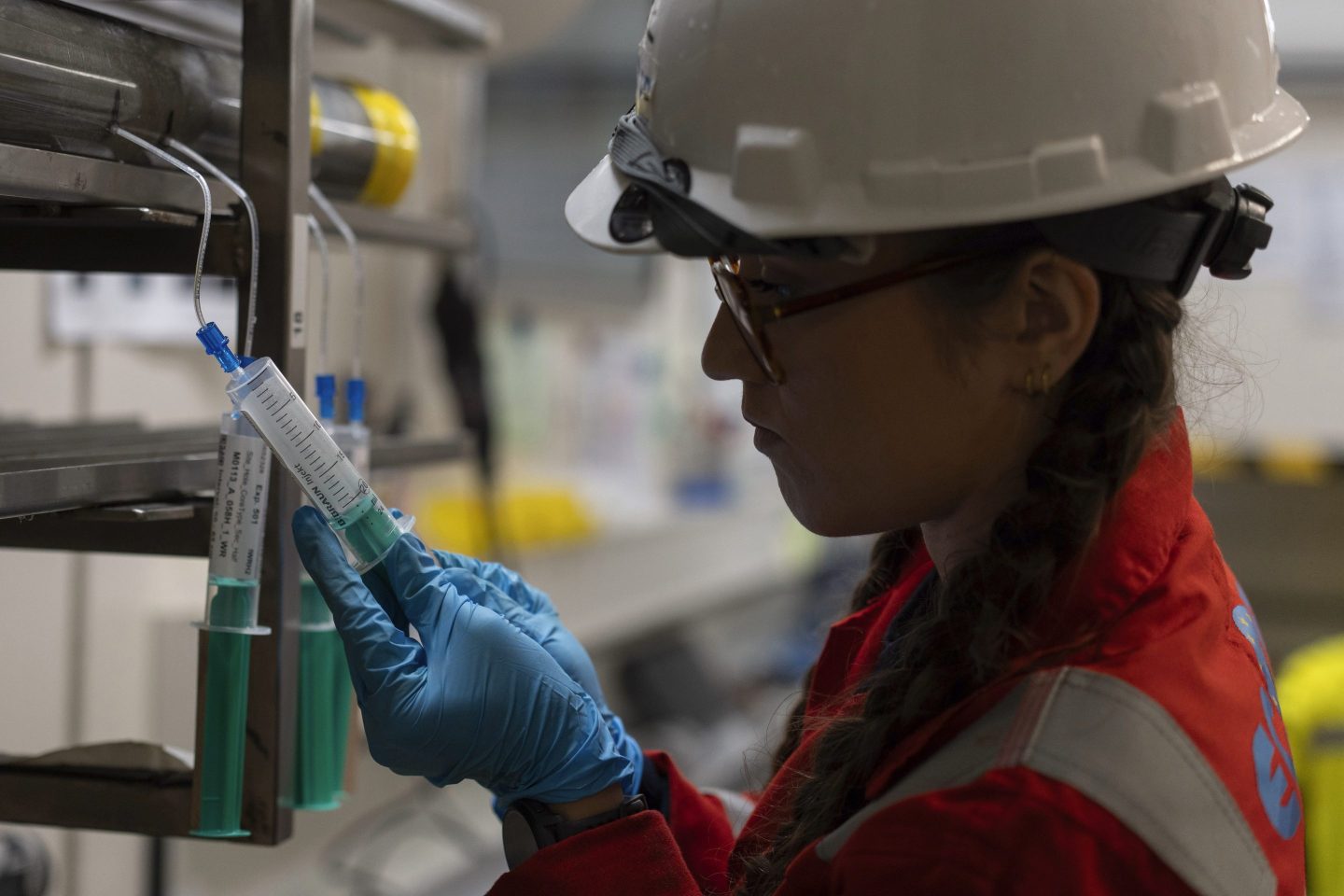
On the platform, around the clock, the racket of metal bore pipes and machinery, the drilling grime and the speckled mud mingled with the quieter, cleaner work of scientists in trailers converted to pristine labs and processing posts.
There, samples were treated according to the varying needs of the expedition’s geologists, geochemists, hydrologists, microbiologists, sedimentologists and more.
Passing through clear plastic tubes, muck was sliced into disks like hockey pucks. Machines squeezed water out. Some samples were kept sealed to enable study of ancient gases dissolved in the water. Other samples were frozen, filtered or left as is, depending on the purpose.
After six months of lab analysis, all the science teams of Expedition 501 will meet again — this time in Germany for a month of collaborative research that is expected to produce initial findings that point to the age and origin of the water.
On July 31, Liftboat Robert cranked up its legs from this place of hidden water to end a mission that lent credence to another passage from “The Rime of the Ancient Mariner,” Samuel Taylor Coleridge’s classic poem about life, death and mysteries at sea.
In a prelude to the poem, in some editions, Coleridge wrote: “I readily believe that there are more invisible than visible Natures in the universe.”
___
Woodward reported from Seekonk, Massachusetts.
___
The Associated Press receives support from the Walton Family Foundation for coverage of water and environmental policy. The AP is solely responsible for all content. For all of AP’s environmental coverage, visit https://apnews.com/hub/climate-and-environment