• Home
  • Latest
  • Fortune 500
  • Finance
  • Tech
  • Leadership
  • Lifestyle
  • Rankings
  • Multimedia

Trendingnow

1

MacKenzie Scott alone accounted for one-third of America's $19.2 billion in megagifts last year

2

Philanthropy leader at Warren Buffett and Bill Gates’ Giving Pledge says children of billionaires are pushing them to give their wealth away faster

3

Elon Musk on MacKenzie Scott giving away $26 billion of her fortune: 'Sadly,' it makes the world a worse place

1

MacKenzie Scott alone accounted for one-third of America's $19.2 billion in megagifts last year

2

Philanthropy leader at Warren Buffett and Bill Gates’ Giving Pledge says children of billionaires are pushing them to give their wealth away faster

3

Elon Musk on MacKenzie Scott giving away $26 billion of her fortune: 'Sadly,' it makes the world a worse place
CommentaryCloud

I’m Cloudera’s chief strategy officer and here’s why your $1 billion AI budget just became obsolete

By
Abhas Ricky
Abhas Ricky
Down Arrow Button Icon
By
Abhas Ricky
Abhas Ricky
Down Arrow Button Icon
February 10, 2026, 9:30 AM ET
Abhas Ricky is Chief Strategy Officer, Cloudera. Previously, he served as chief of staff and vice president for business transformation at the company. Prior to the Cloudera/Hortonworks merger, he helped scale Hortonworks’ go-to-market efforts as global head of customer innovation and value management. 
abhas
Abhas Ricky is chief strategy officer for Cloudera.courtesy of Cloudera
Add Fortune on Google for similar content.

AI is entering a new phase: its 2.0 era. AI 1.0 was built on unstructured data that applied general machine learning to broad business problems. It marked the shift from experimental AI into early operational and agentic systems, anchored in the belief that larger models would naturally yield the most powerful results. This concept was reinforced by hyperscalers racing to build ever-large frontier models, creating an arms race that drove breakthroughs but also unsustainable compute demands and rising infrastructure costs.

Recommended Video

AI 2.0 is different and challenges that belief as larger models are proving far less valuable in practice. Rather than modeling language or statistical likelihoods, AI 2.0 focuses on modeling real world dynamics. It leans on physics-informed machine learning – rigorous, simulation-driven models grounded in differential equations but accelerated by AI. These models don’t hallucinate; they compute and predict within the constraints of real world operations, making them far more suitable for production environments. This shift also reinforces that enterprises can no longer rely on hyperscaler economics alone. Training frontier-scale models requires compute footprints only a few providers can support, pushing organizations to rethink whether “bigger” is even accessible, let alone optimal, for their use cases.

Ultimately, the defining characteristic of AI 2.0 isn’t scale, it’s restraint. We are moving toward AI systems that know when to stop thinking. These are models engineered for precision, cost efficiency, and sound reasoning rather than endless computation.

The Transition from AI 1.0 to AI 2.0

AI 1.0 was built largely on inference, and dominated by experimentation and proof-of-concepts, where organizations optimized for demos and benchmarks rather than operational outcomes. The primary question wasn’t whether AI could scale economically or reliably; it was simply whether it could work at all. 

Within this phase, many leaders fell into what became known as the “accuracy trap,” where they optimized for accuracy alone, rather than compute or contextual awareness. Models that looked strong in controlled environments ultimately failed in actual deployment because they were either too slow for real world demands or too expensive to scale with healthy unit economics. The instinct was to start with the largest model possible, assuming that adaptation would naturally improve performance. 

AI 2.0 reframes this thinking. Leaders are now accountable for measurable ROI, not demos or benchmark scores. In 2.0, we need to stop training models to know everything and instead train AI models to simulate what matters. It’s a more specialized paradigm, where the goal is to learn and perfect one or several capabilities rather than chase generalization for its own sake.

In AI 2.0, every industry – from healthcare to manufacturing to financial services – will have the ability to build smaller, domain-specific models that simulate their unique physics, constraints, and environments. It’s analogous to moving from mass automotive manufacturing to custom assembly: people will be able to “build their own cars” because production will no longer be dictated solely by economies of scale. In healthcare, for example, smaller physics-informed models can simulate disease progression or treatment responses without relying on vast generalized systems. This eliminates hallucination risks and increases reliability in safety critical workflows.

Furthermore, the hyperscaler dynamic is also shifting here. Instead of running everything through massive centralized models, enterprises are distributing intelligence by blending foundational models with small language models, reducing hyperscaler dependence and optimizing performance for specific, local environments. 

The shift is not just technical, it’s economic and operational.

The Key to Success: Knowing When to “Stop Thinking”

In enterprise environments, “thinking” has a real cost. More parameters rarely translate to better outcomes for most workloads. For many applications, GPT-5 class models are overpowered, expensive, and slow, leading to stalled rollouts and constrained use cases.

The foundation of AI 2.0 is constraint-aware intelligence. World models allow systems to build a task specific representation of reality, allowing systems to reason over what matters instead of recomputing understanding from scratch at every step. A similar discussion just sparked at Davos this year when AI pioneer Yann LeCun stated we’ll “never get to human-level intelligence by training LLMs or by training on text only. We need the real world.” His stance is that generating code is one thing, but reaching the cognitive complexity of, for example, level-five self-driving cars, is far beyond what today’s large models can do.

All of this ladders up to GPT-5 class models not being trained on real world scenarios. Whereas smaller, specialized, and efficiently tuned models can achieve sufficient accuracy faster, deliver dramatically lower latency, run at a fraction of the cost, and scale predictably with real world demand. In practice, AI shouldn’t think endlessly and it certainly cannot operate under a “one model to rule them all” architecture approach. It should operate within a defined decision space. The emerging pattern includes architectures that route tasks to the simplest effective model, escalate only when necessary, and continuously balance accuracy with speed and cost. 

In other words, model size is the most dangerous metric on the dashboard. It’s a remnant of the 1.0 era that confuses capacity with capability. What truly matters is cost per solved problem: how efficiently a system can deliver an accurate, reliable outcome within the constraints of real operations. 

Enterprises won’t win by running the largest models; they’ll win by running the most economical ones that solve problems at scale.

The Talent Arbitrage in AI 2.0

Talent is another critical variable of AI 2.0 that will dramatically shift AI industry dynamics, as success requires a workforce that can build models for highly variable applications. Today, only a small percentage of global talent can develop foundational models, and the majority of that talent is concentrated in a handful of global technology hubs.

Right now, researchers are the superstars and they’re compensated accordingly because they’re in high demand. But the shift to AI 2.0 demands a move from magicians to mechanics: professionals who can tune, maintain, and optimize models to solve specific real world problems. This talent transition will be one of the biggest arbitrage opportunities of this next phase of AI. If AI is to be truly democratized, enterprises need talent everywhere that understands sectors’ physics – whether in medicine, manufacturing, logistics, etc. – and can translate that expertise into specialized, usable AI systems.

So how does this impact 2026 AI roadmaps? It means we need to collectively work smarter, not harder. Budgets and strategies need to shift toward efficiency but also usability, favoring smaller, optimized models, hybrid and multi-model architectures, and systems engineered for durability at scale. Success metrics will evolve from model size to cost per outcome, time to decision, and tangible real world impact. 

AI 2.0 isn’t about abandoning large models. It’s using them deliberately and economically. Organizations that adopt these practices will move faster, spend less, and achieve more than those still chasing brute-force scale.

The opinions expressed in Fortune.com commentary pieces are solely the views of their authors and do not necessarily reflect the opinions and beliefs of Fortune.
About the Author
By Abhas Ricky
See full bioRight Arrow Button Icon
Add Fortune on Google for similar content.

Latest in Commentary

Finance
Lorem ipsum dolor sit amet, consectetur adipiscing elit, sed do eiusmod tempor incididunt ut labore et dolore magna aliqua. Ut enim ad minim veniam
By Fortune Editors
October 20, 2025
Finance
Lorem ipsum dolor sit amet, consectetur adipiscing elit, sed do eiusmod tempor incididunt ut labore et dolore magna aliqua. Ut enim ad minim veniam
By Fortune Editors
October 20, 2025
Finance
Lorem ipsum dolor sit amet, consectetur adipiscing elit, sed do eiusmod tempor incididunt ut labore et dolore magna aliqua. Ut enim ad minim veniam
By Fortune Editors
October 20, 2025
Finance
Lorem ipsum dolor sit amet, consectetur adipiscing elit, sed do eiusmod tempor incididunt ut labore et dolore magna aliqua. Ut enim ad minim veniam
By Fortune Editors
October 20, 2025
Finance
Lorem ipsum dolor sit amet, consectetur adipiscing elit, sed do eiusmod tempor incididunt ut labore et dolore magna aliqua. Ut enim ad minim veniam
By Fortune Editors
October 20, 2025
Finance
Lorem ipsum dolor sit amet, consectetur adipiscing elit, sed do eiusmod tempor incididunt ut labore et dolore magna aliqua. Ut enim ad minim veniam
By Fortune Editors
October 20, 2025

Most Popular

Finance
Lorem ipsum dolor sit amet, consectetur adipiscing elit, sed do eiusmod tempor incididunt ut labore et dolore magna aliqua. Ut enim ad minim veniam
By Fortune Editors
October 20, 2025
Finance
Lorem ipsum dolor sit amet, consectetur adipiscing elit, sed do eiusmod tempor incididunt ut labore et dolore magna aliqua. Ut enim ad minim veniam
By Fortune Editors
October 20, 2025
Finance
Lorem ipsum dolor sit amet, consectetur adipiscing elit, sed do eiusmod tempor incididunt ut labore et dolore magna aliqua. Ut enim ad minim veniam
By Fortune Editors
October 20, 2025
Finance
Lorem ipsum dolor sit amet, consectetur adipiscing elit, sed do eiusmod tempor incididunt ut labore et dolore magna aliqua. Ut enim ad minim veniam
By Fortune Editors
October 20, 2025
Finance
Lorem ipsum dolor sit amet, consectetur adipiscing elit, sed do eiusmod tempor incididunt ut labore et dolore magna aliqua. Ut enim ad minim veniam
By Fortune Editors
October 20, 2025
Finance
Lorem ipsum dolor sit amet, consectetur adipiscing elit, sed do eiusmod tempor incididunt ut labore et dolore magna aliqua. Ut enim ad minim veniam
By Fortune Editors
October 20, 2025
Fortune Secondary Logo
Rankings
  • 100 Best Companies
  • Fortune 500
  • Global 500
  • Fortune 500 Europe
  • Most Powerful Women
  • World's Most Admired Companies
  • See All Rankings
  • Lists Calendar
Sections
  • Finance
  • Fortune Crypto
  • Features
  • Leadership
  • Health
  • Commentary
  • Success
  • Retail
  • Mpw
  • Tech
  • Lifestyle
  • CEO Initiative
  • Asia
  • Politics
  • Conferences
  • Europe
  • Newsletters
  • Personal Finance
  • Environment
  • Magazine
  • Education
Customer Support
  • Frequently Asked Questions
  • Customer Service Portal
  • Privacy Policy
  • Terms Of Use
  • Single Issues For Purchase
  • International Print
Commercial Services
  • Advertising
  • Fortune Brand Studio
  • Fortune Analytics
  • Fortune Conferences
  • Business Development
  • Group Subscriptions
About Us
  • About Us
  • Press Center
  • Work At Fortune
  • Terms And Conditions
  • Site Map
  • About Us
  • Press Center
  • Work At Fortune
  • Terms And Conditions
  • Site Map
  • Facebook icon
  • Twitter icon
  • LinkedIn icon
  • Instagram icon
  • Pinterest icon

Latest in Commentary

senate
CommentaryCongress
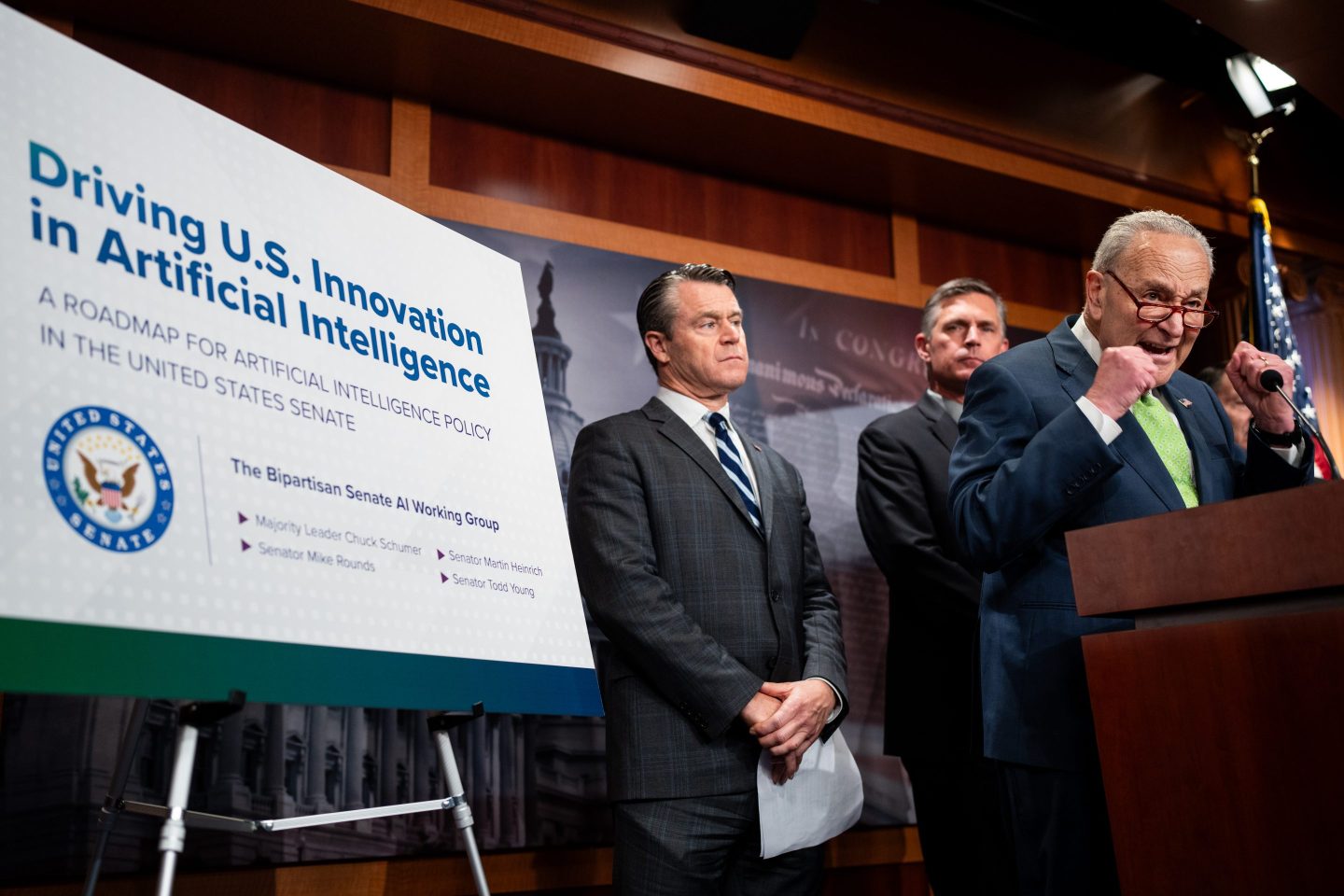
One rare bipartisan AI bill is moving through Congress. Here’s why it deserves to pass
By Neil Björkman and Betsy BrewerJuly 1, 2026
2 hours ago
I know how Gen Z can survive the ‘jobpocalypse’ because I built an AI company — in 2015
CommentaryCareers
I know how Gen Z can survive the ‘jobpocalypse’ because I built an AI company — in 2015
By Jeremy FainJuly 1, 2026
2 hours ago
mr
Commentary250 Years of Innovation
America needs 3.8 million manufacturing workers. This CEO has a blueprint to find them
By Mark RayfieldJuly 1, 2026
2 hours ago
usa
Commentary250 Years of Innovation
America at 250: why the Constitution was built to restrain government, not celebrate majority rule
By Steve H. HankeJuly 1, 2026
2 hours ago
t
CommentaryMedia
Netflix could turn NBC into its biggest bet yet — and this time, the math actually works
By Jeffrey Sonnenfeld and Steven TianJune 30, 2026
21 hours ago
wb
CommentaryLeadership
I grew BDO from $600 million to $3.4 billion. Here’s the 3-part formula that made it possible
By Wayne BersonJune 30, 2026
1 day ago

Most Popular

MacKenzie Scott alone accounted for one-third of America's $19.2 billion in megagifts last year
Success
MacKenzie Scott alone accounted for one-third of America's $19.2 billion in megagifts last year
By Sydney LakeJune 25, 2026
6 days ago
Philanthropy leader at Warren Buffett and Bill Gates’ Giving Pledge says children of billionaires are pushing them to give their wealth away faster
Success
Philanthropy leader at Warren Buffett and Bill Gates’ Giving Pledge says children of billionaires are pushing them to give their wealth away faster
By Preston ForeJune 27, 2026
4 days ago
Elon Musk on MacKenzie Scott giving away $26 billion of her fortune: 'Sadly,' it makes the world a worse place
Success
Elon Musk on MacKenzie Scott giving away $26 billion of her fortune: 'Sadly,' it makes the world a worse place
By Sydney LakeJune 29, 2026
2 days ago
'Humanity has chosen to become idiots': This Brown professor switched to take-home exams after a mass shooting and discovered mass cheating
AI
'Humanity has chosen to become idiots': This Brown professor switched to take-home exams after a mass shooting and discovered mass cheating
By Catherina GioinoJune 29, 2026
2 days ago
The U.S. Army is opening military bases to private billions — here's why that changes everything for the next 250 years
Commentary
The U.S. Army is opening military bases to private billions — here's why that changes everything for the next 250 years
By Marc AndersenJune 30, 2026
1 day ago
The retired college professor fighting a $313 trespassing ticket in Wisconsin thinks he's part of a national struggle
Environment
The retired college professor fighting a $313 trespassing ticket in Wisconsin thinks he's part of a national struggle
By Catherina GioinoJune 28, 2026
3 days ago

© 2026 Fortune Media IP Limited. All Rights Reserved. Use of this site constitutes acceptance of our Terms of Use and Privacy Policy | CA Notice at Collection and Privacy Notice | Do Not Sell/Share My Personal Information
FORTUNE is a trademark of Fortune Media IP Limited, registered in the U.S. and other countries. FORTUNE may receive compensation for some links to products and services on this website. Offers may be subject to change without notice.