Over the past week, a highly speculative piece of financial fiction has gripped Wall Street. Titled “The 2028 Global Intelligence Crisis,” the viral essay by Citrini Research and Alap Shah paints a catastrophic picture of an economy destroyed by artificial intelligence. Framing itself as a “macro memo from June 2028,” the piece describes a world in which the S&P 500 has plummeted 38%, unemployment has spiked to 10.2%, and the U.S. economy is trapped in a deflationary spiral caused by the mass displacement of white-collar workers.
However, Ken Griffin’s market-making giant Citadel Securities has swiftly dismantled the viral narrative. In a blistering new macro strategy report authored by Frank Flight, Citadel systematically debunks Citrini’s doomsday scenario, using real-time economic data to prove that the so-called intelligence crisis is actually rooted in a profound misunderstanding of macroeconomic fundamentals and technological adoption curves.
Viral ‘doomsday’ narrative
To understand Citadel’s takedown, one must first understand the hysteria Citrini, a macroeconomic analysis research firm founded in 2023 by James van Geelen, attempted to incite. Citrini’s Substack essay imagines a “human intelligence displacement spiral”—a negative feedback loop with no natural brake. In this hypothetical future, AI agents rapidly replace software engineers, financial advisors, and middle management. Companies lay off workers to expand margins, reinvesting those savings into more AI compute, which only accelerates further layoffs.
Citrini argues this leads to systemic financial ruin. It hypothesizes that stripped of their high-paying salaries, prime borrowers will default on their portion of the $13 trillion residential mortgage market. Furthermore, Citrini predicts a bloodbath in private credit, forecasting that PE-backed software-as-a-service (SaaS) companies like Zendesk will default on billions in debt as AI coding agents allow clients to build internal software rather than pay subscription fees. In Citrini’s eyes, AI represents an “economic pandemic” generating “Ghost GDP”—output that benefits the owners of compute but never circulates through the human consumer economy.
Citrini became the top finance Substack after accurately identifying early investment prospects in artificial intelligence and weight-loss pharmaceuticals. Its recent viral memo spooked markets and divided audiences, who found it either eerily prescient or inherently flawed.
Software jobs are rising, not falling
Citadel Securities didn’t mince words in its response, pointing out that “despite the macroeconomic community struggling to forecast two-month-forward payroll growth with any reliable accuracy, the forward path of labor destruction can apparently be inferred with significant certainty from a hypothetical scenario posted on Substack.”
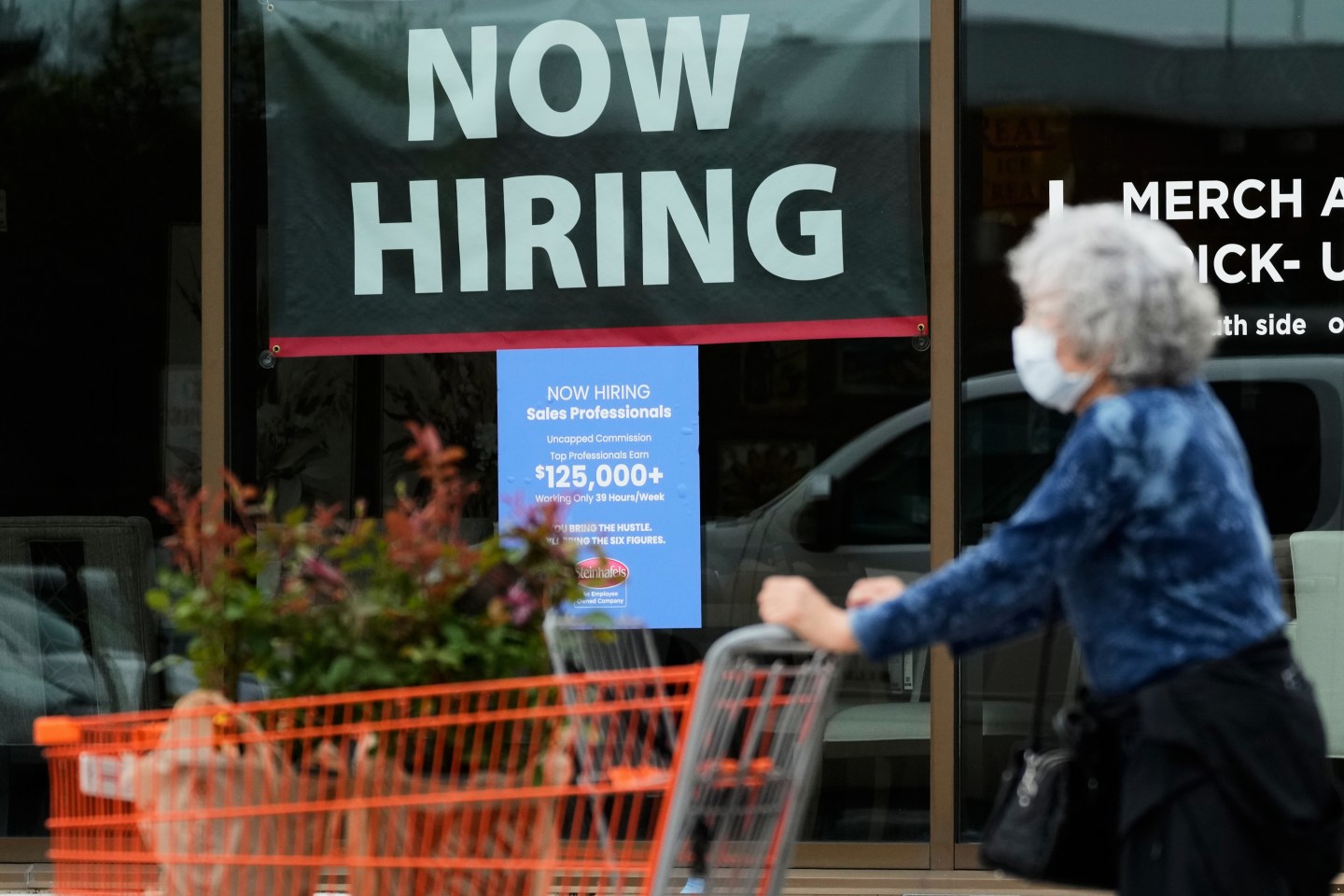
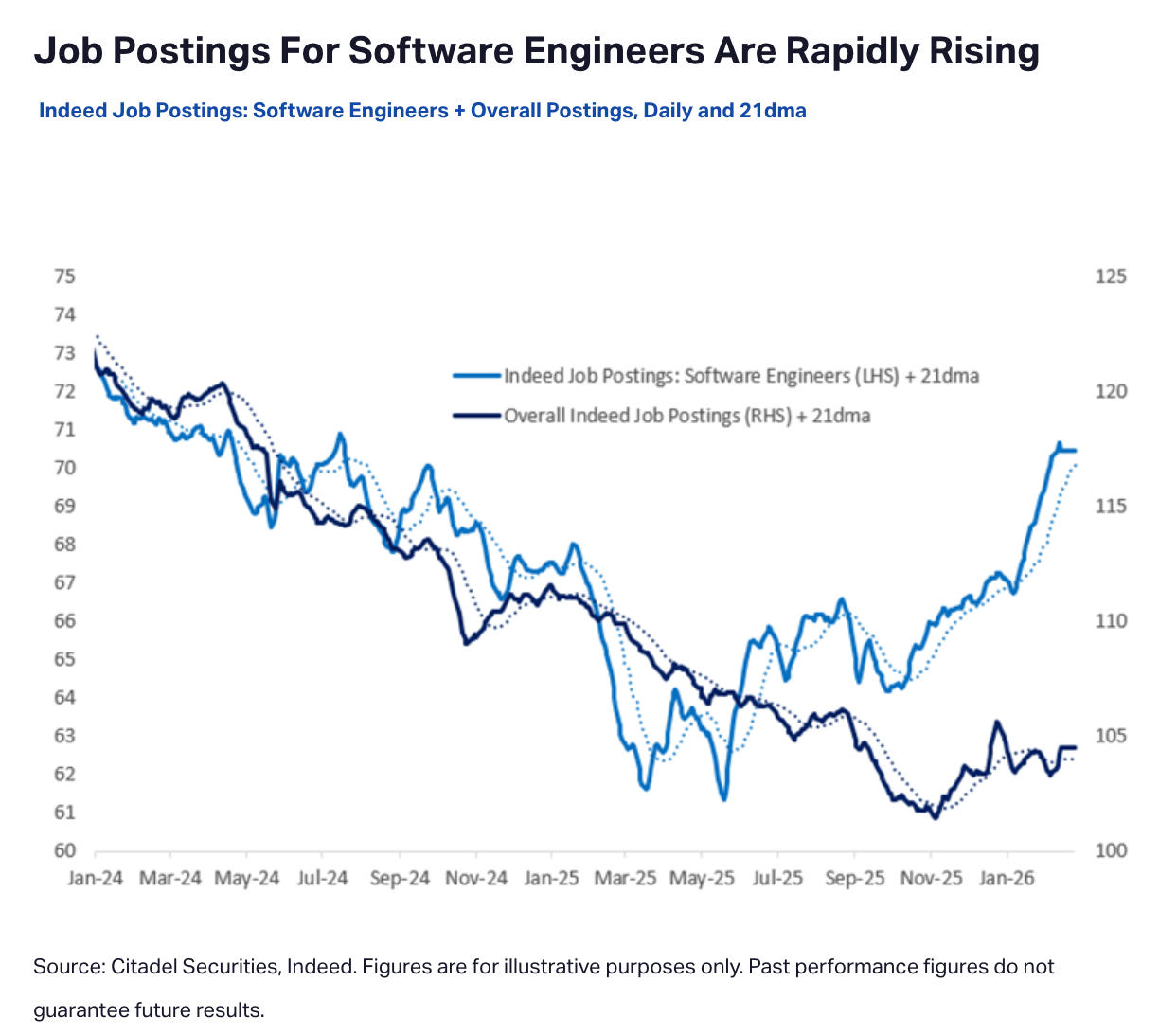
Flight begins the demolition by looking at actual labor market data. While Citrini’s essay insists that software and consulting jobs are currently collapsing, Citadel points to Indeed job posting data showing that demand for software engineers is actually rising rapidly, up 11% year over year in early 2026.
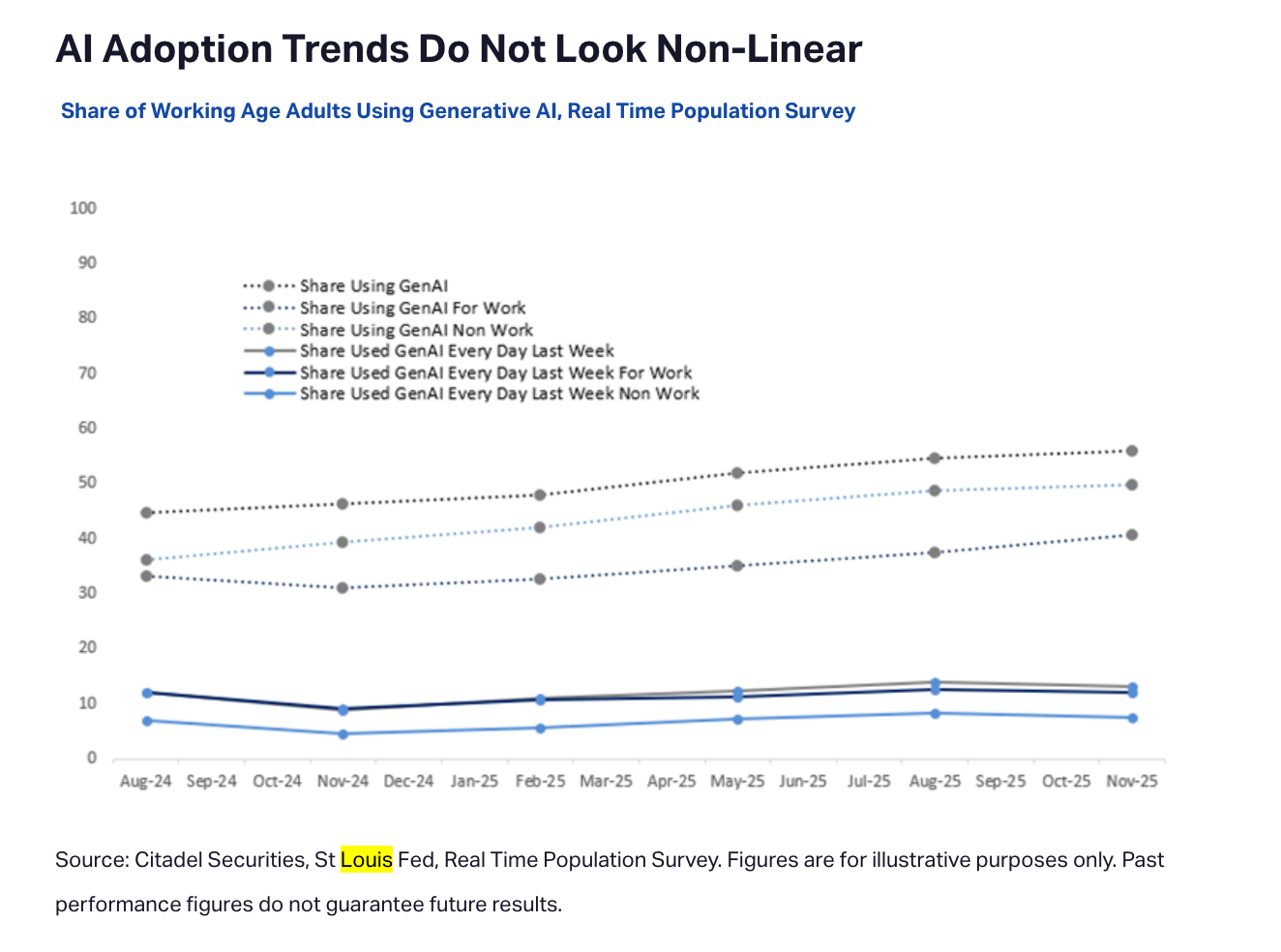
Furthermore, the data on AI diffusion completely contradicts the idea of an overnight white-collar wipeout. Using the St. Louis Fed’s analysis of the Real-Time Population Survey, Citadel notes that the daily use of generative AI for work is remaining “unexpectedly stable” and currently “presents little evidence of any imminent displacement risk.” Instead of a collapsing economy, new business formation in the U.S. is rapidly expanding, and the construction of massive AI data centers is currently driving a localized boom in construction hiring.
The ‘recursive technology’ fallacy
The core of Citrini’s error, according to Citadel, is conflating recursive technology with recursive economic adoption. Citrini’s premise assumes that because AI can write code to improve itself, its integration into the economy will compound infinitely and instantaneously.
Citadel calls this fundamentally flawed. Technological diffusion has historically followed an S-curve, where early adoption is slow, accelerates as costs fall, and eventually plateaus as saturation sets in and marginal returns diminish. Furthermore, Citadel points out a massive physical constraint that Citrini ignores: energy and computing power.
“Displacing white-collar work would require orders of magnitude more compute intensity than the current level utilization,” Flight writes. If automation were to expand at the breakneck pace Citrini fears, the demand for compute would inherently rise, pushing up its marginal cost. “If the marginal cost of compute rises above the marginal cost of human labor for certain tasks, substitution will not occur, creating a natural economic boundary.” In other words, physical capital, energy availability, and regulatory friction will naturally brake the “unstoppable” feedback loop Citrini envisions.
Ignorance of macroeconomic fundamentals
Citadel’s most damning critique targets Citrini’s apparent ignorance of basic macroeconomics. Citrini claims that AI is a unique threat because it will destroy aggregate demand while boosting output, violating the basic laws of economic accounting.
“Productivity shocks are positive supply shocks: They lower marginal costs, expand potential output, and increase real income,” Citadel counters. Historically, every major technological leap—from the steam engine to the internet—has followed this exact pattern. If AI allows firms to produce more at a lower cost, prices fall, and margins expand. Lower prices increase real purchasing power for consumers, which in turn increases consumption. Higher margins lead to reinvestment.
Citadel argues that for Citrini’s scenario to play out, one must assume that labor income completely collapses and capital income has a spending velocity of zero, which is historically false. Profits from AI efficiency will be reinvested, distributed, taxed, or spent. Moreover, Citadel points out that AI is highly likely to be a complement to human labor rather than a strict substitute. The economy consists of a vast array of physical, relational, and supervisory tasks fraught with coordination frictions and liability constraints that algorithms cannot easily navigate. Citadel poses a simple historical reality check: “Was the advent of Microsoft Office a complement or substitute for office workers?”
The Financial Times’ Robert Armstrong, who writes the Unhedged column, has been among the Citadel-leaning critics over the past week, along with Tyler Cowen of George Mason University and the Marginal Revolution blog, but he argued on Wednesday that more nuance could support the Citrini scenario. Paul Kedrosky, tech analyst at SK Ventures, wrote to Armstrong about the so-called Engels’ pause, a scenario Fortune has previously covered, named by economist Robert Allen after Karl Marx’s 19th-century partner and benefactor, Friedrich Engels.
Engels noted that per capita GDP was increasing but wages were stagnating in the U.K. during the late 18th and early 19th centuries, and analysts at the Bank of America Institute, while not using the Engels’ pause phrase, noted the same dynamic taking place recently. “Profits are gaining ground versus wages,” they wrote in February, explaining that “recent productivity gains have been piling as corporate profits, with labor income steadily falling as a share of U.S. GDP.”
Allen told Armstrong by email that he thinks the Engels’ pause in the U.S. and U.K. economies actually dates back to the early 1970s, referring him to a 2024 paper that analyzed labor market trends dating back to 1620. Wages briefly outpaced inflation during the pandemic labor shortages, leading to a short-lived era called “the Great Resignation,” but anemic job growth over the past few years suggests companies believe they overhired.
The Keynesian trap
Citadel refers back to another economist in its attempt to drive the final nail into the coffin of the “Global Intelligence Crisis,” invoking a famously optimistic and incorrect prediction by John Maynard Keynes. In 1930, Keynes famously predicted that soaring productivity would lead to a 15-hour workweek by the 21st century. He was right about the productivity, but entirely wrong about the labor market.
Why didn’t jobs disappear? Because, as Citadel explains, “rising productivity lowered costs and expanded the consumption frontier.” Humans simply shifted their preferences to higher-quality goods, novel services, and previously unimaginable forms of expenditure. “Keynes underestimated the elasticity of human wants,” Citadel asserts. Citrini is making the exact same analytical mistake today. AI will alter the composition of demand and generate entirely new industries, just as the internet did. The 2026 economy is probably not heading for a sci-fi apocalypse; in other words, it is simply experiencing the next great, manageable wave of human productivity.
For this story, Fortune journalists used generative AI as a research tool. An editor verified the accuracy of the information before publishing.