
• Home
  • Latest
  • Fortune 500
  • Finance
  • Tech
  • Leadership
  • Lifestyle
  • Rankings
  • Multimedia
EconomyProductivity

Workers around the world are scared. A massive new survey shows just how much

Nick Lichtenberg
By
Nick Lichtenberg
Nick Lichtenberg
Business Editor
Down Arrow Button Icon
Nick Lichtenberg
By
Nick Lichtenberg
Nick Lichtenberg
Business Editor
Down Arrow Button Icon
March 25, 2026, 8:15 AM ET
worker
How secure do you feel in your job?Getty Images

Even as global unemployment hits historic lows, a sweeping new study of the global workforce by one of the definitive workforce data sources finds that “anxiety”—not confidence—defines how most workers feel about their job, their future, and AI transforming both.

Recommended Video

The numbers don’t lie, and they don’t comfort. Only 22% of workers worldwide strongly agreed that their job was safe from elimination, according to a new report from ADP Research released Wednesday. The finding comes from one of the largest workforce sentiment surveys ever conducted—more than 39,000 workers across 36 countries—and lands with the force of a gut punch: The world’s workers are consumed by fear.​

“Despite three years of historically low global unemployment and steady economic growth, our data reveals widespread job insecurity expressed by workers worldwide,” said Nela Richardson, chief economist at ADP.​

The culprit is hiding in plain sight: artificial intelligence. As generative AI tools race into the workplace at breakneck speed, workers from Tokyo to Topeka are struggling to process what it means for their livelihoods—and they’re not reassured by what they see.​ “AI is not like the weather. It is not just going to descend upon us,” Richardson told reporters in a briefing on the survey results in New York City. “It really is hitting us at the task level—by augmenting and making certain tasks more high value.”

A world of anxious workers

The ADP Research Today at Work 2026 report, based on survey responses collected in late summer 2025, paints a portrait of a global workforce caught in the crosscurrents of technological disruption, demographic upheaval, and deep uncertainty. The anxiety cuts across borders and industries, but ADP found that it hits hardest at the bottom of the organizational ladder.​

Among individual contributors—the frontline workers who make up the bulk of most companies’ headcount—only 18% felt their job was safe. Frontline managers fared only slightly better at 21%. Confidence rose predictably with seniority: Middle managers came in at 23%, upper managers at 31%, and C-suite executives at 35%. In other words, the higher your perch in the org chart, the less afraid you are of falling.​ But even then, only barely more than a third of top executives feel like they have job security, according to the results.

The geographic divides are equally stark. In Japan—a country long defined by lifetime employment culture—only 5% of workers felt their jobs were secure, the lowest reading of any market in the survey. Nigeria, by contrast, registered the most confident workforce, with 38% of workers expressing job security, driven largely by a young, tech-savvy population and booming AI adoption. In the United States, the figure was 28%.​

AI is making it worse—and better, sort of

The paradox at the heart of the report is this: AI use is correlated with higher engagement and less stress, yet it’s also making workers feel dramatically less productive. Daily AI users were four times as likely as nonusers to say they weren’t as productive as they could be.​

The explanation, researchers suggest, is psychological. AI has taken over the small, checklist-style tasks that gave workers a sense of daily accomplishment—answering emails, summarizing documents, generating first drafts. Without those quick wins, people feel as if they’ve done less, even when they’ve arguably done more. “AI does the things that we used to say make us feel productive,” Richardson explained to reporters. “It writes our emails for us. It responds. It summarizes documents for us. And so we have to kind of remeasure productivity in a different way; it’s shifting from productivity based on volume of work to value [of work].”

The flip side: 30% of daily AI users were fully engaged at work, versus just 14% of those who never use AI. Heavy AI users were also significantly less likely to experience negative stress: 11% reported feeling overloaded, compared with 23% of nonusers. The data suggests AI may be a powerful tool for worker well-being, if companies can figure out how to deploy it without triggering dread.​

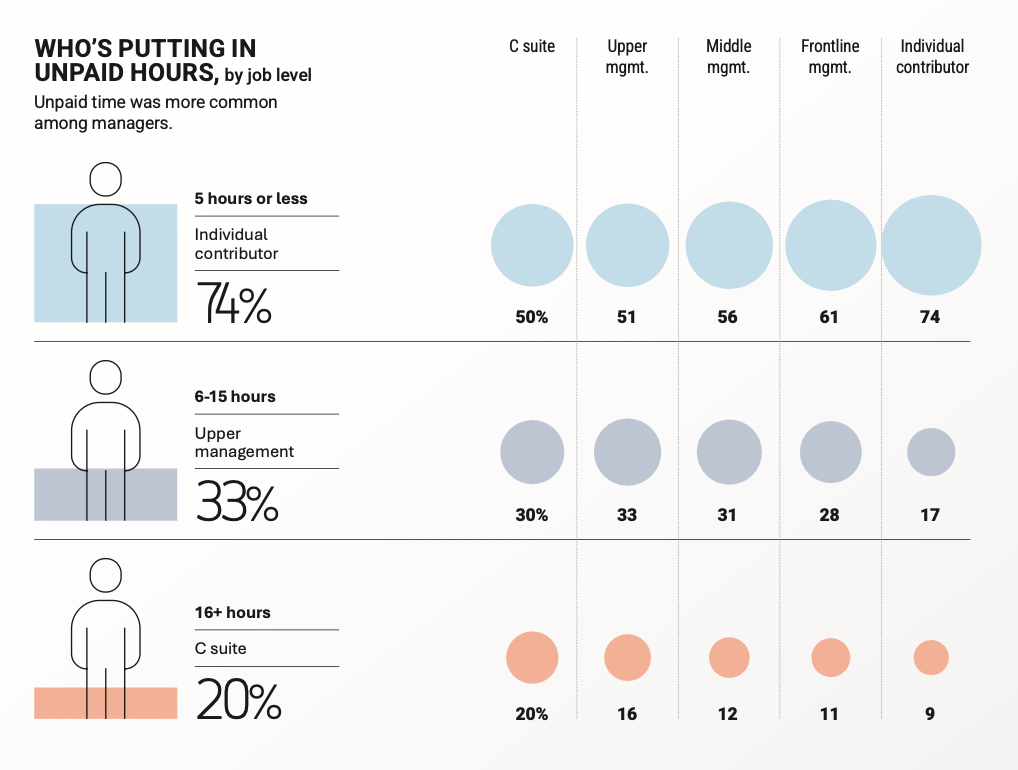
The creeping, unpaid extension of the workday isn’t helping with this angst over productivity: 62% of global workers said they put in up to five hours of unpaid work per week, while 38% reported working off the clock for six hours or more; 12%—disproportionately executives and upper managers—said they work without pay for 16 hours or more weekly.​

The data reveals a troubling paradox: Workers logging the most unpaid hours are simultaneously the most engaged and the most likely to be looking for another job. They’re dedicated enough to give their time for free, yet burned out enough to be quietly interviewing elsewhere. “Free work comes at a cost,” the report concludes. “People who put in unpaid hours are more likely to feel unproductive and stressed. They’re also more likely to quit.”
“AI is entering a workforce that is anxious,” said Jay Caldwell, ADP’s chief talent officer. “And to me, that’s very, very risky. And the importance for HR professionals right now is not as much about the technology. It’s more around, ‘How do we lead through the technology? And how do we bring our workforce along?’ And the transformation that comes with that.”

Five generations, one nervous breakdown

Compounding the AI anxiety is a demographic collision unlike anything the modern workplace has ever seen. For the first time in history, five generations are working side by side—from teenagers to great-grandparents. And they are not on the same page.​

Young workers ages 18 to 26 were the most optimistic, with 29% saying they had the skills needed to advance. But older workers ages 55 to 64 told a bleaker story: Only 18% felt similarly equipped, and just 12% believed their employer was investing in their development. Meanwhile, 20% of young workers strongly agreed AI would positively impact their jobs in the next year—a figure that dropped to just 10% among workers ages 55 to 64.​

“Younger workers are definitely more optimistic about their skill set,” Richardson told reporters. “Older workers are also, you know, more likely to say that they’re financially unprepared. Which is interesting. They make more money, but they feel more stretched financially. They’re more likely to say that they’re less productive and less engaged than younger workers. Youth and optimism go hand in hand.” She connected these findings back to Japan, which has a culture famously respectful towards elders. Fortune has previously covered the madogiwazoku, or “window workers,” who are so named because they sometimes just stare out the window. The upshot is that jobs for younger workers are harder to come by.

The data also exposes a troubling engagement crisis hiding beneath the surface calm of low unemployment. Only 19% of workers globally were fully engaged on the job in 2025—unchanged from the year before—meaning more than 80% of the world’s workforce is, by some measure, just going through the motions. Workers who find meaning in their jobs are 12.5 times as likely to be fully engaged as those who don’t.​

What employers must do

ADP researchers are emphatic that the anxiety gripping workers is not inevitable; it is, in large part, a leadership failure. Workers who feel their employers are investing in their skills were 5.3 times as likely to feel their jobs were secure. Among those who strongly agreed their employer was investing in them, 53% were fully engaged. Among those who didn’t feel that investment, only 12% were.​

The prescription is clear: Communicate, upskill, and stop treating workers as passive recipients of technological change. “Upskilling isn’t just a strategy,” Richardson said at the briefing. “It’s a reassurance. It’s a trust pact between the employer and the worker.”

Caldwell urged HR professionals to help workers reframe what productivity even means in an AI-driven world—away from task volume and toward judgment, creativity, and long-term impact. “Workers who clearly see the role their existing skill sets will play in an organization’s future,” Caldwell said, “will be more engaged, productive, and have the confidence to thrive in this next era of work.”

For now, though, the world’s workers are mostly not thriving. They’re waiting, watching, and wondering whether their jobs will survive the machines. The survey suggests that the answer—for most—remains maddeningly unclear.


The Fortune 500 Innovation Forum will convene Fortune 500 executives, U.S. policy officials, top founders, and thought leaders to help define what’s next for the American economy, Nov. 16-17 in Detroit. Apply here.
About the Author
Nick Lichtenberg
By Nick LichtenbergBusiness Editor
LinkedIn icon

Nick Lichtenberg is business editor and was formerly Fortune's executive editor of global news.

See full bioRight Arrow Button Icon

Latest in Economy

Finance
Lorem ipsum dolor sit amet, consectetur adipiscing elit, sed do eiusmod tempor incididunt ut labore et dolore magna aliqua. Ut enim ad minim veniam
By Fortune Editors
October 20, 2025
Finance
Lorem ipsum dolor sit amet, consectetur adipiscing elit, sed do eiusmod tempor incididunt ut labore et dolore magna aliqua. Ut enim ad minim veniam
By Fortune Editors
October 20, 2025
Finance
Lorem ipsum dolor sit amet, consectetur adipiscing elit, sed do eiusmod tempor incididunt ut labore et dolore magna aliqua. Ut enim ad minim veniam
By Fortune Editors
October 20, 2025
Finance
Lorem ipsum dolor sit amet, consectetur adipiscing elit, sed do eiusmod tempor incididunt ut labore et dolore magna aliqua. Ut enim ad minim veniam
By Fortune Editors
October 20, 2025
Finance
Lorem ipsum dolor sit amet, consectetur adipiscing elit, sed do eiusmod tempor incididunt ut labore et dolore magna aliqua. Ut enim ad minim veniam
By Fortune Editors
October 20, 2025
Finance
Lorem ipsum dolor sit amet, consectetur adipiscing elit, sed do eiusmod tempor incididunt ut labore et dolore magna aliqua. Ut enim ad minim veniam
By Fortune Editors
October 20, 2025

Most Popular

Finance
Lorem ipsum dolor sit amet, consectetur adipiscing elit, sed do eiusmod tempor incididunt ut labore et dolore magna aliqua. Ut enim ad minim veniam
By Fortune Editors
October 20, 2025
Finance
Lorem ipsum dolor sit amet, consectetur adipiscing elit, sed do eiusmod tempor incididunt ut labore et dolore magna aliqua. Ut enim ad minim veniam
By Fortune Editors
October 20, 2025
Finance
Lorem ipsum dolor sit amet, consectetur adipiscing elit, sed do eiusmod tempor incididunt ut labore et dolore magna aliqua. Ut enim ad minim veniam
By Fortune Editors
October 20, 2025
Finance
Lorem ipsum dolor sit amet, consectetur adipiscing elit, sed do eiusmod tempor incididunt ut labore et dolore magna aliqua. Ut enim ad minim veniam
By Fortune Editors
October 20, 2025
Finance
Lorem ipsum dolor sit amet, consectetur adipiscing elit, sed do eiusmod tempor incididunt ut labore et dolore magna aliqua. Ut enim ad minim veniam
By Fortune Editors
October 20, 2025
Finance
Lorem ipsum dolor sit amet, consectetur adipiscing elit, sed do eiusmod tempor incididunt ut labore et dolore magna aliqua. Ut enim ad minim veniam
By Fortune Editors
October 20, 2025
Fortune Secondary Logo
Rankings
  • 100 Best Companies
  • Fortune 500
  • Global 500
  • Fortune 500 Europe
  • Most Powerful Women
  • Future 50
  • World’s Most Admired Companies
  • See All Rankings
Sections
  • Finance
  • Fortune Crypto
  • Features
  • Leadership
  • Health
  • Commentary
  • Success
  • Retail
  • Mpw
  • Tech
  • Lifestyle
  • CEO Initiative
  • Asia
  • Politics
  • Conferences
  • Europe
  • Newsletters
  • Personal Finance
  • Environment
  • Magazine
  • Education
Customer Support
  • Frequently Asked Questions
  • Customer Service Portal
  • Privacy Policy
  • Terms Of Use
  • Single Issues For Purchase
  • International Print
Commercial Services
  • Advertising
  • Fortune Brand Studio
  • Fortune Analytics
  • Fortune Conferences
  • Business Development
  • Group Subscriptions
About Us
  • About Us
  • Editorial Calendar
  • Press Center
  • Work At Fortune
  • Diversity And Inclusion
  • Terms And Conditions
  • Site Map
  • About Us
  • Editorial Calendar
  • Press Center
  • Work At Fortune
  • Diversity And Inclusion
  • Terms And Conditions
  • Site Map
  • Facebook icon
  • Twitter icon
  • LinkedIn icon
  • Instagram icon
  • Pinterest icon

Latest in Economy

Photo: Donald and Melania Trump.
PoliticsMarkets
Trump has no good options in Iran—here are 5 of them ahead of his speech to the nation tonight
By Jim EdwardsApril 1, 2026
1 hour ago
The more women earn, the more housework they do: inside the paradox a Wharton economist calls ‘an existential problem for men’
SuccessLabor
The more women earn, the more housework they do: inside the paradox a Wharton economist calls ‘an existential problem for men’
By Catherina GioinoApril 1, 2026
3 hours ago
MUSCAT, OMAN - MARCH 22: The Albina Bulk carrier sits anchored on March 22, 2026 at Sultan Qaboos Port in Muscat, Oman.President Donald Trump had threatened to attack Iran's energy infrastructure if it did not end its de facto blockade of the Strait of Hormuz by just before midnight GMT of March 23. A subsequent statement from President Trump said the U.S. and Iran had held "very good and productive conversations regarding a complete and total resolution of our hostilities in the Middle East," and that he would postpone any attacks on Iranian energy infrastructure for five days. Maritime traffic through the strait, which conveys about 20% of the world's oil and gas, has mostly come to a halt after the joint U.S.-Israeli war with Iran that began on February 28.
EnergyIran
Trump has a labyrinth of bad options in the Strait of Hormuz. Here’s why some warn that walking away could transcend ‘our defeat in Vietnam’
By Jordan BlumMarch 31, 2026
13 hours ago
Wall Street just had its best day in nearly a year over a rumor
EconomyMarkets
Wall Street just had its best day in nearly a year over a rumor
By Eva RoytburgMarch 31, 2026
14 hours ago
Bobby Witt Jr. throws a baseball. He is standing in front of a FanDuel sign on a baseball field.
Bankinggambling
Credit card delinquencies among millennials and Gen Z have soared because of sports betting—even in states where it’s illegal, new Fed study finds
By Sasha RogelbergMarch 31, 2026
14 hours ago
hegseth
EnergyWhite House
‘Go get your own oil’: Trump’s message to allies who haven’t backed war in Iran
By Jon Gambrell, Mike Corder, Darlene Superville and The Associated PressMarch 31, 2026
14 hours ago

Most Popular

Jerome Powell says the $39 trillion national debt is ‘not unsustainable,’ but warns the trajectory ‘will not end well’
Economy
Jerome Powell says the $39 trillion national debt is ‘not unsustainable,’ but warns the trajectory ‘will not end well’
By Fortune EditorsMarch 30, 2026
2 days ago
A man used AI to call 3,000 Irish bartenders to track the cost of Guinness. Now pubs are lowering their prices to compete
AI
A man used AI to call 3,000 Irish bartenders to track the cost of Guinness. Now pubs are lowering their prices to compete
By Fortune EditorsMarch 30, 2026
2 days ago
Markets cheer as Trump threatens to abandon Iran war, but Jamie Dimon sides with allies: ‘Win this thing and clean up the straits’
Energy
Markets cheer as Trump threatens to abandon Iran war, but Jamie Dimon sides with allies: ‘Win this thing and clean up the straits’
By Fortune EditorsMarch 31, 2026
20 hours ago
The federal government shed 385,000 employees last year. Now the Trump administration is on a blitz to hire Gen Z workers
Politics
The federal government shed 385,000 employees last year. Now the Trump administration is on a blitz to hire Gen Z workers
By Fortune EditorsMarch 31, 2026
1 day ago
Kevin O'Leary says if you earn $68,000 a year and follow this rule, you'll retire a millionaire
Personal Finance
Kevin O'Leary says if you earn $68,000 a year and follow this rule, you'll retire a millionaire
By Fortune EditorsMarch 31, 2026
19 hours ago
A CEO trying to reindustrialize America says blue-collar pay is headed for 'massive hyperinflation' and kids should skip college to become welders
Success
A CEO trying to reindustrialize America says blue-collar pay is headed for 'massive hyperinflation' and kids should skip college to become welders
By Fortune EditorsMarch 30, 2026
2 days ago

© 2026 Fortune Media IP Limited. All Rights Reserved. Use of this site constitutes acceptance of our Terms of Use and Privacy Policy | CA Notice at Collection and Privacy Notice | Do Not Sell/Share My Personal Information
FORTUNE is a trademark of Fortune Media IP Limited, registered in the U.S. and other countries. FORTUNE may receive compensation for some links to products and services on this website. Offers may be subject to change without notice.