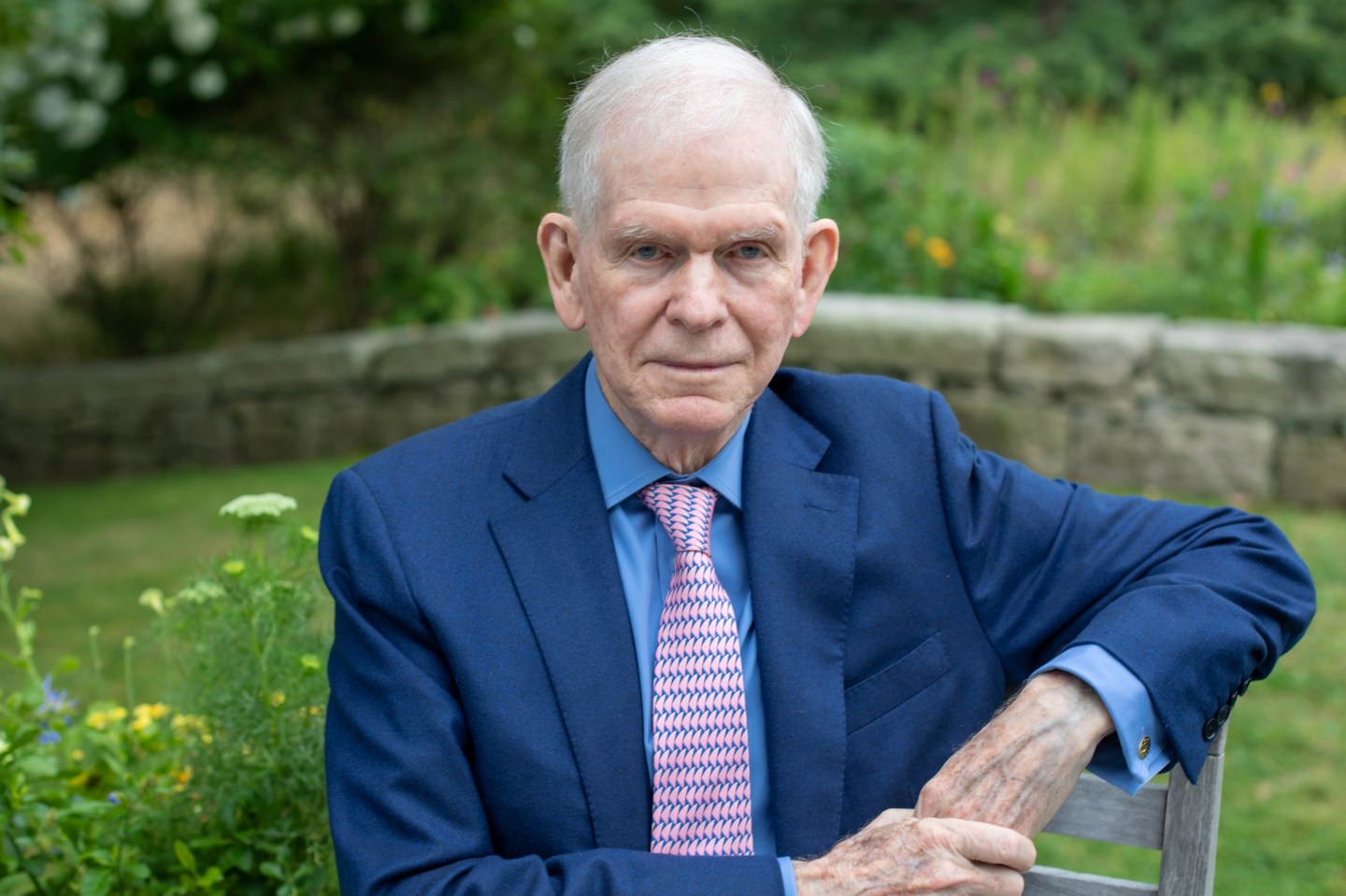
Jeremy Grantham has been called many things. Permabear. Doom merchant. Cassandra with a British accent. For decades, the co-founder of the Boston-based asset manager GMO has warned that financial markets were inflated to dangerous, unsustainable heights—and he has made enemies for it. But ask him how he feels about all of it, and he sounds almost cheerful.
“Data is data,” he told Fortune in a recent interview. “I quite like thinking these things through.”
The equanimity makes more sense once you know his Myers-Briggs “animal”: he’s a dolphin.
At a dinner years ago, during his time managing a $1 billion mandate alongside JPMorgan, Morgan Stanley, and Goldman Sachs, Grantham was administered an elaborate personality test featuring animal avatars. When the results came in, six of the seven people at the leadership table turned out to be owls—dominant, decisive, strategic. The seventh was Grantham. “I was this innocent, idealistic dolphin on a table of sharks masquerading as owls,” he said. When the dolphins were asked to stand in the room of roughly 60 finance executives, there were only two: Grantham and the woman running the test. (It was strange, he added, when one bank in particular had a table full of “foxes.”)
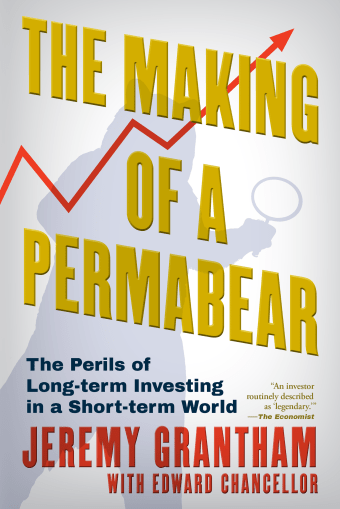
So that settles it, according to the co-author of the recently released memoir, The Making of a Permabear, written alongside financial historian Edward Chancellor. He’s not a bear — he’s a dolphin, driven by a powerful streak of idealism, the kind that lets you pursue an uncomfortable truth, call it better than anyone else, and feel quietly satisfied even when no one wants to listen. He calls the whole framework “Myers-Briggs crap,” but admits the data shows it works—which, he notes, is more than you can say for most of the academic models that are supposed to.
Grantham has earned the right to trust his own instincts over consensus. Over 40 years, he called out the Japanese stock and real estate bubbles before they collapsed at the turn of the 1990s. He called the dotcom bubble before it burst a decade later. And in September 2007, he wrote in these very pages that the U.S. housing sector was in “genuine bubble territory” — months before that market’s implosion triggered the Great Financial Crisis. As late as August 2007, the Federal Reserve was skeptical of such bubble talk, while Grantham was dismissed as a pessimist, a dismissal that soon proved mistaken.
People don’t react well to the bear—or the dolphin—in the room, Grantham said. “It makes people really angry,” he explained, “but not uniformly.” The angriest reactions are “when things are getting really crazy” in markets, he said, recalling a quarterly letter he wrote in 2021, around the theme of “waiting for the last dance.” In January 2022, he talked about in a Bloomberg podcast appearance and found the response “ballistic and viral, I think is the expression.” It struck a nerve with the Bitcoin crowd, he explained, who are “crazy as coots,” and three particular comments “went to great lengths to point out that I had big ears, for God’s sake. I had not heard that since I was about six or seven years old.”
“I irritated the stock market players, irritated the newbies who were investing their Biden’s money, as it were,” Grantham said, referring to the stimulus package widely seen as fueling a surge in speculative investments, including the “meme stock” craze that still occasionally resurfaces. “To the moon, they were having a real time with those meme stocks. Everything worked out well.”
The bubble within a bubble
Grantham’s current thesis is that U.S. equities are trapped inside what he calls a “bubble within a bubble.”
The original super-bubble, as he sees it, was already inflating dangerously through 2021 before the S&P 500 started to crack. People don’t remember it now, but the S&P 500 had actually fallen about 25% from January through October 2022, but then ChatGPT arrived. “The day after Chat came out, the Mag 7 lifted the market on its broad shoulders and staggered forward,” he said, injecting a fresh speculative frenzy on top of an already overvalued system. The AI boom didn’t fix the underlying problem, according to Grantham— t deferred it while making it larger.

His January 2026 paper, co-authored with Chancellor, was titled Valuing AI: Extreme Bubble — New Golden Era — Or Both? The answer, in Grantham’s view, is mostly the first. He has said there is a “slim to none” chance the AI bubble does not eventually burst, and that it could drag the broader market down to levels not seen since the worst bear markets in modern history. The market’s price-to-book ratio and cyclically adjusted earnings multiples are at extremes that were only surpassed in 1929, 1972, 1999-2000, and 2021, he noted — each followed by devastating corrections. It’s just what the data suggests, he told Fortune rather cheerily, noting that exuberance in the markets still isn’t as dramatic as the dotcom boom.
His diagnosis is that the market is constitutionally incapable of looking further than the present moment. It extrapolates current conditions, piles fat price-to-earnings multiples on top of already-fat profit margins, and double-counts prosperity. “The stockbrokers would die of boredom” if bubbles didn’t get inflated, Grantham said. “The investors would die of boredom and a lot of money would be saved; the turnover would drop and everyone would end up making exactly the same money with a lot less excitement and doing a lot less crazy things.”
It’s almost as if owls, foxes, and dolphins are all jostling together, contending with their animal spirits more than with any rational analysis of data.
Layers of time around reality
Fortune responded that Grantham’s worldview sounds like the 17th-century quote from the French philosopher Blaise Pascal: “all of humanity’s problems stem from man’s inability to sit quietly in a room alone.”
That is “absolutely true,” Grantham responded, before getting back to his nuts-and-bolt analysis of all the data he currently sees as quite disturbing. But this also takes him somewhere that most market commentators won’t follow.
“There are kind of layers of time around reality,” he said. “Forget the stock market, which really has a very short horizon and extrapolates today’s conditions — the environment the current market is operating in is clearly about as bad as it ever gets.”
This is Grantham’s deeper, more dolphin-ish insight: a lot more than the fate of the S&P 500 is at stake. Nothing less than the long-term viability of the way we live is on his mind. Grantham put the turning point back in 2011, when he wrote a paper called Time to Wake Up, arguing that the earth was running out of abundant resources. “We were the first people that actually said, ‘Dudes, for 100 years, we’ve had technology at a bigger level than scarcity.'” The takeaway: “We are going to have to get used to slower growth rates, lower resource use.” And most societies, he said, have no plan for dealing with it.
Start with population. Grantham said he has become increasingly alarmed by what he sees as a mathematically certain demographic collapse. South Korea’s fertility rate has fallen to 0.7 — roughly one-third of the 2.1 births per woman needed to sustain a population. Japan’s cohort of 20-year-olds has already halved from its peak. The same forces — urbanization, female workforce participation, expensive housing, scarce childcare — are now spreading to China, Europe, and eventually the United States. “If they’re going to conquer anyone, they’d better get it over with fast,” Grantham said of China, “because anyone falling in population at that speed is not going to do much of anything.”
Although the U.S. fertility rate is below replacement, it is nowhere near South Korea’s figure, but Grantham stressed the long view, globally: “We’ve palled up with the experts who’ve studied these things for literally 30, 40 years, they think that in as little as 20, 25 years, the average young couple will need help … [and] in 40 to 50 years, the viability of the species is at risk.”
Then there are resources. Copper ore grades that once ran at 4% have fallen to 0.6% or less. Nickel, zinc, and lithium are present in the Earth’s crust at concentrations of less than 0.01%. These are not recoverable shortfalls. “You don’t have them in the Earth’s crust,” he says. “You don’t have them available.” And the data centers powering the AI boom that Wall Street is currently pricing at extraordinary multiples depend entirely on these same scarce metals. The International Energy Agency, S&P Global, BloombergNEF, Wood Mackenzie, and Goldman Sachs have all corroborated Grantham’s point, with the IEA projecting shortages in copper and lithium within a decade.
Perhaps most alarming, and certainly least discussed, is what Grantham calls the toxicity crisis. He has long funded research into declining male fertility and points to meta-analyses showing that sperm counts have dropped by more than two-thirds since the early 1970s. The culprits, in his view, are the endocrine disruptors embedded in plastics, cosmetics, and above all pesticides, which a pregnant mother absorbs at levels that can affect not just her child but potentially her grandchildren. He claimed that a study of Parkinson’s disease rates found they were double within a mile of golf courses compared to areas farther away, a statistic he relayed with a certain grim relish given that his weekend home sits exactly one mile from a golf course.
The dolphin’s consolation
So why isn’t any of this depressing him?
“I see it as a wonderfully challenging topic,” he said. “What depresses me is when the government goes out of its way to do things that go backwards.” He attributed his composure directly to his dolphin nature — the same idealistic, questing quality that keeps him willing to swim against the current of bullish consensus, stare at uncomfortable data, and conclude, with something approaching pleasure, that he has made the case more rigorously than anyone else. He said that he sometimes make bullish calls, as he did in March 2009 with a letter titled “reinvesting when terrified.” He argued in it that “the market does not turn when it sees light at the end of the tunnel. It turns when all looks black, but just a subtle shade less black than the day before.”
He also told Fortune he was philosophical about human nature and the animal spirits that drive economies—and societies—forward. “I suspect over hundreds of thousands of years that pessimism was not a great help to survival,” he said. “Everyone left hanging on by their fingernails, good times, bad times, everyone’s dying, running out of food, lots of food, running out of food again. But being an optimist is probably a great help.” We are probably an optimistic species as a result, he argued, “but optimism, in a sense, by definition, means you’re not in a great position to do unbiased analysis.”
Grantham has decades of experience, he has just published his memoir, and he is telling you, with the cheerful conviction of a man who has been right before and expects to be right again, that the world is running out of time, resources, and people.
He is also telling you that almost no one wants to hear it. But that’s the thing about being the only dolphin in a room full of owls: you get used to swimming alone.