Duncan Wardle, who spent 30 years at Disney, starting as a coffee boy in London and eventually rising to Head of Innovation and Creativity across Disney, Pixar, Marvel, and Lucasfilm, left the company in 2017 with a bronze Jiminy Cricket statue marking three decades of service and one central conviction: the question every business reflexively asks is usually the wrong one.
Since leaving Disney, Wardle has operated as an independent innovation consultant and keynote speaker through his firm iD8 & innov8, becoming one of the most-booked speakers on the corporate circuit and teaching innovation masterclasses at Yale, Harvard and other universities.
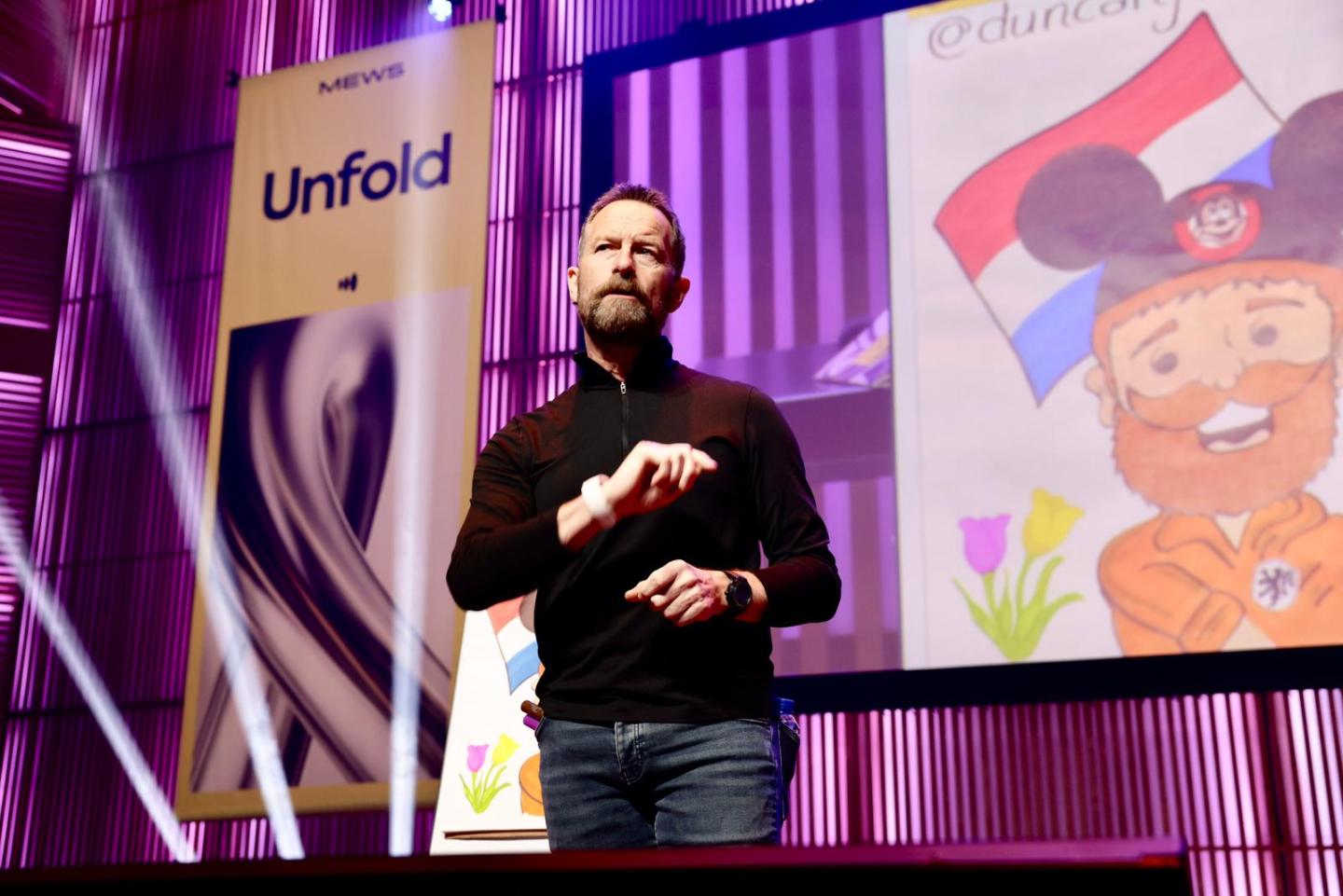
“If you’d asked ‘how might we make more money?’ we’d have put the gate price up. What does that get you? A three percent gain you’d complain about within a quarter,” Wardle told an audience of hospitality executives at the Mews Unfold conference in Amsterdam. “You don’t get to iterate in a post-pandemic world.”
Instead, his team flipped the question: “How might we solve the biggest consumer pain point?”
His team didn’t look inside the theme park industry for answers. They looked outside and found what Wardle describes as a pharmacy in Tokyo using RFID technology so customers didn’t have to wait in line to pick up prescriptions—and, he says, that observation became the seed of what Disney would call the MagicBand. (A separate account of the MagicBand’s development, documented by product historians, attributes its conception to a Disney executive who spotted a golf tracker wristband in a SkyMall catalog on a flight, but these accounts are not mutually exclusive. Disney has not yet responded to Fortune’s request for comment.)
The MagicBand is a wristband that functions as a park ticket, hotel room key, payment method, dining reservation, and ride booking system. It eliminated the need to check in or check out of a hotel. It removed the line at the park entrance. It let guests pre-order food on their phones, walk into a restaurant whenever they wanted, sit wherever they chose, and have fresh food delivered to their table. The result was startling in its simplicity: the average Walt Disney World guest gained two extra hours of free time per day, Wardle said.
Disney’s finance team spotted an opportunity to cut front desk jobs entirely. Wardle pushed back: this was a hospitality company, not a cost center. Those employees were redeployed as personal concierges on guest floors, deepening the experience rather than cheapening it.
And what did those guests do with their newfound time? They spent money.
Wardle says the MagicBand generated $1.92 billion in incremental revenue every 12 months — a figure which has not been previously reported. Disney has never publicly disclosed a specific return figure for the MagicBand or its underlying MyMagic+ infrastructure, which cost the company over $1 billion to build. This happened “not by asking how might we make more money,” Wardle said. “By refusing to ask it.”
Wardle’s second provocation is aimed squarely at the service industry’s most repeated mantra.
“It is not customer first. It’s employee first,” he said. “Your employees spend eight hours a day with your guests. You don’t. How do you not understand this?”
He pointed to Delta Airlines as a case study. When the airline expanded its profit-sharing program, service improved because employees had a direct stake in whether customers came back.
Disney, he said, operationalized the idea in an unusually direct way. The company mandates that every executive sweep theme park streets for two eight-hour shifts per year and spend one full day annually in the living room of a consumer. He was particularly against focus groups, saying no one tells the truth in that sterile box. But in someone’s home, sitting on their couch, watching how they actually live, they tell the truth.
“Focus groups are a waste of money,” Wardle said. “If you ask a man what he does at Disney World, he’ll say he does the thrill rides. If his wife is sitting next to him, she’ll say, ‘No, no, no, he went on It’s a Small World three times.’ The real insights for innovation are lying in the living room.”
When Disneyland Paris needed to boost attendance, the data said everything looked right: the target audience could afford the brand, had affinity with it, and had been in the market for five years. But the guests weren’t coming.
Wardle’s intuition told him the data was missing something human. His team went into homes and asked parents to picture their favorite photograph of their children — a real one, on a wall or a shelf. They asked how old the children were in the photo. The answer was always the same: years younger than the children actually were, sometimes seven years, maybe 10, and sometimes 20.
“Every single mom in this room today woke up exactly the same way she wakes up every single day,” Wardle said, “worried about her children and how quickly they’re growing up, and how she wants to make special memories for them while they still believe, while they still hold my hand, while they’re still here.”
That emotional truth became the campaign. Wardle credits it with driving record attendance at Disneyland Paris, and, he says, with transforming a product-obsessed executive culture into a genuinely consumer-centric one.
When Wardle left Disney in 2017, the company gave him a bronze Jiminy Cricket statue, the traditional farewell gift for employees who reach 30 years. He had started as a barman at the Rose & Crown Pub at Epcot in 1986. He left as the person who had helped redesign how tens of millions of annual visitors experienced time itself. What he took with him, more than the statue, was a framework: the most expensive question in business is the obvious one.
Wardle says he has been consulting with Google in work he describes as touching on its AI lab DeepMind, exploring what skills will matter most as AI reshapes the economy. He said the most valuable human capabilities over the next decade will be the ones hardest to code: curiosity, empathy, imagination, and bravery — the same skills every child is born with and every corporation spends decades training away. (Google has not yet responded to Fortune’s request for comment).
“We all complain we don’t have time to think,” he said. “What’s AI about to give us? Technically, time to think.”
“The opposite of bravery is not cowardice, it’s conformity,” he said. The man who gave Disney guests two hours back is now asking whether the rest of us will use ours.