• Home
  • Latest
  • Fortune 500
  • Finance
  • Tech
  • Leadership
  • Lifestyle
  • Rankings
  • Multimedia

Trendingnow

1

Elon Musk on MacKenzie Scott giving away $26 billion of her fortune: 'Sadly,' it makes the world a worse place

2

MacKenzie Scott alone accounted for one-third of America's $19.2 billion in megagifts last year

3

Philanthropy leader at Warren Buffett and Bill Gates’ Giving Pledge says children of billionaires are pushing them to give their wealth away faster

1

Elon Musk on MacKenzie Scott giving away $26 billion of her fortune: 'Sadly,' it makes the world a worse place

2

MacKenzie Scott alone accounted for one-third of America's $19.2 billion in megagifts last year

3

Philanthropy leader at Warren Buffett and Bill Gates’ Giving Pledge says children of billionaires are pushing them to give their wealth away faster
EconomyMarkets

The central bank of central banks just released its flagship annual report — and it sees a $1 trillion AI investment boom headed for a reckoning

Nick Lichtenberg
By
Nick Lichtenberg
Nick Lichtenberg
Business Editor
Down Arrow Button Icon
Nick Lichtenberg
By
Nick Lichtenberg
Nick Lichtenberg
Business Editor
Down Arrow Button Icon
June 29, 2026, 5:31 PM ET
bis
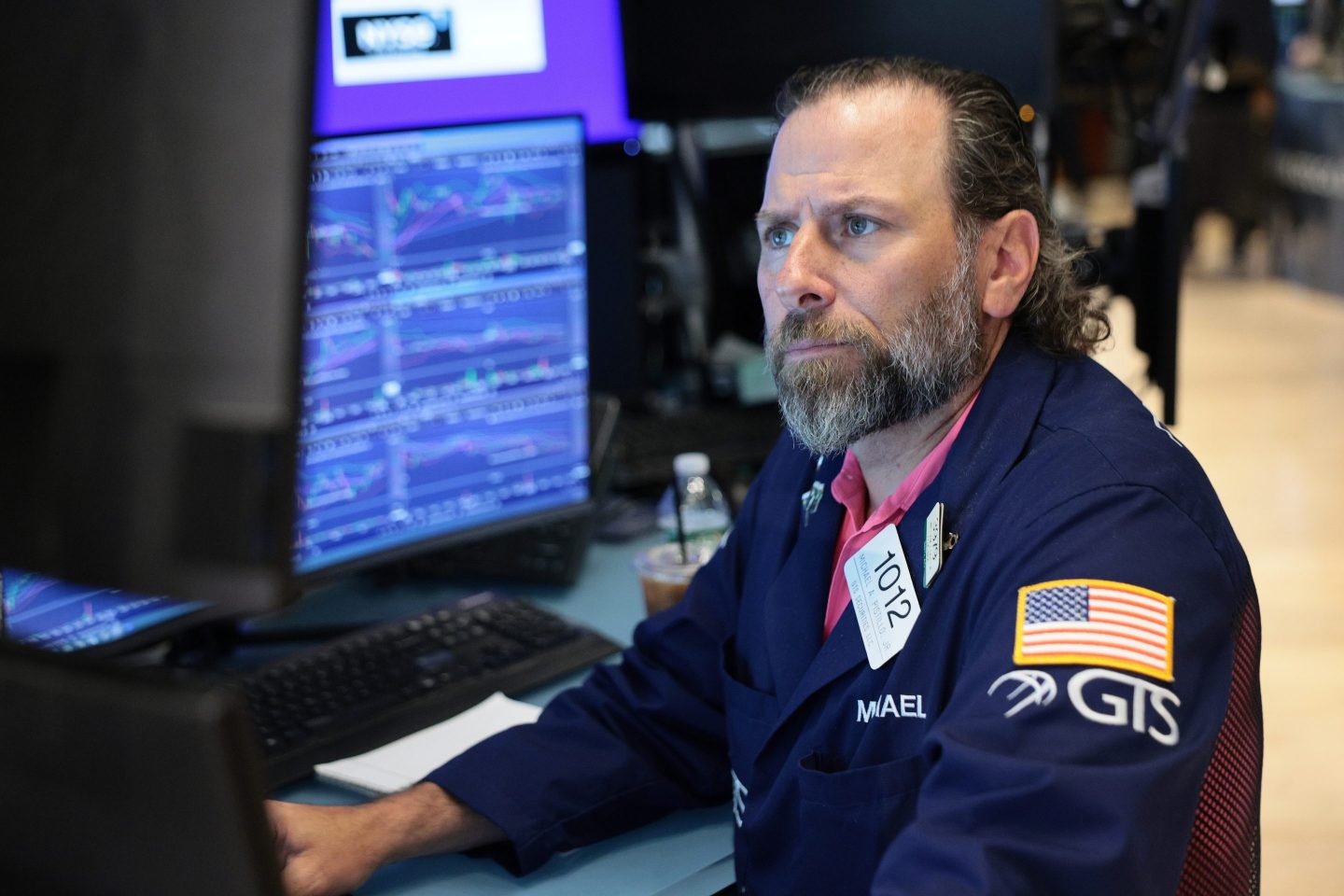
Traders work on the floor of the New York Stock Exchange during morning trading on June 26, 2026 in New York City. Stocks continued a downward trend with all three major indexes in the red at opening amid an announcement by OpenAI that it is considering delaying its IPO. Michael M. Santiago/Getty Images
Add Fortune on Google for similar content.

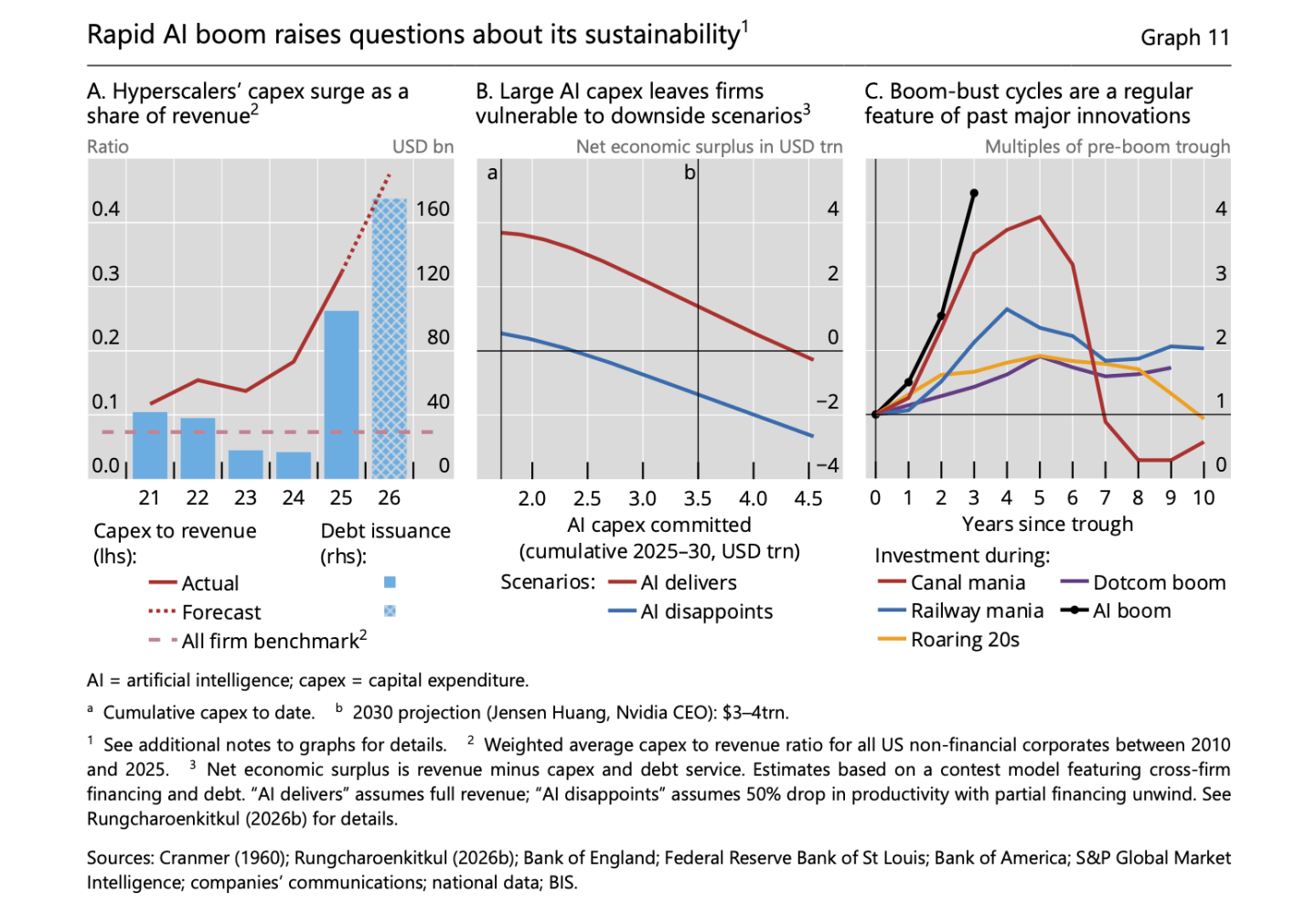
The canal mania of the 1830s. The British railway bubble of the 1840s. The dot-com crash of 2000. Each began with a genuine technological breakthrough that attracted more capital than commercial returns could ultimately justify. Each ended in a recession.

Recommended Video

The Bank for International Settlements — the Basel-based institution that coordinates the world’s central banks and serves as the global financial system’s most authoritative watchdog — sees the $1 trillion AI investment boom in the same lineage. And it’s not subtle about the comparison.

“The scale and pace of the current AI investment boom, accompanied by expectations of large productivity payoffs, bear resemblance to these precedents,” the BIS writes in its Annual Economic Report 2026, released Sunday. “These episodes ended with an eventual reversal in investment, inducing economy-wide recessions.”

A bet that’s already outrunning the balance sheet

The five largest hyperscalers are on pace to spend more than $1 trillion on AI-related capital expenditure across 2025 and 2026 combined — a sum the BIS says is already outpacing their earnings and free cash flow, forcing some to issue debt to cover the gap.

The BIS’s concern isn’t that AI is a fraud. The technology is real, and the report acknowledges that task-level studies consistently show productivity gains of 20% to 50% in time savings. But the concern is that every major hyperscaler is making the same massive bet simultaneously, driven by the perception that only a handful of players will ultimately dominate the market. That logic, the BIS warns, is a recipe for collective overcommitment.

“The intense competition raises the risk of firms over-committing resources to investment projects with still uncertain returns,” the report states, “leaving all firms vulnerable to disappointments in AI payoffs.”

Using contest-theory modeling, BIS economists find that as competitive pressure drives capital expenditure higher, the net economic surplus for the sector as a whole — total payoffs minus investment costs — declines and could turn negative in adverse scenarios. A disappointment in returns, the report warns, “could trigger a sudden pullback in financing and turn the capex boom into a protracted investment bust.”
The hidden wiring underneath

What makes an AI bust particularly dangerous, the BIS argues, isn’t just the scale of the spending — it’s how it’s financed.

Hyperscalers, chipmakers, and AI labs are linked through what the report calls “a complex web of private arrangements.” The most prominent is circular financing: hyperscalers take equity stakes in AI labs, which in turn commit to multi-year purchases of chips or computing power from those same hyperscalers. Data centers are outsourced to third-party contractors that lease the facilities back under long-dated contracts with embedded exit clauses.

“The terms of such deals are typically poorly disclosed,” the BIS writes, “with risks of the same asset being pledged multiple times.”

If the hyperscalers slow or halt their aggressive capex deployment, the entire supply chain — infrastructure contractors, chipmakers, AI labs, and the private credit lenders behind them — would face simultaneous revenue shortfalls. The engineering and construction firms at the end of that chain are particularly vulnerable, carrying “comparatively weak” balance sheets with little cushion against a sudden reversal.

BIS Asia-Pacific representative Zhang Tao told the South China Morning Post that a correction could unwind “much faster than previous banking crisis episodes” — precisely because so much of the financing flows through hedge funds and private credit vehicles that carry less regulatory oversight than traditional banks.

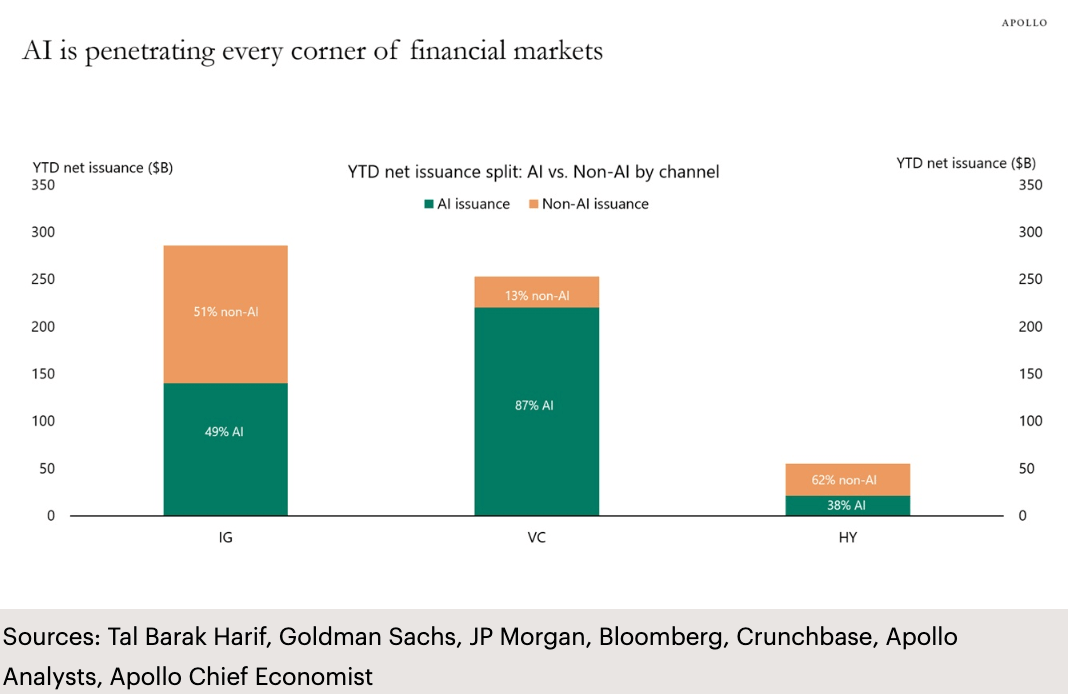
Such warnings are commonplace across Wall Street. Apollo Global Management Chief Economist Torsten Slok, for example, argued in mid-May that AI was “penetrating every corner of financial markets,” with an equity market phenomenon mutating into a capital markets-wide transformation. Meanwhile, AI accounts for nearly half of all investment-grade bond issuance, 87% of venture capital funding, and a growing share of high-yield debt.
The wealth effect problem

The financial fallout wouldn’t stay contained in Silicon Valley or on hyperscaler balance sheets. U.S. stocks now account for roughly 64% of the MSCI Global index, and household equity exposure has more than doubled relative to income since 2010.

A major repricing of AI-related stocks, the BIS warns, “could have more pronounced wealth effects and sharper consumption pullback than in the past.” And given the U.S. market’s global footprint, the wealth destruction would propagate internationally.

Direct lending funds — already a $1 trillion-plus ecosystem — have quadrupled their lending to the AI and IT sectors over the past five years, now representing about 15% of their portfolios. Signs of stress are already visible: some retail-facing direct lending funds have faced mounting redemption requests, forcing asset liquidations.

“A larger shock,” the BIS writes, “whether from a renewed inflation surge or a sharp AI-led repricing, could trigger a more widespread credit crunch.”

The Hormuz complication

The AI risk doesn’t exist in a vacuum. The report’s opening chapter documents a second major shock that arrived in early 2026: the closure of the Strait of Hormuz following the start of the Iran conflict in late February, which cut more than 10 million barrels of crude oil per day from global supply — a larger disruption than either the 1973 oil embargo or the 1979 Iranian revolution.

Oil prices surged 67% to an intraday peak of $120 a barrel within two weeks. Fertilizer and plastics prices both soared 50%. Global headline inflation has jumped by half a percentage point since the conflict began.

The energy shock and the AI risk interact in an uncomfortable way. Financial markets have remained buoyant — equity valuations rich, credit spreads compressed — on the assumption that the Hormuz disruption is temporary and that the AI boom will continue. But if inflation proves stickier than expected and central banks are forced to raise rates, the same tightening that’s needed to contain energy-driven inflation could be what pops the AI-financed debt bubble.

“The current tension between exuberant risk appetite and elevated macroeconomic risks,” the BIS writes, “could unwind abruptly.”

The BIS stops short of calling the AI boom a bubble outright. Its prescription is for “robustness” — a word it uses carefully and repeatedly to describe what it wants policymakers to build beyond the fragile “resilience” the global economy has demonstrated so far.

That means central banks staying vigilant on inflation even when it’s politically uncomfortable, governments restoring fiscal space rather than deploying stimulus, and regulators extending prudential standards to the non-bank financial institutions now sitting at the center of AI financing.


Subscribe to Fortune Gulf Brief. Every Tuesday, this new newsletter delivers clear-eyed, authoritative intelligence on the deals, decisions, policies, and power shifts shaping one of the world’s most consequential regions, written for the people who need to act on it. Sign up here.
About the Author
Nick Lichtenberg
By Nick LichtenbergBusiness Editor
LinkedIn icon

Nick Lichtenberg is business editor and was formerly Fortune's executive editor of global news.

See full bioRight Arrow Button Icon
Add Fortune on Google for similar content.

Latest in Economy

Finance
Lorem ipsum dolor sit amet, consectetur adipiscing elit, sed do eiusmod tempor incididunt ut labore et dolore magna aliqua. Ut enim ad minim veniam
By Fortune Editors
October 20, 2025
Finance
Lorem ipsum dolor sit amet, consectetur adipiscing elit, sed do eiusmod tempor incididunt ut labore et dolore magna aliqua. Ut enim ad minim veniam
By Fortune Editors
October 20, 2025
Finance
Lorem ipsum dolor sit amet, consectetur adipiscing elit, sed do eiusmod tempor incididunt ut labore et dolore magna aliqua. Ut enim ad minim veniam
By Fortune Editors
October 20, 2025
Finance
Lorem ipsum dolor sit amet, consectetur adipiscing elit, sed do eiusmod tempor incididunt ut labore et dolore magna aliqua. Ut enim ad minim veniam
By Fortune Editors
October 20, 2025
Finance
Lorem ipsum dolor sit amet, consectetur adipiscing elit, sed do eiusmod tempor incididunt ut labore et dolore magna aliqua. Ut enim ad minim veniam
By Fortune Editors
October 20, 2025
Finance
Lorem ipsum dolor sit amet, consectetur adipiscing elit, sed do eiusmod tempor incididunt ut labore et dolore magna aliqua. Ut enim ad minim veniam
By Fortune Editors
October 20, 2025

Most Popular

Finance
Lorem ipsum dolor sit amet, consectetur adipiscing elit, sed do eiusmod tempor incididunt ut labore et dolore magna aliqua. Ut enim ad minim veniam
By Fortune Editors
October 20, 2025
Finance
Lorem ipsum dolor sit amet, consectetur adipiscing elit, sed do eiusmod tempor incididunt ut labore et dolore magna aliqua. Ut enim ad minim veniam
By Fortune Editors
October 20, 2025
Finance
Lorem ipsum dolor sit amet, consectetur adipiscing elit, sed do eiusmod tempor incididunt ut labore et dolore magna aliqua. Ut enim ad minim veniam
By Fortune Editors
October 20, 2025
Finance
Lorem ipsum dolor sit amet, consectetur adipiscing elit, sed do eiusmod tempor incididunt ut labore et dolore magna aliqua. Ut enim ad minim veniam
By Fortune Editors
October 20, 2025
Finance
Lorem ipsum dolor sit amet, consectetur adipiscing elit, sed do eiusmod tempor incididunt ut labore et dolore magna aliqua. Ut enim ad minim veniam
By Fortune Editors
October 20, 2025
Finance
Lorem ipsum dolor sit amet, consectetur adipiscing elit, sed do eiusmod tempor incididunt ut labore et dolore magna aliqua. Ut enim ad minim veniam
By Fortune Editors
October 20, 2025
Fortune Secondary Logo
Rankings
  • 100 Best Companies
  • Fortune 500
  • Global 500
  • Fortune 500 Europe
  • Most Powerful Women
  • World's Most Admired Companies
  • See All Rankings
  • Lists Calendar
Sections
  • Finance
  • Fortune Crypto
  • Features
  • Leadership
  • Health
  • Commentary
  • Success
  • Retail
  • Mpw
  • Tech
  • Lifestyle
  • CEO Initiative
  • Asia
  • Politics
  • Conferences
  • Europe
  • Newsletters
  • Personal Finance
  • Environment
  • Magazine
  • Education
Customer Support
  • Frequently Asked Questions
  • Customer Service Portal
  • Privacy Policy
  • Terms Of Use
  • Single Issues For Purchase
  • International Print
Commercial Services
  • Advertising
  • Fortune Brand Studio
  • Fortune Analytics
  • Fortune Conferences
  • Business Development
  • Group Subscriptions
About Us
  • About Us
  • Press Center
  • Work At Fortune
  • Terms And Conditions
  • Site Map
  • About Us
  • Press Center
  • Work At Fortune
  • Terms And Conditions
  • Site Map
  • Facebook icon
  • Twitter icon
  • LinkedIn icon
  • Instagram icon
  • Pinterest icon

Latest in Economy

A woman types into a kiosk at an airport.
Travel & LeisureAviation
‘You can expect prices to be high and stay high’: Domestic airfare is skyrocketing faster than international flight costs, despite using less jet fuel
By Sasha RogelbergJune 30, 2026
44 minutes ago
mill
InvestingWealth
America added more than 1,200 millionaires per day in 2025, but the heyday of the ‘everyday millionaire’ is already over
By Nick LichtenbergJune 30, 2026
1 hour ago
US President Donald Trump arrives to speak during a Rose Garden Club dinner with American farmers at the White House in Washington, DC, on June 25, 2026.
EconomyBig Oil
Trump takes his inflation battle to gas retailers after his plot against the Fed runs aground—sets target for $2.50 a gallon
By Eleanor PringleJune 30, 2026
6 hours ago
Mark Zuckerberg, CEO of Meta
EconomyMarkets
AI stocks are in an ‘air pocket’ and Meta and Microsoft are being traded like ‘bear market names that cannot be owned,’ top analyst says
By Jim EdwardsJune 30, 2026
6 hours ago
Gulf bond markets extend their rally despite uncertain outlook
NewslettersFortune Gulf Brief
Gulf bond markets extend their rally despite uncertain outlook
By Melissa HancockJune 30, 2026
6 hours ago
GCC debt markets have rallied since the ceasefire, but tight liquidity remains a key hurdle 
Middle EastBonds
GCC debt markets have rallied since the ceasefire, but tight liquidity remains a key hurdle 
By Melissa HancockJune 30, 2026
7 hours ago

Most Popular

Elon Musk on MacKenzie Scott giving away $26 billion of her fortune: 'Sadly,' it makes the world a worse place
Success
Elon Musk on MacKenzie Scott giving away $26 billion of her fortune: 'Sadly,' it makes the world a worse place
By Sydney LakeJune 29, 2026
1 day ago
MacKenzie Scott alone accounted for one-third of America's $19.2 billion in megagifts last year
Success
MacKenzie Scott alone accounted for one-third of America's $19.2 billion in megagifts last year
By Sydney LakeJune 25, 2026
5 days ago
Philanthropy leader at Warren Buffett and Bill Gates’ Giving Pledge says children of billionaires are pushing them to give their wealth away faster
Success
Philanthropy leader at Warren Buffett and Bill Gates’ Giving Pledge says children of billionaires are pushing them to give their wealth away faster
By Preston ForeJune 27, 2026
3 days ago
'Humanity has chosen to become idiots': This Brown professor switched to take-home exams after a mass shooting and discovered mass cheating
AI
'Humanity has chosen to become idiots': This Brown professor switched to take-home exams after a mass shooting and discovered mass cheating
By Catherina GioinoJune 29, 2026
19 hours ago
The retired college professor fighting a $313 trespassing ticket in Wisconsin thinks he's part of a national struggle
Environment
The retired college professor fighting a $313 trespassing ticket in Wisconsin thinks he's part of a national struggle
By Catherina GioinoJune 28, 2026
2 days ago
Current price of oil as of June 29, 2026
Personal Finance
Current price of oil as of June 29, 2026
By Joseph HostetlerJune 29, 2026
1 day ago

© 2026 Fortune Media IP Limited. All Rights Reserved. Use of this site constitutes acceptance of our Terms of Use and Privacy Policy | CA Notice at Collection and Privacy Notice | Do Not Sell/Share My Personal Information
FORTUNE is a trademark of Fortune Media IP Limited, registered in the U.S. and other countries. FORTUNE may receive compensation for some links to products and services on this website. Offers may be subject to change without notice.